
Team Scotland's export support and promotion: evaluation - 2021/22 - 2023/24
A detailed assessment of public sector export support and promotion in Scotland, examining its role in increasing exports, creating and safeguarding jobs, and supporting wider economic benefits. Includes findings and recommendations to inform future delivery.
5.9. Future exporting outlook
Exporting companies and non-exporting companies with plans to export were asked to identify the top three barriers to exporting goods or services that they expected in the next three years. The absolute majority of 91% of firms expected a variety of barriers to affect them in the future, especially customs duties or levies, tariff uncertainty and regulatory compliance procedures (see Figure 16).[34] About 8% of beneficiaries cited other reasons such as increased costs for running the business and exporting, geopolitical conflicts and uncertainty, and consumers having less disposable income.
Figure 16. Top three barriers to exporting goods or services expected in the next three years (% of 173)
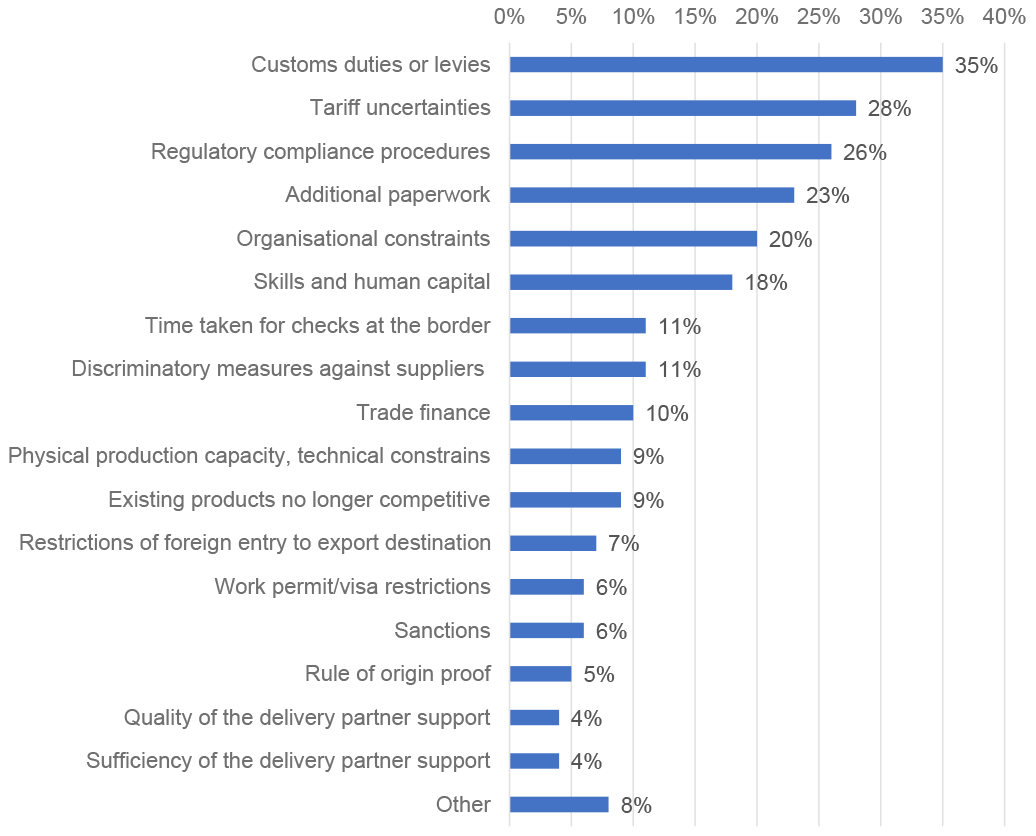
Chart of the top three barriers to exporting goods or services expected in the next three years, percentage of 173 firms. Barriers vary from 4% to 35%, while "other" category was selected by 8% of firms.
Beneficiaries largely thought that the type, content and delivery of support that they received from the delivery partners would be effective in addressing export barriers in the next three years, though the degree of effectiveness varied as summarised in Table 18.
|
Response |
% of 158 |
|---|---|
|
Very effective |
12% |
|
Fairly effective |
23% |
|
Somewhat effective |
23% |
|
A little effective |
15% |
|
Not at all effective |
20% |
|
Don't know |
8% |
Companies also identified numerous critical gaps that would help them to address export barriers in the future, mainly finding new overseas contacts or customers (cited by 54% of firms), regulatory compliance (46%), customs and tariffs (41%), understanding markets and demand issues (38%) and finding new markets (36%). Other critical gaps varied somewhat but were still useful to about 10 – 20% of respondents:
- Transport and distribution (20%)
- Financial advisory support (20%)
- Legal support (19%)
- Information on exporting (15%)
- Export licenses (12%)
- Other (3%), such as financial support (e.g., export credit guarantees)
Over a third of companies (36%) expected to export to new market sectors in the next three years (48% did not expect and 16% did not know if they would). These sectors varied though the energy sectors (renewables, oil and gas) were most commonly reported by 40% of firms:
- Energy - low carbon and renewables (26%)
- Technology, Digital & Media (19%)
- Engineering and Advanced Manufacturing (16%)
- Food and drink (14%)
- Energy - oil and gas (14%)
- Life Sciences (12%)
- Construction (10%)
- Tourism, Financial and Business Services, Chemical Sciences, Education (each mentioned by 5 firms or fewer)
- 15% of firms mentioned other varying sectors including social housing, automotive, retail, defence, leisure and consumer goods.
Lastly, over two-thirds of businesses (70%) planned to export to new countries in the next three years, including non-exporting firms with plans to export.[35] Seventy-eight per cent of companies were able to specify their expected markets: top five cited countries were USA (reported by 20% of firms), Canada (12%), Australia (11%), Japan (11%) and Germany (8%). See Table 35 in the Appendix 2 for the full list of planned export countries.
5.10. Satisfaction and areas for improvement
On average, beneficiaries rated their satisfaction with the support at 7 out of 10 (ranging from 0 to 10, where 10 is “extremely satisfied”). Interestingly, the median value was higher than the mean (8/10), which indicates that the overall average was lower due to a number of respondents rating the support very lowly (nine per cent rated it as less than 3).
Those companies that rated the support as less than 8/10 were asked to elaborate and 56 respondents left their comments. With some minor overlap, about a quarter (25%) of feedback centres on the support’s focus and personalisation, for instance, wishing for better tailored support, more focus on growth, representing “real life experience of exporting” etc. More likely in companies that rated the support as low was a theme on the lack of support (mentioned by 25% of firms) in terms of its consistency, sufficiency or availability. Further 18% of firms found issue with administrative burden in accessing the support, for instance, time and effort for the application process. Eighteen per cent of businesses provided comments on the scope of the support which varied, including limited export markets they could use the support for, wishing for more 1-on-1 support, support with specific EU trade customs issues etc. Lastly, 14% had suggestions for the communication with the delivery partners, for example, more contact or following up, with a few firms focusing on better communication about available support.
Thinking about navigating the landscape of export support services from delivery partners, mainly firms found it neither easy nor difficult to navigate (33%). However, more companies found the landscape difficult (28%) than easy to navigate (20%) (Table 19). Of the 54 firms that specified why the landscape was not easy to navigate, nearly half (48%) made suggestions to improve communication and information, for example, creating a single source of information online about export requirements to different countries, providing a single point of contact for the support, clearer signposting to available support and how to access and so on. Twenty-four per cent of firms preferred a different scope of the support, mainly focusing on their sector better or specific export markets. The remaining comments varied and included reducing administrative burden, quicker processes, more support, financial support and developing contacts.
|
Response |
% of 198 |
|---|---|
|
Very easy |
4% |
|
Easy |
16% |
|
Neither easy nor difficult |
33% |
|
Difficult |
20% |
|
Very difficult |
8% |
|
Don't know / Not applicable |
19% |
Thirty per cent of firms reported that they would have sought export support from other organisations in 2021–2024 if they had not received export support from the delivery partners. Beneficiaries specified sources such as UKTI, UK Government (DBT was cited a few times), Scottish Chamber of Commerce, professional advisors, freight forwarders, customs agents, Scale up Scotland, Institute for Export, Innovate UK, Scottish Government, Business gateway, Scottish Food and Drink association and Energy systems catapult.
Lastly, sixty firms (30%) specified other type of support they wished they had received to help with achieving export sales. Predominantly other types of support consisted of specific support ranging from legal to IP, marketing, R&D, manufacturing, specific geographical market support etc. (cited by 25% of firms) and financial support for various activities (e.g., R&D, market expansion, exhibitions) (23%). Seventeen per cent of firms would have found support for regulatory compliance and customs useful and 15% specified trade missions and exhibitions. Others also mentioned sector-specific support and expertise, connections to new customers, consistent ongoing support etc.