
Take-up rates of Scottish benefits - 2026
This publication contains our latest estimates of take-up of Scottish benefits delivered by Social Security Scotland.
Analysis in development - disability benefit eligibility benchmarks
Introduction
This chapter introduces new disability benefit eligibility benchmarks for Adult Disability Payment (ADP) and Child Disability Payment (CDP)[1]. These benchmarks are part of ongoing analytical development to improve understanding of disability benefit receipt. They are not estimates of take-up and should be interpreted as indicative measures intended to provide additional context only. The methodology will continue to be refined as further evidence and data become available.
Previous take-up publications discussed possible measures of eligibility for CDP. This year’s publication expands the analysis to also cover ADP. This reflects wider interest in improving understanding of take-up and access to disability benefits, including amongst seldom-heard groups, as highlighted by the Independent Review of Adult Disability Payment (ADP).
Understanding take-up for disability benefits is particularly challenging because eligibility cannot be estimated directly from survey data. For example, of the disabled working-age population identified by the Family Resources Survey most do not receive ADP. ADP eligibility depends on specific needs-based criteria which are distinct from the survey measure of disability.
These benchmarks provide additional context on the population that may be eligible for support and help interpret changes in disability benefit receipt over time. They provide a more informative benchmark than survey measures of disability alone.
Additional technical details are covered in Annex C.
Challenges in estimating take-up
Robustly estimating eligibility and take-up for disability benefits continues to be a significant challenge. Currently, no official estimates of take-up rates of disability benefits in the UK have been published by the Department for Work and Pensions (DWP), the Scottish Government, or any other stakeholder.
For a disability benefit such as ADP, estimating the eligible population requires estimating the number of working-age adults in Scotland who would be awarded ADP if they applied to Social Security Scotland, including those who may not have considered applying for the benefit.
Social Security Scotland assesses eligibility for disability benefits in a person-centred way, taking decisions based on individual need against criteria specific to each benefit. This creates a challenge for estimating the eligible population for disability benefits, because these specific criteria do not align with questions asked in national surveys, while application data only reveal information about the pool of applicants, who may have differing characteristics from the eligible population. This challenge is even more pronounced when attempting to assess take-up rate for particular segments of the potentially eligible population, such priority family and seldom-heard groups,
Developing a disability benefit eligibility benchmark
Survey data
This publication uses estimates of the disabled population of Scotland based on the Family Resources Survey (FRS).
The FRS provides annual estimates of the disabled population, using the core definition of disability under the Equality Act 2010. Being disabled under the Act means “someone has a physical or mental impairment that has a 'substantial' and 'long-term' negative effect on their ability to do normal daily activities". FRS data is collected through face-to-face interviews, and is matched to administrative records where appropriate to do so.
In 2024-25, approximately 140,000 children, around 1,000,000 working-age adults, and around 470,000 pension age adults in Scotland were estimated to be disabled based on this survey.
Previous publications concluded that the FRS was likely to provide the most useful annual benchmark for CDP eligibility, with it reflecting the Equality Act 2010 and providing a stable basis for regularly updating a benchmark with annual survey updates. The FRS is also used in other Scottish Government analysis of Social Security.
However, other surveys are available, such as the Scottish Health Survey, which estimated that around 1,900,000 people had a long-term condition or illness in 2024, and the 2022 Scottish census, which estimated that there are around 1,300,000 disabled people using a question similar to the FRS, but is only collected every 10 years. These differences reflect how different surveys use different measures and questions to collect information about ill health and being disabled.
Adult Disability Payment
ADP is primarily a working age benefit, but is also available to those aged 16-18 (who are not receiving CDP), and can be continued to be paid when individuals reach state pension age. Adjusting for these factors, we estimate that in 2024-25 there were around 1,100,000 people who meet the definition of disability set out in the FRS, and are the relevant age for ADP.
Child Disability Payment
CDP is open for applications for children aged 0 to 16. Children already in receipt at age 16 can keep receiving CDP until age 18, though they cannot receive CDP and ADP simultaneously. This means the potentially eligible population are disabled people aged 0-16, plus those over 16 already in receipt of CDP and have not transferred to ADP. In 2024-25, FRS survey data suggests that approximately 130,000 people meet the definition of being disabled set out in the FRS, and are the relevant age for CDP.
In addition, the percentages of disabled children receiving CDP and of disabled people receiving ADP cannot be directly compared, as CDP has different eligibility criteria to ADP, reflecting that care needs differ between children and adults.
Using application data to adjust for non-eligibility
Not all disabled people meet the eligibility criteria for ADP or CDP, meaning the disabled population measured in survey data must be adjusted downwards to estimate benefit eligibility. Because eligibility is not directly observed, determining the appropriate adjustment is challenging.
We therefore developed an eligibility benchmark using information on current benefit recipients and application success rates. The benchmark is indicative rather than definitive, as it relies on assumptions that may cause it to overestimate or underestimate eligibility.

Graphic text below:
Eligibility Benchmark equals ADP caseload plus [Disabled population not receiving ADP multiplied by Application Success Rate]
All people receiving disability benefits are treated as eligible by definition. For people in the disabled population who do not receive a benefit, we apply an adjustment based on the proportion of applicants whose applications are successful. Application success rates are one of the few available sources of information on the proportion of individuals who meet the eligibility criteria for disability benefits, though what information can be extracted from these rates is limited, as set out in detail below.
The resulting benchmark therefore combines information on survey-reported disability, benefit receipt and application success rates. An increase in the disabled population increases the number of people who may potentially meet the eligibility criteria for support, while an increase in the number of people receiving benefits means more eligible people are already receiving support.
While this benchmark should not be interpreted as a direct measure of the eligible population, it can provide useful evidence on changes over time. Applying a consistent methodology across years allows changes in benefit receipt to be considered alongside changes in the modelled benchmark population.
Eligibility benchmarks
Below, we plot a benchmark for ADP. The figure shows the disabled population from the FRS and the number of people receiving working-age disability benefits in Scotland over time. It also includes a modelled estimate of eligibility amongst those not receiving ADP based on application success rates.
It is necessary to also include the number of people previously on legacy reserved benefits in addition to those on ADP to illustrate the benchmark over the period in which people in Scotland moved from UK benefits like Personal Independence Payment, to the Scottish payment ADP.
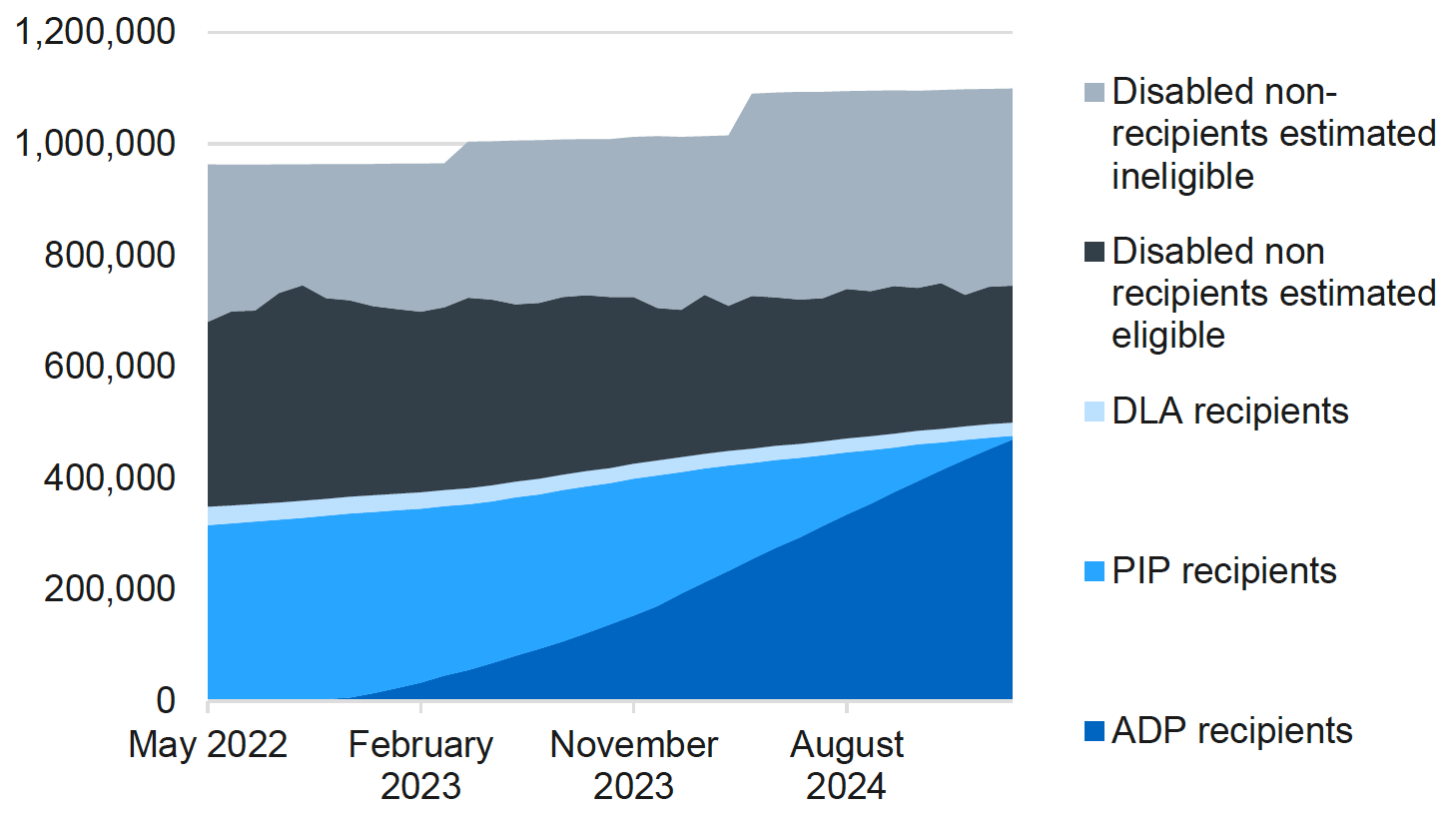
The modelled eligibility benchmark for ADP has risen from around 630,000 in May 22 to around 730,000 in March 25. It has risen by less than both the disabled population and the number of people receiving disability benefits across the same period.
Application success rates provide evidence about the proportion of applicants who meet the eligibility criteria for ADP and therefore contribute to our understanding of the potential eligible population, although it is unlikely that applicants are representative of all disabled people who are not receiving ADP.
In March 2025, the number of people receiving ADP represented around 70% of this eligibility benchmark, an increase from around 50% in May 2022. As noted above, this should not be interpreted as the take-up rate for ADP.
Figure 4 plots the number of children receiving disability benefits from April 2022 to March 2025, using the same methodology. The figure plots both CDP and the remaining children receiving DLA (as case transfers were ongoing throughout 2022-23). It also plots the population aged 0-15 who are identified as disabled in the FRS and are not in receipt of disability benefits, and uses the application success rate for CDP to model the fraction of this population who are eligible but not in receipt. This contributes to an eligibility benchmark for CDP.
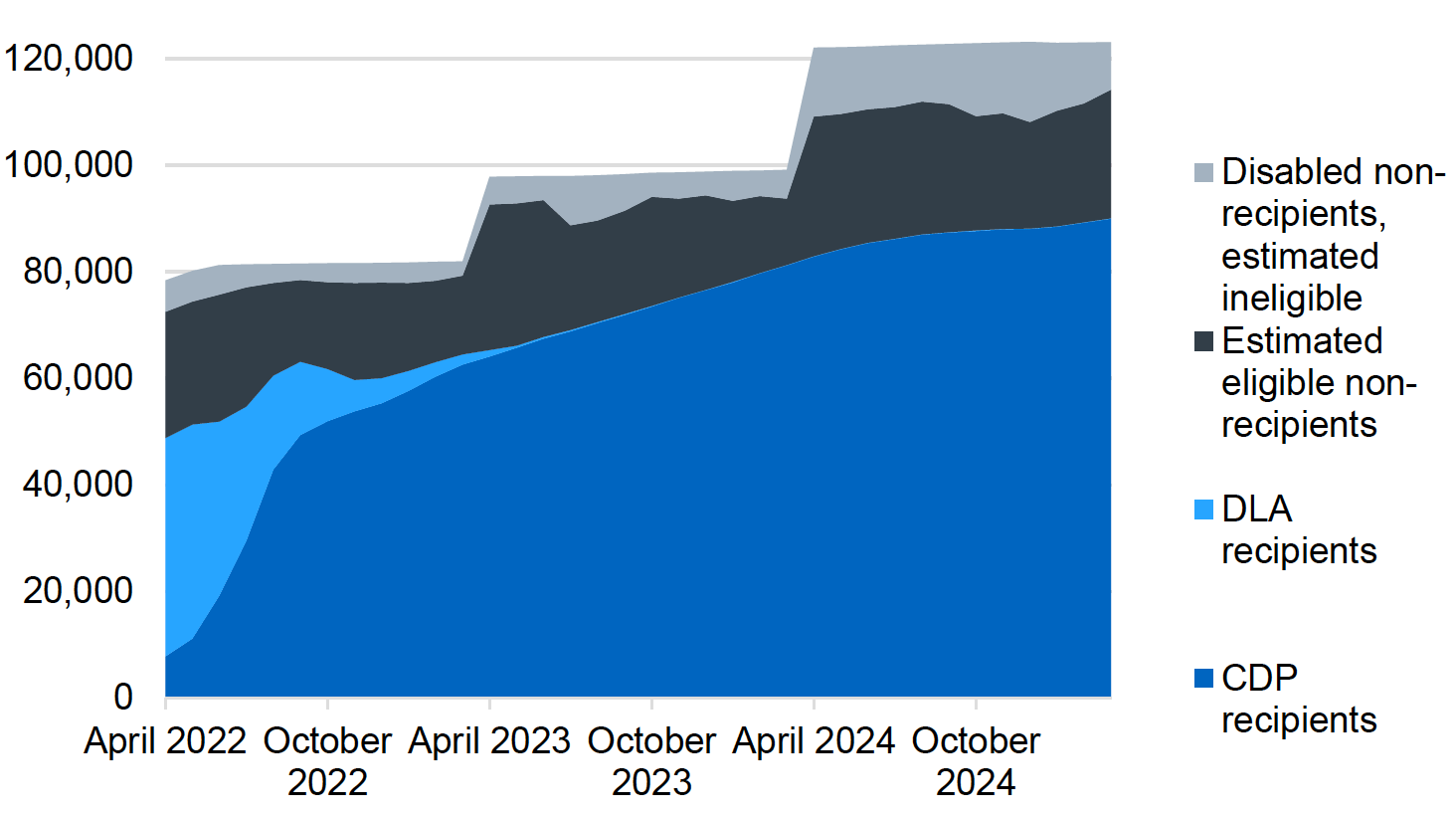
The overall number of children receiving disability benefits in Scotland has grown at a similar rate to this eligibility benchmark. The number of children receiving CDP has represented around 80% of this population from 2022-23 to 2024-25. As noted above, this should not be interpreted the take-up rate for CDP, but it does develop the previous analysis by adjusting for the fact that not everyone in the wider survey-defined disabled population would meet the benefit eligibility criteria.
This modelled benchmark features the same assumptions as with ADP.
Limitations
The benchmarks presented above improve our understanding of the population that may be eligible for disability benefits, by incorporating benefit-specific application success rates into the analysis. They provide indicators that can be tracked over time and compared with the number of people receiving ADP and CDP.
However, the benchmarks should not be interpreted as estimates of take-up. They rely on two key assumptions: that applicants are representative of disabled people who are not currently receiving disability benefits, and that the population eligible for disability benefits is contained within the disabled population measured by the FRS. If these assumptions do not hold, the benchmarks may overestimate or underestimate the potentially eligible population.
Changes in the benchmark over time should not automatically be interpreted as changes in the underlying potentially eligible population. Survey measures of disability can be affected by factors such as changes in diagnosis or reporting, while application success rates may be influenced by who applies for a benefit and wider operational factors. Changes in either of these measures could therefore affect the benchmark without reflecting a genuine change in eligibility.
The benchmarks in this chapter are stylised, modelled estimates and contain significant uncertainty. They provide useful contextual evidence on trends in disability prevalence, application outcomes and benefit receipt, but are not as robust as the take-up estimates presented elsewhere in this publication. Changes in the benchmark over time should therefore be interpreted with caution and considered alongside other evidence.
Seldom-heard groups
A motivation for developing the disability benefit benchmarks was to improve understanding of take-up and access amongst seldom-heard groups, as highlighted by the Independent Review of ADP. The Scottish Government has identified a number of seldom-heard groups, including disabled people and those with long term ill health conditions. They include:
- Mobile populations
- Vulnerable groups
- End of life
- Carers and care experienced;
- Survivors of abuse
- People with mental health conditions
- People with fluctuating and/or less visible conditions
- People with learning disabilities and/or difficulties
The current benchmarks do not provide estimates for individual seldom-heard groups, but they provide a framework for considering what further analysis may be possible. There are several additional challenges in breaking take-up analysis down further.
Social Security Scotland currently publishes some demographic information in their benefit statistics and also publish diversity statistics on applications annually. However, this does not capture all seldom-heard groups, and for take-up analysis it would be necessary to link diversity information to people receiving the benefits, in addition to applications.
For eligibility, surveys such as the Family Resources Survey record information about disability, in addition to demographic and equalities information. However, in many cases, the Scottish sample in these surveys can be very small for specific subgroups, making it hard to produce robust estimates of the eligible population. Additionally, many of the obstacles which seldom-heard groups face in accessing the social security system may also make them less likely to participate in traditional surveys.
Similar challenges exist in producing breakdowns by other characteristics, such as condition. A recent change in the breakdowns of application data published by Social Security Scotland for 2025-26 means that the eligibility benchmarks introduced above could be calculated for smaller subgroups in the future, once survey data on 2025-26 becomes available.
Conclusion
For disability benefits, the principal challenge in estimating take-up is establishing the size of the potentially eligible population. Unlike many income-based benefits, entitlement depends on benefit-specific criteria and cannot be directly modelled from existing survey data. As a result, there is currently no robust basis on which to estimate entitlement to ADP or CDP or to produce take-up estimates comparable to those published for other devolved benefits.
The benchmarks presented in this chapter seek to improve on simple comparisons between disability prevalence and benefit receipt by incorporating application outcomes alongside survey data. They provide additional context on the population that may be eligible for support and on trends in disability benefit receipt over time. However, they should not be interpreted as estimates of entitlement, take-up or unidentified entitlement.
The main insight provided by the benchmarks is how the number of people receiving disability benefits has changed relative to the benchmark over time. The proportion of children receiving disability benefits relative to the CDP benchmark has remained broadly stable throughout the period. By contrast, the proportion of people receiving ADP relative to the benchmark has increased over time, which reflects changes in disability prevalence and application outcomes. As discussed elsewhere in this report, the benchmarks are not measures of eligibility and differences between trends in receipt and the benchmark may reflect a range of factors, including changes in awareness, application patterns, application volumes and other aspects of the disability benefit system.
The Independent Review of Adult Disability Payment highlighted the challenges of understanding take-up and access, particularly amongst seldom-heard groups. The measures presented here provide additional evidence to support that understanding, but they do not resolve the underlying challenges of estimating eligibility, unmet need, barriers to access, or take-up amongst specific groups.
Contact
Email: ceu@gov.scot