
Marine Protected Areas and priority marine features management in Scottish waters: social impacts research
This research informs the SEIA by improving understanding of the social values of coastal and island communities and how proposed marine management measures may affect them. It identifies community perceptions, potential social impacts, and key issues and concerns.
2 Methodology
The approach to developing the SEIA is based on the Scottish Government’s Guidance for undertaking SEIAs for MPAs in inshore waters (2022)[10]. In relation to social and participatory aspects, this guidance proposes, among other things, that:
- The full range of impacts affecting populations, their health, wellbeing and prosperity should be assessed;
- The whole assessment should take a participatory approach;
- Different types of communities should be considered for inclusion in the assessment, including “communities of place” (the people who are connected through living in a particular place), “communities of practice” (those who are connected through activities or livelihoods that they have in common even if they do not share the place: see Annex 1 of guidance), and “communities of interest” (people who share a common interest or passion but may not be linked in any other way);
- Impacts should be considered at different levels, i.e., local, regional, Scotland or UK.
The research was designed as a series of steps which together ensured that the key requirements of the Guidance were met, from setting out a common framework for engagement in each of the research locations, to ensuring that an appropriate sample of locations was selected and the relevant stakeholders engaged, suitable methods were used and the analysis drew out the main themes. An overview of the approach to the project is shown in Figure 1, with additional information on each aspect below, and full details in Appendix 3.0.

Framework
Selection of Study Areas
Stakeholder mapping
Drop-in sessions
Workshops
Analysis
2.1 Social values framework
The approach to identifying the social values drew on previous work in 2015 which developed a conceptual framework of social values from engagement with coastal communities in Scotland [11] (see Appendix.1.0). The framework was adapted to explore the social values of communities in locations where there are proposed fisheries management measures. The categories from the framework were used to establish a set of themes and issues to start the engagement with communities. Applying the conceptual framework of social values in SEIA practice aims to provide a better understanding of what is important to local communities, the potential impacts of proposed MPA and PMF fisheries management measures (both positive and negative) and opportunities for mitigating impacts of the fisheries management measures on communities. This is intended to make SEIAs more meaningful for the communities involved and more useful as an input to marine planning and decision-making.
2.2 Selecting the study locations
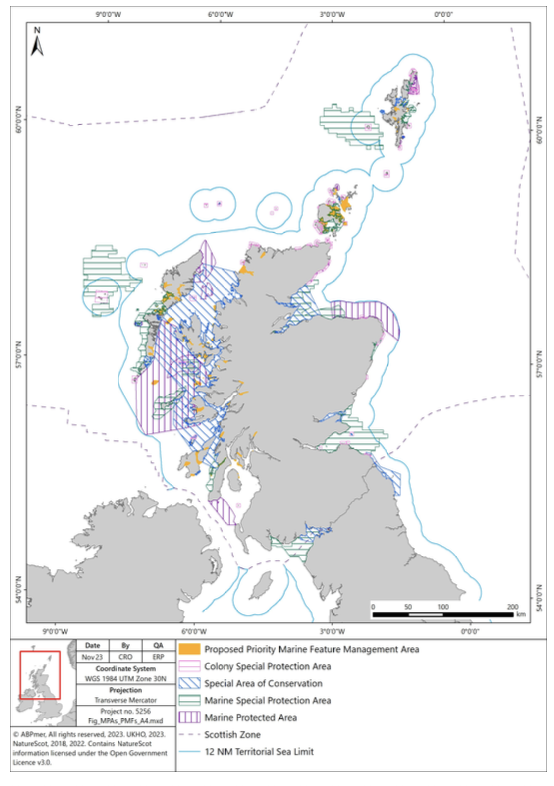
The locations for engagement needed to be close to areas in the inshore MPA network and PMF areas that were being considered for fisheries management measures as shown in Figure 2. Marine Directorate requested a targeted approach to selection, based on judgement and experience, as well as fulfilling a range of criteria to ensure coverage of different regions, types of areas and designation types.
The locations selected for engagement were:
- Peterhead;
- Lerwick;
- Troon;
- Oban;
- Ullapool; and
- Stornoway (and linked online event for Barra).
Details on the criteria and approach for the selection of study areas are provided in Appendix.2.0.
2.3 Stakeholder Mapping
Stakeholder mapping was carried out to identify the stakeholder groups in each location and to understand the relevance of the proposed fisheries management measures and stakeholders’ interest in the topic of fisheries management measures. This information was used to target publicity for the drop-in sessions and to select priority stakeholders for the workshops. Details are provided in Appendix.2.0.
2.4 Drop-in Sessions
Drop-in sessions were held in each location to enable engagement with a broad cross-section of the local community. The objective was to gather information from local people, both organisations and individuals, on the aspects of their community and location they valued, and how the proposed fisheries management measures might impact them personally and things they valued. Over all the drop-in sessions approximately 200 people participated
The drop-in sessions consisted of a set of engagement stations which visitors could look at independently and provide comments on, either verbally or in writing. These stations were:
- A map of location as a prompt to engage in conversation with participants.
- A poster with the question: What do you value in your local community? to obtain information about values under six headings: Environment, land and seascape; Family life and community; Jobs, employment and local economy; Health, education and housing; Being involved, decision making and politics; Culture and heritage.
- Maps showing MPAs with proposed fisheries management measures and proposed PMF management areas[12] to prompt discussion about the proposed measures.
- A poster with the question: What effects might the proposed fisheries management measures have on the things you value in the local community?[13] to obtain information about potential impacts.
- An online or paper-based survey to gather additional views.
2.5 Workshops
Stakeholder workshops were held in each of the six locations (plus an online event for stakeholders from Barra who could not attend the event in Stornoway[14]). The workshops were held on the day after the drop-in session and were attended by up to 16 participants. Over all the workshops 82 stakeholders participated. These were structured to explore the framework of social values and understand how they are prioritised in different locations and in what ways these could be impacted by the fisheries management measures proposed. The workshop programme was similar for each location, to facilitate comparison across the locations. The workshops allowed more in-depth discussion of issues within smaller groups.
2.6 Attendees
Table 1 summarise the numbers of attendees in each location by engagement type.
| Place and Information | Peterhead | Lerwick | Troon | Oban | Ullapool | Stornoway (Western Isles) | Barra (Western Isles) |
|---|---|---|---|---|---|---|---|
| Drop-in Location | Albert Hotel | Lerwick Town Hall | Troon Town Hall | The Royal Hotel | McPhail Centre | Bayhead Bridge Centre | N.A. |
| Date | 5.6.2023 | 7.6.23 | 19.6.23 | 21.6.23 | 27.6.23 | 29.6.23 | N.A. |
| Participants | 12 | 124[15] | 18 | 20 | 10 | 7 | N.A. |
| Workshop Location | Albert Hotel | Shetland Hotel | South beach hotel | The Royal Hotel | McPhail Centre | Bayhead Bridge | N/A |
| Date | 6.6.23 | 8.6.23 | 20.6.23 | 22.6.23 | 28.6.23 | 30.6.23 | 11.8.23 |
| Participants | 13 | 12 | 7 | 16 | 6 | 13 | 17 |
| Completed survey | 4 | 175 | 9 | 8 | 5 | 2 | N.A. |
Table 2 indicates the types of stakeholders who attended the events for each location. Not all the attendees at the drop-in events were representing an organisation or mentioned their affiliation at the registration. For information about the survey respondent demographic see Appendix 4.
Table 2: Characterisation of stakeholders by location and event
Peterhead
- The majority of attendees at the drop-in were representatives from the commercial fishing industry, mainly active fishers; participants also included two local councillors. The workshop participants included representatives from the commercial fishing industry (9), the community council (1), and fish wholesalers (3).
Lerwick
- The majority of attendees in the drop-in were full- and part-time fishers and their family members; there were also some representatives of aquaculture companies and ecotourism operators. The workshop participants included representatives of the fishing industry (6), community council representatives (3), one representative of the aquaculture industry, and one academic researcher.
Troon
- Attendees of the drop-in session included a representative of commercial fishing (1), marine conservation NGOs, the local council, the community council and individuals. The workshop participants included representatives of commercial fishing (5), one representative of the community council and one marine conservation NGO representative.
Oban
- Attendees of the drop-in event included representatives from commercial fishing (4), tourism (3) aquaculture sector (2) and a community trust (1). The workshop participants included representatives of commercial fishing (8), representatives of community organisations (3), a marine research institution (2) and a representative from a marine conservation NGO.
Ullapool
- Attendees of the drop-in event included representatives from commercial fishing (3), marine conservation organisations (2) and one adventure activities operator. Participants attending the workshop included one conservation NGO representative, one community council member, a representative of Wester Ross Fisheries Trust and representatives of commercial fishing (3).
Stornoway
- Participants attending the drop-in were mostly representatives of commercial fishing and a couple of unaffiliated individuals. The workshop participants included representatives of commercial fishing (10), and representatives of the community council (3).
Barra
- Participants attending the workshop included representatives of the local community council (2), a local Councillor, a local council employee, fish farming (2), shellfish processing (1) and representatives of commercial fishing organisations and active fishers.
2.7 Analysis
The social research software Dedoose[16] was used to code and analyse the data from the drop-ins, workshops and surveys. The approach to drawing out themes from the data was both deductive and inductive. An initial set of themes and codes were identified from previous research; further topics were added as material was coded and a new set of themes emerged from the analysis. These themes have been used to structure reporting.
2.8 Limitations
Representativeness
Invitations were sent to a range of stakeholder types in each location. Because the proposed fisheries management measures being discussed have the potential to directly impact on fishers and affect their livelihood, the drop-in sessions and (to a lesser extent) the workshops had a higher participation of fishers and those associated with the fishing industry than of other stakeholder types. This was commented on by some participants who noted that certain perspectives were less well reflected in the discussions.
The larger number of fishers attending the sessions, compared to other types of stakeholder, also had the effect of making the views and perceptions of fishers come through strongly. This had been recognised as a risk and care was taken in the workshops to ensure that all participants had a chance to put forward their views.
Attribution of comments
Some important differences between stakeholders were not captured in data gathering, which has limited the capacity to attribute responses to certain groups of interest. For example, while the survey included a section for participants to provide information about themselves, because of a need to keep the survey short and accessible, it did not ask for information for fishers about size of vessel or gear type, which would have been valuable for analysing the results.
In the case of evidence obtained at the drop-in sessions, the participants did not put their names on individual comments, making it impossible to say which comments were made by participants from different stakeholder groups. This has limited the capacity to attribute comments to specific stakeholder groups.
Contact
Email: marine_biodiversity@gov.scot