
Scottish Shellfish Farm Production Survey 2024
Statistics on the employment, production and value of shellfish from the Scottish shellfish farming sector.
Production
The shellfish species cultivated in Scottish waters in 2024 are shown in table 1.
Table 1: Shellfish species surveyed in this report and their corresponding scientific name.
Common mussel - Mytilus spp.
Pacific oyster: Magallana gigas (also known as Crassostrea gigas)
Native oyster: Ostrea edulis
King scallop: Pecten maximus
In 2024, production was dominated by common mussel and Pacific oyster, although small quantities of king scallop and native oyster were also produced. The 2024 production data for each species by region are given in tables 2 and 3. There were other shellfish produced during 2024 but there were not reported due to the low levels and low number of producers.
| Region | Common mussel (tonnes) | Pacific oyster (thousands of shells) | Native oyster (thousands of shells) | King scallop (thousands of shells) |
|---|---|---|---|---|
| Highland | 650 | 314 | 0 | 23 |
| Orkney | 0 | 152 | 1 | 0 |
| Shetland | 10,234 | 20 | 0 | 0 |
| Strathclyde | 483 | 1,771 | 166 | 0 |
| Western Isles | 323 | 161 | 3 | 0 |
| All Scotland | 11,690 | 2,418 | 170 | 23 |
| Weight (tonnes) | 11,690 | 193 | 14 | 3 |
Values are shown in tonnes for common mussel, and thousands of shells for Pacific oyster, native oyster and king scallop.
Note: Table = sales directly for human consumption. Individual values have been rounded to whole numbers of tonnes for common mussel, and to thousands of shells for other species. ‘All Scotland’ values are summed regional values. Conversion to weight used the following assumptions (based on sector figures): individual oysters averaged 80g; individual scallops averaged 120g.
Data Source: Scottish Shellfish Farm Production Survey 2024, Supplementary Tables, Table 1
| Region | Common Mussel (tonnes) | Pacific Oyster (thousands of shells) | Native Oyster (thousands of shells) | King Scallop (thousands of shells) |
|---|---|---|---|---|
| Highland | 3 | 5 | 20 | 0 |
| Orkney | 0 | 0 | 0 | 0 |
| Shetland | 2,274 | 0 | 0 | 0 |
| Strathclyde | 20 | 605 | 44 | 0 |
| Western Isles | 206 | 0 | 0 | 0 |
| All Scotland | 2,503 | 610 | 64 | 0 |
Values are shown in tonnes for common mussel and thousands of shells for Pacific oyster, native oyster and king scallop.
Note: On-growing = sales to other businesses for on-growing. Individual values have been rounded to whole numbers of tonnes for common mussel, and to thousands of shells for other species. ‘All Scotland’ values are summed regional values.
Data Source: Scottish Shellfish Farm Production Survey 2024, Supplementary Tables, Table 1
Trends in common mussel production for table and on-growing in Scotland are shown in chart 1, whilst trends in Pacific oyster production for table and on-growing in Scotland are shown in chart 2.

The upper green dashed line shows the production for the table and the lower dark grey line shows the production for on-growing.
Data Source: Scottish Shellfish Farm Production Survey 2024, Supplementary Tables, Table 2
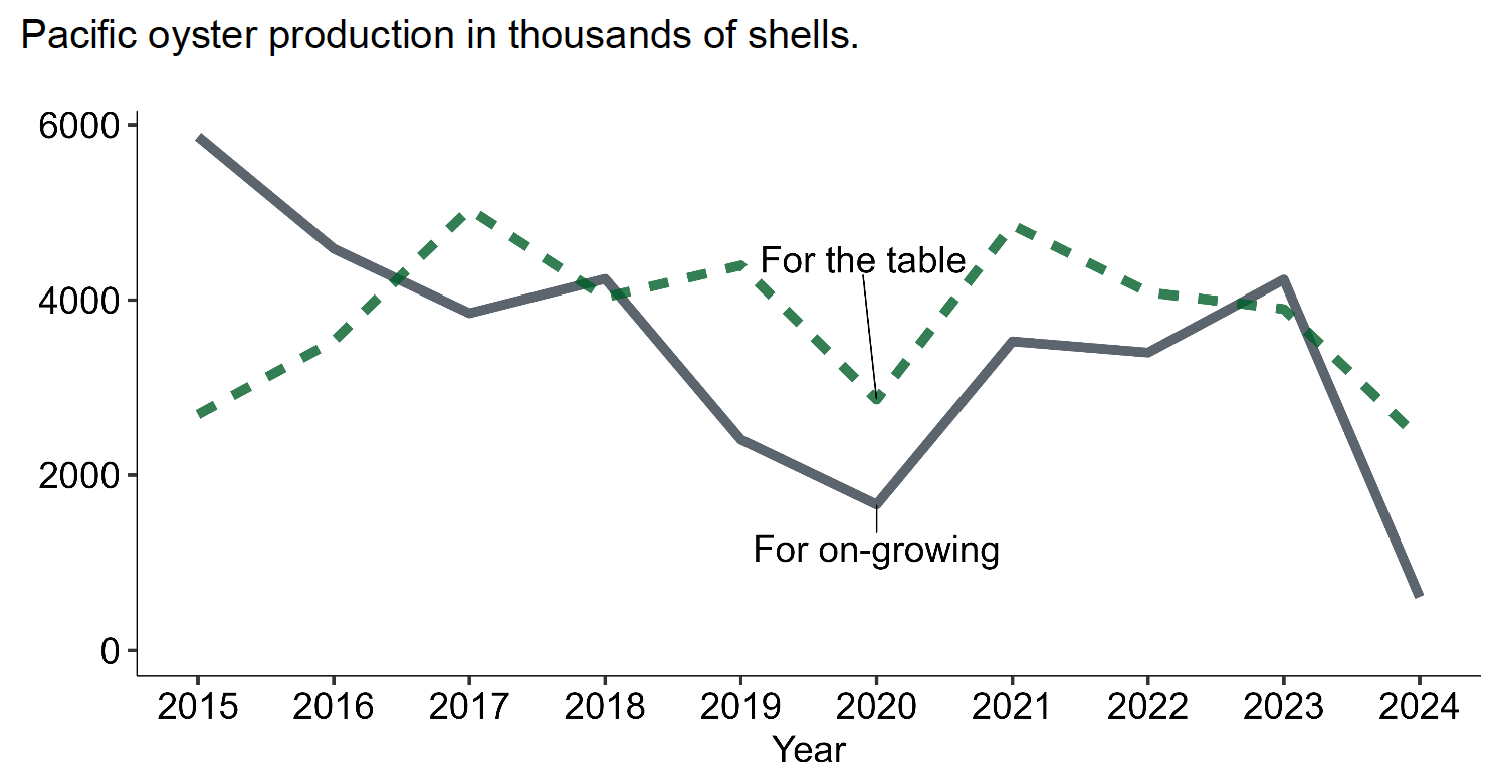
The upper green dashed line shows the production for the table and the lower dark grey line shows the production for on-growing. The data for this figure are shown in the supplementary data.
Data Source: Scottish Shellfish Farm Production Survey 2024, Supplementary Tables, Table 2
Trends for table production for native oyster and king scallop are illustrated in chart 3. Trends in on-growing production for native oyster and king scallop are illustrated in chart 4.

The upper red dashed line shows native oyster production for the table (in thousands of shells). The lower purple line shows king scallop production for the table (in thousands of shells). The data for this figure are shown in the supplementary data.
Data Source: Scottish Shellfish Farm Production Survey 2024, Supplementary Tables, Table 2

The upper red dashed line shows native oyster production for on-growing (in thousands of shells). The lower purple line shows king scallop production for on-growing (in thousands of shells). The data for this figure are shown in the supplementary data.
Data Source: Scottish Shellfish Farm Production Survey 2024, Supplementary Tables, Table 2
Common mussel production, for the table, increased by 13% in 2024 (see chart 1) from 10,311 to 11,690 tonnes. This is the highest level of mussel production recorded in Scotland. The greatest regional contribution to mussel production was from Shetland, accounting for 10,234 tonnes (88%) of Scotland’s total. Pacific oyster production for the table decreased by 38% from 2023 (from 3,897,000 to 2,418,000 shells). Table production of native oysters increased by 53% while table production of king scallops decreased by 4%. Historical data for all shellfish species show that production levels vary year on year. This can be due to a number of different factors such as poor spat fall, algal toxins, poor growth, adverse weather and fluctuations in market prices.
Prices of farmed shellfish fluctuated throughout the year. Their value at first sale was estimated from the following figures obtained from the shellfish farming sector. These vary with demand, level of production and geographical area of origin. The average price of Pacific oyster was £0.60 per shell; native oyster, £0.75 per shell; king scallop, £2.44 per shell; and common mussel £1,048 per tonne. The value of the table trade is estimated from the production figures shown in Table 2 and 3.
Common mussel: £12.3 million
Pacific oyster: £1.5 million
Native oyster: £0.1 million
King scallop: £0.1 million
In 2024, the total value at first sale for all species was calculated at approximately £14.0 million, a decrease of 1% from the £14.1 million estimated value in 2023.
Contact
Email: MD.Productionsurvey@gov.scot