
Scottish Referral Guidelines for Suspected Cancer 2025
The Scottish Referral Guidelines (SRGs) for Suspected Cancer support primary care clinicians in identifying patients who are most likely to have cancer and therefore require urgent assessment by a specialist.
Introduction
Cancer is a common condition with 36,036 new cases diagnosed in 2022 in Scotland (excluding non-melanoma skin cancers). Cancer remains a national clinical priority for the Scottish Government and National Health Service (NHS) Scotland.
The Scottish Government’s Cancer Strategy (2023 to 2033) launched in June 2023. This Strategy aims to strengthen core elements of the cancer pathway while focusing on cross-cutting issues that will enable success. The Strategy focuses on improving the prevention, detection and treatment of cancer, reducing both late-stage diagnosis and the health inequality gap, particularly for those from areas of deprivation.
Cancer survival is dependent on disease biology, stage at diagnosis and patient access to timely treatment. Earlier diagnosis can reduce premature deaths from some cancers and have a positive effect on overall life expectancy. A new earlier cancer diagnosis vision was developed as part of the Scottish Government’s Cancer Strategy for Scotland. The vision is to reduce later stage (3 or 4) disease by 18 percentage points by 2033.
A key objective is to work with healthcare professionals and wider primary care teams to promote referral or investigation at the earliest reasonable opportunity for people with clinical features suspicious of cancer, while making the most efficient and equitable use of NHS resources, avoiding adverse impact on access to services.
Cancer incidence in Scotland
| Cancer type | ICD-10 code | Total new cases in 2022 (Scotland) | No. cases per average GP practice per year in Scotland |
|---|---|---|---|
| Trachea, bronchus and lung | C33-C34 | 5,391 | 6.08 |
| Breast | C50 | 5,183 | 5.84 |
| Prostate | C61 | 5,064 | 5.71 |
| Colorectal | C18-C20 | 4,337 | 4.89 |
| Malignant melanoma of skin | C43 | 1,656 | 1.87 |
| Head and neck | C00-C14, C30-C32 | 1,389 | 1.57 |
| Kidney | C64-C65 | 1,115 | 1.26 |
| Non-Hodgkin’s Lymphoma | C82-C86 | 1,021 | 1.15 |
| Oesophagus | C15 | 992 | 1.12 |
| Pancreas | C25 | 866 | 0.98 |
Column four shows the expected number of new cases per year in an average (mean) General Practitioner (GP) practice (based on a GP practice count of 887[2] and 2021 census population figures[3], giving 6,129 individuals per practice). It should be noted that the variability in GP practice populations (e.g. list size, age distribution, urban versus rural and socioeconomic factors) affects the applicability of this data to an individual practice.
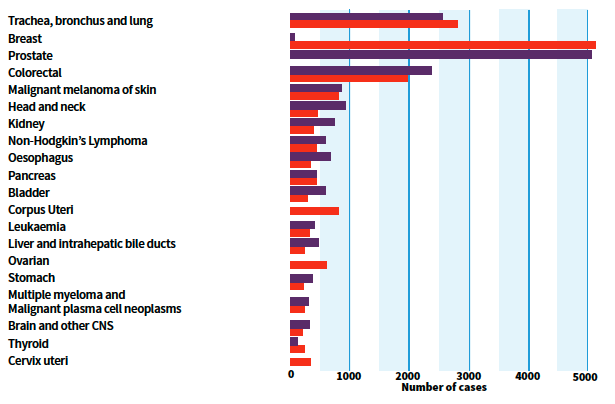
Demographic factors
Socio-economic deprivation affects the incidence of, and mortality associated with, cancers. Cancer risk has been shown to increase from those living in the least deprived to those in the most deprived areas of Scotland. For the period 2015 to 2019, age-standardised incidence rates were 35% higher in the most deprived areas compared with the least deprived. In 2021, the difference was 30%[4]. Staging data from 2022[5] shows that patients from more deprived areas tend to be diagnosed at a later stage.
The Inverse Care Law[6] describes how access to healthcare is poorest for those who need it the most, driven by a variety of factors. It is essential that any consultation, or other opportunity where a person from a deprived area presents with symptoms suggestive of cancer, is used to full advantage.
Some cancers occur more frequently in certain communities e.g. the lifetime risk of prostate cancer in black men is twice that of white men[7]. Risk factors such as these have been highlighted in each referral guide to aid primary care in assessing the risk of cancer and making onward referrals.
A practical guide has been developed by the Scottish Primary Care Cancer Group (SPCCG) that can be used to help address inequalities in cancer care - Cancer Inequalities in Scotland: A Practical Guide for GP Practices.
Comorbidity
The ageing population and the increasing number of people with long-term conditions and co-morbidity pose major clinical challenges. This affects both the incidence of and mortality from cancer. Chronic disease management programmes may afford an opportunity to identify symptoms suggestive of cancer.
In this context, a healthcare professional must differentiate between people whose symptoms may be due to cancer and the much larger number of people with similar symptoms arising from other causes. For certain symptoms, it may be entirely appropriate for a clinician to wait to see if they resolve. Persistence or worsening of symptoms, or recurrent presentations, may alert the healthcare professional to the possibility of cancer. These Guidelines have been developed to support healthcare professionals with this task.
Contact
Email: cfsdcancerandedteam@nhs.scot