
Scottish Housing Market Review: Q2 2025
Quarterly bulletin collating a range of previously published statistics on the latest trends in the Scottish housing market.
Part of
6. Mortgage Interest Rates
After a tightening cycle which took Bank Rate from 0.1% prior to the December 2021 Monetary Policy Committee (MPC) meeting to 5.25% following the August 2023 meeting, its highest level since 2008, the MPC held Bank Rate steady for the following 12 months. The MPC then cut Bank Rate in increments of 0.25% points at their meetings in August 2024, November 2024, February 2025 and May 2025, which took it to 4.25%, where it was maintained at the June 2025 MPC meeting.
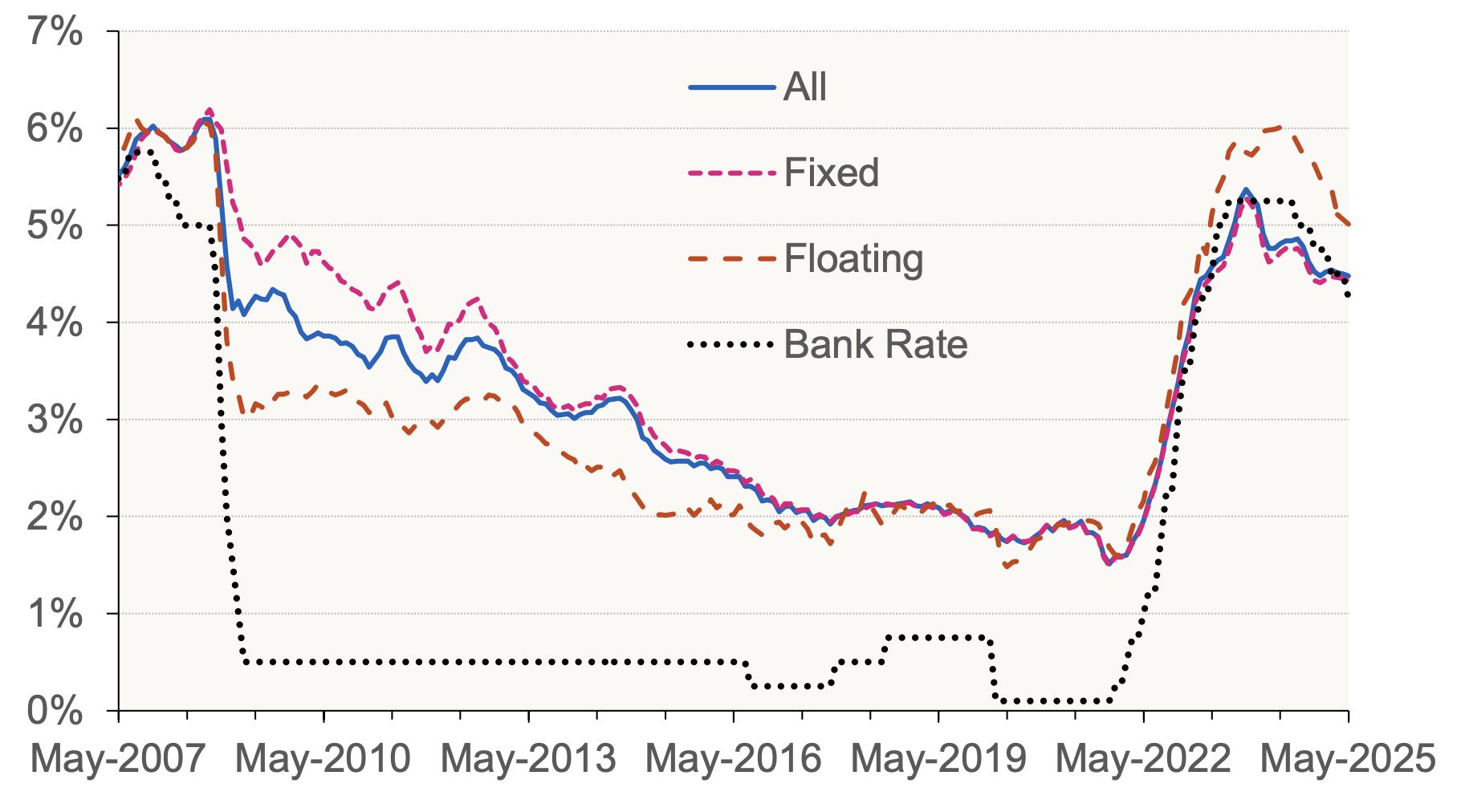
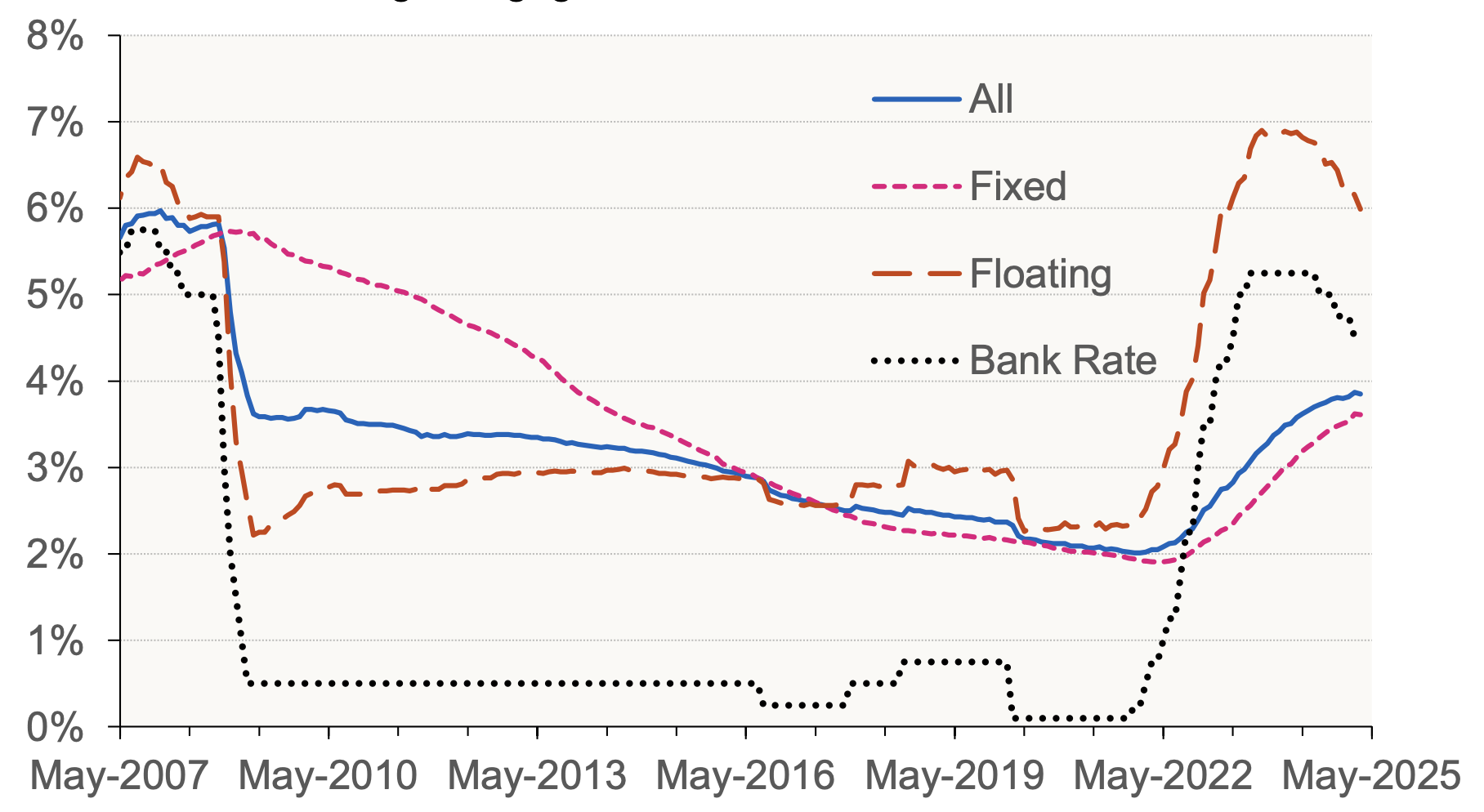
Chart 6.1 and Chart 6.2 shows the effective (or average) interest rates on new mortgage advances and outstanding mortgage balances. [Source: Bank of England]
Reflecting successive cuts in Bank Rate since August 2024, over the year to May 2025, the average interest rate for new floating-rate mortgage advances has fallen by 1% point to 5.01%, while for fixed-rate mortgages it fell by 0.29% points to 4.43%. As a result, the average rate for all new mortgages has fallen by 0.33% points to 4.48%.
While the average rate on outstanding variable-rate mortgages has also fallen over the last year in response to the cuts in Bank Rate (by 0.90% points to 5.92%), the average rate on outstanding fixed-rate mortgages has continued to trend up (by 0.47% points to 3.66%) as the period of their fix ends and mortgages are refinanced at higher rates – this applies particularly to mortgages which had longer-duration fixes. As the vast majority of borrowers are on fixed-rate mortgages (see Chart 6.4), the average rate on all outstanding mortgages has also increased over the last year (by 0.25% points to 3.87%)
Effective monthly interest rates on mortgage lending to households: UK (Data as at month-end, to May 2025)
Source: Bank of England
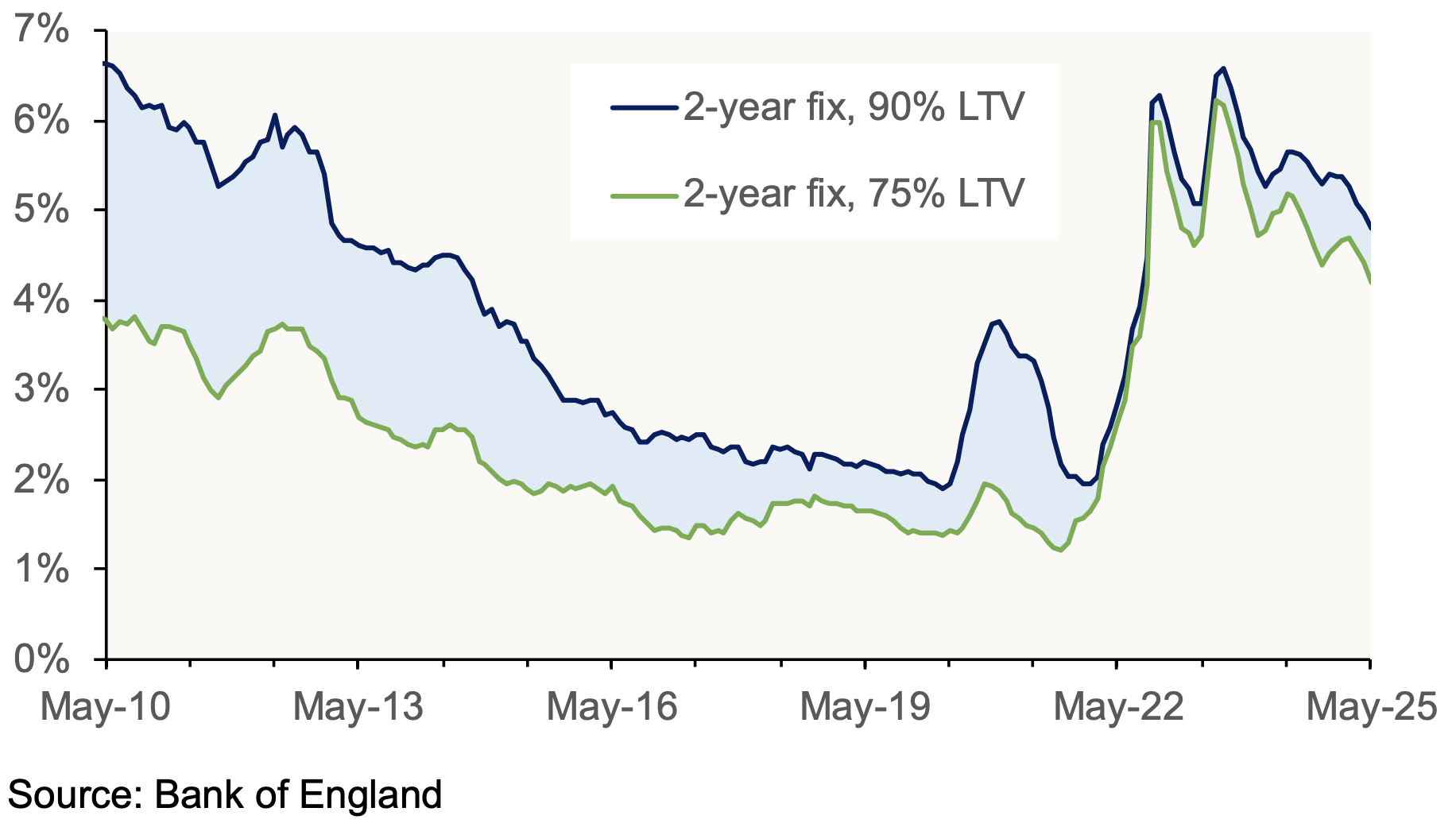
Bank of England data on advertised mortgage rates (as opposed to data in Chart 6.1 which is based on interest actually paid) also shows that advertised mortgage rates are significantly off the peaks reached during the current interest-rate cycle: the average advertised two-year fixed rate for a 75% LTV mortgage has fallen from its post-pandemic peak of 6.22% in July 2023 to 4.19% in May 2025 (down 2.03% points), while the average advertised rate for a 90% LTV mortgage has fallen from its post-pandemic peak of 6.57% in August 2023 to 4.81% in May 2025 (down 1.76% points). The spread between the two LTV values was 0.62% points in May 2025.
Source: Bank of England
Data from the Moneyfacts Treasury Report, also relating to advertised rates but averaged across LTVs,[3] shows that the average 2-year fixed-rate mortgage interest rate across LTVs decreased from 5.93% in June 2024 to 5.12% in June 2025. Meanwhile, over the same time period, the average interest rate for a 5-year fix fell from 5.50% to 5.09%.
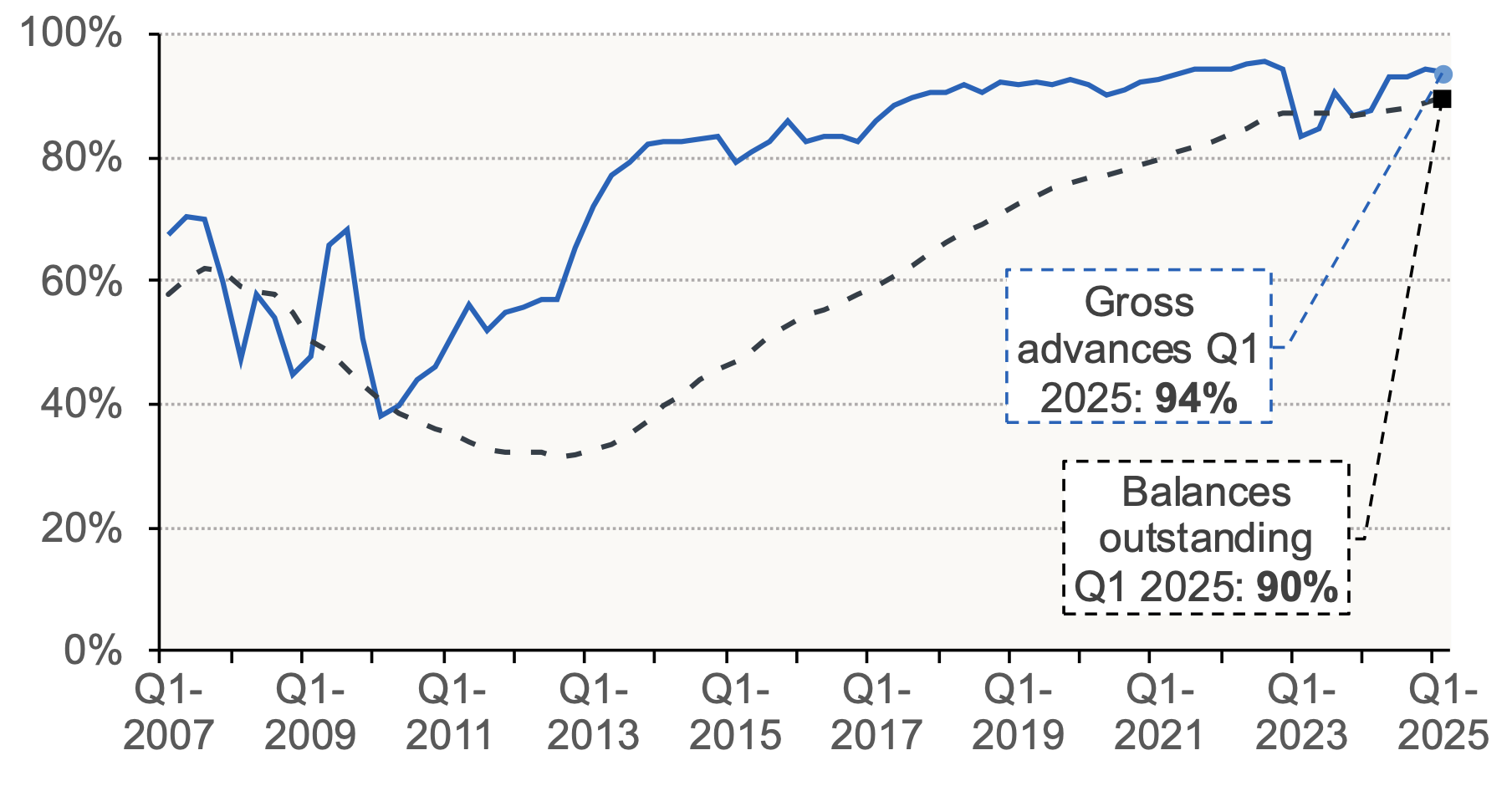
Chart 6.4 shows that the vast majority of regulated[4] mortgages are on fixed rates. The share of gross advances on fixed rates in Q1 2025 was 94%, while the share of outstanding balances on fixed rates in Q1 2025 was 90% which is the highest since the data series begin in 2007. (Source: FCA).
Source: FCA
Contact
Email: Jake.forsyth@gov.scot