
Scottish Education Exchange Programme (SEEP) Test and Learn Project Evaluation
The Scottish Government introduced the Scottish Education Exchange Programme (SEEP) Test and Learn Project to support Scotland’s post-Brexit international education ambitions and address gaps left by the UK’s withdrawal from the Erasmus+ programme.
Findings
This chapter presents the main findings from the evaluation, drawing on the college and university survey responses, in-depth interviews and project end of year reports.
The findings explore how SEEP Test and Learn was implemented across the college and university sectors, the nature of the projects delivered, and the outcomes generated for institutions, staff, students, and international partners. The chapter is structured around three core themes: programme design, project delivery, and project impact. It highlights both the value of the programme and the challenges encountered.
Programme design and implementation
Institutions generally reported that the SEEP application and grant management process was clear, user-friendly and accessible. The support provided by Scottish Government staff was highlighted as a particular strength, with interviewees and survey respondents noting the team’s responsiveness and clarity of communication. Most found the application straightforward, they also found that the funding criteria matched their internationalisation and mobility aspirations.
Despite this majority view, a few institutions with less experience of mobility programmes required external support to navigate eligibility rules and complete applications, particularly around what constituted allowable expenditure and required documentation for international partners.
As already mentioned, the flexibility of SEEP's design was welcomed. Interviewees and survey respondents valued that SEEP allowed for activities beyond those typically supported by Turing, such as scoping visits, inward mobility, and strategic development. As one interviewee noted, “SEEP gave us room to design something that fit our people and our strategy — we didn’t have to squeeze ourselves into someone else’s framework” (Interviewee, college).
Funding programme constraints
The key constraint of SEEP was the compressed timeline for both the application process and project delivery. Many institutions highlighted the timelines between funding confirmation and project delivery had been a challenge. The short period between announcing the funding and application submission and the timing of the announcement limited institutions’ abilities to plan the design of the projects and establish international collaborations. “We didn’t hear until December, that left us just over two months to plan a trip to a country we’d never worked in” (Interviewee, university). This short notice period was improved in the second year of SEEP project delivery, though the timeframe for delivery continued to be raised as a challenge.
Alignment with the academic year would increase opportunities for project delivery, particularly so that summer mobilities could be included, which is an easier and more desirable time for many of these activities to take place. Delivery within the full academic year would assist with embedding projects and developing international partnerships more effectively.
One other factor that was raised about the content of the application form related to the information requests about partners. Some institutions reflected that while elements such as Fair Work policy and data protection requirements (e.g. GDPR) are standard and well understood within Scottish institutions, the expectation to evidence equivalent policies in partner institutions, particularly in contexts where relationships are new or developmental, could be administratively burdensome or seen as culturally inappropriate.
A sector specific issue raised in the interviews and survey responses was the challenge faced by some in the further education (FE) sector. Some colleges would value more support in developing their applications in recognition of their reduced capacity and/or limited international experience. While the SEEP criteria were drawn from Scotland’s International Education Strategy, intending to reflect both college and university ambitions, a few colleges noted that the language and framing felt more aligned to university contexts, making aspects of the application not as relatable to the college sector. “Some of the language felt geared more towards HE — we had to interpret how to apply it in our FE context” (Interviewee, college).
Despite these issues, many institutions felt that SEEP’s flexibility had enabled them to design more ambitious or innovative projects than would otherwise have not been possible.
In terms of monitoring requirements, these were seen as proportionate to the funding levels with an appropriate balance between accountability and manageability. Some institutions highlighted the restrictions on word count which they felt prevented a full description of the projects so flexibility on this in the future would be welcomed.
Suggestions for improvements to future mobility funding programmes
Alongside changes to communication timings and timeframe, additional suggestions for supporting the development and completion of funding applications included:
- developing an online application portal or toolkit to streamline processes further;
- creating more guidance to support applicants;
- light touch support in the pre-application stage or informal webinars; and
- adjusting the language within the application form so it resonated more with applicants from the FE sector.
Project delivery
Across the two funding cycles, SEEP funded 56 projects involving 29 different institutions across Scotland’s college and university sectors. These projects reached a wide geographical spread of international partners spanning over 30 countries across Europe, Africa, Asia, North America, and Oceania. Destinations included well-established exchange countries such as Germany, France, and the USA, and less common partners like Kenya, Ghana, Thailand, and the Philippines. This is summarised below, with the same information presented visually in Figure 2.
- Projects Funded: 56
- Number of Staff Participants from Scottish Institutions: 345
- Amount of Financial Contributions from Partners: £132,351
- Funding Awarded: £834,704
- Number of Student Participants from Scottish Institutions: 103
- Number of Staff Participants from International Partners: 384
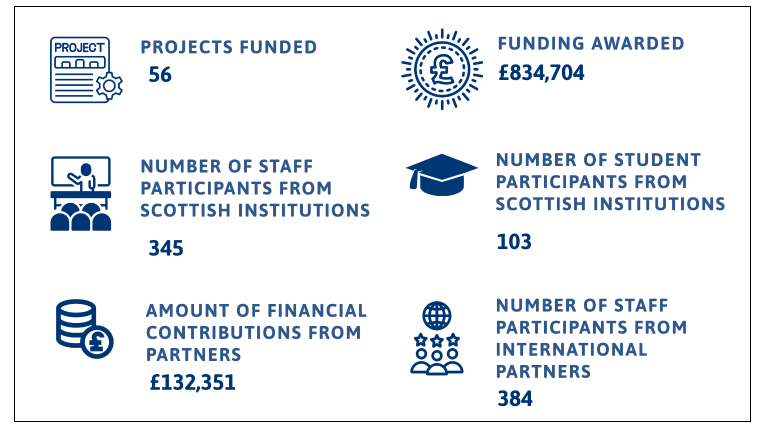
This scale of engagement demonstrates SEEP’s role in enabling widespread and diverse international activity within a £835,000 funding envelope.
Breadth and focus of project delivery
SEEP-funded projects encompassed a diverse mix of delivery models shaped by institutional priorities and partnership ambitions. Across both funding cycles, projects spanned strategic scoping visits, curriculum co-design, staff and student mobility, civic engagement, and hybrid or digital collaboration. This variety demonstrated institutions' ability to adapt SEEP to meet local needs and international aspirations. The survey showed that institutional aspirations differed slightly between the sectors – for colleges the top three priorities were: promoting knowledge exchange, fostering international partnerships and creation and development of transnational education (TNE) opportunities, whereas for universities, the top three priorities were: enhancing the institution's global reputation, fostering international partnerships and creation and development of TNE opportunities.
A short summary of each project is provided in appendices 1 and 2. Projects could be broadly grouped into the following overlapping themes:
- curriculum innovation and pedagogical exchange;
- mobility and inclusion;
- strategic partnership building;
- staff development and knowledge exchange; and
- civic and cultural engagement.
Curriculum innovation and pedagogical exchange
A substantial number of projects focused on co-developing or enriching curriculum content with international partners. These included modules developed through Collaborative Online International Learning (COIL), joint MSc or MBA courses, and aligned professional learning in areas such as net-zero, nursing, and creative industries. A few institutions developed interdisciplinary curriculum content aligned with broader strategic goals, one focusing on Transnational Education (TNE) and sustainable development, and another emphasising inclusive education and global citizenship in collaboration with its Zambian partner.
Mobility and inclusion
The funding enabled both outward and inward mobility, with a strong emphasis on inclusive access. Certain colleges focused on widening participation, offering first-time international experiences to students from underrepresented groups including care-experienced students, English for Speakers of Other Languages (ESOL) learners, and adult returners. In several cases, institutions structured visits to be more accessible to carers, part-time students, or those with dependents, an important complement to more traditional mobility schemes.
Strategic partnership building
Two universities and several colleges used SEEP to rekindle Erasmus+ links that had lapsed or stalled following Brexit, or initiate new collaborations in regions, such as Southeast Asia, Africa, and Canada. These projects often combined exploratory visits with formal relationship-building activities and planning for future collaboration which laid the groundwork for long-term institutional ties.
Staff development and knowledge exchange
Several projects placed staff development at the centre of their activities, facilitating two-way staff visits, co-teaching sessions, and leadership exchange. This often led to professional growth, mutual learning, and the instigation of cross-institutional research or teaching collaborations.
Civic and cultural engagement
A smaller but notable set of projects focused on cultural understanding, civic values, and social inclusion. These included digital storytelling, public engagement, and place-based learning. For instance, one university project fostered a creative exchange between students and staff in Scotland and Indonesia, using traditional textile techniques to promote intercultural understanding and sustainability in design education. A college project also fostered civic and cultural engagement by drawing on German best practice to propose a structured integration and language support system for asylum seekers in Scotland, aiming to build inclusive communities and reduce barriers to participation.
In addition to the range and scope of project activity, SEEP played a role within institutions that influenced delivery mechanisms, supported collaboration across teams, and informed how international engagement was approached and delivered. This impact on institutions, staff and students is explored later in this chapter.
Several institutions integrated digital components into their projects to extend engagement beyond the physical mobility window. With one college embedding online collaboration into their project by using shared digital platforms for students to connect with peers in partner countries before travel. Another college similarly used online pre-travel sessions to introduce students to partner institutions, deliver cultural awareness content, and prepare for collaborative tasks. These virtual elements allowed students who were new to travel to feel more supported and enabled richer collaboration during shorter mobility windows.
Delivery challenges
While SEEP enabled a wide range of impactful and innovative projects, institutions also encountered a number of delivery challenges, many of which stemmed from their institutional processes, and the practicalities of cross-border collaboration.
- institutional bureaucracy and risk aversion: internal approval processes including financial sign-off, international risk assessments, and safeguarding were cited as challenges, especially when staff were unfamiliar with international projects, “institutional processes made it difficult, even getting travel booked required multiple approvals and took weeks” (Interviewee, college);
- inward mobility logistics: welcoming partners to Scotland was often more complex than sending staff or students abroad. Challenges included visa delays, accommodation shortages (particularly in cities) and unfamiliarity with safeguarding expectations in Scottish institutions. “We had to host inward visits at the last minute — finding visas and accommodation in the city during term time wasn’t easy” (Interviewee, college);
- limited staff capacity for administrative and project management work: project leads frequently had to juggle international activity alongside teaching or leadership responsibilities, with no dedicated resource. “It was just me — the teaching, the planning, the bookings, all of it. We don’t have a mobility team” (Interviewee, college);
- fluctuating student engagement: some colleges noted that even with strong initial interest, participation declined due to personal, financial, or caring responsibilities, especially where projects were rescheduled due to delays. “A few of the students we lined up for the trip had to pull out, work shifts, personal stuff. We had to scramble to fill spaces” (Interviewee, college);
- digital capacity gaps: institutions that pursued hybrid or online elements found that not all staff or partners had the same level of digital fluency or access to platforms “We had planned a lot of online pre-engagement, but our partner didn’t have the systems for it — we had to change tack” (Interviewee, university);
- sectoral misalignment in cross-institutional projects: projects involving HE–FE or interdisciplinary teams encountered differences in operational culture, expectations, and timelines. “Our university partner was great but had a totally different academic calendar — it took a while to align” (Interviewee, college); and
- limited flexibility for contingency: projects often lacked contingency funding or schedule flexibility to absorb disruptions such as illness or travel delays. Some institutions had to scale back ambitions as a result.
Despite these institutional-specific challenges beyond SEEP’s remit, colleges and universities expressed strong support for the programme and significant value from their involvement in it. This value is described in more detail in the next section.
Impact of the projects
Beyond the successful delivery of activities, SEEP-funded projects generated a wide range of positive impacts for the institutions, the staff, and the students. The funding strengthened institutional confidence in extending their international activities, acting as a catalyst for internal collaboration, broadening participation in mobility programmes, and deepening international partnerships.
Student outcomes
Institutions widely reported that SEEP-funded projects had a positive impact on students. In the survey, 47% of respondents observed tangible student benefits, including increased confidence, cultural awareness, or improved communication skills. Interviewees highlighted that it was particularly evident for those students with little prior exposure to international travel or collaboration. For many learners, especially those from widening access backgrounds, participation in international activity represented a personal milestone that helped build independence. Projects involving care-experienced students, ESOL learners, and mature students were particularly impactful in this regard.
Colleges and universities noted that students developed transferable skills through their participation in the SEEP-funded projects, including communication, teamwork, problem-solving, and intercultural awareness. Staff highlighted that these skills were being recognised in student self-assessments, reflective learning logs, and CVs. For projects that included hybrid or virtual components, the students gained experience in digital collaboration, e.g. working across time zones, navigating online platforms, and contributing to shared outputs and these skills were valued by both students and staff as important for employability and future learning.
Staff across several institutions observed that international experiences acted as a motivator for learning. While not always formally measured, anecdotal reports described renewed enthusiasm for coursework, increased classroom participation, and improved attendance following SEEP participation.
Several of the projects explored global themes such as climate change, social justice, heritage, and cultural identity which helped students to engage with wider global issues. In some cases, curriculum-linked mobility experiences helped students to draw comparisons between domestic and international approaches to their field of study, enriching their academic learning and understanding of global citizenship.
Two colleges described how students who had taken part in SEEP activity became advocates or ambassadors for international learning. Some helped with project dissemination, presented to senior leaders or supported other student cohorts through peer mentoring roles.
Barriers to participation
While SEEP funding helped in widening access, several institutions noted that structural barriers remained. Eligibility rules, costs not covered by funding (such as visas or childcare for learners with caring responsibilities), and varying definitions of disadvantage continued to limit participation for some.
Staff development
One of the most reported impacts was the professional development of academic and support staff. Projects across both cycles created opportunities for early-career staff to lead international work. For some, it was their first experience of managing budgets, risk assessments, or cross-institutional coordination, this was especially valued in colleges and newer universities. “For our newer lecturers, this was transformational — they’ve never had the chance to do anything like this” (Interviewee, university).
Institutions reported that staff returned from visits with new insights into teaching practice and curriculum design. These experiences often prompted reflective discussions, adaptation of learning content or changes to teaching strategies within their home institutions. Projects involving collaborative curriculum development or co-teaching provided staff with opportunities to exchange pedagogical methods and content.
Projects that involved inward mobility and institutional visits by international partners were also impactful for staff. These visits allowed deeper cultural understanding and reciprocal learning and for some Scottish institutions, hosting staff from partner countries was a first. For staff, these experiences fostered global perspectives and built confidence with some facilitating peer-to-peer learning between international and Scottish staff.
The survey responses reinforce these findings with 73% of institutions reported increased staff confidence and international awareness and 66% of responses stating that staff had incorporated international themes into teaching or planning.
Strengthening institutional confidence and ability
Projects reported SEEP helping their institutions rebuild momentum in their international activity following disruption caused by Brexit, the pandemic, and the withdrawal from Erasmus+. Many reported that the programme gave them practical support to re-engage internationally.
This confidence extended to new or less experienced international teams. For some colleges, SEEP represented their first substantial international engagement. Several institutions highlighted that SEEP enabled their international strategies to be repositioned with a greater emphasis on values such as equity, civic engagement, and mutual benefit.
The SEEP programme sparked wider interest in internationalisation within institutions. Some participants described a “ripple effect” in which other departments or teams expressed interest in replicating SEEP-style projects. At one college, for example, the initial SEEP-funded exchange prompted other curriculum areas to consider similar approaches. “It’s sparked a bit of a cultural shift” (Interviewee, college).
Some institutions organised internal debriefs or workshops where returning staff shared their learning with colleagues. This helped to cascade knowledge across departments and increase wider staff interest in international engagement. The survey data also highlighted that more than 70% of institutions reported improved staff confidence in working internationally following SEEP participation.
Several projects created new cross-departmental links, enabling staff from different teams such as academic departments, international offices, and community engagement units to work together for the first time. This peer-to-peer approach helped build wider organisational understanding of internationalisation which will support institutional readiness for future international partnerships or funding bids.
Contact
Email: exchangeprogramme@gov.scot