
Scottish Education Exchange Programme (SEEP) Test and Learn Project Evaluation
The Scottish Government introduced the Scottish Education Exchange Programme (SEEP) Test and Learn Project to support Scotland’s post-Brexit international education ambitions and address gaps left by the UK’s withdrawal from the Erasmus+ programme.
Context and methodology
Strategic and policy context
Scotland’s withdrawal from the Erasmus+ programme, marked a significant loss for the education sector (Universities Scotland, 2023). Erasmus+ had long provided robust frameworks for reciprocal international exchange, strategic partnerships, and cross-sector mobility involving learners and staff across schools, colleges, universities, adult education, and youth work (Zotti, 2021; Coburn and Gormally, 2017).
Participation in Erasmus+ enabled Scottish institutions to form deep and sustained partnerships with peers across Europe and beyond. These partnerships supported collaborative research, professional development for educators, international curriculum development, and inclusive learning opportunities for students—particularly those from disadvantaged backgrounds. The programme played a critical role in internationalising the student experience, embedding intercultural competencies in teaching practice, and fostering innovation through transnational cooperation.
Its loss represented more than a reduction in funding: it created a structural gap in Scotland’s ability to participate in international education networks and policy dialogues. Institutions reported disruption to longstanding partnerships, the decline of reciprocal exchange opportunities, and increased difficulty in attracting inward mobility (Highman, Marginson, and Papatsiba, 2023). The withdrawal also limited the strategic visibility of Scottish education institutions within the European and global context.
For many stakeholders, the departure from Erasmus+ symbolised a weakening of Scotland’s international engagement in education and training. This made it imperative to explore alternative approaches, such as SEEP, to mitigate the loss, re-establish key relationships, and sustain Scotland’s reputation as a collaborative, outward-looking education system.
Turing Scheme
While the UK Government’s Turing Scheme was introduced in 2021 as a domestic replacement, it did not replicate the full scope of Erasmus+. The Turing Scheme has a focus primarily on unidirectional, short-term student placements (The British Academy, 2023).
The Turing Scheme does not support:
- staff mobility;
- inward mobility of students or staff;
- strategic partnerships and capacity-building projects.
Where Scottish institutions had previously relied on Erasmus+ for activities that extended beyond student exchanges, this gap limited opportunities to build or sustain international partnerships.
As such, while Turing has provided some continuity in outward mobility, it has not addressed the broader strategic objectives of international education engagement, leaving a rationale for the development of a complementary, Scottish-led approach.
Scottish International Education Strategy
In response, the Scottish Government set out a clear commitment to reassert Scotland’s role as a leader in international education. This commitment was articulated through the Scottish International Education Strategy (2024) and the Purpose and Principles (2023) series of documents. Together, these documents outlined a vision for a globally connected, inclusive, and values-led education system, rooted in mutual benefit, global solidarity, and a commitment to high-quality learning experiences for all.
The Scottish Education Exchange Programme (SEEP) was developed in direct alignment with these objectives; the Test and Learn Project phase of SEEP provided a mechanism to begin realising these ambitions. It enabled Scottish institutions to re-engage with European counterparts, while also supporting the development of new partnerships in other global regions, including South Asia, South America, East Asia, and Sub-Saharan Africa. It offered space for experimentation, testing new models of mobility, capacity-building, and strategic cooperation that reflect the broader ambitions of the Scottish Government’s international education agenda.
The experience and learning generated through SEEP will play an important role in informing how Scotland can maximise the benefits of this engagement, ensuring equitable access, strategic alignment, and readiness across the education system. This learning will be particularly useful for project development in Scotland in the instance that the UK Government continues working towards rejoining Erasmus+ (Scottish Government, 2025).
Scottish Education Exchange Programme (SEEP)
Scotland’s exclusion from the Erasmus+ programme left a gap in opportunities for staff and students to engage in reciprocal mobility and collaborative transnational activity. SEEP aimed to enable innovation through the creation of new global connections. The programme was governed by the Scottish Government, with grant payments administered by the Student Awards Agency Scotland (SAAS) in year one and by core Scottish Government in its second year. A cross-sectoral Test and Learn Working Group, including representatives from colleges, universities, sector bodies, and the Scottish Funding Council, informed the initial programme development. Their guidance underpinned the design and application process for both cycles.
The Test and Learn approach
The Scottish Government committed to a Test and Learn Project to pilot the re-establishment of key elements formerly enabled by Erasmus+. This approach sought to test the demand, feasibility, and value of a Scottish-led exchange model that supports outward and inward staff mobility, institutional partnerships, and collaborations with schools, youth work, adult learning and sports organisations. The Test and Learn Project:
- aligns with the Scottish International Education Strategy, Scotland’s commitment to being a good global citizen, and the “Globally Respected” principle within the Purpose and Principles (2023); and
- contributes to delivering the Programme for Government (2023–24) commitment to establish a longer-term Scottish Education Exchange Programme, prioritising disadvantaged groups and strengthening global partnerships.
Importantly, the Test and Learn Project evaluation is not intended to assess the long-term impact of each funded project, given the short timescales and scale of funding. Rather, it aims to generate insight into programme delivery approaches, funding models, stakeholder engagement, and the potential for future scalability.
The Test and Learn Project consisted of two funding cycles:
- Cycle 1 (October 2023 – March 2024) supported 19 projects with a total grant allocation of £298,934.
- Cycle 2 (July 2024 – March 2025) funded 37 projects, with a total of £535,770 awarded.
Grants ranged from £1,000 to £25,000, or up to £35,000 where proposals included partnerships across different Scottish education sectors. Institutions were permitted to submit multiple applications in cycle 2, up to the value of £25,000, reflecting the high level of engagement and interest. The programme design ensured funding was directed primarily to Scottish institutions and encouraged match funding from international partners.
Methodology
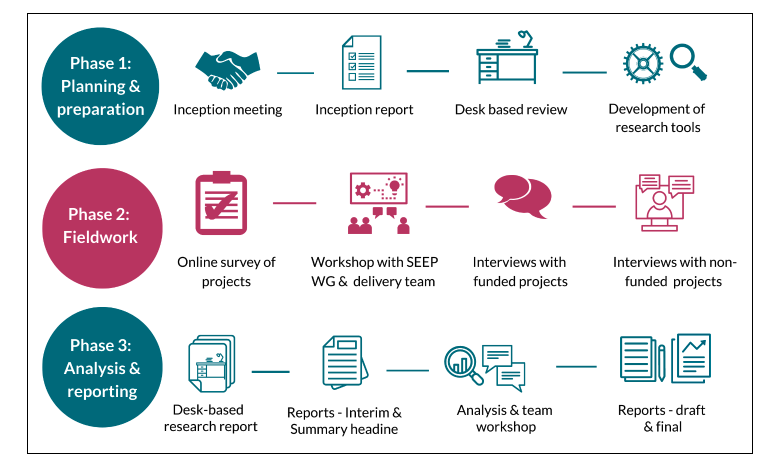
The remainder of the chapter describes the evaluation approach. This is summarised below, with the same information presented visually in Figure 1.
Phase 1: Planning and Preparation
- Inception meeting
- Inception report
- Desk based review
- Development of research tools
Phase 2: Fieldwork
- Online survey of projects
- Workshop with SEEP Working Group and delivery team
- Interviews with funded projects
- Interviews with non-funded projects
Phase 3: Analysis and Reporting
- Desk-based research report
- Reports – interim and summary headline
- Analysis and team workshop
- Reports: draft and final
Desk based review of grant documentation
The applications and end of year grant reports were reviewed at two points during the evaluation, to understand the types of projects funded, what has been delivered and key achievements. This activity shaped the research tools, informed the summary of projects and some of the findings in this report.
Online survey of funded projects
The online survey aimed to create a snapshot of experiences and perspectives of institutions who have received SEEP funding across cycle 1 and cycle 2. The survey was designed and administered using Snap Surveys and the questions explored a range of issues including the programme application and reporting experience, project context and delivery, project outcomes and reflections and future planning. The survey link was distributed by the Scottish Government team. The link was live for four weeks and 22 institutions responded (75% response rate) 17 universities and five colleges, with one college submitting two responses making a total of 23 responses to the survey.
Interviews with funded projects
Online group and individual discussions and an in-person interview were held with seven institutions (five colleges and two universities) that delivered 11 projects across cycle 1 and 2. These discussions explored participants’ experiences of SEEP in more depth, covering topics such as the application and delivery process, the nature of funded activities, challenges encountered, perceived outcomes, and reflections on sustainability and future ambitions. They also captured institutional and sectoral insights on the distinctiveness and value of SEEP, complementing evidence gathered through the survey and end-of-project reports.
Interviews with institutions that had not received funding
Online interviews with two colleges that had not applied for SEEP funding were conducted. These conversations explored their perspectives of the SEEP Test and Learn Project, particularly around accessibility, perceived barriers to application, and broader sectoral needs and provided valuable insights into why some institutions did not engage with SEEP.
SEEP working group discussion
A facilitated discussion was held with Colleges Scotland, Universities Scotland and the British Council to explore strategic -level reflections on the SEEP Test and Learn project which included its positioning and visibility, the different needs of colleges and universities, and opportunities for future programme development.
Analysis and reporting
The content of the report is informed by the:
- interviews with seven institutions that delivered 11 projects over cycle 1 and cycle 2;
- interviews with two colleges that had not applied for SEEP funding;
- the working group discussion with Colleges Scotland, Universities Scotland and the British Council;
- the 23 survey responses from institutions that delivered SEEP-funded projects; and
- analysis of 52 end of year reports and 54 applications from cycle 1 and cycle 2 projects.
The qualitative data gathered from the interviews, the survey responses and the grant documentation were analysed in line with the evaluation aims and key questions. This involved a process of coding responses to identify key and recurring themes as well as any differences in viewpoints among different groups of participants.
An internal team meeting to discuss the key emerging themes was held before producing the report outline. This was shared with the Scottish Government team for comment before the draft report was produced. The results of the analysis are presented in this report.
Strengths and limitations of the evaluation approach
This evaluation drew on a diverse evidence base, combining survey data, interviews, documentary analysis, and a sector working group discussion. A key strength of the approach was the ability to triangulate perspectives from funded and non-funded institutions, from the college and university sectors as well as capturing both operational and strategic insights. The combination of qualitative and quantitative data provided a robust understanding of delivery and learning across a range of institutional contexts.
However, several limitations should be acknowledged. The fieldwork was conducted during the summer term, a period that posed practical challenges for engagement. Some staff were involved in international activity due to their roles, while others faced end-of-academic year workload pressures or limited availability due to the impending summer break. As a result, some institutions were unable to participate in interviews and the majority of interviews were with college representatives. In contrast, the survey which achieved a reasonable response rate had responses that were heavily weighted towards universities.
Despite these constraints, the breadth and depth of the available data provide a strong foundation for understanding the overall effectiveness, value, and learning generated through the SEEP Test and Learn Project.
Contact
Email: exchangeprogramme@gov.scot