
Publication - Research and analysis
Scottish Economic Bulletin: November 2026
Provides a summary of latest key economic statistics, forecasts and analysis on the Scottish economy.
Business Conditions
Business activity indicators strengthened during the third quarter, however energy price concerns and uncertainty continue to weigh on business optimism.
Business Activity
- Business surveys indicated some improvements in business activity over the third quarter of 2026, albeit latest data for September continued to reflect the challenging conditions facing businesses.
- The Scottish Business Monitor for Q3 reported an improvement in both the volume and value of business indicators relative to Q2, while the Scottish Chambers of Commerce’s Quarterly Economic Indicator reported alight improvements in revenue and cashflow indicators, though both remained weak overall.
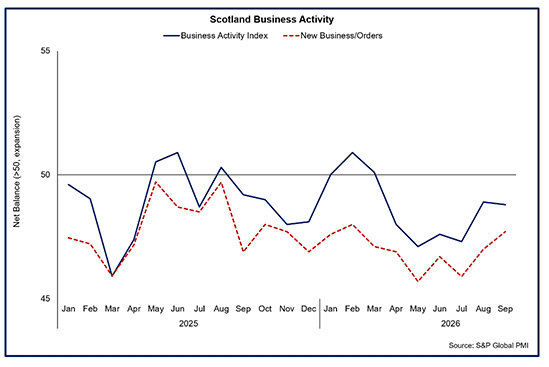
- These indicators remained relatively subdued however, and the monthly PMI business survey indicates that business activity in Scotland continued to fall in September for a sixth consecutive month with the index falling marginally over the month to 48.8 (a reading below 50 indicates contracting business activity).
- The survey indicates that an ongoing contraction in new business orders continues to underly the current weakness in activity, albeit the new business indicator improved to its highest level since February and is reflective of the improvement in staffing indicators in recent months.[10],[11]
- Furthermore, latest Business Insights and Conditions Survey (BICS) data for September reported that the share of businesses reporting an increase in demand over the month fell to 12.1% (its lowest share in two years and down from 14.5%), while the share reporting a fall in demand rose to 15.7% (up from 15.2%). Around half of businesses (50.5%) reported that demand stayed the same.[12]
Business Concerns
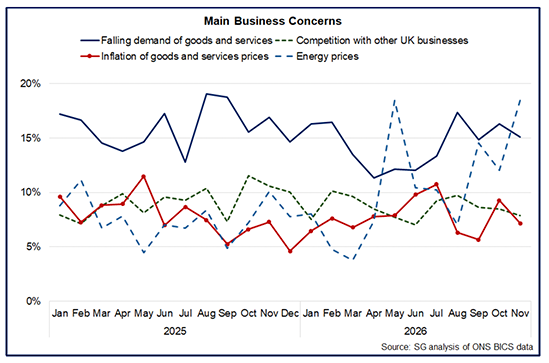
- The latest BICS data from October illustrates the growing concern that businesses continue to have about energy prices. The share of businesses reporting energy prices as a main concern increased to 18.4% in October and exceeded the share of businesses reporting falling demand of goods and services (15.1%).
- When asked specifically about how concerned they are about energy prices, concern remains broad based across industries, but is most notable in Transport and Storage, Construction, Manufacturing and Accommodation and Food Services.
- Business concerns regarding inflation of goods and services more broadly eased in September to 7.2%, however continues to reflect risks around energy prices progressively feeding through to wider prices directly and indirectly in the coming months.
Business Costs
- Businesses are continuing to navigate a challenging cost and pricing environment in which indicators of cost pressures have remain elevated, and picked up again in September as wholesale energy prices increased.
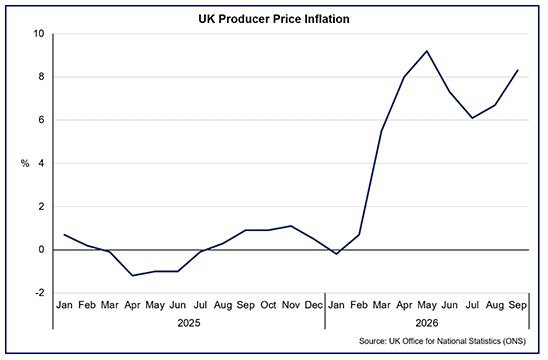
- UK producer input prices rose by 8.3% annually in September, up from 6.7% in August and to its highest rate since May. Crude oil prices were the main driver of the pick-up in September, rising by 14% over the month and have risen 51% over the past year. [13]
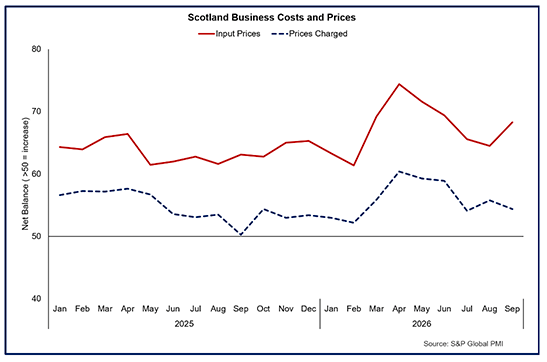
- The PMI business survey for Scotland also indicated that business input cost inflation increased in September with the indicator rising to its highest level for 3-months. Output price inflation remained positive, however slowed over the month and has remained broadly stable over the third quarter as businesses consider the extent to which to pass on higher prices. [14]
- The current rate of pass through of input costs to customers in part reflects the challenging demand conditions that business are currently operating in but is also reflective of the pace at which the increase in energy and fuel prices are impacting businesses.
- In October, 40.8% of businesses reported being very concerned about the increase in fuel prices while 33.8% were very concerned about energy prices. While fuel prices pass quickly through to pump prices, in July, almost 50% of businesses reported that they did not expect their current gas and electricity energy contracts to end until after September 2026. This indicates that the increases in energy prices will likely start to feed through more as businesses renew their electricity and gas contracts.
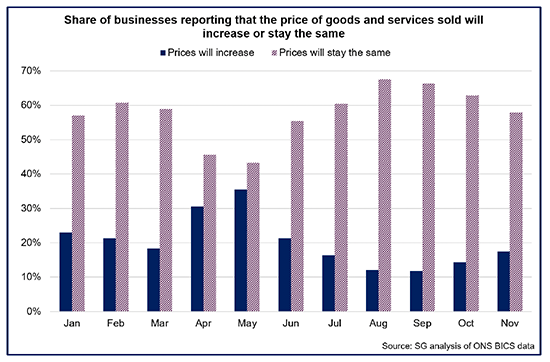
- BICS data from October shows that the share of firms reporting that they expect to raise prices on goods and services sold has picked up again in recent months (17.5%, up from 14.3% in September) while there is a falling share expecting prices to remain unchanged.
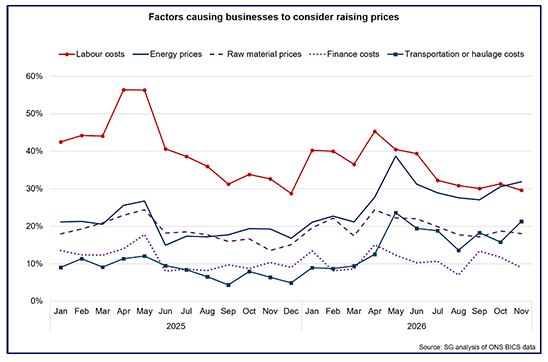
- For businesses expecting to increase prices, energy prices have become the main factor driving this consideration. In October, 31.8% reported energy prices as a factor, followed by labour costs (29.7%). Transportation or haulage costs has also increased as a factor (21.3%) as higher fuel prices continue to feed through the supply chain costs.
Business Optimism
- Global economic uncertainty and rising energy costs have continued to weigh on business sentiment and optimism going into the final quarter of the year.
- The PMI business survey for Scotland business optimism indicator fell sharply in September to 54.6, its second lowest level since the end of 2022.
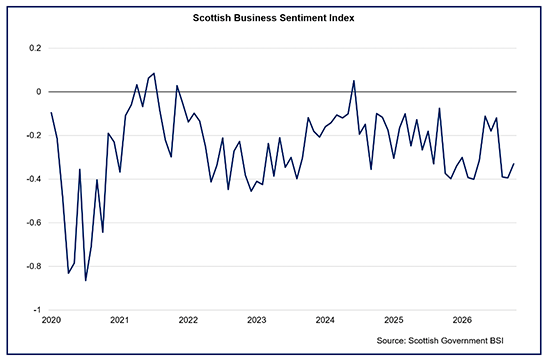
- The Scottish Business Sentiment Index (BSI) provides a real-time measure of business confidence in Scotland by analysing sentiment in news articles related to corporate and industrial developments.
- Latest data indicates that the BSI increased in October to -0.33 however remains notably lower than the sentiment levels during the second quarter and the average for 2025 (-0.24).[15],[16]
Contact
Email: economic.statistics@gov.scot