
Publication - Research and analysis
Scottish Economic Bulletin: November 2026
Provides a summary of latest key economic statistics, forecasts and analysis on the Scottish economy.
Inflation and Cost of Living
Inflation rose to 3.5% in September, primarily driven by rising fuel costs.
Inflation
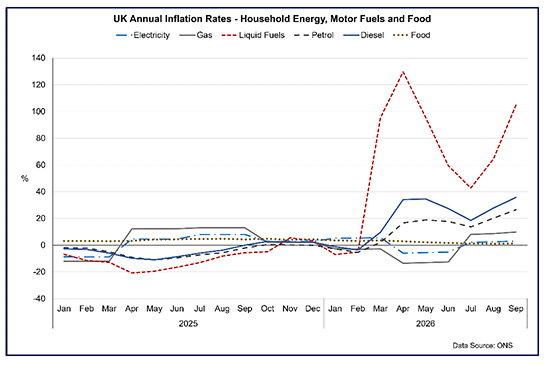
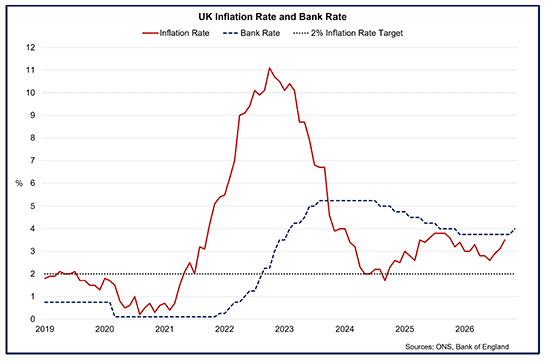
- UK inflation increased to 3.5% in September, up from 3.1% in August and is at its highest rate since October 2025. The key driver of the increase over the month was in motor fuel prices with the annual inflation rate for diesel rising to 35.8% and 26.5% for petrol.[3]
- Fuel prices rose through September and early October, reflecting higher oil prices amid ongoing tensions and disruption risks in the Middle East. Average UK petrol prices increased from 164.4 pence per litre (ppl) in early September to a peak of 175.3 ppl in mid-October, before easing to 172.8 ppl at the start of November. Diesel prices rose from 186.4 ppl to a peak of 200.0 ppl over the same period before declining to 198.6 ppl. Despite this recent easing, petrol and diesel prices remained 38.4 ppl and 56.0 ppl higher respectively than a year earlier.[4]
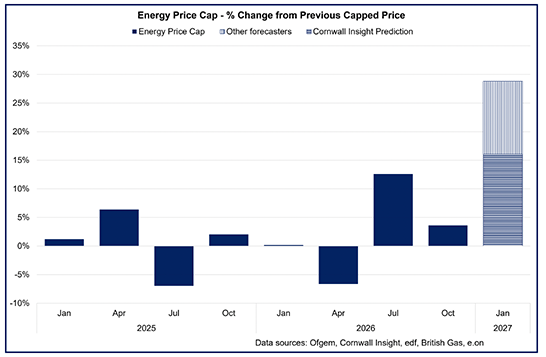
- Household energy price inflation (electricity, gas and other fuels) increased further in September, with annual domestic heating oil inflation accelerating sharply from 64.6% in August to 104.9% in September. Over the same period, electricity price inflation increased from 2.5% to 3.0%, while gas price inflation rose from 8.6% to 9.8%, and are expected to rise further with the Energy Price Cap increasing by 4% in October.
- The ongoing conflict in the Middle East continues to create volatility in energy markets. As well as increasing in October, current forecasts suggest the Energy Price Cap will rise by around a further 30% in January, although the final level remains uncertain. While higher energy costs are expected to add to inflationary pressures, the extent of pass-through to wider prices remains unclear, with core inflation unchanged at 2.8% in September.[5],[6],[7]
Monetary and Credit Conditions
- Inflationary pressures are expected to remain elevated over the coming months, reflecting higher energy costs and their pass-through to households and businesses. The increase in the Energy Price Cap in October, alongside higher fuel prices, is expected to contribute to upward pressure on both household bills and wider consumer prices.
- While there remains limited evidence of broad-based second-round effects on wages and prices, the Bank of England's Monetary Policy Committee (MPC) judged that stronger-than-expected economic activity, signs of labour market stabilisation and increasing inflationary pressures in the pipeline had shifted the balance of risks to the inflation outlook.
- The MPC voted by a majority of 8–1 in November to increase Bank Rate by 0.25 percentage points to 4.0%, the first increase since August 2023. One member voted for a larger 0.5 percentage point increase to 4.25%. The MPC's decision follows decisions by the US Federal Reserve and the European Central Bank to leave policy rates unchanged at 3.75%-4.00% and 2.50% respectively.
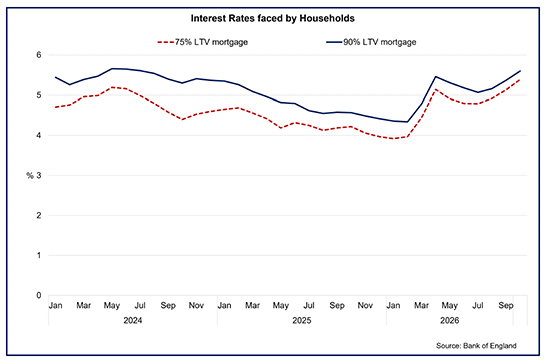
- Increased expectations of higher inflation and elevated global uncertainty have continued to push up borrowing costs in the UK. While mortgage rates fell steadily through much of 2025, this trend has reversed over the past year. Rates on two-year fixed-rate 75% and 90% LTV mortgages have risen from 4.92% and 5.16% in August 2026 to 5.39% and 5.60% respectively in October 2026. Mortgage rates are now around 1.5 percentage points higher than their late-2025 lows, highlighting the extent to which tighter financial conditions have fed through to households.[8]
Contact
Email: economic.statistics@gov.scot