
Rural Support Plan (RSP)
The Rural Support Plan as required in terms of s2 of the Agriculture and Rural Communities (Scotland) Act 2024 outlining the expected use by Scottish Ministers during the plan period of the powers conferred on them by s6 of the Act
Monitoring and Evaluation
Background: What is Monitoring and Evaluation and Why is it Needed?
Monitoring is the ongoing process of data collection that happens throughout a government programme. It aims to help track the progress of a programme and whether we are on track to meet our ambitions.
Evaluation provides an understanding of the economic, financial, social, and environmental impacts of a programme, and/or provides an assessment of how it is or was implemented, whether it delivered as expected, and whether it represents value for public money.
Implementing effective monitoring and evaluation mechanisms ensures there is evidence-based insights to inform current decision-making and future policy design. It is essential for:
- Tracking delivery
- Evidencing if policy priorities have been achieved
- Determining most effective use of public money
- Ensuring accountability to stakeholders
- Enabling continuous improvement
For the Rural Support Plan, monitoring and evaluation allows us to track processes, outcomes, impacts and value for money, and learn lessons for our agricultural and rural communities, and for Scottish Government.
It will also demonstrate how well the Rural Support Plan has delivered against the strategic outcomes and ARC Act objectives. The findings can be fed in to give direction to the tiers, support schemes, requirements, and delivery mechanisms, to ensure that they are delivering against objectives and ensures continuous improvement.
Monitoring and Evaluation under the Common Agricultural Policy
Monitoring and evaluation under the Common Agricultural Policy focussed on the Scottish Rural Development Programme (SRDP). It consisted of:
- Annual implementation reports to meet European Commission regulations – which reported information like the number of beneficiaries supported, number of actions/operations supported, and area supported for each Focus Area and Measure.
- Individual scheme evaluations – which assessed the implementation and effectiveness of individual schemes. These evaluations were then collated and summarised in an ex-post scheme summary evaluation.
- An ex-post evaluation - which was structured to the European Commission evaluation questions and examined what was delivered and achieved through the SRDP as a whole.
With the end of the SRDP 2014-2020 the requirement to produce and submit an Annual Implementation Report to the European Commission has also ended. The final report covering the period from 2014 until the end of 2023 was submitted to the European Commission in June 2024. The requirement for an Annual Implementation Report has been extended for an additional year. The extension for a year ensures there is no gap in reporting until the future Rural Support Plan monitoring and evaluation activity coming into effect. The report will focus on the outputs from the continuing schemes that were part of the SRDP 2014-2020.
Legislative requirement to report under the Rural Support Plan
The ARC Act sets out requirements for reporting, monitoring and evaluation.
Section 21 of the ARC Act outlines how support schemes must be monitored and evaluated, and how any support provided otherwise than under a support scheme or the provision of other relevant assistance may be monitored and evaluated. A link to section 21 is provided here: Agriculture and Rural Communities (Scotland) Act 2024.
The ARC Act section 5 outlines the reporting requirements on the Rural Support Plan. It provides for the Scottish Ministers to report on each successive Rural Support Plan. A link to section 5 is provided here: Agriculture and Rural Communities (Scotland) Act 2024.
There are also specific reporting requirements on the delivery of Continued Professional Development schemes ARC Act. A link to section 31 is provided here: Agriculture and Rural Communities (Scotland) Act 2024.
Monitoring and evaluation structure
The Strategic Outcomes Framework (detailed in section 3 (Strategic outcomes) above) sets out five strategic outcomes and associated sub-outcomes. These outcomes set out what it will mean for Scotland to fulfil the objectives set out in the ARC Act and Vision for Agriculture.
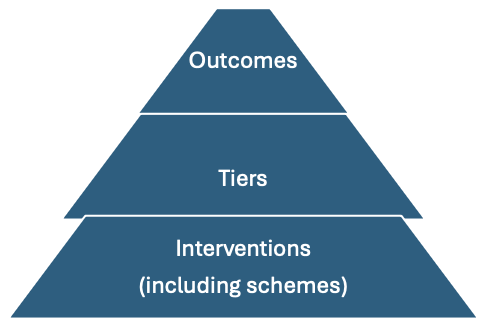
As outlined in this Rural Support Plan, multiple interventions fall under four tiers of support. Together these interventions intend to influence change across the five strategic outcomes and sub-outcomes.
As a point of definition, ‘intervention’ is used as a catch-all term to refer to ongoing projects, support schemes (such as LFASS), policies, and requirements (such as Whole Farm Plan) that sit under the four Tiers.
The structure of the Rural Support Plan’s monitoring and evaluation will reflect this structure of support. It will show how the interventions under each Tier will achieve change against the strategic outcomes.
Summary of Intended Monitoring and Evaluation Reports
2026-2031: End of Plan Period reporting
- Rural Support Plan impact monitoring: baseline set for 2025 with progress reports every 5 years in line with RSP periods
This is the mechanism for monitoring the impact of the Rural Support Plan required under the ARC Act. Indicator updates may be made between cycles based on data availability and strategic relevance.
- Rural Support Plan 2026-2030 Ex-Post Evaluations
This will include an overarching evaluation of the delivery of the plan as a whole and tier level monitoring and evaluation reports which will include relevant schemes/CPD. They will assess implementation and effectiveness, and identify impact, cost effectiveness, strengths, weaknesses, and areas for improvement. This reflects the evaluation requirements within the Act in regard to –
(i) the effectiveness of the strategic priorities
(ii) whether any specific outcomes have been achieved
(iii) progress made in respect of the objectives
These evaluations will be published as soon as practicable after this Rural Support Plan period ends.
Reporting during the plan period:
- Tier and intervention implementation monitoring, including payment and delivery data
Monitoring of payment information and other management information will follow focus on scheme/tier-specific measures. New measures will be integrated into established reporting mechanisms.
This is the mechanism for monitoring legislative requirements such as the:
(a) the total amount of support provided during the plan period (including monetary value for non-financial support)
(b) the amount of support provided to each support scheme etc
(c) a description of how non-financial support has been provided
(d) the distribution of support (including geographically and by sector)
Ad-hoc targeted / responsive reporting:
- Additional reporting will be provided over the plan period depending on prioritisation / need – this could include, for example, early evaluations of new schemes, significant changes, or evaluation requirements for government decision making. This will meet the requirement for proportional evaluation of schemes under the ARC Act.
- A prioritisation tool has been developed to assist with decision making for this type of targeted or responsive reporting
Approach to Monitoring
Monitoring of the Rural Support Plan will follow the reporting structure summarised above. It will track implementation of the plan and assess its contribution to the strategic outcomes over the plan period.
Monitoring of payment and delivery data will offer insights into how effectively interventions and schemes have been implemented. Delivery data will also inform evaluation processes and help assess the overall effectiveness of support provided.
Impact indicators for individual schemes and tiers will be developed to provide a detailed picture of whether they are achieving what they set out to do, and their contribution to the strategic outcomes and sub-outcomes. These indicators will form part of the Tier and Scheme ex-post monitoring and evaluation reports.
At a plan level, impact indicators are being selected to assess progress of the RSP and reflect the broader trends anticipated from agricultural reform in Scotland. These will be set out in the Impact Monitoring Framework which will be published in 2026. This will be the basis for baselining and future monitoring activities. These impact indicators will provide specific, objective measures to track progress against our strategic outcomes and sub-outcomes. They help answer the core question: are we achieving the results we expect?
Where appropriate, milestones or targets are defined for outcomes and sub-outcomes to indicate the level of achievement expected at a given point in time. These are aligned to where statutory targets have been set under existing legislation, such as the Climate Change Act. However, most indicators are assessed against an agreed trend—increasing, stable, or declining—rather than fixed targets. This is reflective of the complex relationships that exist between outcomes in our framework. Not all outcomes are always mutually beneficial. There are those where progress in one area may have detrimental impacts or present additional challenges in other areas.
By using trends rather than targets, we are able to monitor this balance and aim to keep all outcomes moving in the right direction. In developing the framework, however, we will also be considerate of how to ensure that this approach does not compromise transparency, accountability and learning opportunities. We are also working with academics to better understand these dynamics and potential challenges and opportunities within the outcomes framework.
The indicators selected will form a suite of measures that collectively represent aspects of Scotland’s agricultural sector. They should be interpreted together and in context, as no single indicator provides a complete picture. Additional context and links to other monitoring frameworks will be highlighted throughout the monitoring framework.
Indicator development
The indicators for our sub-outcomes were developed collaboratively with input from external stakeholders with agricultural, environmental and climate interests. This collaborative approach has been key to informing the identification and agreement of indicators to be included in the framework.
It is important to note that many desired changes, such as biodiversity improvements and reductions in greenhouse gas emissions from new technologies, will occur over longer timescales than the five-year RSP period. As such, the outcomes monitoring framework will be supplemented by the usual output monitoring undertaken by schemes, which will be used as a means of tracking the delivery of the programme, and will be utilised as part of the ex-post evaluation process.
Establishing a baseline
Understanding progress made through the RSP is contingent on establishing a baseline for future comparison. An initial baseline report for 2025 data will form the basis against which to measure progress over the plan period. A progress report will be published using 2030 data.
Establishing a robust baseline is dependent on the availability of good quality data.
Approach to Evaluation
Evaluation will follow a similar structure to monitoring, with the intention to evaluate the impact of the Rural Support Plan as a whole, as well as reporting on the relevant schemes which will be grouped by Tier.
As outlined, targeted earlier evaluation of individual schemes will take place as required. This will ensure that the legislative requirements for monitoring and evaluation of schemes are met, whilst also ensuring value for money by prioritising those that require the greatest evidence and learning for ongoing development and decision making.
There are three main types of evaluation: process evaluations (how an intervention/programme was delivered); impact evaluations (how and why did an impact occur or what difference was made); and value for money evaluations (is it the best use of resources). An evaluation strategy is in development outlining, in more detail, how these different types of evaluation will be incorporated into the Rural Support Plan monitoring and evaluation work.
Evaluations will consider:
- Whether the intervention was delivered as intended, to the people it intended to reach
- The experiences of those involved
- Whether, and how, the intervention contributed to any change in outcome indicators
- What lessons can be learned, or improvements made, for the future
- Whether the intervention delivered value for money
Alignment with wider Scottish Government strategies and policy
We are aiming for an integrated approach to monitoring the Rural Support Plan. To support this, the outcomes framework is designed to align with the aims and outcomes of other key Scottish Government strategies. Aligning outcomes ensures consistency across policies, avoids duplication, and helps deliver more coherent and effective outcomes for rural communities and the environment. For example, linking rural support measures with climate and biodiversity strategies helps ensure that actions to improve farm resilience also contribute to reducing emissions and enhancing nature.
Figure 1 below illustrates how objectives and aims in other key Scottish Government documents connect with our five strategic outcomes, and where we will seek alignment in our monitoring approach.
Please note: this mapping exercise focuses on policy outcomes rather than specific targets, as not all plans currently include monitoring arrangements. Where monitoring and evaluation plans do exist, and where specific indicators have been identified for those plans, these will be included in the upcoming Monitoring Framework Report, to be published in early 2026. Furthermore, this does not include the contribution/alignment of CLLD and SRN.
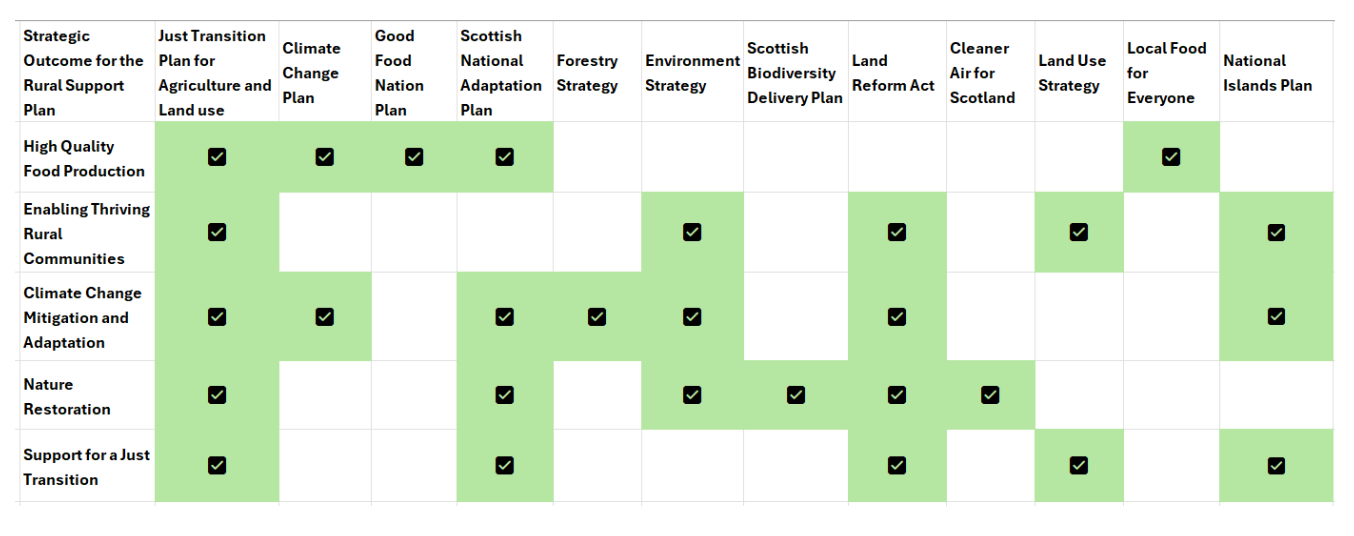
The strategic outcomes of the Rural Support Plan 2026-2031 are aligned with the aims and outcomes of other key Scottish Government strategies.
High Quality Food Production is aligned with the Just Transition Plan for Agriculture and Land Use, Climate Change Plan, Good Food Nation Plan, Scottish Natural Adaption Plan and Local Food for Everyone.
Enabling Rural Communities to Thrive is aligned with the Just Transition Plan for Agriculture and Land Use, Environment Strategy, Land Reform Act, Land Use Strategy and National Islands Plan.
Climate Change Mitigation and Adaption is aligned with Just Transition Plan for Agriculture and Land Use, Climate Change Plan, Scottish Natural Adaption Plan, Forestry Strategy, Environment Strategy, Land Reform Act and National Islands Plan.
Nature Restoration is aligned with Just Transition Plan for Agriculture and Land Use, Scottish Natural Adaption Plan, Environment Strategy, Scottish Biodiversity Delivery Plan, Land Reform Act and Cleaner Air for Scotland.
Support for a Just Transition is aligned with Just Transition Plan for Agriculture and Land Use, Scottish Natural Adaption Plan, Land Reform Act, Land Use Strategy and National Islands Plan.
The RSP Strategic Outcomes also align with the following UN Sustainable Development Goals:
- 2 End hunger, achieve food security and improved nutrition and promote sustainable agriculture
- 8 Promote sustained, inclusive, and sustainable economic growth, full and productive employment, and decent work for all
- 13 Take urgent action to combat climate change and its impacts
- 15 Protect, restore, and promote sustainable use of terrestrial ecosystems, sustainably manage forests, combat desertification, and halt and reverse land degradation and halt biodiversity loss
Contact
Email: CAP.SRDP.Policy@gov.scot