
Review of Abortion Law in Scotland Expert Group: report
A report prepared by an Expert Group commissioned by the Scottish Government to review the law on abortion in Scotland.
Annex A
The Expert Group’s Approach
The Expert Group agreed to structure its review around three key areas of Scotland’s current abortion law: gestational limits and grounds, pathways to abortion care, and offences. This ensured a thorough review of the legal provisions that impact abortion services within Scotland. Each of these topics encompassed a number of related sub-topics:
Gestational Limits and Grounds
- Gestational limits for abortions currently under ‘Ground C/D’
- Gestational limits for other abortions
- Grounds for abortions below a gestational limit
- Grounds for abortions permitted after a gestational limit
Pathways
- Who can provide abortions
- Where can abortions be provided
- Regulation of abortion providers
- Conscientious Objection
- Data and Reporting
- Counselling
- Waiting Periods
Offences
- Offences for a patient (including Concealment of Birth legislation)
- Offences for a provider (including unregulated providers and other third parties)
- Coercion and Forced Abortion
The governance structure that supported the review process - depicted in the diagram below at figure 1 – enabled coordination between an Expert Group, an Advisory Group of reproductive rights, women’s and equalities organisations, and a wide body of stakeholder organisations who were asked to provide written submissions on all aspects of the review. The Advisory Group, as noted in the diagram, was represented on the Expert Group. Its purpose was to ensure that a concern for universal reproductive rights and gender equality was central to all stages of the Group's work, together with ensuring that the lived experience of pregnancy and abortion were represented throughout the process.
The further body of wider stakeholder organisations who have contributed significantly to the review included Pro-Life and faith-based groups, campaign and advocacy groups, abortion and other service providers, academics, women’s organisations, medical bodies, disability rights organisations and a range of other organisations that had registered interest in particular topics.
For each of the topics, the Group began by reviewing the current law in Scotland. This included examining how the law operates in practice and the extent to which it aligns with the Group’s agreed overarching principles, which are set out on page 26-27 of this report. The Group assessed the strengths and limitations of the current legal framework in relation to these principles and determined for each topic, whether the existing law should remain in place or whether consideration of proposals for reform should be recommended.
The Group then considered stakeholder input. Around 50 organisations were contacted in advance of each topic and invited to submit written evidence. The Group reviewed the perspectives put forward, and the quality and relevance of the supporting evidence. Alongside the wide stakeholder consultation carried out by the Group, the Advisory Group of reproductive rights, women's and equalities organisations provided reproductive rights perspectives, equalities analysis and lived experience input. As noted, a representative of the Advisory Group sat directly on the Expert Group, ensuring that this input was integrated into discussions throughout the process. In addition, the Chair met a number of Pro-Life organisations to listen to their views and to discuss any additional concerns they wished to raise. Whilst the terms of the review precluded the removal or restriction of rights to access abortions, these groups have provided useful insights, which have assisted the Group by identifying specific points of concern, which were carefully discussed.
The Group also undertook a comparative review of international approaches to abortion law in order to identify instances of best practice. In line with its terms of reference, it focused particularly on jurisdictions that had recently reformed or reviewed their abortion laws to treat abortion as a healthcare issue, however it also considered a number of other jurisdictions suggested by stakeholders. These international models were assessed both in terms of how they function in practice and how well they reflect the principles adopted by the Group, and experts from relevant countries attended Group meetings to provide the Group with an understanding of how reforms may work in practice.
To bring together the full breadth of material submitted, the Group considered relevant additional evidence brought by the members of the Group. Using this evidence base, the Group then went on to engage in detailed discussion of potential models for legal reform. These discussions were iterative, utilising the expertise of the Group alongside the evidence base. Proposals were tested against the Group’s overarching principles, considered in light of stakeholder and expert input, and examined for their practicality, coherence, and alignment with both the clinical situation in Scotland and international best practice. Where proposals raised legal, clinical, or practical complexities, further discussion and evidence-gathering was undertaken before reaching any recommendations.
This process was repeated for each of the three core topics and their associated sub-topics, ensuring a consistent and robust approach throughout. Every element of the Group’s work has been conducted with a focus on evidence-based decision-making. The Group’s methodology reflects a comprehensive approach to the complexities of this review, which are acknowledged by the Group. The process enabled careful and consistent exploration of the issues covered by this review, close consideration of stakeholder views, and development of recommendations that are grounded in evidence and responsive to the needs of women and pregnant people in Scotland.
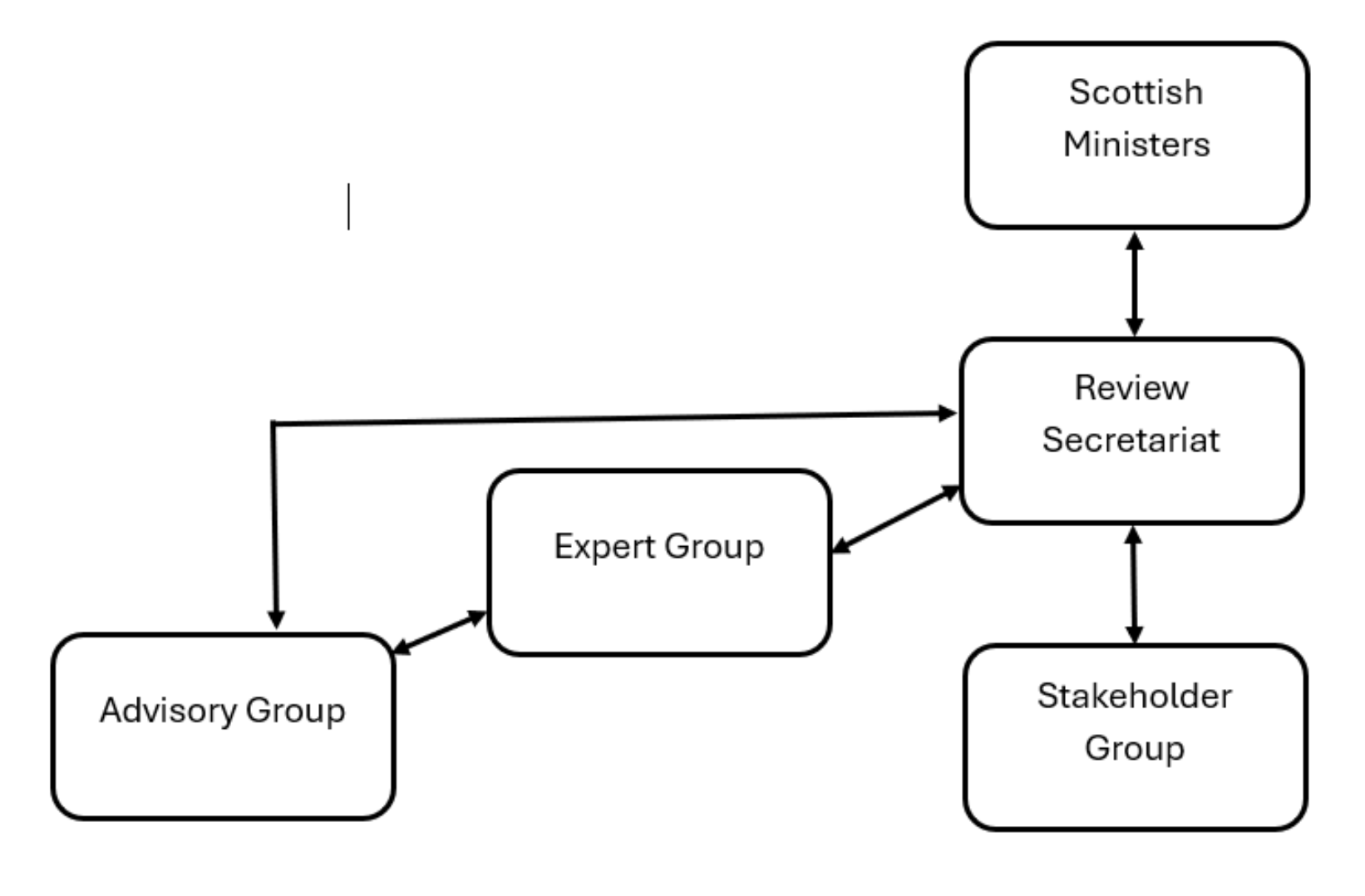
Scottish Ministers commissioned the review and will consider report findings before consulting on proposals for reform.
The Review Secretariat is made up of Scottish Government Officials. The Review Secretariat liaises between the Expert Group, Advisory Group, Stakeholder Group and Scottish Ministers.
The Expert Group is chaired by Professor anna Glasier, the Scottish Government’s Women’s Health Champion. The Expert Group’s core membership is academic, clinical and legal experts.
The Advisory Group is made up of women’s and reproductive rights organisations. The Advisory Group advises the Expert Group on patient perspectives and lived experience. One representative of the Advisory Group sits on the Expert Group.
The Stakeholder Group is made up of all other stakeholders who provided written or verbal submissions to the Expert Group.
Contact
Email: abortionteam@gov.scot