
Research into protests and vigils that take place outside clinics and hospitals offering abortion care
Research into protests and vigils that take place outside healthcare settings providing abortion care in Scotland.
Chapter five: NHS staff and patient research
5.1. Introduction
To understand the prevalence and frequency of vigils and protests as well as the impacts for staff delivering care and those who receive care, the research sought to engage with both NHS staff and patients. This section outlines the findings from the research completed with NHS staff. We were not successful in recruiting patients to participate in the research.
5.2. Methodology
Five primary NHS research sites, across three NHS boards, were identified by the Scottish Government as both providing greater volumes of abortion care and experiencing more frequent protests and vigil activity. These sites were the Aberdeen Maternity Hospital, the Family Planning Centre (Sandyford Clinic), the Queen Elizabeth University Hospital, the Chalmers Clinic and the Princess Royal Maternity Unit, Royal Infirmary Glasgow.
From these five primary sites the research sought to recruit NHS staff to participate in interviews or focus groups and a survey designed to capture the observed prevalence of vigils/protests. The research also sought to recruit patients to take part in interviews.
In addition, all Health Boards were asked to complete a survey in relation to their experience of vigils/protests.
Rocket Science attempted to gain access to appointment data from the primary sites, but this was not possible due to staffing constraints.
Ethical approval
Ethical approval was received from the Scottish Government on 17 November 2022 and from the NHS Research Ethics Committee on 10 March 2023. Following this, Local Health Board research and development (R&D) approval was sought and received for all five of the primary sites where this was required.
In order to increase patient engagement, an amendment to the methodology was submitted to the NHS Research Ethics Committee on 23 January 2024. The methodology underwent two iterations following feedback from the ethics sub- committee and was approved on 13 May 2024. Approval to proceed by the NHS Lothian and NHS Greater Glasgow and Clyde research and development (R&D) teams was received on 22 May and 7 June respectively. Despite receiving the necessary ethical approvals, due to resource constraints within the NHS teams it was not possible to implement the methodology.
Research with NHS staff
The following instruments were used to gather data from NHS staff.
- Electronic surveys
Two electronic surveys were developed. The first, a short survey (6 questions), was designed to capture the observed prevalence, scale and nature of vigils and protests which occur outside of services offering abortion care. This survey was sent to service leads at the five primary sites in 2023, with information about the survey and with the request to distribute the survey to the relevant staff at their sites. A reminder was sent out to encourage further responses. In total there were just 5 responses on the prevalence survey received across two sites. Due to the low response rate the findings from this survey have not been included within this report.
A second survey was designed to capture the NHS staff’s experience of witnessing protests and vigils outside their place of work and any impacts for them and/or their delivery of care. 128 NHS staff completed a survey about their experience of protests or vigils. Responses were received from staff at eight of the fourteen NHS Health Boards.
- Interviews and focus groups
Semi-structured discussion guides were developed to collect data through one-to- one interviews or focus groups. 21 staff, from four of the five primary sites, participated in focus groups. These were conducted either in-person or via MS Teams depending upon the preference of the service. Where the local research ethics committee has allowed, focus groups were transcribed. In instances where we did not have permission for transcripts, detailed notes were maintained.
Research with patients
Following the Scottish Government Social Research Ethics and the NHS Research Ethics Committee guidance, patient recruitment was initially via signposting by NHS staff and the provision of information sheets which were included in care packs at the five primary research sites.
The methodology to recruit patients was adapted following a lack of participation. Surveys were to be distributed via a one-time text message sent via the abortion services appointment messaging system, and a QR code with a link to the survey was added to the participant information leaflets which led to the survey. Recruitment for interviews was intended via the survey and information posters and leaflets, containing contact details for the research team. Despite the adaptations to the methodology, no patients were recruited to participate in the study.
5.3. Results
This section presents the results of the staff survey responses. As noted above, the findings in this section relate to the survey designed to capture the NHS staff’s experience of witnessing protests and vigils and impacts, rather than the prevalence survey. Findings from the NHS staff short survey (prevalence survey) have not been included in this report due to the low response rate.
Experiences of protest and vigils outside of healthcare facilities
The NHS staff survey received 128 responses across eight of the fourteen Health Boards. The highest level of participation was from NHS Greater Glasgow and Clyde with 97 responses, followed by 16 responses in NHS Grampian. This high number of responses is likely due to the number of sites in the Health Board, as well as the number of primary research sites in the area.
As shown in Figure 5 below, 42% of the 128 NHS staff who completed the survey have been working at their clinic for more than ten years and 13% have worked at their site for five to ten years. This also reflected the length of experience in focus group participants, with the majority of participants having worked in the services for five or more years. Across all sites, 64% of staff had witnessed a protest or vigil in their time at the site (Figure 6).

Base: All respondents (n=128), Source: Rocket Science NHS staff online survey

Base: All respondents (n=128), Source: Rocket Science NHS staff online survey
Differences, however, could be found based on the location of the site. Respondents from NHS Ayrshire and Arran, NHS Borders, NHS Highland, NHS Orkney and NHS Shetland reported not having witnessed any protests or vigils. For NHS Grampian 6% of respondents, for NHS Forth Valley 50% of respondents and for NHS Greater Glasgow and Clyde 79% of respondents reported having witnessed protests or vigils.
The perception of the prevalence of protests or vigils differed substantially among the staff who had witnessed protests or vigils. Of the 82 staff who had witnessed a protest or vigil, 27% believed they took place once or twice a year. A further 16% were aware of the protests during Lent, explaining that in that period, protests or vigils were taking place daily or several times each week. Focus group participants working in services which experienced frequent and regular vigils or protests reported being aware of these, however many also reported that activity often started and finished whilst staff were on shift and so they did not often witness these directly.
13% of staff having witnessed protests or vigils believed they were taking place once a quarter, 10% believed it was 1 or 2 times a month, 7% believed it was 1 or 2 times a week and one person believed it was daily. 26% of staff were unsure how often protests and vigils took place but mentioned that they did not identify a pattern to the protests and vigils. During focus groups some sites reported not having experienced a protest or vigil (to the participants’ knowledge) in the last 12 months.
51% of staff members who had witnessed protests and vigils stated that staff were not aware of the activity prior to them taking place, 30% did not know if staff were aware and 18% knew that protests or vigils were going to occur. If staff are made aware, this is usually through an email notification from the management team within the hospital or clinic. There is also some general awareness among the staff about protests occurring during specific times of the year, such as Lent.
The nature of protests and vigils
When asked about the proximity of vigils or protests to the healthcare facility, 44% of the 82 staff who had witnessed a vigil or protest reported this to have taken place, in their judgement, within 10 metres of the site entrance. 15% indicated that the protests or vigils took place 10-50 metres from the entrance, 15% believed the protests or vigils took place 50-150 metres from the site or that it varied in proximity to the site. 11% of staff witnessed them more than 150 metres away from the site entrance. During focus groups a number of staff identified protest/vigil activity within the vicinity of the hospital; however, this was not always present outside the service providing terminations.
As seen in Figure 7, of the 82 staff members who reported having witnessed protests or vigils, the most commonly observed activities undertaken by protesters included holding up placards and posters, singing or chanting and silent prayer. The most commonly named ‘other’ activities included using a megaphone or loudspeaker to read out bible quotes or to pray aloud.
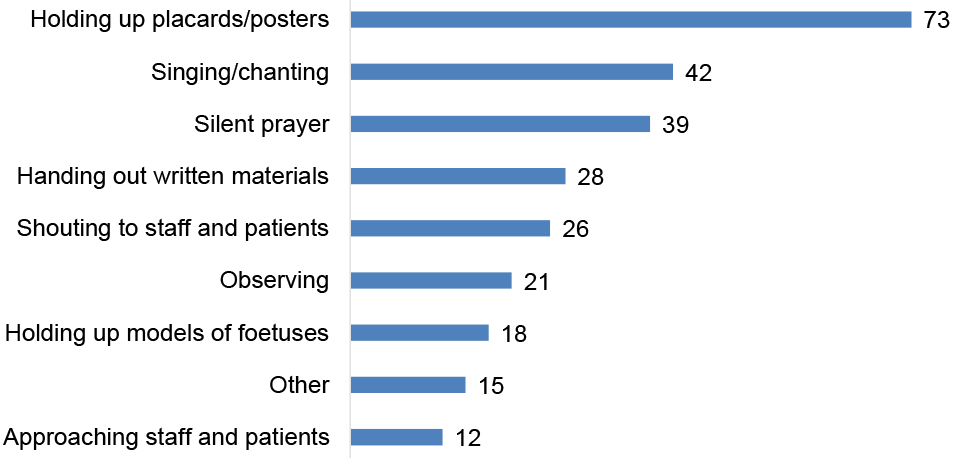
Base: Respondents who had witnessed a protest or vigil (n=82), Source: Rocket Science NHS staff online survey
The survey findings also reflected the experience of staff participating in the focus groups, with most identifying the use of signs and placards, distribution of leaflets and the use of what participants described as “upsetting imagery”. Whilst participants at one site described the activity as “not loud”, another identified a more ‘interventionist’ approach to protests/vigils, including making telephone calls to self-referral lines and entering the site and trying to engage reception staff. It was noted in this particular site that police had intervened due to concerns about staff and patient safety.
Impact of protests and vigils
This section summarises the perceived impact of protests and vigils on NHS staff and patients attending the sites for abortion care and other services. Impacts on NHS staff
As seen in Figure 8, of the 82 staff who had witnessed a protest or vigil, 36% reported no impact on their ability to fulfil their role. However, 63% reported that the protests and vigils have had a significant negative or negative impact on their work.

Base: Respondents who had witnessed a protest or vigil (n=82), Source: Rocket Science NHS staff online survey
Respondents from Health Boards which reported the most protest/vigil activity were more likely to report negative impacts upon their ability to deliver care.
Staff who had witnessed a protest/vigil were asked about the impact this had on them. Of the 64 responses received to this question, 52% reported the main impact on themselves as an increased concern about patients accessing the services. In addition:
- 20% reported feeling frustrated, annoyed or irritated
- 17% reported feeling angry
- 15% reported a negative atmosphere on the site
- 14% reported feeling anxious
- 14% felt afraid of being targeted by protestors
- 9% felt uncomfortable
- 6% changed the way they accessed work because of protests and vigils
In the free-text boxes within the survey, staff recorded their views on the impact of protests and vigils upon themselves and on patients. Some examples of staff views obtained for the survey are provided below.
“It is difficult to provide a private, dignified service to patients when there are protests outside the entrance they use.”
“They [patients] are making difficult healthcare decisions and need to be free from judgement, intimidation and abuse.”
“I find the protestors intimidating and feel concern for the patients who are attending for help with their mental health.”
“Patients are sometimes upset, angry or distressed when they come for their appointments and need support with this, leaving less time to deal with [the] reason for their appointment.”
“I am able to fulfil my role in counselling and supporting patients however the protests can make consenting individuals more time consuming as they become cautious of what other people think rather than focusing on what is best for themselves.”
Whilst during focus groups staff highlighted their ability to continue to provide person-centred care, it was acknowledged that some of the staff felt angry on days when protests/vigils took place. For some it was felt that such activity increased their resolve to provide abortion care, however there was also a concern that they would be identified, harassed or threatened as a result of their work. As a result, some staff identified a number of changes they made to their behaviour including using different entrances and exits.
Participants also identified resource implications of the activity including staff making additional telephone calls to patients to warn them of protests/vigils and services having to create ‘action plans’ which provide guidance on how to escalate concerns and when to involve the police.
Impacts on patients
Of the 128 staff who responded to the survey, 35% reported an awareness of impacts on patients’ behaviour on days that protests and vigils took place at their sites. As shown in Figure 9, the biggest perceived impact among the 44 staff who reported an awareness of impact related to a perception that patients were missing appointments (45%) and/or rearranging appointments (39%).
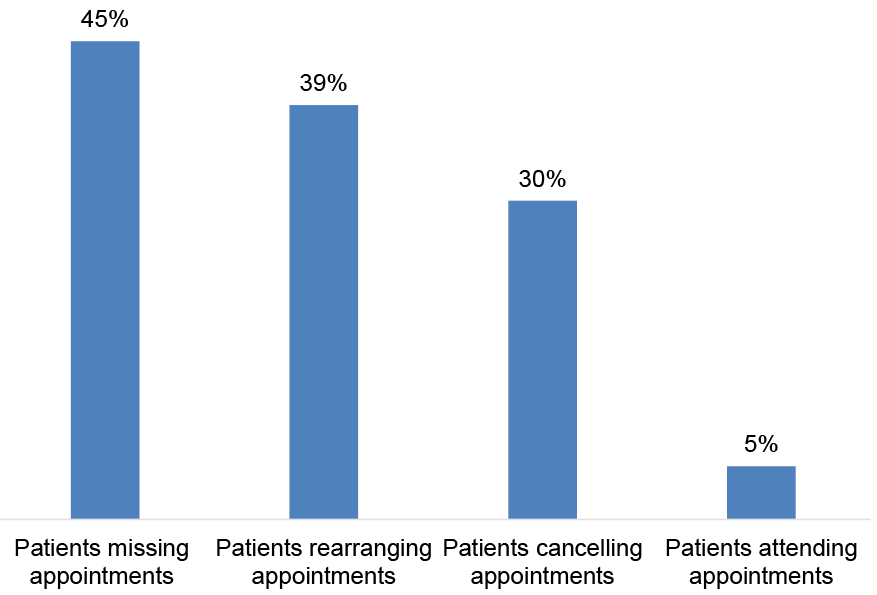
Base: Respondents who reported an awareness of impacts of protests or vigils (n=44), Source: Rocket Science NHS staff online survey
Survey respondents were asked their perceptions of broader impacts of vigil and protest activity, including any upon adjacent or co-located services. Of the 128 staff who responded to the survey, 30% believed this activity had wider impacts.
Staff who believed this activity had wider impacts were asked to describe these in more detail. The free text responses were categorised as follows (some responses mentioned more than one impact):
- 17 referenced a perceived negative impact on patients accessing other services, such as contraception, gender service or high-risk pregnancy appointments.
- 15 referenced the presence of vigil/protest activity making a difficult situation worse for patients
- 11 referenced a risk of increased trauma for patients
- 8 referenced patients feeling a fear of being stigmatised
- 6 raised concerns around the potential loss of anonymity through attendance at services being videoed and/or photographed and posted online
- 6 referenced increased anxiety for patients
Free text responses within the survey are provided below.
“Some patients will avoid the clinic when they hear there is a protest or walk away when they see them. This means they miss their appointment which could be urgent, and it is difficult to get through to switchboard to re-arrange.”
“Women and families are upset enough at having to receive/seek abortion care without seeing these protests. They feel unfairly judged and it further adds to their distress. Some patients described it as being traumatised.”
“I work with families who have suspected or diagnosed foetal abnormalities. This is a very distressing time for them, and some do choose to have a termination of pregnancy. These babies are very much wanted and often women say to me they would never have chosen this for a healthy baby. They experience a wide range of emotions including guilt, emotional distress and doubt.”
“[The protests and vigils] impact their thoughts and feelings regarding the procedure, although in my experience it hasn’t changed someone’s decision to follow through with the procedure”
Of the 82 staff who had witnessed a protest or vigil, the majority (62%) reported that patients had spoken to staff about these (Figure 10). The topics patients wanted to discuss included finding the protests intimidating (14 respondents), feeling angry (10 respondents), finding protests inappropriate (9 respondents), feeling guilty about their choice (8 respondents), and concerns about their own and staff safety (7 respondents).
Three staff members responding to the survey reported patients not understanding why people would protest against a woman’s choice and one staff member explained that patients were upset about the counter protest and the attention the abortion protests and vigils got because of this, rather than the silent vigils prior to that.
48% of those who had witnessed a protest or vigil also believed that the protests had wider impacts on patients accessing the clinic for any type of service (Figure 11).

Base: Respondents who have witnessed a protest/vigil (n=82), Source: Rocket Science NHS staff online survey]

Base: Respondents who have witnessed a protest/vigil (n=82), Source: Rocket Science NHS staff online survey]
Again, these findings were consistent with the experience of staff participating in focus groups. Each of the four sites reported that patients were “upset” as a result of witnessing the protest/vigil activity, with one site particularly emphasising that the impact on patients was not correlated with the volume or nature of the activity; “it doesn’t need to be loud or aggressive for it to be upsetting”. Focus group participants similarly reported that, in their experience, although patients did not change their course of treatment, witnessing protests/vigils could increase doubts about the procedure, even for medically necessary terminations. As a result of this, staff reported that distress could occur, and that the patient felt a greater need to justify their choices in care.
“They felt that they had to justify why they were getting a termination. That they have reasons why they’re doing it but that’s their reasons that they didn’t need to share that with us.” – Staff focus group
Two sites also identified that patients were known to make enquiries about protests/vigil activity when making an appointment and expressed concerns about being identified or put on social media as a result of attending the service. A number of participants also identified impacts for patients attending adjacent or proximate services and reported being aware of anger or upset caused by protest/vigil activity for those not attending for abortion care. One participant highlighted the potential traumatic impacts for people who had previously accessed abortion care and were now witness to such activities when attending healthcare for other needs or just passing as members of the public.
Of the 53 staff who reported there was an impact of vigils/protests upon their ability to fulfil their role, the main concern was that patients would stop attending services for follow-up appointments or other services at the site (18 respondents). Staff mentioned a range of services that this may impact upon, including contraception, gender services, counselling support, high risk pregnancy services and any services related to future pregnancies.
Other long-term impacts mentioned by the 53 staff included:
- Negative impact on staff morale (15 respondents)
- Long-term trauma/PTSD for patients (15 respondents)
- Patients might question their choices/be influenced to make a choice that they do not want to make (8 respondents)
- Concern about their pictures/videos being uploaded by protesters (2 respondents)
- Negative reputation of the site (1 respondent)
Five members of staff mentioned that they don’t think there is a negative long-term impact or that they are not sure. For those who mentioned that they do not think there is a long-term negative impact, they explained this was due to limited numbers of protests and vigils, as well as the site managing protests and vigils well, to reduce the impact on patients.
Free text responses within the survey are provided below.
“I believe that the protests and vigils have a significant detrimental impact on both patient attendance and staff morale, impacting on service ability to retain staff, on staff ability to provide high quality care, and costing the NHS significant resources in relation to missed appointments.” - Staff survey response
“As long as they are allowed, there will always be additional anxieties for some people attending who are worried about encountering them, therefore making it harder for them to access services.” - Staff survey response
“Yes, as the clinic now has the reputation of ‘the one with the protesters outside’.” - Staff survey response
Both survey respondents and focus group participants mentioned the media and social media as a catalyst for the impact on patients. Staff told us that media and social media attention has led to an increase in enquiries of whether protests will take place on the day of their appointment and heightened anxiety around the potential of protests and vigils taking place. During focus groups in two sites, staff reported that social media has also been used to make threats of violence against the services. Staff were also concerned about the scale of protests taking place in the US and were concerned about the safety implications for staff and clinics because of this. This comes following reports from the US of violent protesters attacking staff and clients on their way into abortion clinics. In the survey, staff mentioned that this concern was also amplified by social media.
“I have had several clients not wish to return for planned appointments for contraception for fear that protestors will be outside again. They [the protestors] did not attend very many times but the impact of them being here at all and the media coverage has given the impression that they are here a lot more frequently.” – Staff survey response
“Clients attending sexual health clinic, there are people videoing it and putting on social media. These clients may not wish anyone to know that they are at the clinic.” – Staff survey response
“The clinic I work in cares for many different people and provides many different services. Clients attending any healthcare appointment are entitled to confidentiality and cannot get this with cameras and protests happening.” – Staff survey response
Staff also told us that patients had expressed concern about protests taking place in the US and were concerned about both safety and privacy implications for themselves. NHS staff told us that social media, and media coverage more broadly, may be impacting on patients, regardless of whether in-person vigil/protest activity is actually experienced.
5.4. Summary
From the survey responses received it is apparent that staff delivering care in abortion or adjacent services, such as other sexual health services, experienced protests and/or vigils outside of their place of work. This would appear to be the case for those working in urban or city-centre services in particular, such as those in the Greater Glasgow and Clyde area, although the limited sample size prevents drawing robust conclusions about this. A number of the staff who have experience of protests and/or vigils report a negative impact upon them personally.
Whilst the research was unable to engage patients, NHS staff are uniquely positioned to provide an insight into the impact of protest/vigil activity for those accessing care. The survey responses date indicates that, in the experience of many staff members, there were a number of negative impacts for patients including increased fear of not being able to receive healthcare confidentially, increased experience of stigma, and reduced attendance at appointments. Those sites which report more regular activity are also more likely to report negative impacts for patients, staff and their ability to provide care.
Contact
Email: abortionteam@gov.scot