
Research into protests and vigils that take place outside clinics and hospitals offering abortion care
Research into protests and vigils that take place outside healthcare settings providing abortion care in Scotland.
Chapter two: Digital and social media content analysis results
2.1. Introduction
Social media and digital content are widely used by organisations to reach new audiences, communicate views and disseminate information about events. This content analysis was undertaken to enable the research team to gather insights into the potential motivations of people who engage in, and/or who organise vigils and protests outside healthcare facilities that provide abortion care.
2.2. Methodology
The content analysis comprised two parts: the quantitative tracking of posts, and the qualitative analysis of the content of the posts. The quantitative analysis comprised the tracking and recording of all social media and online website content related to organisations that were known to be involved in vigils and protests in Scotland. In total, we tracked the digital and social media content of nine organisations which have an active social media presence in Scotland. This included obtaining content from X (formerly Twitter), Facebook, website posts and news articles for six months, between January and June 2023. Retweets were not included as they do not include original content from the organisation. Some of the organisations are national, and some international, therefore posts were carefully screened and only those that mentioned Scotland were included within the analysis. In total, 5545 posts were identified across the six months, and 231 were included within the analysis, excluding reposts and any content not relating specifically to Scotland. Each of the 231 posts were assigned a unique identifier number to ensure that once the abstraction and analysis process began, the original data could still be traced and checked.
After the initial tracking and gathering of data, we began the qualitative analysis process. This involved two concurrent processes: de-contextualisation and re- contextualisation. The de-contextualisation involved dividing the original text or images into units of meaning and assigning thematic codes to these units. At the next stage, we conducted abstraction, or analytic coding, which involved developing a hierarchical structure of codes. We then began the process of re-contextualising the data, examining multiple data sources together, comparing and contrasting to allow the identification of patterns. Codes were then sorted according to their similarities and differences, which allowed them to be abstracted into sub-categories. Once the relationships between the sub-categories became evident, we developed these into categories. The aim throughout this process was to examine what the content could tell us about the motivations of the organisations and individuals who arrange and engage in protests and vigils outside healthcare facilities that provide abortion care in Scotland.
Some of the limitations associated with this approach is that it can be difficult for researchers to ensure that the codes within each layer of the coding hierarchy contain the same level of abstraction. The approach is interpretivist[2] in nature, and belongs within the paradigm of hermeneutics[3] and so, as with all qualitative research, there is no way to conclusively eliminate researcher bias. To reduce and render visible any researcher bias, the team met regularly and engaged in analytic, reflective discussions where each researcher was asked to provide a robust rationale for coding decisions. Discussions evolved until full team agreement was achieved. All discussions were guided by the existing evidence base, which is presented in the separate rapid evidence review (Appendix two). This form of reflective, analytic discussion is often referred to as inter-rater agreement and debate and is a known method for achieving methodological and analytic rigor within qualitative research.
2.3. Results
This section presents the analysis and explores the results. The section begins with a table which summarises the main themes and sub-themes that were identified via the analytic process (Table 1). Each of the themes are then discussed in turn, including a chart which visually displays the main themes identified within the content.
| Theme | Definition and sub-themes |
|---|---|
| Motherhood as a natural, pre- destined state for women | Content built on the belief that motherhood is natural for women and that, by having an abortion, women are disrupting their natural purpose of motherhood:
|
| Contested beliefs about abortion (abortion ‘lies’) | Content which argues there is widespread misconceptions, lies, and deception about the realities of abortion in society:
|
| Supporting women | Content presenting ‘pro-life’ as a form of support for women who feel they have no other choice:
|
| Religious symbolism, unity and belonging | Religious imagery and symbolism:
|
Content theme 1: Motherhood as the natural state for a woman
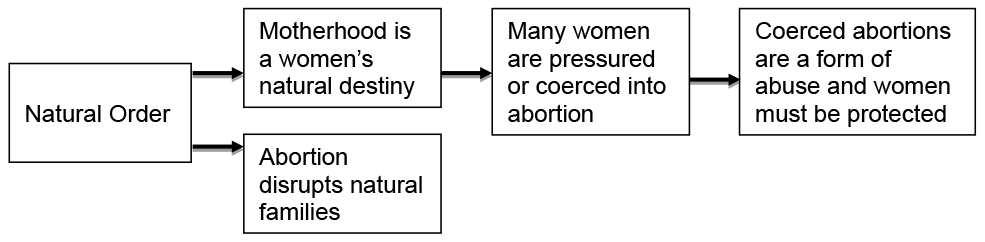
Many of the analysed social media and website posts constructed motherhood as a natural state of being for women, as part of their natural purpose and destiny. In the digital and social media content, the concept of motherhood as pre-destined and natural was linked to the concept that women would only choose to have an abortion if they had no other choice, and if they had been coerced by either social pressure or a lack of information about possible alternatives. This relates to concepts explored by Lowe and Page (2019), whose research proposed that many people who attend protests and vigils outside abortion healthcare facilities are motivated to do so to provide women with a sign that a different decision is possible. This also relates to other existing research, which indicates that some people are motivated to take part in vigils and/or protests because of a desire to protect ‘traditional family’ structures and the role of women as mothers first before all else (Lowe and Page, 2019; De Sordo, Marre and Smietana, 2022).
The themes derived from this element of the digital and social media content analysis are presented in Figure 1 below.
Content theme 2: ‘Abortion lies’ and representations of ‘truth’
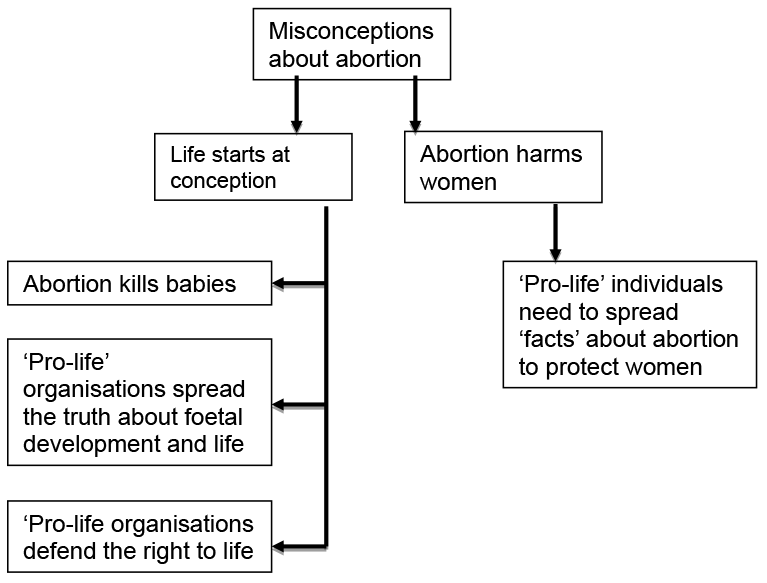
Within social media posts, websites, and promotional materials, several organisations who are involved in organising protests and vigils in Scotland made reference to the notion of ‘truth’, and a desire to dispel ‘abortion lies’. This was found to also relate to the representation of motherhood as a natural, pre-destined state for women, and a motivation to take part in protests or vigils to provide education to women, to raise awareness about the ’truths’ of conception, science and human development. This related to the concept that human life begins at conception, and a motivation to change beliefs about abortion, to recognise abortion as wrong. The themes and sub-themes discussed in this section are visualised in the graphic below.
Content theme 3: Supporting women
A further theme identified in the analysis relates to the representation of ‘pro-life’ organisations as providing support to women and potential parents. The types of activities promoted include prayer vigils and pavement counselling actions as offering support to women in need. This finding aligns with Lowe and Page’s (2022) research, which found that some people who take part in protests or vigils outside abortion healthcare facilities are motivated to do so out of a desire to provide a compassionate presence, support, advice and guidance to women. In the digital and social media content, we noted several examples where vigil organiser groups represented their activities as being an attempt to support women.
The digital and social media content also contained several representations and examples of practical and emotional support that those in attendance at vigils could seek to provide to women as an alternative option to reduce the likelihood of women going through with their abortions. Again, this linked to the concept that women would be less likely to choose to have an abortion if they were made aware of alternative sources of support, and the concept that the presence of vigils can give women ‘a sign’ that a different choice is possible.
A diagram showing this theme, and how it may relate to the motivations of people who take part in vigils is outlined in Figure 3, below.
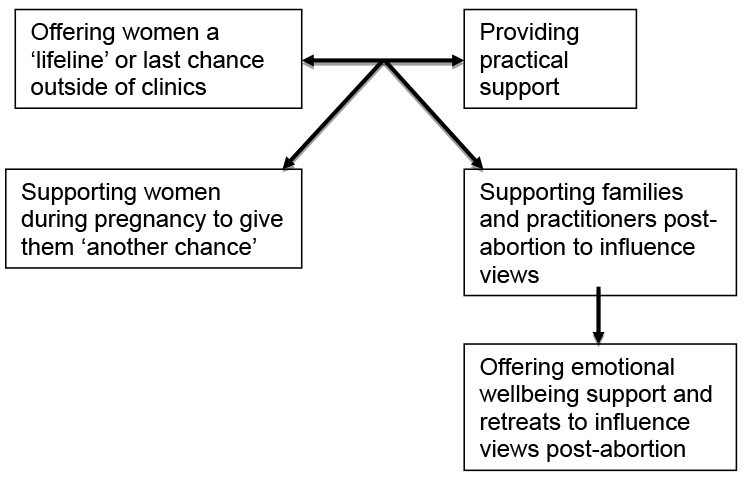
This could suggest that some vigil organisers and/or attendees may be motivated by a desire to provide women with a different choice, and some may see their activities as a means to provide a lifeline immediately before an abortion takes place. The underlying assumption is that some women may be choosing abortion due to personal situations, a lack of support, or because they are facing financial hardship. There were several examples within the digital and social media content where organisations had shared the anonymised stories of women who had been provided with practical, emotional or financial support by the organisations who arrange vigils. There was one key example, which included an infographic about the type of practical support that could be provided by those attending vigils. This included maternity and baby clothing, toys, safety and feeding equipment, cots, and bedding. This represents providing support as being a primary motivation for engaging in vigils outside clinics and hospitals. The accompanying text within this example stated that the organisation’s aim is to ‘support pregnant women that need help’. It also noted that ‘being ‘pro-life’ doesn’t end with birth’. Ronnee Schreiber (2017) argues that by framing ‘pro-life’ activities in this way, the discourse shifts away from religion and conception, toward the concept of supporting women.
The digital and social media content also suggests that providing emotional support to women who are entering clinics and hospitals to access abortion healthcare may also be an expressed motivating factor for those who organise vigils.
Content theme 4: Religious symbolism, unity and belonging
In common with Lowe and Page’s (2019) findings, our content analysis suggests that although ‘pro-life’ organisations do not necessarily imply they are religious organisations per se, their online materials, and the placards that feature in photographs taken at vigils frequently use religious iconography and symbolism. We found that the image of the Virgin Mary and Our Lady of Guadalupe frequently appeared in online content. Lowe and Page (2019) propose that both images are symbols that are used to convey the notion that motherhood is a natural sacrifice that women must make. These symbols are considered to be used to induce guilt in Catholic women, symbolically conveying that abortion is a sin and that sacrificial motherhood is the natural and God-given destiny of a woman (Lowe and Page, 2018).
Our content analysis revealed several examples of religious symbolism that was woven throughout a lot of the organisations’ online content, which suggests that religion may be a motivating factor for some vigil attendees. Often, the imagery was used to convey specific concepts or ideas relating to religion through symbolism. Within the theme of religious symbolism, the researchers identified several sub- themes. These are presented in the graphic below (Bletsas and Beasley, 2012). The use of religious symbolism in the digital content of ‘pro-life’ organisations in Scotland is outlined in Figure 4 below.
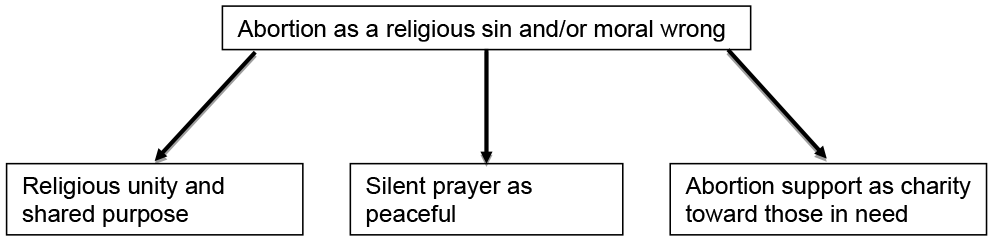
There were several examples in the digital content of the representation of abortion as a moral sin, and a sin against God. This related to an expressed belief that human life begins at the moment of conception, and so abortion ends an unborn life. There were examples that suggest that some vigil attendees may be motivated to engage in prayer for the woman and the unborn child.
Within the digital and social media content, we noted several examples of the concept of religious unity and shared purpose, particularly in content seeking to encourage students to take part in vigils and protests. For example, one video depicted a young person giving a public speech about her experience being involved in the ‘pro-life movement’, while urging others to join in activities such as protests, street campaigns and vigils. The young person expressed that joining in ‘pro-life’ activities would be ‘Standing with God, standing with the truth’. They also claimed that by attending vigils, they were ‘standing with our unborn brothers and sisters’. We note that the term brothers and sisters is sometimes considered to have religious connotations to brotherhood and sisterhood of the premise that humans are children of God (Sandnes, 2022). By citing this connection, the speech could be considered to be seeking to motivate people to take part in vigils/protests or other forms of activism out of their moral and/or religious duty to care for others.
We noted several examples whereby the digital and social media content appears to build upon a foundation of a promised community and collectivism, particularly for young people. We noted several examples of website entries where language and imagery both represented the concept that being pro-actively pro-life, and taking part in activities such as protests, vigils and campaigning more broadly would open up the person to a community and to God. In several examples, the ‘pro-life’ student movement in particular was represented as being young, energetic and determined. It is not clear from the content, however, the impact that this type of messaging may have, and the extent to which unity and belonging may be a motivator for young people to become involved in the protests and vigils that take place outside abortion healthcare facilities in Scotland.
2.4. Discussion
In this section, we bring together the threads of the results and discuss their meaning. The content analysis themes can be summarised into the categories outlined below.
- Motherhood as the natural and pre-destined state for women
- Abortion lies, and the concept of ‘truth’
- Vigils as an offer of support to women
- Religious symbolism, unity and belonging
The results suggest that all of the above themes are interconnected. The thread of narrative that ran through much of the online digital and social media content relates to the concept of motherhood as the pre-destined, ‘natural’ and desired state for women. Within this, abortion was represented to be unnatural insofar as it disrupts this ‘natural state’. The theme of ‘abortion lies’ was linked to the notion that no woman would willingly choose abortion if she was in possession of all the ‘facts’. The analysed content suggests that one of the motivations of those who arrange, and/or who attend vigils and/or protests, may be to provide education about the nature of conception, and to raise awareness about beliefs concerning the beginning of human life.
The analysed content suggests that a further motivation for some vigil attendees is to support women, and to offer women a sign that there are alternative options to abortion. This also relates to a motivation to offer women emotional, practical and/or financial support, due to a belief that women may be choosing to have an abortion only because they feel that they have no other choice, and no other sources of support. This motivation was found to relate to the concept of charity, and of doing good in the service of others. This also related to the concept of a vigil as a way to persuade women not to go through with abortion, thereby preserving life. These representations were found to relate to the concept of providing compassionate support to women, and the concepts align with existing literature on this topic (Lowe and Page, 2019). The authors note, however, that although the intent may be to provide support, many women experience the presence of vigils and protests as distressing. It is not possible to ascertain from the current analysis whether or not vigil organisers or attendees are aware of the potential harms associated with offering this type of presence outside clinics and hospitals where women are accessing abortion healthcare (Lowe and Page, 2022; Sifris, Penovic and Henckels, 2020; Jackson and Valentine, 2017).
Contact
Email: abortionteam@gov.scot