
Re-thinking trust in Scotland: from theory to practice
This report presents a literature review of work on trust in government, and uses this to re-think how Scottish Government could conduct future research on trust in government.
2. Literature review
What is the problem? The evidence we have available shows us that trust in Scottish Government has declined. The 2023 Scottish Social Attitudes Survey (SSAS) shows that 47% of people trusted the Scottish Government to work in Scotland’s best interests. This is the lowest level since the survey began. 35% thought that the Scottish Government was good or very good at listening to people’s views before making decisions, representing a decrease from 51% in 2019.
The Scottish Household Survey (SHS) findings from 2023 offers us some more context as to which government institutions the public express more or less trust towards. People are more likely to express distrust in the Scottish Government (45%) and local government (35%), while least likely to express distrust in education system (15%) and in the police (16%) (see Figure 1, below).
| Institution | Trust it | Distrust it | Don’t know or not sure |
|---|---|---|---|
| The Health System | 78 | 18 | 4 |
| The Police | 73 | 16 | 11 |
| The Education System | 62 | 15 | 23 |
| The Civil Service | 56 | 17 | 27 |
| The Justice System | 56 | 21 | 23 |
| Local Government | 53 | 35 | 12 |
| The Scottish Government | 45 | 45 | 10 |
Source: Scottish Household Survey 2023: trust in public institutions
Finally, trust in the UK Government has consistently been lower than trust in the Scottish Government (see Figure 2 below).
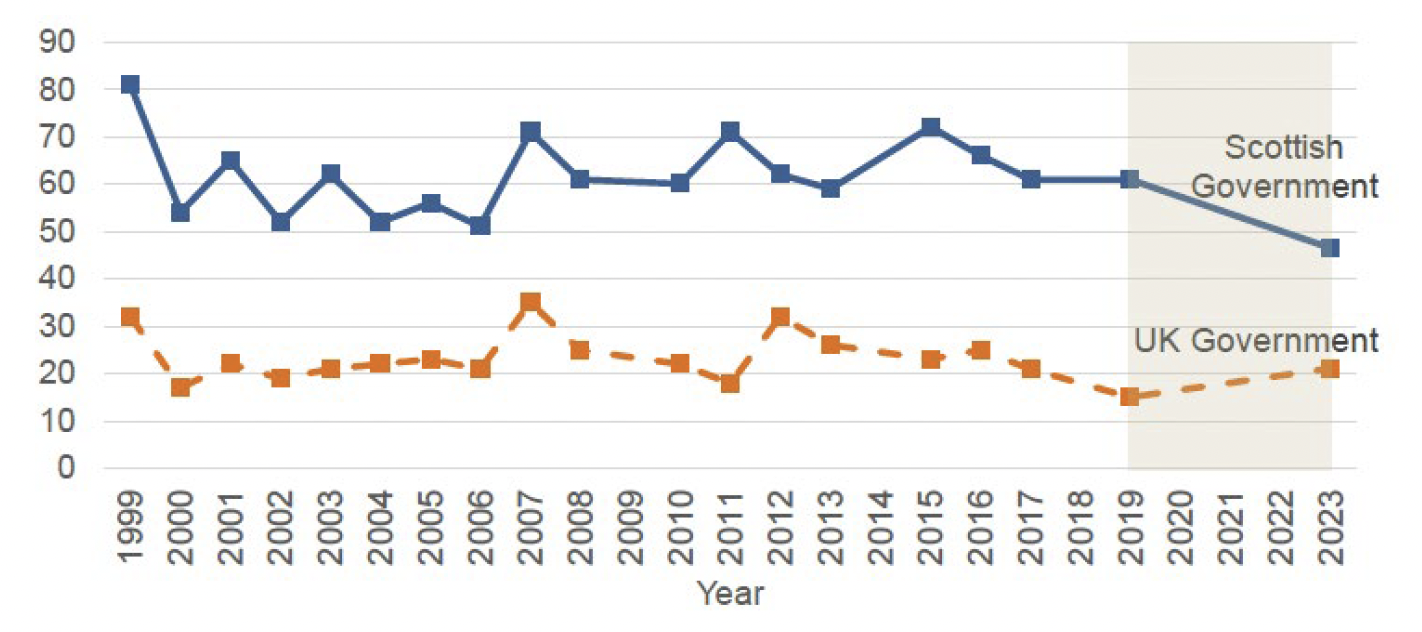
The SSAS 2023 shows that 43% thought that the Scottish Government has the most influence on how Scotland is run, but 61% of people thought that the Scottish Government should have the most influence.
Declines of trust in government are not only found in Scotland but represent a global trend. This is demonstrated in the OECD’s 2024 Drivers of Trust in Public Institutions (OECDa),1 which shows that trust in national governments in most OECD countries has dropped on average two percentage points since 2021.
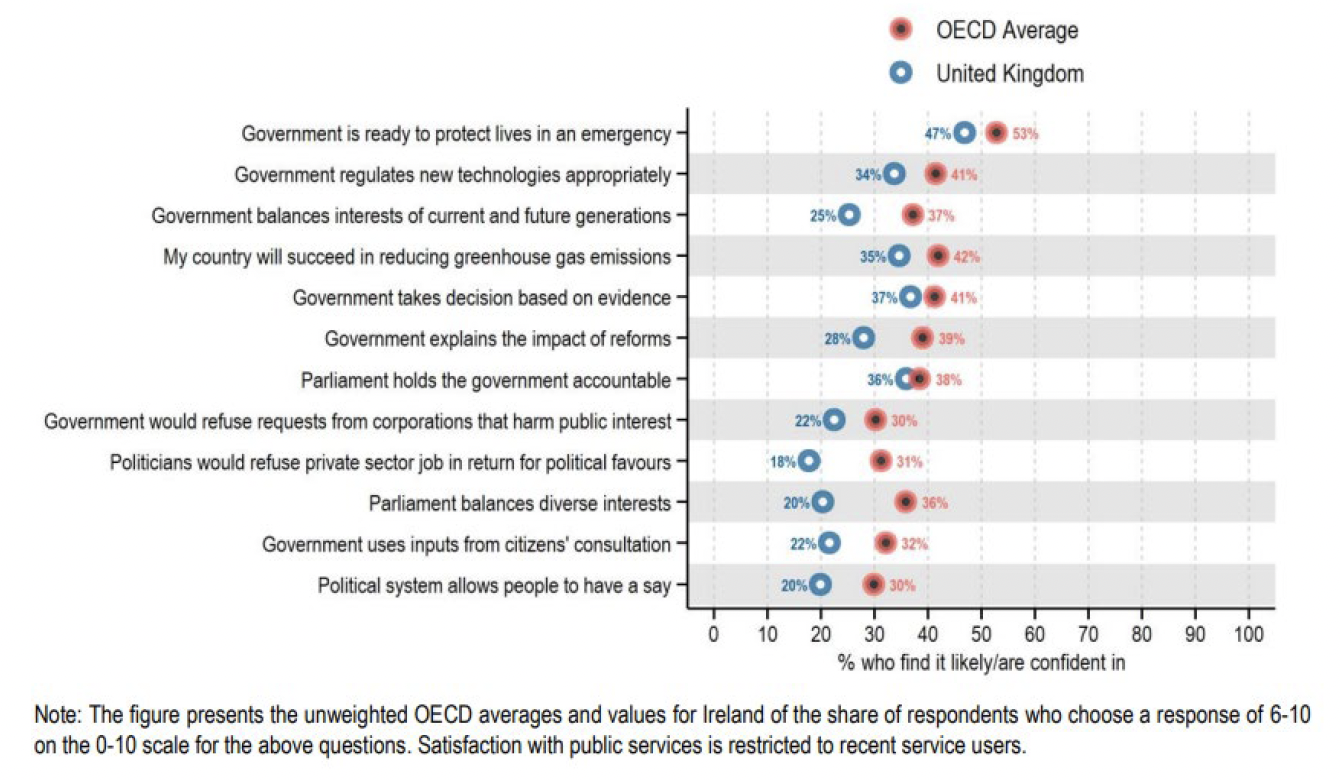
The OECD reports at UK level, so it does not provide Scotland-specific data or insight – this is worth noting given the historic and current differences in levels of public trust in the Scottish Government compared to the UK Government. This data will, however, provide insight on general trends that are useful for understanding what could drive levels of trust in Scotland. It shows that 27% of people in Great Britain reported ‘high or moderately high trust’ in national government.2 This is below the OECD average of 39%. In addition, the survey found that people in Great Britain tend to have lower levels of trust in certain institutions when compared to the OECD average. These institutions include the: police (56%), local government (34%), national government (27%), national parliament (24%), news media (19%), and political parties (12%). In addition, the population of the UK has a lower level of confidence in the UK Government on all measures of decision-making on complex policy issues than the OECD average. What these complex policy issues are and the public’s perceptions of them can be viewed in Figure 3 below.
Looking at the European level, the Eurobarometer finds that the percentage of those saying they trust the European Union has declined from 60 percent in 2004 to 36 percent in 2015, while trust in national governments has declined from 36 percent to 29 percent over the past decade (Foster and Frieden, 2017:512). A recent Eurobarometer Report (2025) shows a growing public distrust towards democratic institutions and processes (49% of respondents), and that 32% of respondents think there is a lack of transparency around “political content promoted through AI”. Another finding from the same report is that 78% of respondents were ‘not very’ or ‘not at all’ familiar with activities where people are directly part of decision-making in the European Union.
This trend is not new. These surveys demonstrate that the evidence we have shows a global trend of declining trust in governments. Debates around (political) trust and a ‘democracy in crisis’ is by no means new, as it can be traced back to the end of post-war period (Carstens, 2023). However, scholarship on political trust has gotten a boost since the Covid-19 pandemic (Carstens, 2023: 2096). But the question to ask here is, if the problem is not new, why is it newly a topic of intense discussion? The topic of trust has recently become widely researched, presenting as a key concern for researchers, politicians and policymakers, some of which the report has already introduced (for example, OECD, Eurobarometer, and SSAS).
Today’s declining trust in governments must be understood as resulting from a combination of local, national, and global contexts and factors. How this context influences trust in government will be explored further in the later section of this report on determinants. The most recent OECD (2024a) report outlines that the context of the Covid-19 pandemic, rising inflation, and war in Europe, has impacted people’s trust in government. These factors are likely to be experienced in the UK, where they also integrate with other local and national factors. A report by the National Centre for Social Research (Curtice, Scholes and Chabdu, 2025) looks specifically at political trust in Britain, and highlights that due to the pandemic, Britain faced a combination of a public health crisis, and inflation which rose to its highest since 1970 in 2022, all while the UK left the EU. In addition to these structural factors, several political events happened between 2019 and 2024 which appear to have impacted public attitudes towards democracy and trust (Renwick, Lauderdale, Russen, 2023). These include the resignation of former Prime Minister Boris Johnson and the resignation of his successor, former Prime Minister Liz Truss (Curtice, Scholes and Chabdu, 2025; Renwick, Lauderdale, Russen, 2023). This was also at a time of increasing levels of disinformation, which can result in citizens’ lack of trust in institutions and official information (Bennett and Livingston, 2018), forming a breeding ground for populism (Carstens, 2023).
In sum, the reason why political trust is back at the centre of academic and political debate is due the nature and difficulty of government responses to multiple crises and challenges faced in today’s democracies (Carstens, 2023), forming a key concern during the Covid-19 pandemic onwards. Having established the problem and the reasons why trust has re-emerged as a topic of concern, the next section of this report will introduce key definitions that will help the reader in better grasping how trust is understood and debated. To do this we need to move beyond surveys and survey data towards including wider academic scholarship.
Defining trust and political trust. Trust comes with a level of vulnerability and uncertainty (Boswell, 2018), because it involves what Warren (2010:1) states to be:
a judgement, however implicit, to accept vulnerability to the potential ill will of others by granting them discretionary power over some good. When one trusts, one accepts some amount of risk for potential harm in exchange for the benefits of cooperation.
This raises the point that trust is fundamentally relational and situational (Zmerli and Van der Veer, 2017:4), which we can see in the definition that “A trusts B to do X” (Hardin, 2000:26) or as “a state of mind for individuals, but…also a characteristic of a polity” (Dalton, 2004: 162, cited in Zmerli and Van der Veer, 2017:4). The OECD is a central international actor in producing knowledge on trust in governments, and defines trust as “a person’s belief that another person or institution will act consistently with their expectations of positive behaviour” (OECD, 2017:44). This distinguishes between interpersonal and institutional trust (OECD, 2017:45).3
Defining political trust. This report focuses on what is called ‘political trust’. There is a range of ways to conceptualise political trust and define it – this next section will set out a definition for how this concept will be understood and used in this report. Zmerli and Van der Veer’s (2017:4) Handbook of Trust uses the approach (inspired by Pippa Norris) that:
limits political trust to a specific set of political objects. These objects comprise, on the one hand, the core institutions of liberal democracy – such as parliament, government and the justice system as well as the civil service, the police and the military – and on the other hand, incumbent political stake-holders, such as party leaders, legislators and public officials.
Devine et al (2025:1396) defines political trust as “people’s basic evaluative and affective orientation to the institutions and actors governing their polity”. Furthermore, Devine et al (2025:1395) add that it is “the belief that an actor or institution would produce preferred outcomes even if left unattended”. This report brings together these conceptualisations of trust, using a working definition that includes objects (i.e. institutions, actors) and social relations (i.e. people’s views of and feelings about these and other people). Having established the latter, this report will use the terms ‘trust’ and ‘political trust’ interchangeably – if there is mention of other types of trust (such as social trust) this will be specified.
Political trust and its linkage to democracy. Another important component to understanding political trust is its complex relationship to democracy. This has increasingly gained scholarly attention. Democracy can be defined as “institutions and associations that enable people to engage in collective self-government” (Warren, 2017:75). There is the possibility that when a person trusts, they lose some power and control over their self-determination, to the will of someone else – for example, in a democracy they agree that certain types or levels of decisions are taken on their behalf. In a political situation, this means that the individual’s interests might sometimes be in conflict with collective action (Warren, 1999:1). Healthy democracies support mechanisms which, through this lens, can be seen as sometimes challenging individualised interests – such as voting, referendums, and freedom of speech (Warren, 2010:2). Simultaneously, healthy democracies rely on forming relations of trust in order to take decisions at a large scale and on behalf of an electorate which has chosen its representatives. In this way, healthy democracies rely on trust just as much as they can challenge trust. It raises the question of what levels of trust does democracy actually need? This question will be further explored later in the report, in relation to the concept of the ‘family of trust’.
Who ought we to distrust if not those to whom is committed great authority, with great temptations to abuse it?
Jeremy Bentham (cited in Warren, 2017:33).
Introducing the ‘family of trust’ concept. The ‘family of trust’ represents an increasingly emerging idea that helps us to understand different levels and types of trust, what political behaviours are associated to them, and their relationship to democracy. Academic scholarship on the ‘family of trust’ challenges a simplistic understanding of ‘trust versus lack of trust’, a binary which has historically and continues to give the impression that a lack of trust is primarily and only a negative development for democracy and one which might even represent a ‘crisis of democracy’. The ‘family of trust’ concept argues that there are different levels of trust, and some of these – such as political mistrust – can strengthen democracy. This will be explored in greater detail in the next section on re-thinking trust, where this report argues it will be useful to have in mind the idea that the debate on declining trust and the consequences of this for democracy at times is exaggerated and/or lacks nuance.
Determinants of trust. The idea that the decline of political trust has had an impact on democracy has led to scholarly attention to uncover its political determinants (Carstens, 2023). As mentioned earlier, social and political trust are distinct and yet they can reinforce each other (Kumagai and Lorio, 2020). Attitudinal studies suggest that trust is influenced by individual demographics: gender, age, and socio-economic status can influence whether a person is more likely to trust (Brewer et al, 2024:83). In a meta-analysis by Li and Fung (2013), age had a positive correlation with trust towards family, neighbours, strangers and friends. Looking at Scotland, the Scottish Social Attitudes Survey (2023) finds that:
- age is more significant than gender when it comes to the likelihood of trust (younger people are more likely to trust the Scottish Government to act in Scotland’s best interest, compared to the older people (70% of people aged 16 to 24, compared with 38% of those aged 65 and over); it is worth nothing that this seems to contradict with the general international trend, which is for younger people have less trust than older people in government).
- levels of trust indicate increasing to party political allegiance.
In sum, the relationship between trust, demographics and political party allegiance in Scotland is worth exploring further. Individual dispositions have been found to impact the likelihood of trust in other people (social trust), which again influences the political trust we have in institutions. Or put in another way, social trust can be understood as a prerequisite for political trust (Kumagai and Lorio, 2020). While we see that many of the same determinants of trust are found across countries, the above example from Scotland shows that determinants of trust also differ across country level.
In terms of situational factors which make trust more or less likely to develop, culture, values and income inequality are important to consider (Brewer et al, 2024), and there are a range of studies and positions on this. For example, Hakhverdian and Mayne (2012) find that generally more educated individuals tend to be more trusting towards political institutions. The exception is in countries with high levels of perceived corruption, where the relationship between education and political trust is actually reversed. In relation to corruption, other studies find that declines in trust and corruption have a strong correlation (Kumagai and Lorio, 2020; You, 2017; Uslaner 2017). Devine et al (2025) argues that benevolence4 represents the strongest determinant of trust judgements. Foster and Frieden (2017) share a similar conclusion in their research, but specify that trust in government often depends on people feeling that the government serves their material interests.
In summary, this literature review has introduced the reader to key and recent concepts, debates, and definitions on the question of trust in government, especially as they relate to Scotland. We will now move from ‘thinking’ about trust towards ‘re-thinking’ trust. The next section of this report engages with emerging literature and views on the need to challenge established, and at times simplistic, understandings of trust. In doing so, it will enable us to more accurately and thoughtfully understand and approach the question of decline in public trust in Scotland.
Contact
Email: amy.watson@gov.scot