
Proposed North Sea and West Coast of Scotland Haddock Fisheries Management Plan
The North Sea and West Coast of Scotland haddock FMP is one of 43 UK FMPs set out in the Joint Fisheries Statement (JFS). It sets out the policies and actions to continue to maintain the relevant stock at sustainable levels providing positive socio-economic benefits to the UK.
Background
Stock
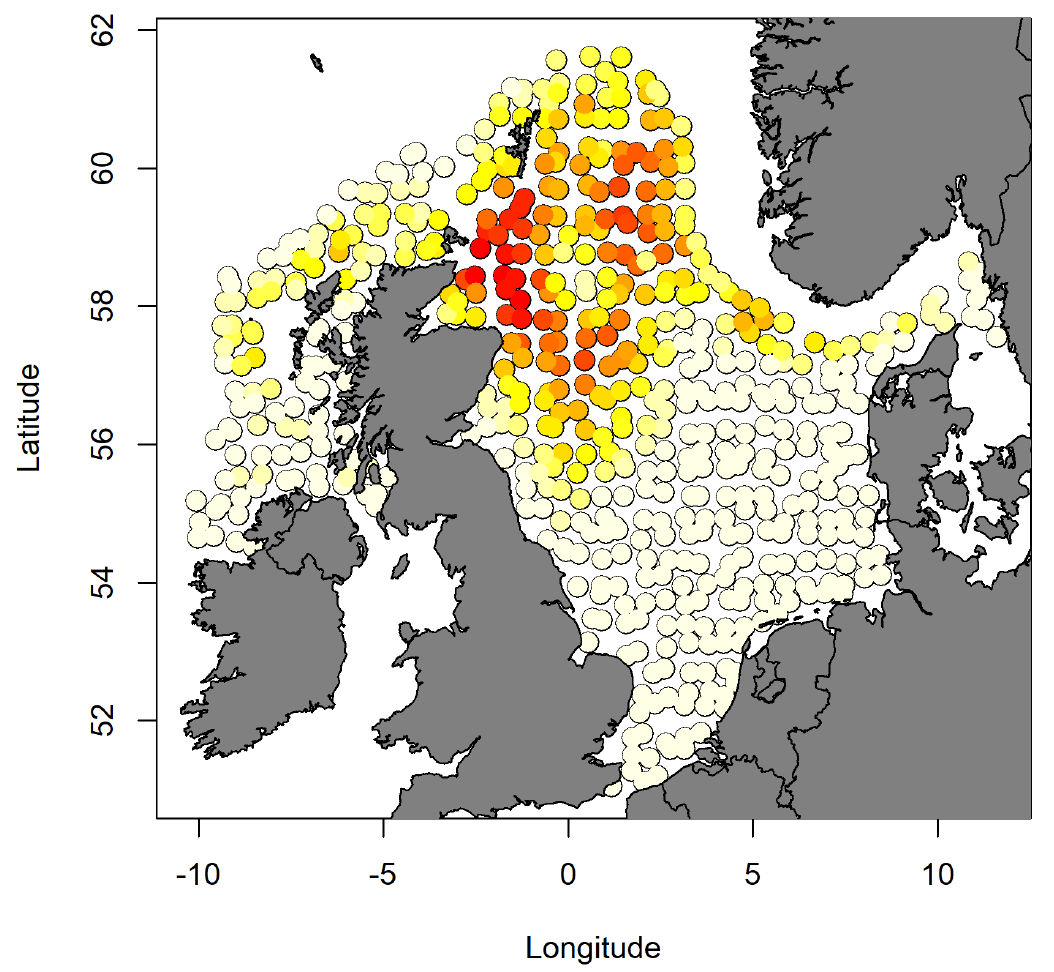
The Northern Shelf haddock stock extends from the west coast of Scotland, around the north of Scotland and into the northern and central North Sea and Skagerrak. Haddock are rarely found below 300 m, preferring depths between 50 m and 200 m. Juveniles are found primarily in coastal areas particularly around the Moray Firth, Orkney and Shetland as well as along the continental shelf and in the Skagerrak. Adult fish are predominantly found around Shetland, in the northern and central North Sea and along the north-western continental shelf edge. Spawning takes place between March and May with a number of spawning aggregations existing mainly around the east and west coasts of Scotland.
Fishing methods vary between countries, with the UK fleet using predominantly trawls, with some seine netting occurring. Other countries also use a mix of trawls and seine nets, as well as longlines and other methods[5]. The figures within this FMP primarily focus on UK fishing vessels, as these are the vessels for which we have accurate data. This is explained further in the fishery section below.
Haddock is a mixed feeder and preys mostly on benthic and epibenthic invertebrates, sandeels, and demersal herring egg deposits. They are also an important prey species, mainly for other gadoids. There is some evidence of predation by marine mammals such as seals, harbour porpoise and white-beaked dolphin.
Haddock are sporadic spawners which results in occasional high recruitment (the number of young fish entering the population each year). These sporadically large cohorts are a key driver of stock dynamics and lead to dominant year classes in the fishery. However, recruitment appears reduced since 2000 with both average recruitment and the size of the sporadically larger year classes being lower than seen historically.
The spawning stock biomass (SSB) has been fluctuating below Blim for much of the 2000s though is now well above the MSY Btrigger reference point due to two consecutive stronger year classes in 2019 and 2020. In recent years, fishing pressure has fluctuated between Flim and FMSY, and is at a historical minimum, below FMSY.
There is evidence to suggest that haddock are maturing at smaller sizes, although this has been compounded by the large haddock year classes of 2019 and 2020. Whilst haddock are on average smaller, they are still marketable and therefore no management action is likely to be required to account for this. However, we will continue to monitor the composition of catches and should action be required this will be outlined within a future iteration of this FMP
Location
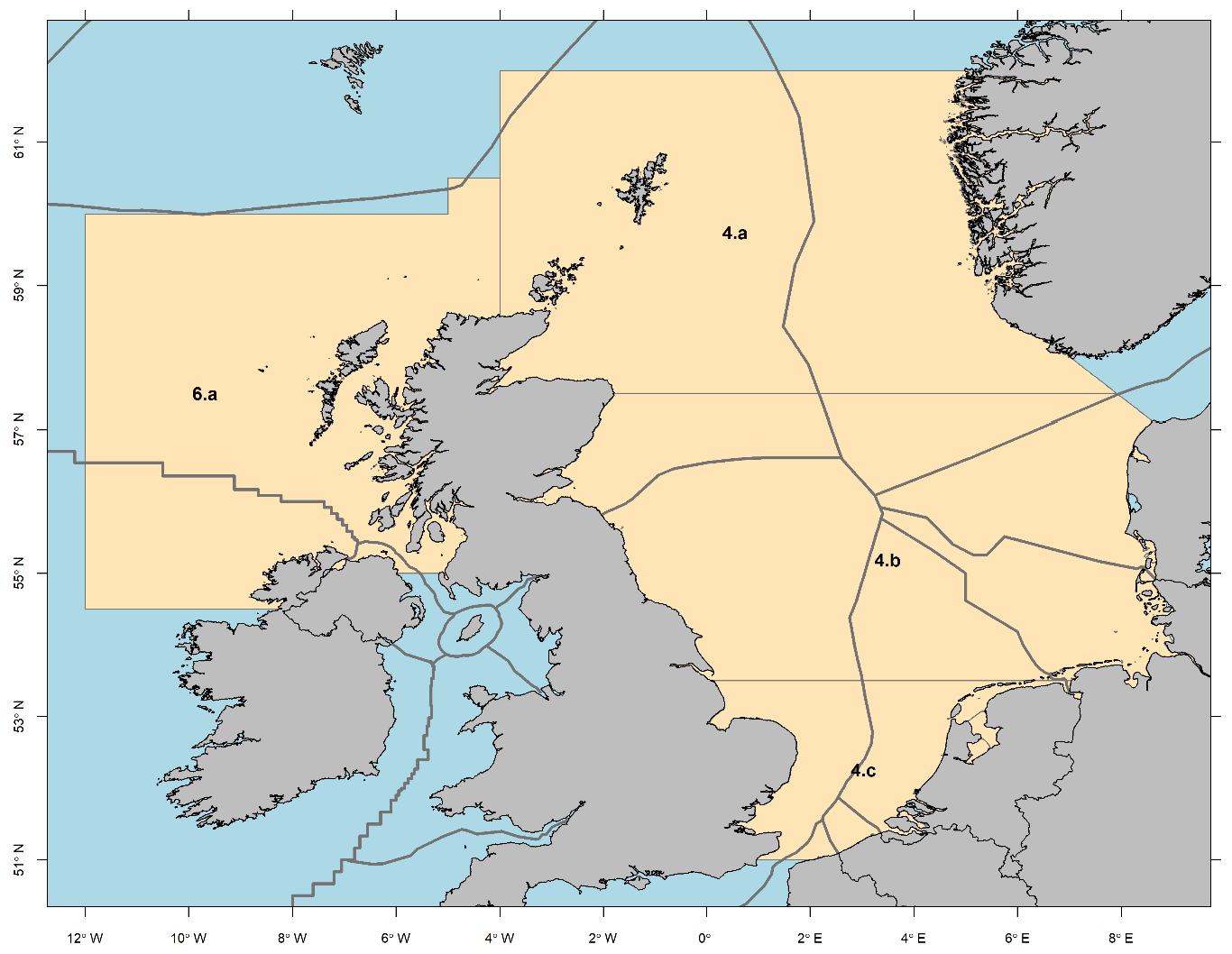
The biological stock is found in ICES subarea 4 (North Sea), Division 6.a (West Coast of Scotland), and Subdivision 20 (Skagerrak). For management purposes, there are two separate TAC areas, denoted by ICES codes HAD/2AC4 and HAD/5BC6A. HAD/2AC4 includes the UK waters of area 2.a, while HAD/5BC6A includes UK and international waters of area 5.b.
The below figures show the location of the ICES areas, along with the known distribution of the Northern Shelf haddock stock within areas 4 and 6.a, according to the latest available survey data.
Most Northern Shelf haddock caught in UK waters are caught in ICES area 4.a, over 80% on average, with around 10% caught in ICES area 6.a and around 8% in ICES area 4.b.
Fishery
Fishing for Northern Shelf haddock in UK waters takes place as part of a mixed fishery, meaning that Northern Shelf haddock is caught alongside other fish stocks, usually other whitefish such as cod, saithe and whiting (these stocks are subject to separate FMPs). There are many shared characteristics between these whitefish stocks, and similarities in where and how they are fished. When considering management action for Northern Shelf haddock as part of this FMP, and in wider management considerations such as the setting of fishing opportunities, fisheries policy authorities consider the role of haddock in the wider marine ecosystem. Many of the issues that are considered as part of this FMP are applicable across demersal whitefish fisheries, and therefore the actions required are often not specific to one particular stock or fishery.
It is important to note that the figures provided in this section are based on the latest available data which is from 2022. Whilst this section provides a snapshot of the fishery at this time, it will not reflect any more recent changes in the fishery.
Northern Shelf haddock is typically caught by demersal-targeting fleets, who landed 90% of the catch between 2019 – 2022. The remaining 10% was landed by shellfish-targeting fleets, which is likely a result of bycatch.
Analysis was undertaken of the UK fishing fleet catching Northern Shelf haddock in ICES subareas 4 (North Sea) and 6.a (West of Scotland). Between 2015 – 2022, ~80% of Northern Shelf haddock was caught in ICES area 4.a; ~10% was caught in area 6.a and the remaining ~ 10% was caught in 4.b. Between 2015 -2021, the UK fleet accounted for, on average, over 80% of the Northern Shelf haddock caught, with some annual fluctuations. The remaining ~20% was caught either by the EU fleet (~11%; predominantly Denmark) or the Norwegian fleet (~6%). Of the Northern Shelf haddock caught by UK vessels in 2022, Scottish-registered vessels accounted for 82% of the tonnage. 18% was landed by English-registered vessels and <1% attributable to Northern Irish vessels.
Analysis of UK fisheries data shows that almost all Northern Shelf haddock caught by the UK fleet in those ICES subareas are caught using demersal trawls (85%) or seine nets (15%), although other non-UK vessels also use longlines as part of this fishery.
| Gear Type | 2015 | 2016 | 2017 | 2018 | 2019 | 2020 | 2021 | 2022 |
|---|---|---|---|---|---|---|---|---|
| Trawls | 83% | 86% | 84% | 83% | 83% | 84% | 87% | 87% |
| Seine nets | 17% | 14% | 16% | 17% | 17% | 16% | 13% | 13% |
The landed value of Northern Shelf haddock was consistently around the £40 million mark between 2015 – 2018. Tonnage and price per tonne (PPT) figures were also consistent (~28,500t and ~£1,400, respectively). Landed value then decreased to around £27.5 million in 2021, primarily due to decreasing tonnages, whilst PPT remained around the £1,400 mark. In 2022 Northern Shelf haddock’s landed value has seen a small increase to just over £30 million as a result of a significant increase in tonnage, back to pre-2019 levels of ~28,000t. However, the extent of this increase has been dampened due to the PPT slumping to a period low of ~£1,100.
Most Northern Shelf haddock caught between 2015-2022 by the UK fleet was landed into the UK (99%), with around 1%, on average, being landed outwith the UK. The main landing districts for haddock in the UK are in the North and North East of Scotland with Peterhead taking most of this tonnage (59%), followed by Shetland (14%), Wick (11%) and Fraserburgh (8%). Within these districts’ ports, Northern Shelf haddock represented a notable portion of the total landed value of the ports where it was landed. The species accounted for around 13% of each of Peterhead’s, Scrabster’s, Kinlochbervie’s and Cullivoe’s total landed value. For Scalloway and Isles, it accounted for 16% of the port’s total landed value.
For the fleet groups that target Northern Shelf haddock, the species is a key stock. North Sea and West of Scotland demersal pair trawl seiners derive 31% of their landed value from the stock; for North Sea and West of Scotland demersal seiners it is 23% of the fleet’s landed value. The North Sea and West of Scotland demersal over 24m and under 24m fleets each derive ~15% of their landed value from the species.
Despite Northern Shelf haddock’s relatively small part in the wider demersal fleet (it represents 4% of UK fisheries’ tonnage and landed value), it is an important species for the ports into which it is landed, and the fleets who land it. In 2022, Northern Shelf haddock was the main species landed by value for the North Sea and West of Scotland demersal pair trawl seine fleet, and the second main species for the North Sea and West of Scotland demersal over 24m fleet. Both fleets accounted for the equivalent of 197 and 527 full-time employees (FTE) respectively[7]. Whilst evaluating the individual significance of Northern Shelf haddock on the fleet’s FTE is difficult (as the fleet also catches other species), it is clear that Northern Shelf haddock supports two fleets with important employment in the UK fishing industry.
Fishing vessels usually target different stocks at different times of year, but because of the mixed nature of the fishery, it is too difficult to separate out the precise differences between vessels and the whitefish they catch, beyond the figures and detail provided within the FMP. Vessels catching haddock will often also catch cod, saithe and whiting. There are indications, however, that haddock and whiting are often found together and further south than saithe and cod, which are also caught together and found further north.
Contact
Email: FMPs@gov.scot