
North Sea Nephrops: proposed Fisheries Management Plan
The North Sea Nephrops (Nephrops norvegicus) Fisheries Management Plan (FMP) is one of 43 FMPs set out in the Joint Fisheries Statement (JFS).This FMP sets out the policies and actions to manage the North Sea Nephrops
stocks at sustainable levels.
Background
Stock
Nephrops are a small decapod crustacean ranging in total body length from 8-24cm (including the tail, carapace and clawed legs). Females will reach maturity at around three years of age although growth is difficult to assess in Nephrops, and it varies geographically, often dependent on food supply. Mating takes place in early summer following moulting and females will carry the eggs for up to nine months before they hatch. During this period berried (egg carrying) female Nephrops will remain mostly hidden in their burrows.[6]
Therefore, throughout this period males are more heavily exploited in the fisheries compared with other times of the year. Since a significant proportion of Nephrops are fished using demersal trawls and because animals are protected from trawls when in their burrows, the emergence patterns significantly influence catch rates.[7] The timing of Nephrops emergence to feed appears to be related to light levels, and greatest catches are often taken at dawn and dusk, although this may vary with water depth and clarity.
Location
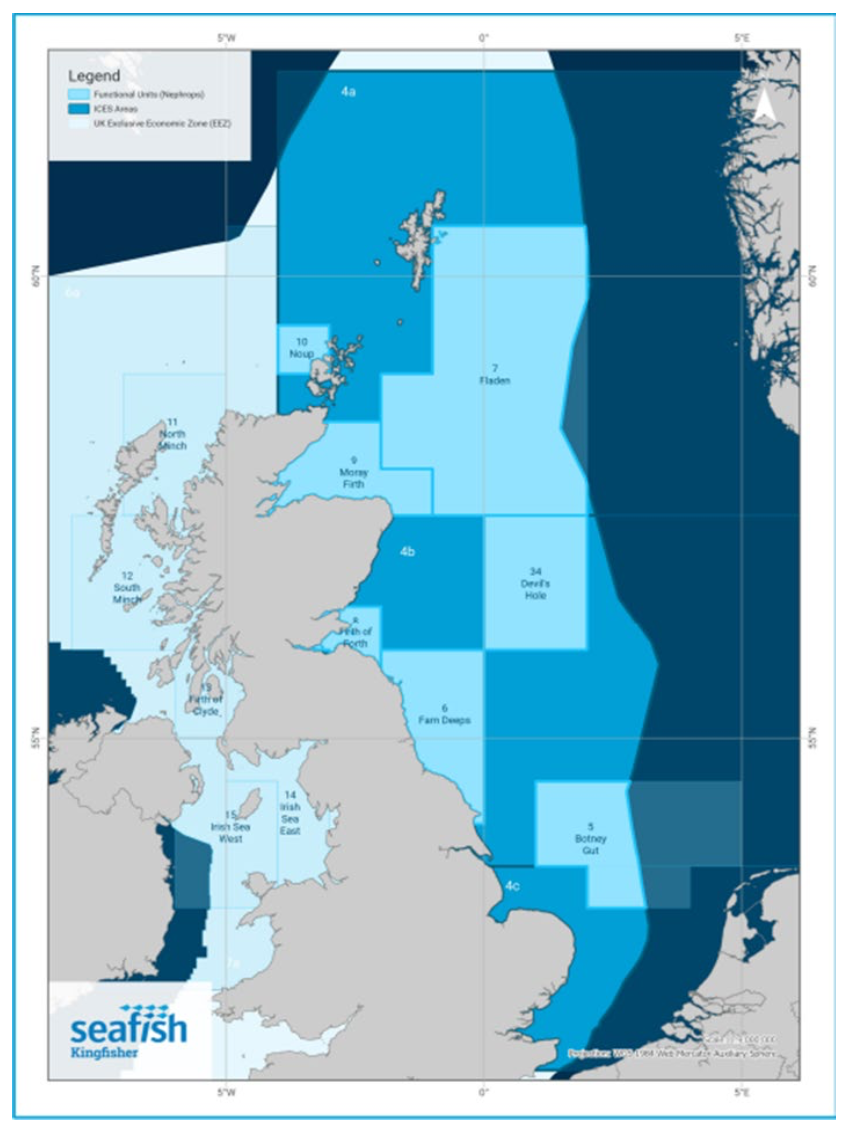
Across Northeast Atlantic, Nephrops are assessed as individual stocks in 34 functional units (FUs). These are based on discrete patches of mud which they inhabit. Within the UK sector of the North Sea there are seven FUs that are targeted by fishers. These include the Farn Deeps, Firth of Forth, Moray Firth, Fladen Ground and, to a lesser extent, the Noup, Devil's Hole and Botney Cut-Silver Pit (Figure 1).
Nephrops are found across the North Sea although their distribution directly correlates to the mud patches they inhabit. As a result, Nephrops fleet activity is generally confined to certain areas of suitable habitat around the North Sea where the mud patches are accessible. The most prominent inshore fishing areas are the Farn Deeps (FU6) off the Northumberland coast in northeast England and along the Firth of Forth (FU8) and Moray Firth (FU9) in Scotland. The largest and most distant area being the Fladen Ground (FU7) which is situated about 100 miles northeast of Aberdeen, between Scotland and Norway. The Fladen Ground borders the Norwegian Deep FU, and the easternmost part of the Fladens straddles the median line between UK and Norwegian waters; other North Sea FUs are entirely inside UK waters. Botney Cut-Silver Pit (FU5) is northeast of the Norfolk coast within UK waters and is covered by this FMP also.
Ports in the northeast of Scotland and northeast England are heavily reliant on Nephrops fisheries which make up a significant proportion of the total value of landings. Nephrops are landed either whole live, whole fresh, or tailed, and in some cases, vessels will freeze whole Nephrops at sea. Whole Nephrops are predominantly exported to the EU, whilst the tails are used in scampi production for domestic markets.
Nephrops fisheries in the North Sea are often mixed, with Nephrops caught alongside quota whitefish species such as cod, haddock, and whiting. The mixed nature of these demersal fisheries is often critical to economic viability of individual vessels.
Fisheries
Fishing for Nephrops in UK waters can take place as part of a targeted and also a mixed fishery. Even within the targeted fisheries, bycatch of non-targeted fish does occur, and it is often the case that when fishing for Nephrops, bycatch of both quota and non-quota species can form part of the overall catch. The composition of the overall whitefish bycatch can vary between functional unit. In the North Sea, there is a specific mixed Nephrops / whitefish fishery, with vessels targeting both species as part of their overall business model. The extent to which there are issues with bycatch and discarding depends on the type of gear and areas in which fishing occurs, along with considerations of available quota and the type of business model followed.
The majority (73%) of Nephrops targeted in the North Sea are caught using otter trawls. Most of the Nephrops caught in trawls are fished by vessels over 10m, working out of ports in the northeast of England and northeast of Scotland. Larger trawlers will often fish multi-day trips, whilst the smaller vessels under 10m are usually restricted to fishing within the 12nm limit and often return to port each day.
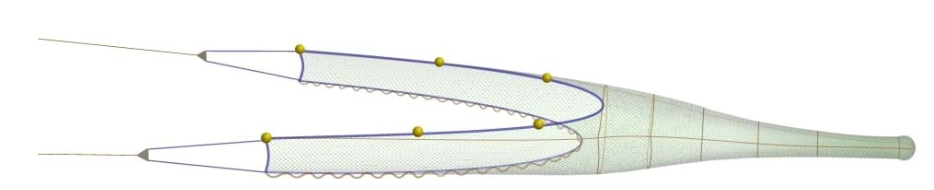
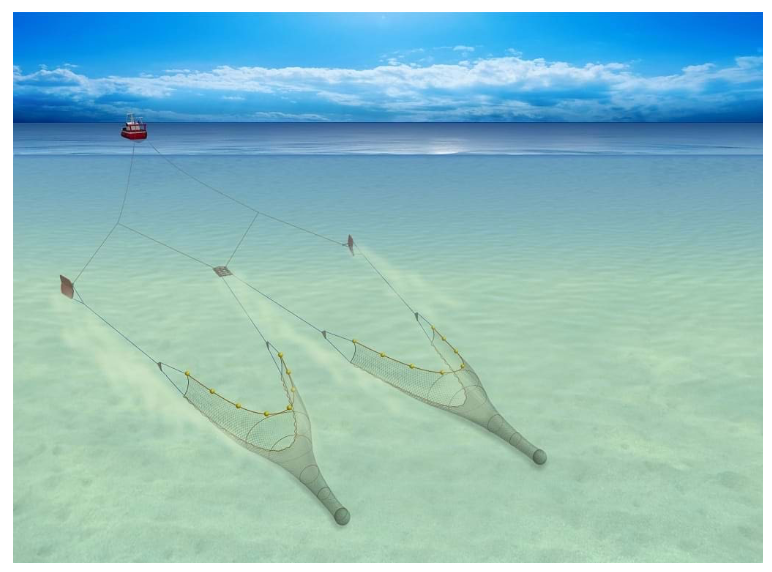
The two most common trawls used in the Nephrops fleet in the North Sea are the demersal trawl and the twin rig trawl. The Nephrops twin rig was initially developed in northeast Scotland as a follow on from the Danish twin rig set up for shrimp and Nephrops. Both these gears are characterised by having long winged low nets, with lightweight ground gear for towing over the soft, muddy areas where Nephrops are found. A pair of otter boards or trawl doors are used to keep the mouth of the net open (Figure 2).
The main difference between the demersal trawl and the twin rig trawl is that a twin rig utilises two separate trawls joined together; this increases fishing efficiency by increasing swept area for species like Nephrops which are less likely to be ‘herded’ towards the net by sweeps. Twin rigs still use only one pair of otter boards to keep the nets open but use a clump or weight between the trawls to stop the inner wings of the net folding over and to keep the sweeps on the seabed (Figure 2). Nephrops trawls are designed to skim over the soft mud and have less interaction with the seabed than some other mobile gears. This is due to carefully balanced footropes and headlines, in conjunction with towing speeds.
The main landing sites for North Sea Nephrops in Scotland are located along the northeast coast. Of particular significance is Fraserburgh which is the UK’s principal Nephrops port, as well as Peterhead. Combined these two ports alone were responsible for nearly 60% of Nephrops landings out of the top 10 Nephrops ports in Scotland. The main landing ports in northeast England for Nephrops are North Shields, Blyth, Amble and Hartlepool. North Shields being the principal port of the Farn Deeps FU fishery.
Target and non-target bycatch in Nephrops trawl fisheries
Whilst Nephrops is the target species for Nephrops fishing vessels, they may also take a bycatch of other fish species. In some cases, this can be in small numbers, and significant steps have been taken to reduce this over the years, however, there can be a cumulative effect, meaning that whilst bycatch at individual level is often small, when scaled up across the number of vessels in the fishery, it can be large. This is further demonstrated later in this FMP when we discuss technical measures. There is also a distinction between wanted and unwanted bycatch of fish – some vessels will rely on a mixed fishery as part of their business model. This is particularly the case for fishing vessels operating within the Fladens area which operate as part of a mixed offshore fishery. For other vessels where whitefish is not part of the business model, this can lead to issues with discarding.
Nephrops landings profile
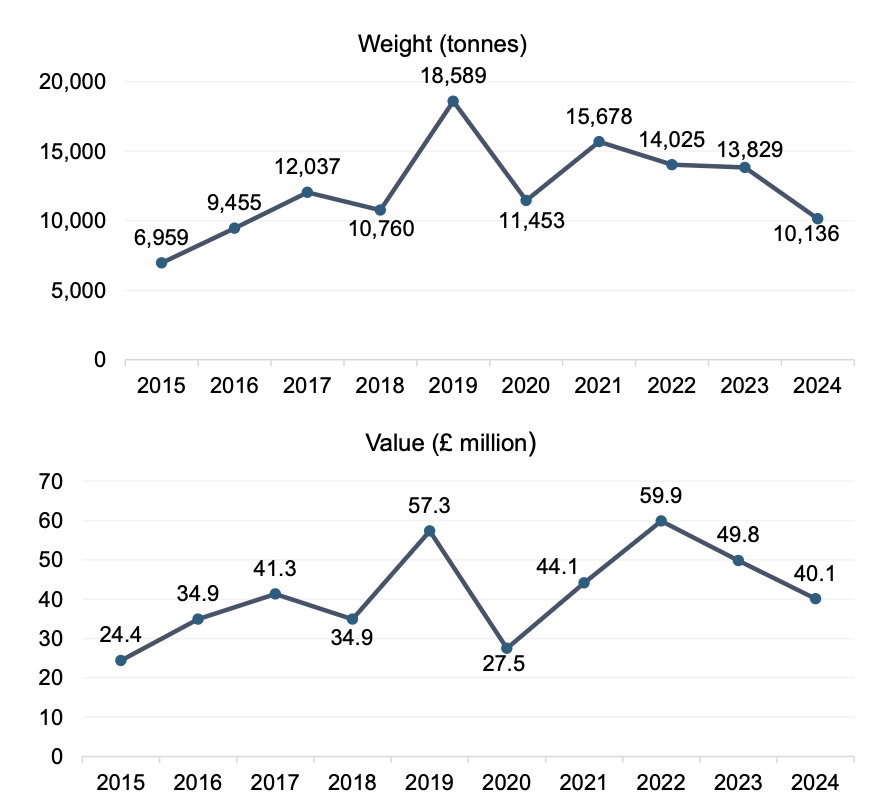
Annual landings fluctuated between 2016 and 2023, ranging from 6,959 tonnes in 2015 to 18,589 tonnes in 2019 (4). The value of landings closely followed tonnage trends, fluctuating between £24.4 and £59.9 million, although dipping to £27.5 million in 2020 due to the impact of Covid-19 on global seafood markets. Both value and tonnage in 2024 have increased compared with 2015 in landings and value by 64% and 46% respectively.
The Fladen Grounds (FU7) are responsible for the largest proportion of total Nephrops landings at 42,833 tonnes (46%) between 2016-2022 within the FMP area. The Farn Deeps (FU6), Firth of Forth (FU8), and Moray Firth (FU9) each contributed 17%, 16% and 9% to total annual FMP landings respectively. By ICES rectangle, 41E7 (FU8) and 39E8 (FU6) were responsible for the most landings, 12,175 tonnes and 8,365 tonnes, between 2016 and 2022.
Nephrops landings in the North Sea generally peak mid-summer. Average monthly landings between 2020 and 2024 increased rapidly during June and peaked in July averaging 1,095 tonnes. Average landings then gradually declined throughout autumn, winter and spring, reaching a low of 347 tonnes in May.
Nephrops export figures
The volume of UK Nephrops exports generally ranged from 22,600-26,600 tonnes between 2016 and 2022, except for 2016 and 2020 when exports dropped to 19,795 and 17,091 tonnes respectively. Between 2016 and 2021, Nephrops export values (not adjusted for inflation) ranged from £107.9 to £119.7 million, except for 2020 when the value of exports dropped to £80.6 million. This was likely related to the impacts of the Covid-19 pandemic on global markets.
Export values then rose by 13% in 2022 reaching £124.9 million, associated with a lower export volume and a higher price per kilo (£10.43/kg in 2022 compared to £7.81-£8.97/kg between 2016-21). The majority of Nephrops exports are frozen (77% on average) with a smaller amount of live/fresh (23% on average), however in terms of export value, the split between the two presentation formats is more even. Frozen Nephrops constitutes 55% of the total export value on average, and live / fresh Nephrops constitutes 45% on average.
Contact
Email: fmps@gov.scot