
North Sea Nephrops: proposed Fisheries Management Plan
The North Sea Nephrops (Nephrops norvegicus) Fisheries Management Plan (FMP) is one of 43 FMPs set out in the Joint Fisheries Statement (JFS).This FMP sets out the policies and actions to manage the North Sea Nephrops
stocks at sustainable levels.
Fisheries management
Management strategy for Nephrops
The UK fisheries policy authorities set out in the JFS a shared ambition to deliver ‘world class, sustainable management of our sea fisheries and aquaculture across the UK, and to play our part in supporting delivery of this globally’. The JFS also states that ‘as part of being an independent coastal State, the fisheries policy authorities will work together to support a vibrant, profitable, and sustainable fishing and aquaculture sector supported by a healthy marine environment that is resilient to climate change’. These ambitions are managed in line with numerous domestic and international policy drivers, which oblige action to consider and mitigate for the wider adverse environmental impacts of fishing activity.
In UK waters, fisheries are managed in line with UK fisheries legislation (such as the 2020 Act, UK and devolved administration secondary legislation) and licence conditions where appropriate.
North Sea Nephrops (in ICES Subarea 4) is also covered by North Sea Multi Annual Plan (MAP) (Regulation 2018/973)[10]. The MAP contains measures to restore and maintain fish stocks above levels capable of producing MSY, and requirements relating to the determination of fishing opportunities, implementation of the landing obligation and engagement with third countries to ensure the relevant stocks are managed in a sustainable manner in line with the MAP objectives.
The management of Nephrops fisheries in the UK is carried out within this overarching context. Furthermore, Nephrops are jointly managed stocks with quota opportunities determined through the bilateral coastal State negotiations between the UK and the EU.
Following the conclusion of annual negotiations with the EU, an agreed Total Allowable Catch (TAC) is then determined as fishing opportunities for British fishing fleet by the Secretary of State and published in a document under section 23 of the 2020 Act.[11] Following this, the UK’s quota is apportioned between the four UK Fisheries Administrations in line with the UK Quota Management Rules[12]. Each UK Fisheries Administration then allocates its share of apportioned quota to vessels/licences under their administration, in line with their quota management rules and Section 25 of the 2020 Act. Quotas are adaptable, for example, they may be transferred between the management groups which represent UK fishing vessels or exchanged with the EU.
Current technical measures
All fishing activity in UK waters is managed through a range of technical measures. These technical measures were historically laid out in the form of technical conservation regulations written into the Common Fisheries Policy (CFP) legislation through various EU delegated acts. Following the UK’s exit from the EU, technical conservation regulations under the CFP are now assimilated into UK law. The UK Government and evolved Governments now have powers to introduce new technical measures, using licence conditions or secondary legislation under the 2020 Act or other relevant UK laws.
There are currently a range of technical measures used within Nephrops fisheries, primarily to reduce discarding of non-target species and undersized fish through improved selectivity, to reduce overall fishing mortality, and to minimise the impact fishing activity has on the wider marine ecosystem.
Nephrops live in areas of muddy substrate which are often inhabited by several other commercially targeted species including cod, haddock and whiting, as well as flatfish like plaice. This means that Nephrops can often be targeted as part of a mixed fishery, which can be of benefit to those fishers that hold quota against other fish species. Technical measures that include mesh sizes and selectivity devices, alongside the landing obligation, play an important role in maintaining the selectivity of the fisheries, and reduce the bycatch of unwanted or undersized species. Specific conditions are also in place under the North Sea Cod Avoidance Plan (NCAP)[13] which permit fishing for Nephrops in the North Sea using a net smaller than the standard 120mm only in defined Nephrops ‘mud areas’.
There are currently two different variations of the Minimum Conservation Reference Size (MCRS) for Nephrops, split by ICES area, as shown in Table 1.
Table 1 . Minimum Conservation Reference Sizes for Nephrops in UK waters
| Subarea 4- Total Length |
Subarea 4- Carapace Length |
Subarea 4- Tail | Subarea 6 and 7- Total Length |
Subarea 6 and 7- Carapace Length |
Subarea 6 and 7- Tail | |
|---|---|---|---|---|---|---|
| Whole Nephrops | 85mm | 25mm | 46mm | 70mm | 20mm | 37mm |
| Nephrops tails | - | - | 46mm | - | - | 37mm |
In English waters, Inshore Fisheries Conservation Authorities (IFCAs) have a duty to manage the inshore waters out to 6nm. This can include introduction of specific management measures via IFCA byelaws, such as permits for trawling, technical measures and gear restrictions, and vessel size restrictions. In the Northumberland IFCA district a number of byelaws are in place which stipulate:
- A permit is required for vessels targeting Nephrops with a single trawl in the district;
- Only vessels under 18.3m can fish for Nephrops with trawls inside 6nm; and
- Technical measures and gear restrictions are in place in specific designated areas, such as Coquet to St. Mary’s Marine Conservation Zone.
- Target and non-target bycatch in Nephrops fisheries
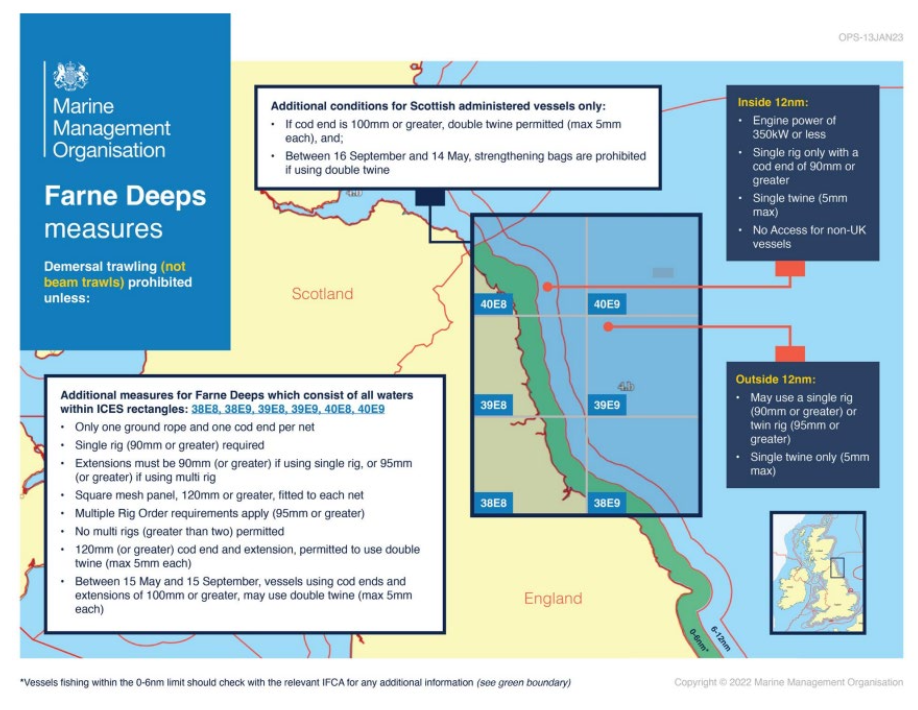
Additional technical measures apply in the Farn Deeps (FU6) which are intended to provide additional protection of a coastal functional unit which is vulnerable to overexploitation.
Contact
Email: fmps@gov.scot