
Planning and Environmental Appeals Division: annual review 2024 to 2025
Planning and Environmental Appeals Division's (DPEA) annual review of its performance for 2024 to 2025.
How We Work
Under the procedures that apply to planning appeals, the reporter will decide what further procedure, if any, is necessary once the grounds of appeal, response by the planning authority and representations by interested parties have been received. For this reason, it is our practice to allocate appeals at an early stage. The reporter considers the submissions made by the various parties to the appeal and decides whether any further procedure is necessary. If a site inspection is to take place the reporter decides whether this will take place on an accompanied or unaccompanied basis. If hearing or inquiry sessions are needed these will normally be restricted to the issues or matters specified by the reporter.
Each of our cases has a dedicated caseworker responsible for the management of the case’s documentation, issuing letters on behalf of the reporter, and acting as a point of contact for parties to the case.
With development plan examinations it is our practice to appoint a lead reporter who has overall responsibility for the conduct of the examination. Depending on the number of unresolved representations one or more additional reporters may be appointed to assist with the examination.
The flowchart below shows the steps in the process once an appeal has been received until a decision has been issued, including what may be involved with the different methods of determination that a reporter may choose to help them come to a decision.
Planning Appeal Process
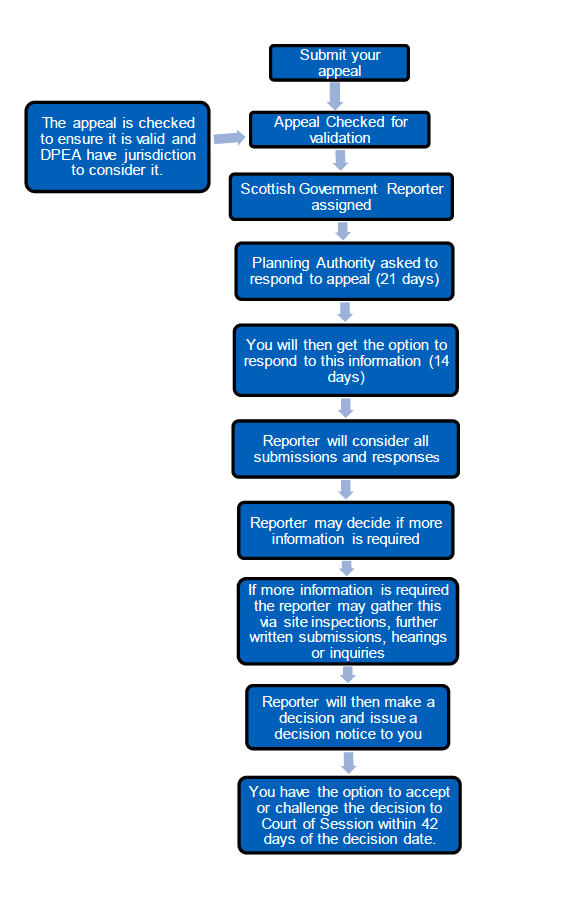
- Submit your appeal
- The appeal is checked to ensure it is valid and DPEA have jurisdiction to consider it. : Appeal Checked for validation
- Scottish Government Reporter assigned
- Planning Authority asked to respond to appeal (21 days)
- You will then get the option to respond to this information (14 days)
- Reporter will consider all submissions and responses
- Reporter may decide if more information is required
- If more information is required the reporter may gather this via site inspections, further written submissions, hearings or inquiries
- Reporter will then make a decision and issue a decision notice to you
- You have the option to accept or challenge the decision to Court of Session within 42 days of the decision date.
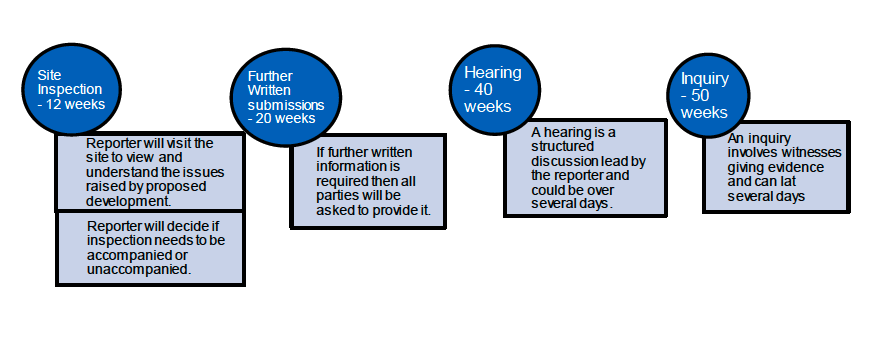
Site Inspection - 12 weeks
- Reporter will visit the site to view and understand the issues raised by proposed development.
- Reporter will decide if inspection needs to be accompanied or unaccompanied.
Further Written Submissions - 20 weeks
- If further written information is required then all parties will be asked to provide it.
Hearing - 40 weeks
- A hearing is a structured discussion lead by the reporter and could be over several days.
Inquiry - 50 weeks
- An inquiry involves witnesses giving evidence and can lat several days
Resources and further information
For further information on the work DPEA are involved in, guidance on procedures and other resources that might be useful please see the links below:
- DPEA website - Scottish Government - Planning and Environmental Appeals Division (DPEA)
- DPEA Webcasting Site - Home - DPEA Webcasts
- MyGov DPEA Site - Planning decision appeals - mygov.scot
- Appeals information - A guide to planning appeals in Scotland - gov.scot
- Guidance - Planning appeals and other cases: guidance on taking part - gov.scot
- Previous annual review - Planning and Environmental Appeals Division (DPEA): annual review 2023 to 2024 - gov.scot
- Contact details - Scottish Government - DPEA - Contact
- Complaints and feedback - Planning and environmental appeals: complaints policy - gov.scot
- Forms and guidance - Planning and environmental appeals: forms and guidance - gov.scot
- Portal guidance - Planning and Environmental Appeals website: user guidance - gov.scot
- Live Cases - Scottish Government - DPEA - Case List
Case Administration
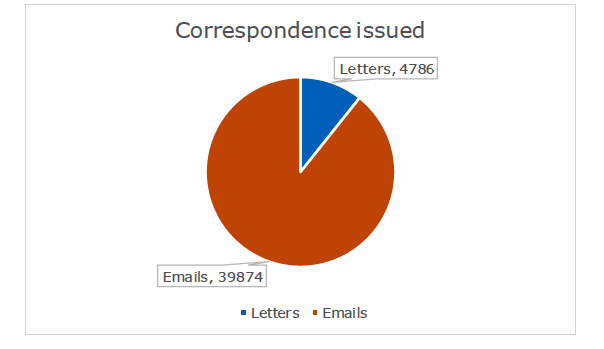
The DPEA Portal records all case details, including documents associated with each case and the parties that are involved. We issued a total of 44,660 emails and letters via the system for a total of 1267 cases in 2024 to 2025.
Webcasting And Virtual Meetings
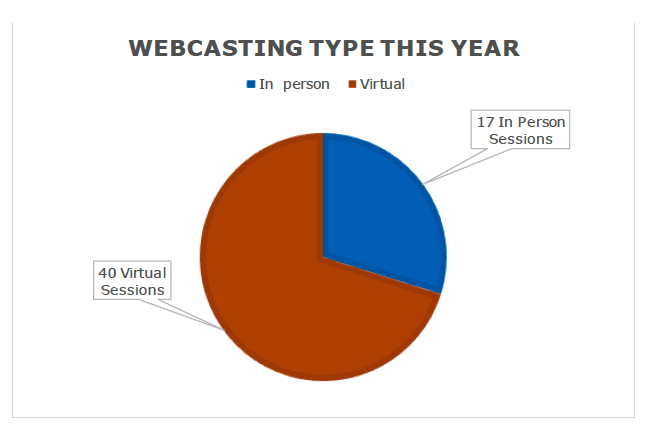
The webcasting of pre-examination meetings, hearings and inquiries has continued in 2024 to 2025. Virtual procedures are now a popular option for holding webcasts with more flexibility and availability to hold virtual procedures ensuring that DPEA processes can proceed at a good pace.
We have provided coverage of procedures in 27 cases. We have had 36,952 visitors to the site who have collectively watched 4,401 hours of webcasts. Live viewings of events remain high as we continue to see a high level of engagement with procedures being webcast.
Webcasting will continue to be an important part of the service provided by the DPEA and we will endeavour to cover as many events as possible.
Contact
Email: dpea@gov.scot