
National Mission on Drugs: annual report 2025 to 2026
Sets out the progress made between 1 April 2025 and 31 March 2026 by national government, local government and third sector partners towards reducing drug deaths and improving the lives of those impacted by drugs in Scotland.
1. Introduction
1.1 Overview
On 20 January 2021, the former First Minister Nicola Sturgeon made a statement to Parliament which set out a National Mission to reduce drug deaths and improve lives through a range of improvements to treatment, recovery and other support services.
This fifth and final National Mission annual report sets out the progress made from 1 April 2025 to 31 March 2026 against the National Mission Plan. Annual analytical reports monitoring the progress of the National Mission are published separately.
Every life lost as a result of drugs is a tragedy, affecting families, communities and services across Scotland. The National Mission concluded in March 2026 and has been succeeded by Preventing Harm, Promoting Recovery: Scotland’s Alcohol and Drugs Strategic Plan 2026–2035 (The Strategic Plan), which sets out the Scottish Government and COSLA’s long-term approach to reducing alcohol and drug-related harms. While our future work will be delivered through that Strategic Plan, this report focuses on activity, progress and the wider context during the final year of the National Mission.
This National Mission annual report is structured in line with the six outcomes and six cross-cutting priorities of the National Mission Plan. It also includes updates on finance, reporting, monitoring and evaluation. Outcomes and cross-cutting priority chapters have the following format: an overview providing context to understand the scope and purpose of the mission, followed by an update on progress in 2025-26.
As the National Mission concludes, reporting arrangements will transition to support delivery of the new Strategic Plan. The Scottish Government and COSLA are considering the most effective approach to monitoring and reporting progress under the new Strategic Plan, including the frequency and format of future reporting. Further details will be set out in due course.
National Records of Scotland reported that 1,133 drug misuse deaths were registered in Scotland in 2025. This was an increase of 11% (116 deaths) compared with 2024. Drug deaths are still much more common than they were in 2000. After adjusting for age, there were 21.4 drug-related deaths per 100,000 people in 2025. This is four times as high as when the series began in 2000.

Patterns of drug use and supply continue to change. The growing use of cocaine and powerful synthetic drugs is creating new challenges for harm reduction, treatment and support services. Cocaine is now the most commonly reported main drug among people starting specialist drug treatment in Scotland. Drug markets continue to evolve under geopolitical influences, with online platforms and social media facilitating access. The benzodiazepine market continues to evolve, with new types of benzodiazepines regularly being identified. Alerts have also been issued about other emerging substances, including nitazenes, bromazolam and xylazine.
We are increasingly concerned about the dynamic changes in the drug supply and rise in potent synthetic opioids such as nitazenes which pose a substantial risk of overdose, drug-related hospitalisation and drug-related death.
Scotland’s Rapid Action Drug Alert and Response (RADAR) system first issued a warning for nitazenes in March 2023. Since then, detections of nitazenes have continued to rise and further alerts have been issued for nitazenes, bromazolam and xylazine.
The Scottish Government recognises the ongoing threat posed by synthetic opioids and is providing an emergency response. During 2024/25, we continued working with Public Health Scotland (PHS) and the National Drug Death Incident Management Team (NDDIMT), which has now issued guidance on the management of clusters of drug-related harms. We have also been working with partners to understand the efficacy of nitazene test strips to inform national guidance on their use. More information on our approach to synthetics can be found at 4.2.4. We continue to develop our surveillance landscape (see 2.2.2) and to progress drug checking facilities (see 4.2.3).
1.2 National Mission Partners
The National Mission has been a collective endeavour. Our key stakeholders and partners are detailed below.
Integration Authorities (IAs) are responsible for integrating certain health and social care services provided by or for Area Health Boards and Local Authorities such as alcohol and drug services. IAs have oversight of planning, designing, and commissioning services and ensure the design and delivery of efficient, integrated services. IAs were established in 2014 in each local council area and, except in Highland, have been established as Integration Joint Boards (IJBs) and in many local areas the integrated services are identified as being provided by a Health and Social Care Partnership (HSCP) rather than separately through Health Boards and Local Authorities.
Area Health Boards (HBs) are responsible for the prevention and treatment of disease. Some healthcare functions, along with the associated budgets, are delegated to Integration Authorities (IAs), including services that provide care and support for people affected by substance use.
National Health Boards are specialised and include Public Health Scotland, Health Improvement Scotland, Public Services Delivery Scotland (formerly NHS Education for Scotland) and the Scottish Ambulance Service.
Local Authorities (LAs) are responsible for providing social care and social work services, including support services for people affected by substance use.
Some functions, along with the associated budgets, are delegated to Integration Authorities (IAs).
Alcohol and Drug Partnerships (ADPs) are multi-disciplinary, non-statutory partnerships established at local authority level to bring together organisations (including statutory and third sector organisations, the Police, and the Scottish Prison Service) that are all working to tackle alcohol and drug issues locally.
Key Third Sector Partners (KTSPs) provide vital expertise and services to support people affected by substance use and their families. This includes peer-led delivery of services and maintaining recovery communities.
- Crew (Scotland) is a nationwide public health charity that aims to reduce the harm and stigma associated with psychostimulant drug use.
- Scottish Drugs Forum is a drugs policy and information agency, working to reduce drugs harm in Scotland and provide a wide range of training and support to people who use substances and to people working in the sector.
- Scottish Families Affected by Alcohol and Drugs support families across Scotland who are affected by a loved one’s substance use, raising awareness of the issues affecting them as well as providing learning and training to people working in the sector.
- Scottish Recovery Consortium is a recovery-oriented charity that builds and promotes recovery in Scotland.
- With You is a charity that provides free confidential support to people who are experiencing issues with drugs, alcohol, or mental health.
Other third sector organisations are also supported via grant funding and make an invaluable contribution to delivery.
Corra Foundation deliver funding programmes for grassroots and third sector organisations for the National Mission on behalf of the Scottish Government.
Justice partners including Police Scotland, Crown Office, and Procurator Fiscal Service (COPFS), Scottish Prison Service and Community Justice Scotland.
1.3 Key publications and milestones April 2025 – March 2026
15 April 2025
Drug-related hospital statistics, Scotland, 2023 to 2024 and dashboard: Drug-related hospital statistics - Scotland 2023 to 2024 - Drug-related hospital statistics - Publications - Public Health Scotland
13 May 2025
Provision of Injecting Equipment in Scotland, 2023/24: Injecting equipment provision in Scotland - 2023 to 2024 - Injecting equipment provision in Scotland - Publications - Public Health Scotland
17 June 2025
National benchmarking report on implementation of the Medication Assisted Treatment (MAT) standards: National benchmarking report on the implementation of the medication assisted treatment (MAT) standards: Scotland 2024/25 - National benchmarking report on implementation of the medication assisted treatment (MAT) standards - Publications - Public Health Scotland
01 July 2025
Interim monitoring report on statutory funded residential rehabilitation placements: Interim monitoring report on statutory funded residential rehabilitation placements Placements approved between 1 April 2021 and 31 March 2025 - Interim monitoring report on statutory-funded residential rehabilitation placements - Publications - Public Health Scotland
15 July 2025
Evaluation of the National Mission on Drug Deaths – Lived experience survey: Evaluation of the National Mission on Drug Deaths: Lived experience survey - Publications - Public Health Scotland
12 August 2025
Public Health Scotland RADAR alert – nitazenes (update): Public health alert for action: Nitazene-type drugs in Scotland
2 September 2025
National Records of Scotland – Drug-Related Deaths in Scotland, 2025: Drug-related deaths in Scotland, 2024 - National Records of Scotland (NRS)
9 September 2025
Consensus approach on prevention of substance use harm among children and young people - Public Health Scotland: Consensus approach on prevention of substance use harm among children and young people - Publications - Public Health Scotland
16 September 2025
Interventions to reduce harms from cocaine – Public Health Scotland: Interventions to reduce harms from cocaine - Publications - Public Health Scotland
23 September 2025
Alcohol-specific deaths 2024 - National Records of Scotland (NRS): Alcohol-specific deaths 2024 - National Records of Scotland (NRS)
28 October 2025
Evaluation of the Scottish Government Residential Rehabilitation programme: Evaluation of the Scottish Government Residential Rehabilitation programme - Analysis of 2023 client-level data - Evaluation of the Scottish Government Residential Rehabilitation programme - Publications - Public Health Scotland
2 December 2025
Residential rehabilitation bed capacity in Scotland, October 2025: Residential rehabilitation bed capacity in Scotland, October 2025 - gov.scot
9 December 2025
Evaluation of the Scottish Government Residential Rehabilitation programme: number of individuals starting a residential rehab placement per financial year – placements started from 1 April 2019 to 31 March 2025: https://publichealthscotland.scot/publications/evaluation-of-the-scottish-government-residential-rehabilitation-programme/evaluation-of-the-scottish-government-residential-rehabilitation-programme-number-of-individuals-starting-a-residential-rehab-placement-per-financial-year-placements-started-from-1-april-2019-to-31-march-2025/
16 December 2025
Estimated numbers of people prescribed opioid substitution therapy in Scotland: Estimated numbers of people prescribed opioid substitution therapy in Scotland (12 month period) Scottish Public Health Observatory 16 December 2025 - Estimated numbers of people prescribed opioid substitution therapy in Scotland - Publications - Public Health Scotland
18 December 2025
Health Education Resources for people with experience of drugs: https://publichealthscotland.scot/publications/better-oral-health-for-adults-in-scotland-drugs-and-oral-health/ NES Turas Accredited Training for third/social sector workers: https://www.mylearning.scot/badges/helping-people-who-use-drugs-with-their-oral-health/
27 January 2026
Drug and alcohol information system (DAISy) overview of initial assessments for specialist drug and alcohol treatment 2024/25: https://publichealthscotland.scot/publications/drug-and-alcohol-information-system-daisy/drug-and-alcohol-information-system-daisy-overview-of-initial-assessments-for-specialist-drug-and-alcohol-treatment-202425/
05 February 2026
Public Health Scotland RADAR alert – new benzodiazepines: Public health alert for action: New benzodiazepines in Scotland
05 February 2026
Public Health Scotland RADAR alert – medetomidine: Public health alert for action: New xylazine-type drug – medetomidine
17 February 2026
Drug-related hospital statistics, Scotland, 2024 to 2025 and dashboard: Drug-related hospital statistics - Scotland 2024 to 2025 - Drug-related hospital statistics - Publications - Public Health Scotland
3 March 2026
Alcohol and Drug Partnerships: annual survey 2024 to 2025: Alcohol and Drug Partnerships: annual survey 2024 to 2025 - gov.scot
10 March 2026
Preventing Harm, Promoting Recovery: Preventing Harm, Promoting Recovery: Scotland’s Alcohol & Drugs Strategic Plan 2026 – 2035 - gov.scot
10 March 2026
Partnership Delivery Framework: Alcohol and drugs: partnership delivery framework - 2026 - gov.scot
10 March 2026
Impact assessments (EQIA, CRWIA, FSD): Alcohol and drugs strategic plan: equality impact assessment summary - gov.scot Alcohol and drugs strategic plan: Fairer Scotland Duty assessment summary - gov.scot Alcohol and drugs strategic plan: child rights and wellbeing impact assessment - gov.scot
10 March 2026
National Specification: Alcohol and drugs services: national specification - gov.scot
17 March 2026
Public Health Scotland – National Drug-Related Death Database: The national drug-related deaths database: analysis of deaths registered in 2021 and 2022
31 March 2026
Estimated prevalence of opioid dependence in Scotland: Estimated prevalence of opioid dependence in Scotland 2014/15 to 2023/24 - Estimated prevalence of opioid dependence in Scotland - Publications - Public Health Scotland
1.4 Outcomes Framework
The National Mission outcomes framework articulated our aim to reduce drug deaths and improve the lives of those affected by drugs. It was structured around six outcomes and six cross-cutting priorities, shown below in Figure 2 and presented in more detail in Annex A.
Figure 2: The National Mission outcomes and cross-cutting priorities
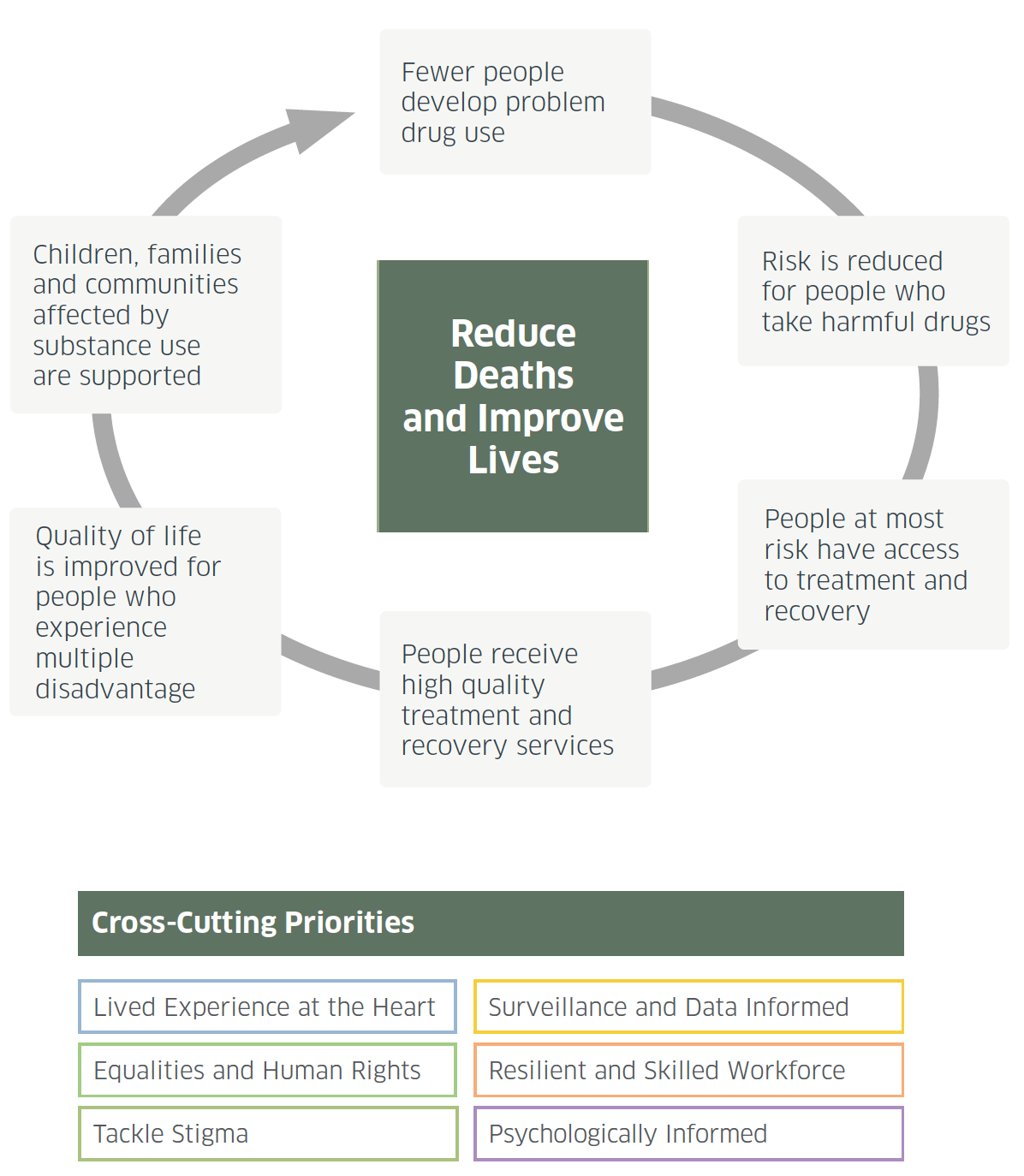
Graphic text below:
- Reduce Deaths and Improve Lives
- Children, families and communities affected by substance use are supported
- Quality of life is improved for people who experiencemultipledisadvantage
- Fewer people develop problem drug use
- People receive high quality treatment and recovery services
- Risk is reduced for people who take harmful drugs
- People at most risk have access to treatment and recovery
- Lived Experience at the Heart
- Equalities and Human Rights
- Tackle Stigma
- Surveillance and Data Informed
- Resilient and Skilled Workforce
- Psychologically Informed
Contact
Email: alcoholanddrugsplan@gov.scot