
National Care Service Charter of Rights
This Charter gives you information on your rights and what you should expect from your support. It gives you information about what to do if you think your rights are not being met.

Upholding your rights: feedback and complaints
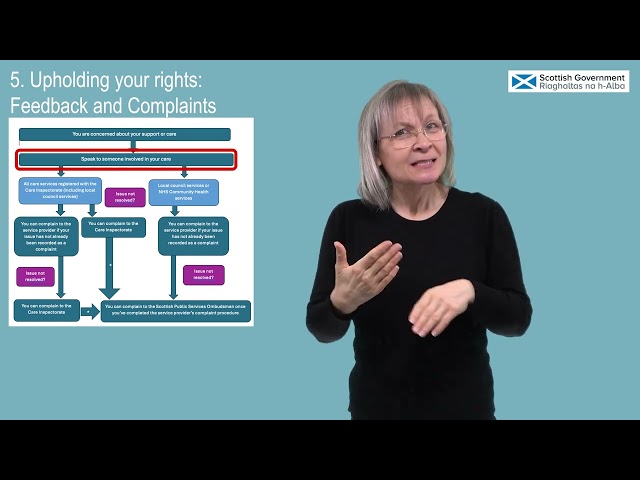
British Sign Language (BSL) translation
Your rights
You have rights to express your views on your care and support.
Read what the Charter means where it says ‘you have rights to’ and ‘you should expect’ in the rights and expectations in this Charter.
Giving feedback on your care
You should expect that your views will be listened to and respected. Your feedback helps to improve services for you and others. Family or others in your support network can give feedback for you, if you agree.
You can give feedback on:
- what went well – this helps services know what to keep doing
- what did not go well – this helps services learn and improve
You can give feedback to anyone involved in your care or their manager. Some services use Care Opinion, where you can give feedback anonymously.
To give feedback, you can:
- visit Care Opinion
- phone 0800 122 3135
Getting support to submit a complaint
It is normal to feel unsure about complaining, especially if you still receive, or are waiting to receive, care from the service. But services should see complaints as a chance to learn and improve.
If you’re worried, you can:
- ask someone you trust to help you
- get support and advice from an independent service
- ask a councillor or MSP to make a complaint for you
Support and advice services
Independent Advocacy
An independent advocate can help you share your views and wishes. They may be able to help sort out problems before they become a complaint. You can find out more in the section your support network, home, unpaid carers and independent advocacy.
Citizens Advice Scotland
Citizens Advice Scotland offers free, impartial and confidential advice. They can help you to make a complaint.
You can:
- visit Citizens Advice Scotland
- phone 0800 028 1456 (open Monday to Friday, 9am to 5pm)
Care Information Scotland
Care Information Scotland can provide information and advice on social care, including how to make a complaint.
You can:
- visit Care Information Scotland
- phone 0800 011 3200 (open Monday to Friday, 9am to 5pm)
Making a complaint
You can make a complaint for any reason you want, such as:
- your rights in this Charter are not being met
- your support does not meet the Health and Social Care Standards
- you are not happy with the service you are getting or have had in the past
When making a complaint you should expect to be:
- listened to with empathy and treated with dignity and compassion
- told when you should expect to receive a response
- kept informed about the progress of your complaint and told the outcome
There are different ways to make a complaint depending on what service you want to complain about. You may wish to speak to someone involved in your care or their manager first. This is often the quickest way to resolve any issues.
If you are concerned about your own or someone else’s safety please read the Protection from harm section of this Charter for advice.
All care services must have a complaints procedure in place and must provide details of this when requested. They have a duty to ensure any complaint raised under their complaints procedure is fully investigated.
All public sector care services must follow the Scottish Public Services Ombudsman (SPSO) rules for handling complaints. These set out what organisations and their staff should do when a complaint is made and the steps they need to follow.
The SPSO also provides information about how to make and progress a complaint about a public service.
Health and Social Care Partnerships
If you want to complain about a service provided through a Health and Social Care Partnership, you should contact the service that gave you the care. This could be the NHS, your local council or another organisation. If the service is registered with the Care Inspectorate, you can also complain to them.
Local council care service
You can contact your local council to find out how to make a complaint. Councils follow a two stage complaints process:
Stage 1: Frontline response
In this stage:
- the council will aim to reply within 5 working days
- if you are not happy with the response, you can ask for your complaint to move to stage 2
Stage 2: Investigation
In this stage:
- the council will aim to reply within 20 working days
- if they need more time, they will let you know
Some complaints may go straight to stage 2. If you are not satisfied with the outcome, you can ask the SPSO to review your complaint (see the Care Inspectorate section).
The Care Inspectorate
The Care Inspectorate checks and regulates registered care services in Scotland.
You can complain to the Care Inspectorate about a registered care service. You can complain about things like:
- care that does not meet expected standards
- people’s rights not being respected
- unsafe care practices
- problems with staff, staff training or staffing levels
The Care Inspectorate encourage you to raise your complaint with the service first, but you can also complain to them directly.
You can complain confidentially: this means that you share your identity with the Care Inspectorate but they will not share it with the service without your consent. This means you can get feedback on the outcome of your complaint.
You can complain anonymously: this means you don’t share your identity with the Care Inspectorate. But this means the Care Inspectorate can’t check information with you or tell you about the outcome of your complaint.
The Care Inspectorate may still investigate if the risk is high, even if you withdraw your complaint.
How long you have to make a complaint
It is best to complain as soon as possible. You usually need to complain within 6 months of the issue. They may consider complaints after this in exceptional cases.
You can:
- email concerns@careinspectorate.gov.scot
- phone 0345 600 9527 (open Monday, Tuesday, Thursday and Friday, 9am to 4pm; Wednesday, 9am to 2pm)
Social workers or social care workers
Social workers and many types of social care worker are registered with the Scottish Social Services Council (SSSC). All social service workers in Scotland are expected to follow the SSSC codes of practice. The SSSC can investigate complaints about an individual worker who is registered. For example the SSSC can investigate complaints about a worker's:
- behaviour
- professional practice
They cannot look at complaints related to a care service.
How long you have to make a complaint
It is best to complain as soon as possible.
You should complain within 6 months of the issue or when you became aware of it. They may accept complaints after this if you give a good reason.
You can make a complaint by:
- visiting Scottish Social Services Council
- phoning 0345 60 30 891 (open Monday to Friday, 9am to 4pm)
If you employ care workers directly
If you employ a Personal Assistant (PA) directly through Self-directed Support, you can find information about managing this relationship in the PA Employer Handbook. You may also be able to get help from your insurance provider.
Community health services
If you’re complaining about a community health service provided by the NHS, you can complain to the NHS Board. If your complaint is about a service provided on behalf of the NHS, such as your GP practice, a pharmacy, dentist or optician, you should complain to the service provider first.
If you are not happy with the response, you can ask the Scottish Public Services Ombudsman to review your complaint.
Further information about the NHS complaints procedure can be found in the Charter of Patient Rights and Responsibilities.
The Scottish Public Services Ombudsman
The SPSO is the final stage for complaints about public services in Scotland. This includes:
- care services provided by local councils
- NHS community health services
You need to complain to the service first before going to the SPSO. If you are not happy with the outcome of a complaint after this, you can contact the SPSO.
How long you have to make a complaint with the SPSO
It is best to complain as soon as possible. You need to complain within 12 months of the issue or when you became aware of it. The SPSO may accept complaints after 12 months if you give good reason.
You can make a complaint by:
- visiting the Scottish Public Services Ombudsman
- phone 0800 377 7330 (open Monday, Wednesday and Friday, 9am to 1pm; Tuesday and Thursday 1pm to 5pm)
How to write a complaint letter
When writing a complaint letter, it can be useful to add the following information:
- explain what went wrong – include what happened, who was involved, when and where it happened, and how it affected you
- describe any steps you’ve already taken to try to resolve the issue
- ask the organisation to explain how they made their decision
Other information you can include:
- link your complaint to a specific legal right or to the Health and Social Care Standards, if you can
- be clear about what you want to happen next and how the service can put things right
- give your name and contact details if you want a response. You can ask for your details to be kept confidential
Legal challenges
This Charter explains your legal rights but does not provide legal guidance.
If you believe your legal rights are not being upheld, or you disagree with a public body’s decision, you may have the option to apply to go to court and ask a judge to decide on your case.
If you are thinking of taking legal action you should seek independent legal advice. You can get help with legal problems, including finding out if you can get legal aid and finding a solicitor, on mygov.scot.
Contact
Email: nationalcareservice@gov.scot