
National Care Service Charter of Rights
This Charter gives you information on your rights and what you should expect from your support. It gives you information about what to do if you think your rights are not being met.

Equality, dignity and respect
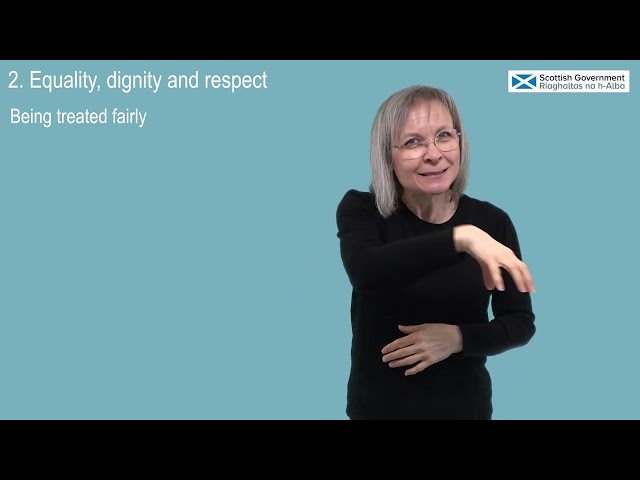
British Sign Language (BSL) translation
Your rights
You have rights to:
- be treated without discrimination and in a way that supports you to have equal opportunities to other people.
- respect for your private and family life, home and correspondence
- be protected from harm, neglect and abuse
- be safe in your home and community, including if you live in a care home or other facility
Read what the Charter means where it says ‘you have rights to’ and ‘you should expect’ in the rights and expectations in this Charter.
Discrimination and equal opportunity
You must not be treated unfairly due to your:
- age
- disability
- race
- sex
- sexual orientation
- gender reassignment status
- pregnancy and maternity
- religion or belief
These are protected characteristics.
Public authorities like local councils and health boards must consider properly how their decisions and actions can help remove discrimination, advance equality, and support good relations between people who share a relevant protected characteristic and those who don’t.
‘Advance equality’ means considering how to:
- remove or reduce disadvantages
- take steps to meet people’s needs
- encourage people to participate fully
‘Support good relations’ means considering how to reduce prejudice and increase understanding between different groups of people.
Dignity and respect
You have rights to respect for your private and family life. This protects your physical and moral integrity and your right to make decisions about your own life. Public authorities like local councils and health boards must provide support in a way that respects these rights.
You should also expect to be treated with dignity, respect, warmth and compassion. This can include respect for your:
- medical condition(s)
- background
- identity
- choices
Equality and access to support
You should expect your support to be provided in a way that recognises your experience and the impact this has had on you. Some experiences or life circumstances may mean it is more difficult to access support. For example, this could include:
Psychological trauma
Psychological trauma can have an impact on people’s ability to feel safe, to manage strong emotions, and to have self-worth, which can make it harder to seek and access support.
Drugs and alcohol
People who have, or have had, problems with drugs or alcohol, and their families, often face discrimination and may be judged unfairly by others. This can make it difficult to seek and access support.
Living in a rural area
Where you live can also affect access to support. In rural areas, including Scottish Islands, there may be fewer services and transport options available. It may be harder to use services privately without other people knowing, which may prevent people from seeking support.
Being treated fairly
To make sure you are treated fairly, there are lots of things that you should expect to happen. For example, you should expect:
- the people who provide your support to work with you and offer you choice where possible, in a way that makes you feel safe and in control
- people who provide your support to understand the impact that psychological trauma may have on those who have experienced it
- your support to enable you to observe religious, spiritual or cultural practices
- to be supported to express your identity and for this to be respected
- your support to be delivered in a way that helps address challenges of living in a rural area
- your support to be provided in accessible places
- to be given accessible information about your support, in a language or format you understand
- to be helped to get the support you need
People who provide your support should ask you what you need. Please tell them, so that they can try to get this for you.
Public authorities like local councils and health boards must make reasonable changes that help to remove barriers to support for disabled people.
Protection from harm
You have rights to not be treated in an inhuman or degrading way and to be protected from harm, neglect and abuse. You have rights to be safe in your home and your community, including if you live in a care home or other facility.
Adults at risk of harm
There is a law to help keep adults safe when they might be at risk of harm and unable to protect themselves. The law focuses on people who may be more vulnerable to harm because of things like illness, disability or mental health challenges. Harm can be accidental or intentional. It can also be as a result of self-neglect or self-harm.
You should expect professionals – like social workers, health staff, and the police – to work together to look into concerns, offer support, and take action to prevent harm if needed. They should aim to prevent and reduce harm in a way that respects the person’s rights and choices.
You should expect people who provide care and support to:
- recognise and respond to signs that you may be at risk of harm
- listen to you and take you seriously if you are concerned about the safety of yourself or others
If you are concerned about someone who may be at risk of harm or you are an adult at risk of harm, you can contact your local social work department in confidence. In an emergency call 999.
To find your local social work department contact Care Information Scotland or phone 0800 011 3200.
Information about what to do if you are a child who may be at risk of harm or if you are concerned about a child at risk of harm is in the children's rights section of this Charter.
Mutual respect
Everyone who uses and provides social care, social work and community health support should be treated with dignity and respect.
Like everyone, people who provide social care, social work and community health support have rights to be protected from harm.
To make sure this happens, your support should be provided in a way that prevents stress and distress and keeps everyone safe.
Contact
Email: nationalcareservice@gov.scot