
Publication - Research and analysis
National Adult Salmon Sampling Project
Report of a project developed by Marine Directorate, Fisheries Management Scotland and local District Salmon Fishery Boards and Trusts to investigate options for sampling adult salmon caught in rod fisheries and scientific netting during 2021-2023.
Annex 1 – Standard Operating Procedure
Minimum reporting requirements:
- Minimum data requirements:
- Date
- Location (using online GIS tool)
- Method of Capture
- Length (cm)
- Weight (kg)
- Digital balance used
- Sex (male/female/unknown)
- Fish state (live/dead, sedated/un-sedated)
- Sea lice (presence/absence)
- Scale sample taken
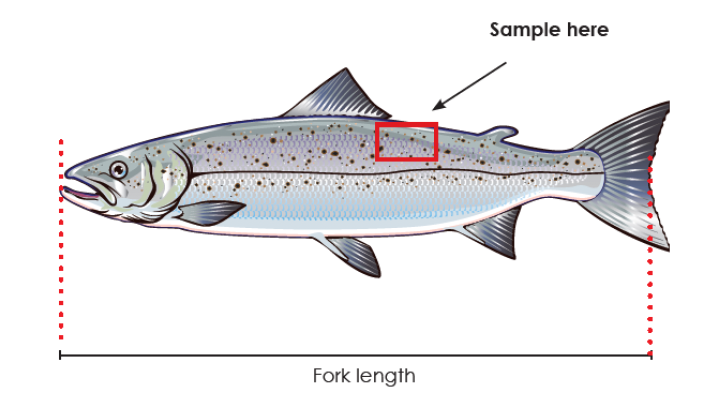
- Fork length (Figure 1) of the fish should be recorded in centimetres to the nearest 0.5 cm either using a measuring board or a tape measure.
- Weight of the fish (ungutted) should be measured in kilograms to the nearest 0.1 kg using a digital balance.
- Presence or absence of sea lice noted.
- For consistency, scales should be taken from the left flank of the fish, from an area immediately behind the dorsal fin and midway between the back of the fish and the lateral line (see Figure 1). Occasionally, in situations where fish may have been sampled previously, consideration instead, should be given to take scales from the right flank, where a higher proportion should be originals.
- A blunt scalpel or a knife blade is used initially in a head to tail direction to remove excess mucus. Then, working in the opposite direction, and by applying more pressure, scales are scraped loose from the fish. Scales may also be removed using forceps. In general, a relatively large sample (10+ scales) is likely to provide more useable scales. Alternatively, for larger fish, dissection forceps can be used to remove individual scales. Scales are transferred from the blade/forceps to a paper scale packet, taking care to clean the instrument between samples.
- For dead fish, a relatively large sample (10+ scales) should be collected.
- For fish that will be returned live to the water, fewer scales should be taken (6-8).
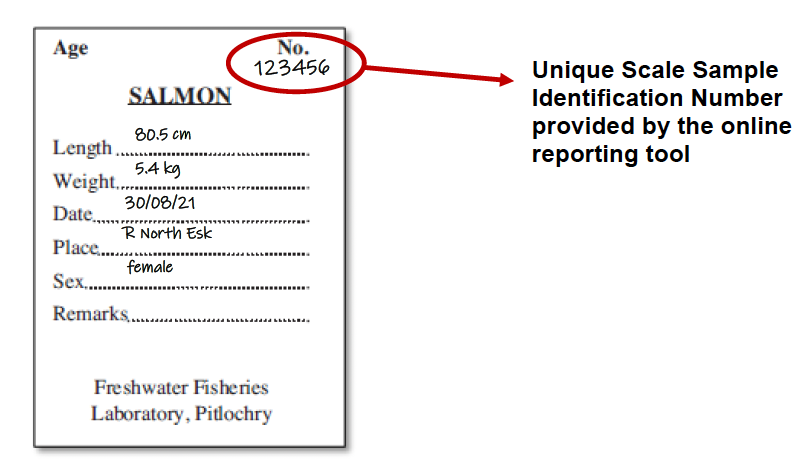
- Each scale packet should be clearly labelled to identify the sample it contains, with details that will help a scale reader interpret growth (length, weight, date, place, sex if known). A unique scale sample identification number will be provided by the online reporting tool when submitting a record; this must be transcribed onto the scale packet to enable linking of the physical and digital record. Scale packets should be allowed to dry fully in open air before being stored and returned to:
Marine Scotland Science
Freshwater Fisheries Laboratory
Faskally, Pitlochry
PH16 5LB
- OPTIONAL: while not required for the National Adult Salmon Sampling Programme, you may wish to take photographs of the fish and there is an option to upload these to the online reporting tool
- Submit data to the online reporting tool available at: National Adult Salmon Sampling Project (Survey123)
Contact
Email: stuart.middlemas@gov.scot