
National Adult Salmon Sampling Project
Report of a project developed by Marine Directorate, Fisheries Management Scotland and local District Salmon Fishery Boards and Trusts to investigate options for sampling adult salmon caught in rod fisheries and scientific netting during 2021-2023.
2. Methods
A standard operating procedure was developed detailing a set of agreed shared practices for the sampling (see Annex 1). These were designed to allow maximum flexibility for local arrangements to be made regarding, for example, how fish would be collected for sampling. Samplers were encouraged to (where possible) select sites:
- From rivers with historic scale sample collections;
- With the best chance of returning a good number of fish;
- As close to the sea as possible.
Samplers were requested to sample both retained and released fish, where appropriate.
Adult salmon were sampled during July-September 2021, June-September 2022 and June-October 2023, with some additional samples provided from May in all three years. Sampling effort was not uniform across the three years but was a function of available funding, with most effort occurring in 2022, followed by 2021 then 2023. Fish were primarily captured by rod angling with some catch and release netting. An on-line GIS based reporting tool was used to allow easy and standardised data collection. The reporting form collected information on the location of capture, fish biometrics, equipment used, photographs and sampler identification. The tool generated a unique code which was written on scale packets. Scale packets were sent to Marine Directorate for pressing, ageing and imaging. Genetic information was extracted from a sub-sample of the scales and used to determine the sex of the individual. This was then compared to the sex noted in the field.
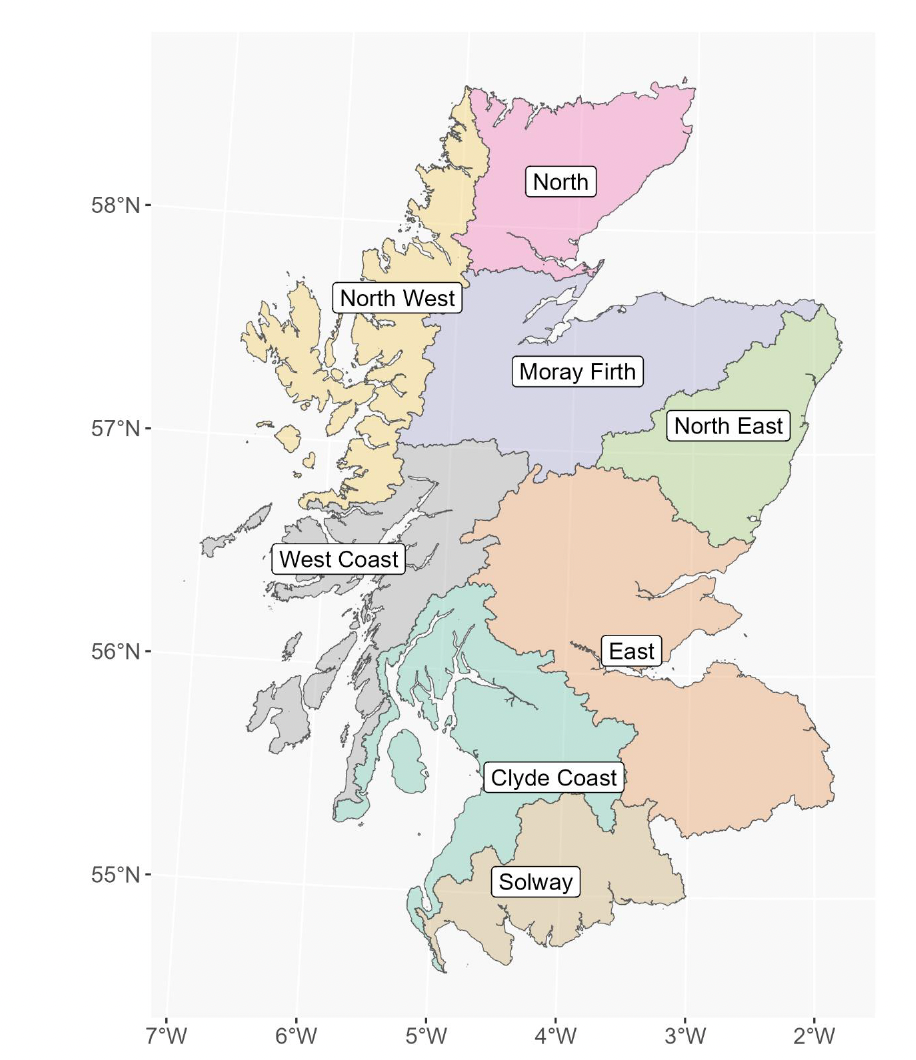
The relatively small number of samples gathered from some areas precludes an in-depth investigation of differences in the ages and sizes of fish sampled in different rivers. The results were therefore aggregated to a regional level (Salmon Fishery Statistical Regions; Figure 1). Further levels of aggregation were used to explore within and between year patterns (Table 1).
|
Coast |
Area |
Regions |
|---|---|---|
|
East |
East |
East |
|
North East |
||
|
North |
Moray Firth |
|
|
North |
||
|
West |
West |
North West |
|
West |
||
|
Clyde |
||
|
Solway |
Contact
Email: stuart.middlemas@gov.scot