
Migration: supporting the future of Scotland's economy and communities
An overview of Scotland’s population and demographic position, the role of migration in supporting population sustainability, economic growth and community resilience, and the Scottish Government’s proposals to help attract, retain and support people to settle in Scotland.
Scotland’s Demographic Position
Scotland’s population is changing in ways that will have significant implications for the country’s economy, workforce, public services and communities, and which highlights the role that the immigration system has to play in supporting Scotland’s demographic profile and economic prosperity.
Recent population statistics show that Scotland is entering a period of slower population growth, population ageing and, ultimately, population decline. At the same time, net migration to the UK has fallen sharply from recent record highs, changing the wider context in which Scotland’s future population and labour market needs must be considered.
The fact that people are living longer is to be welcomed. However, as fewer children are being born and more people are reaching older ages, migration will be increasingly required to support Scotland’s working age population, and thereby support population sustainability, economic growth and community resilience across Scotland.
Population growth is slowing
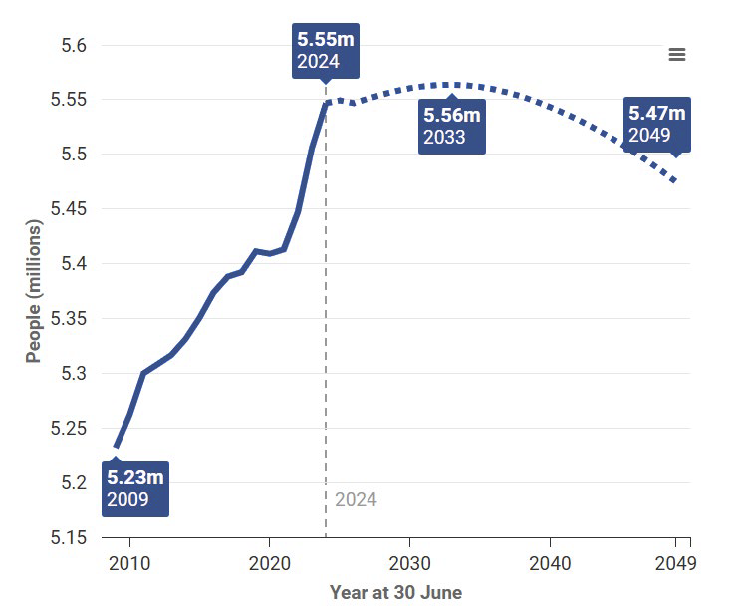
Scotland’s population has grown over recent decades and is currently at a historically high level, increasing from 5.11 million to 5.55 million over the past twenty years. However, the latest National Records of Scotland (NRS) projections suggest this period of growth is coming to an end.
The projections show that Scotland’s total population will remain broadly stable until the early 2030s before entering a period of sustained decline. Between mid-2024 and mid-2033, the population is expected to grow by just 0.3%, reaching approximately 5.56 million. Thereafter, it is projected to fall year-on-year, declining to around 5.47 million by mid-2049, a reduction of 1.3% over the 25-year period since mid-2024.[1]
The principal driver of this trend is negative natural population change driven by the number of deaths outnumbering births, reflecting long-term trends of lower birth rates and an ageing population. While net migration to Scotland is projected to remain positive, it is not expected to continue to offset this decline.
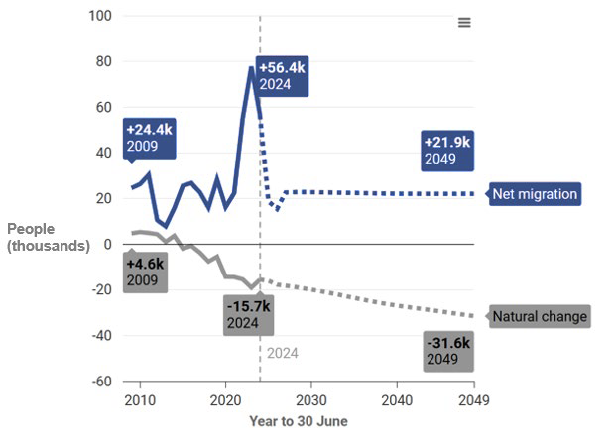
These projections mark an important shift in Scotland’s demographic outlook. Given the projected decline in the level of net migration from recent high levels, future population growth in Scotland can no longer be assumed without a change in policy approach which would bolster levels of inward migration.
Lower migration to the UK
The demographic challenge facing Scotland must also be considered alongside recent changes in UK migration patterns.
Following record levels of migration in 2022 and 2023, UK net migration has fallen sharply. Net migration reached approximately 944,000 in the year ending March 2023, before declining to 331,000 in the year ending December 2024 and falling further to 171,000 in the year ending December 2025. This represents an overall reduction of around 82% from the 2023 peak.
The reduction has been driven primarily by lower numbers arriving on work and study visas, alongside increasing levels of emigration.[4]
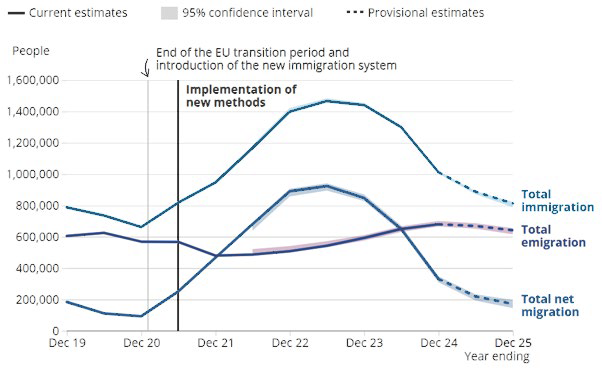
This changing migration picture is particularly significant for Scotland, given that, despite migration levels being projected to remain well below the recent peak, the UK as a whole is not projected to experience population decline below its current level over the coming decades. Consequently, reductions in migration have potentially greater implications for Scotland’s future population growth, workforce availability and economic performance than for other parts of the UK.
Migration from the UK to Scotland
In the year to mid-2025, latest estimates show that 50,200 people moved from the rest of the UK to Scotland, while 41,600 people moved from Scotland to the rest of the UK, resulting in a net migration gain of +8,600 for Scotland.[6]
Recent trends show that Scotland has consistently attracted more people from the rest of the UK than it has lost, with inflows reaching a recent peak in 2021 and remaining relatively high thereafter. Although the number of people leaving Scotland increased in the year to mid-2025, Scotland continued to record a net gain from migration with the rest of the UK, demonstrating its ongoing ability to attract more people than it loses to other parts of the UK.
An ageing population
Alongside projected population decline, Scotland’s population is also expected to become significantly older.
Between mid-2024 and mid-2049, the number of people aged 75 and over is projected to increase by more than 300,000.[7] Over the same period, the number of children aged 0-15 is projected to fall by over 165,000, while the number of young adults aged 16-29 is projected to decrease by almost the same amount, together representing a decline in the number of young people in Scotland of more than 320,000.
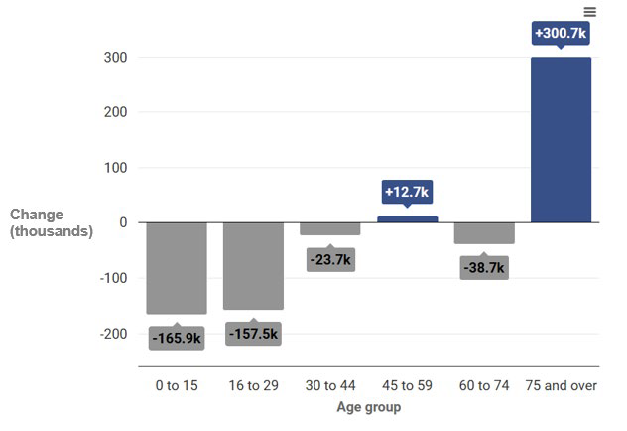
The proportion of Scotland’s population above pension-age is projected to increase from 19.2% in mid-2024 to 22.5% by mid-2049. In contrast, the working-age share of the population is expected to fall slightly from 64.6% to 64.1%.
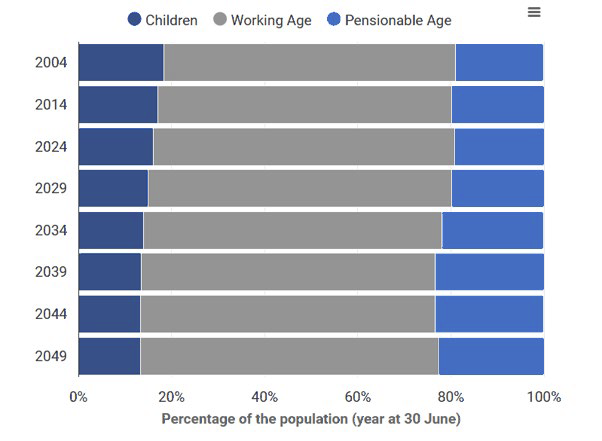
An older population is also likely to mean growing demand for healthcare, social care and other public services, together with increased pressure on the working-age population that supports those services.
Implications for Scotland’s workforce
These demographic changes are already affecting Scotland’s labour market.
Over the coming decades, it is expected that large numbers of workers will retire whilst fewer younger people enter the workforce. Although the projected decline in the working-age population is relatively modest at a national level, the impact is likely to be more pronounced in particular sectors and geographies. For example, recent population estimates show that, over the decade to mid-2025, a number of council areas, including Na h-Eileanan Siar, Shetland Islands and Dumfries and Galloway have experienced declines in both their working-age population and the number of children. At a broader level, population estimates indicate that 20 of Scotland’s 32 local authority areas saw overall population decline during the most recent reporting year.[10]
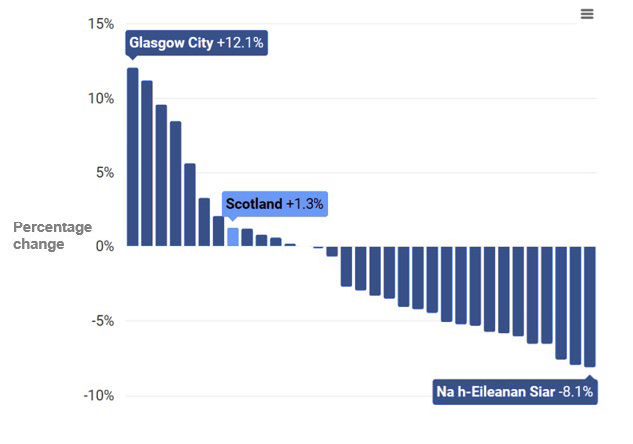
The challenge to support Scotland’s working-age population is not only about skills development, but also about having people available to fill roles. As larger generational cohorts retire, fewer younger workers will be available to take their place. Historically, migration has helped alleviate these pressures by increasing the number of working-age people in Scotland and helping employers meet labour and skills needs across a range of sectors.
Conclusion
Recent population projections reinforce the scale of demographic change that Scotland may undergo in coming decades. Population growth is expected to stall and eventually reverse, the population will become older, and many communities are likely to face growing workforce and service pressures.
At the same time, the sharp decline in UK migration from recent record highs has altered the impact that positive net migration can be expected to have in offsetting domestic population decline. While migration alone cannot reverse all of Scotland’s demographic challenges and is not the only lever available to support population sustainability, workforce growth and public services, the latest evidence suggests that it will become increasingly important in the decades ahead.
Contact
Email: Migration@gov.scot