
Scottish Sentencing and Penal Policy Commission report: Justice That Works
The final report and recommendations of the independent Commission on Sentencing and Penal Policy 'Justice that Works'.
Chapter One: A critical inflection point: sentencing and imprisonment in Scotland – updated trends
In July 2025, we published an interim paper summarising key data and statistical trends on custodial and non-custodial sentencing in Scotland. It outlined sentencing patterns and examined evidence on the use of imprisonment compared with other types of sentences. The paper set out the background and context for the Commission - Scotland’s persistently high prison population and the resulting pressures on prison conditions. For many years, Scotland has had one of the highest prison population rates in Western Europe. The paper also provided an overview of who is imprisoned and how this has changed over time: more men than women; a growing proportion of people convicted of violent and sexual offences; an ageing prison population; fewer admissions and releases; longer sentences; and consistently high remand levels. It highlighted evidence that community-based interventions and sentences are more effective at reducing reoffending than disruptive short prison sentences of less than one year.
The figures below offer a further snapshot of some of the latest published justice data. They do not repeat the information contained in the previous paper. Since then, Scotland’s prison population reached its then highest recorded level of 8441 on the 11th November 2025 and is now significantly over capacity.2 Community justice partners have also been under significant pressure to plan and support tranches of early release to communities. The penal system is at a critical inflection point. The challenges are complex, and the impacts are far-reaching. High incarceration rates and systemic strain have created a justice system that is costly – both in human and economic terms.
Other European nations have implemented sentencing reforms and reduced prison populations without compromising public safety or public confidence. Good practice is observed in nations like Germany, the Netherlands, Finland, Norway, and Spain. Scotland can do the same. Throughout this report, we set out practical, actionable recommendations for change and how these can be achieved. As a way of “bookending” the report, here we start by summarising a snapshot of some of what we do know about sentencing and criminal justice in Scotland. Then, in Chapter Ten, we outline where there are data gaps and recommend where developments are needed to address it. It is difficult to change what we do not know.
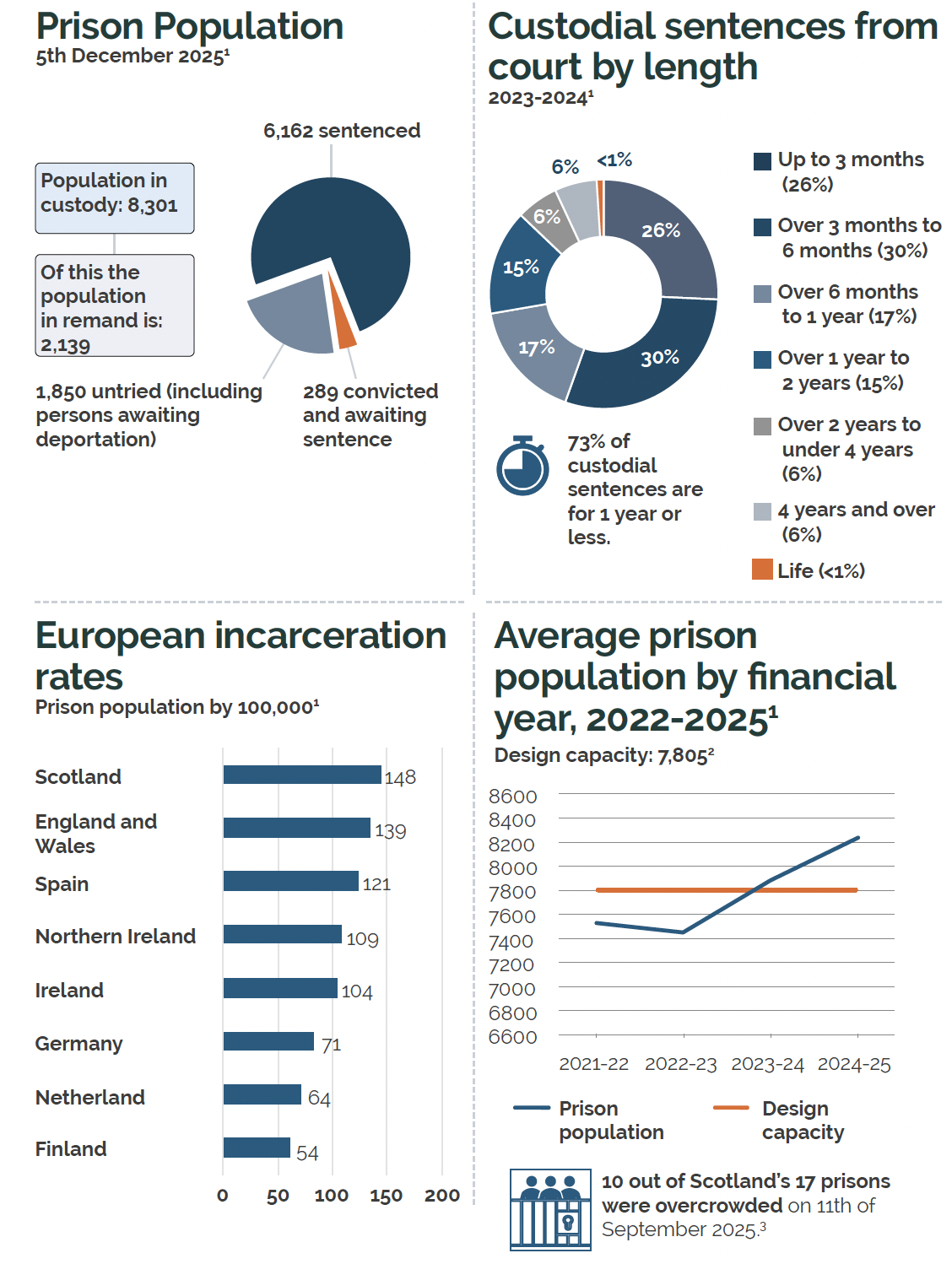
Prison Population (5th December 2025)
- Population in custody: 8,301
- Remand population: 2,139
- Untried (including awaiting deportation): 1,850
- Sentenced: 6,162
- Convicted and awaiting sentence: 289
Custodial Sentences from court by length (2023–2024)
- Up to 3 months: 26%
- Over 3 months to 6 months: 30%
- Over 6 months to 1 year: 17%
- Over 1 year to 2 years: 15%
- Over 2 years to under 4 years: 6%
- 4 years and over: 6%
- Life: <1%
- 73% of custodial sentences are for 1 year or less.
European Incarceration Rates (Prison population per 100,000)
- Scotland: 148
- England and Wales: 139
- Spain: 121
- Northern Ireland: 109
- Ireland: 104
- Germany: 71
- Netherlands: 64
- Finland: 54
Average Prison Population by Financial Year (2022–2025)
- Design capacity: 7,805
2021-22: 7,504
2022-23: 7,422
2023-24: 7,856
2024-25: 8,213
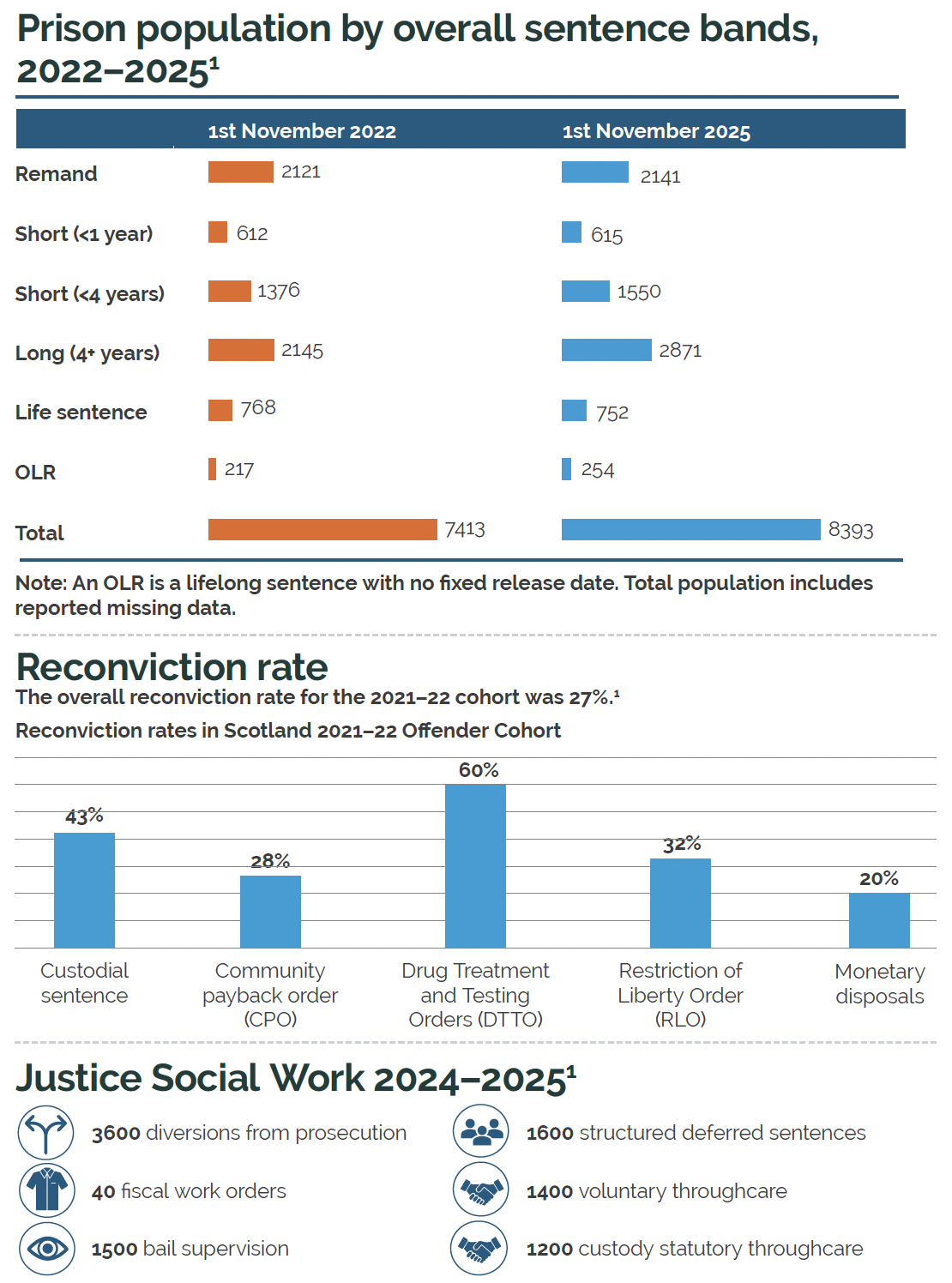
Prison Population by overall sentence bands, 2022-2025
| Date | Remand | Short: <= 1 year | Short: < 4 years | Long: 4+ years | Life | OLR | Total |
|---|---|---|---|---|---|---|---|
| 01 Nov 2022 | 2121 | 612 | 1376 | 2145 | 768 | 217 | 7,413 |
| 01 Nov 2025 | 2141 | 615 | 1550 | 2871 | 752 | 254 | 8393 |
Note: An OLR is a lifelong sentence with no fixed release point. Total population includes reported missing data.
Reconviction Rate (2021–22)
- The overall reconviction rate for the 2021-2022 cohort was 27%.
Reconviction rates in Scotland 2021-2022 Offender Cohort:
- Custodial sentence: 43%
- Community Payback Order: 28%
- Drug Treatment and Testing Order: 60%
- Restriction of Liberty Order: 32%
- Monetary disposals: 20%
Justice Social Work (2024–25)
- 3,600 diversions from prosecution
- 40 fiscal work orders
- 1,500 bail supervision
- 1,600 structured deferred sentences
- 1,400 voluntary throughcare
- 1,200 statutory throughcare
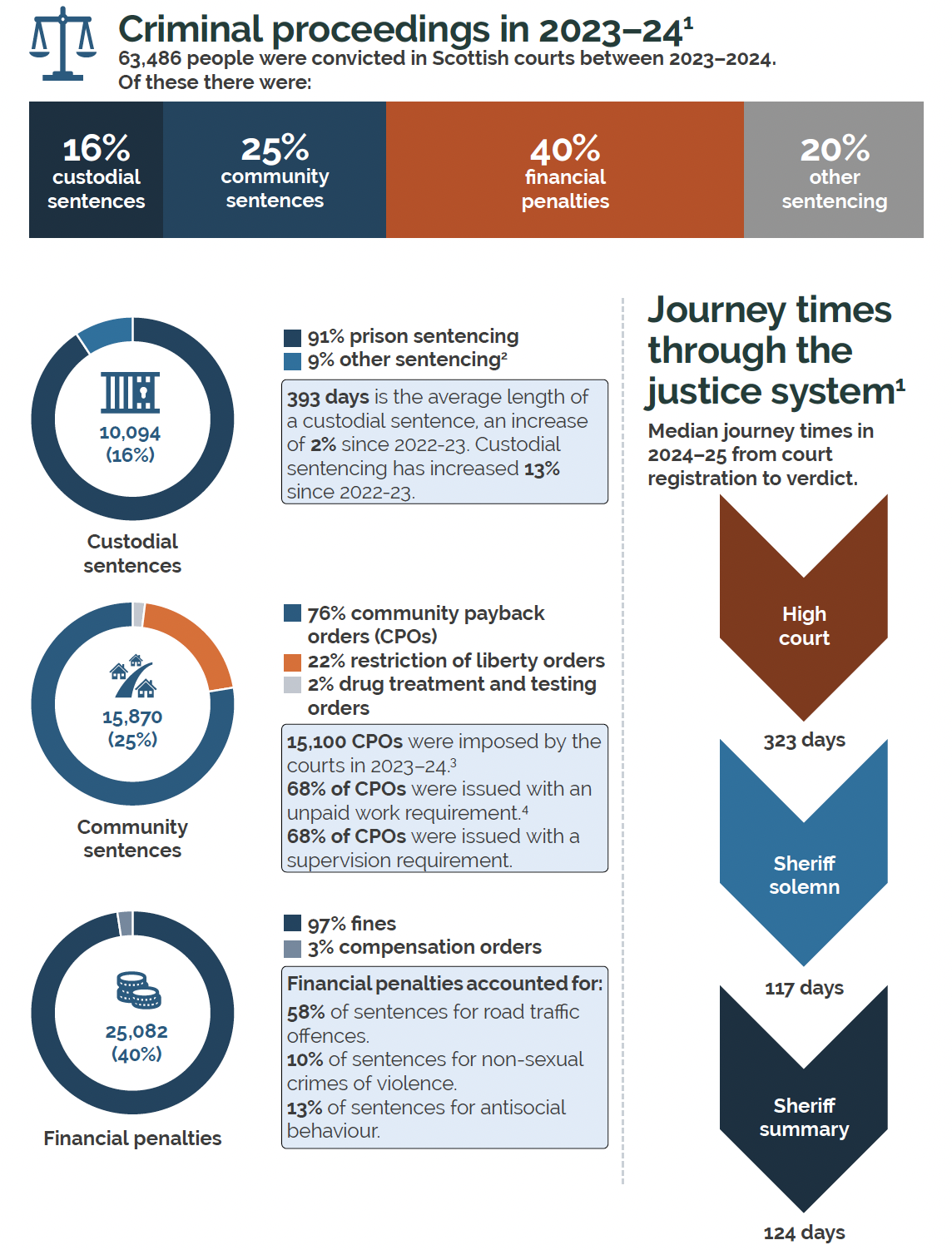
Criminal Proceedings (2023–24)
63,486 people were convicted in Scottish courts between 2023-2024. Of these there were:
- Custodial sentences: 10,094 (16%)
- 91% prison sentencing
- 9% other sentencing
- 393 days is the average length of a custodial sentence, an increase of 2% since 2022-23.
- Custodial sentencing has increased 13% since 2022-23.
- Community sentences: 15,870 (25%)
- 76% community payback orders
- 22% restriction of liberty orders
- 2% drug treatment and testing orders
- 15,100 CPOs were imposed by the courts In 2023-24.3
- 68% of CPOs were issued with an unpaid work requirement.
- 68% of CPOs were issued with a supervision requirement.
- Financial penalties: 25,082 (40%)
- 97 % fines
- 3% compensation orders
- Financial penalties accounted for:
- 58% of sentences for road traffic offences.
- 10% sentences for non-sexual crimes of violence.
- 13% of sentences for antisocial behaviour.
- Other sentencing: 20%.
Journey times through the justice system
Median journey times in 2024-25 from court registration to verdict:
- High Court: 323 days
- Sheriff solemn: 117 days
- Sheriff summary: 124 days
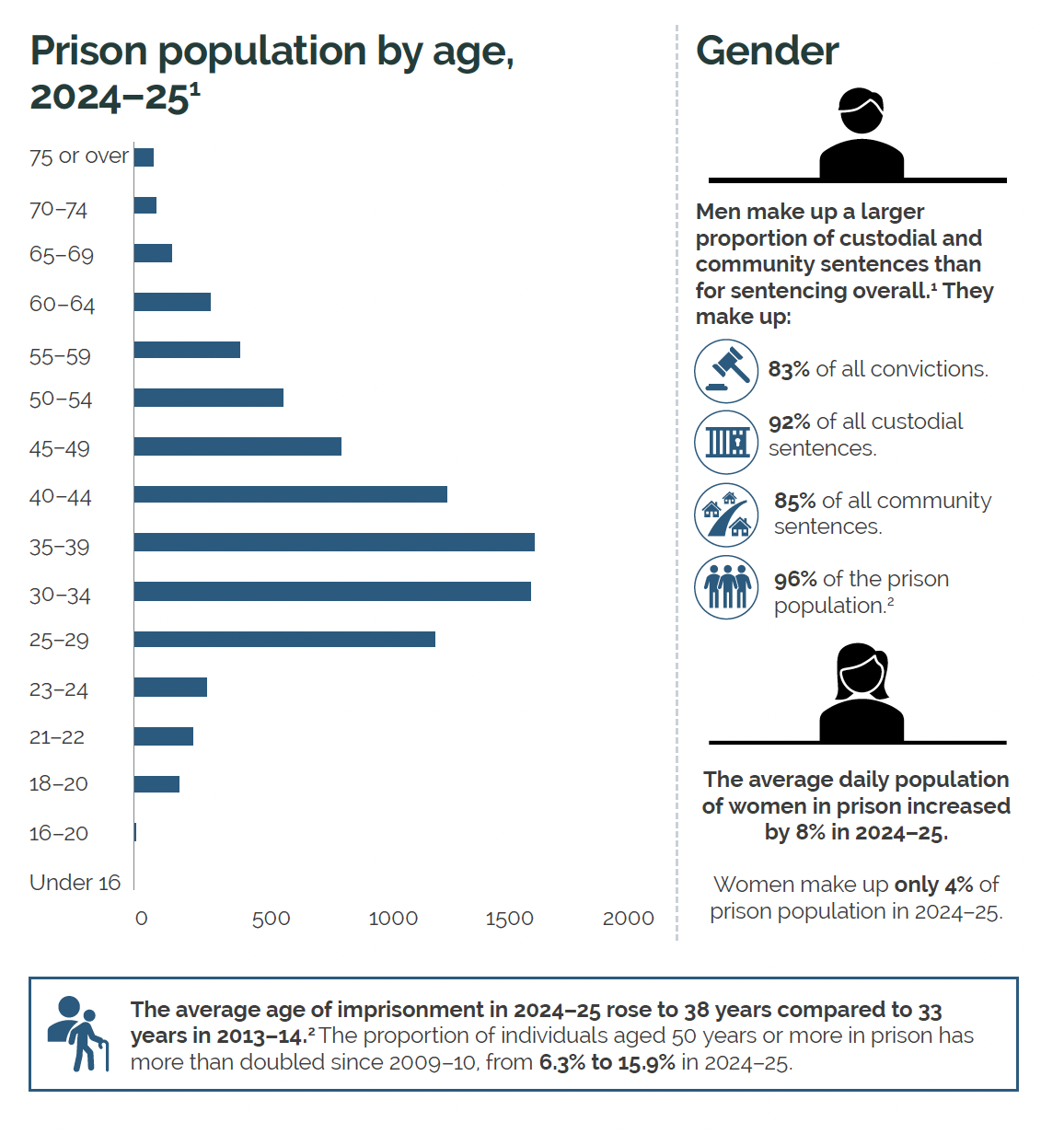
Prison Population by Age (2024–25)
The average age of imprisonment in 2024-25 rose to 38 years compared to 33 years in 2013-14. The proportion of individuals aged 50 years or more in prison has more than doubled since 2009-10, from 6.3% to 15.9% in 2024-25.
| Age | 2024-25 |
|---|---|
| Under 16 | [x] |
| 16-17 | 3 |
| 18-20 | 167 |
| 21-22 | 215 |
| 23-24 | 270 |
| 25-29 | 1,125 |
| 30-34 | 1,486 |
| 35-39 | 1,499 |
| 40-44 | 1,168 |
| 45-49 | 774 |
| 50-54 | 552 |
| 55-59 | 393 |
| 60-64 | 284 |
| 65-69 | 134 |
| 70-74 | 79 |
| 75 or over | 68 |
Gender
- Men make up a larger proportion of custodial and community sentences than for sentencing overall. They make up:
- 83% of all convictions.
- 92% of all custodial sentences.
- 85% of all community sentences.
- ·96% of the prison population.
- The average daily prison population of women increased by 8% in 2024-25.
- Women made up only 4% of prison population in 2024-25.
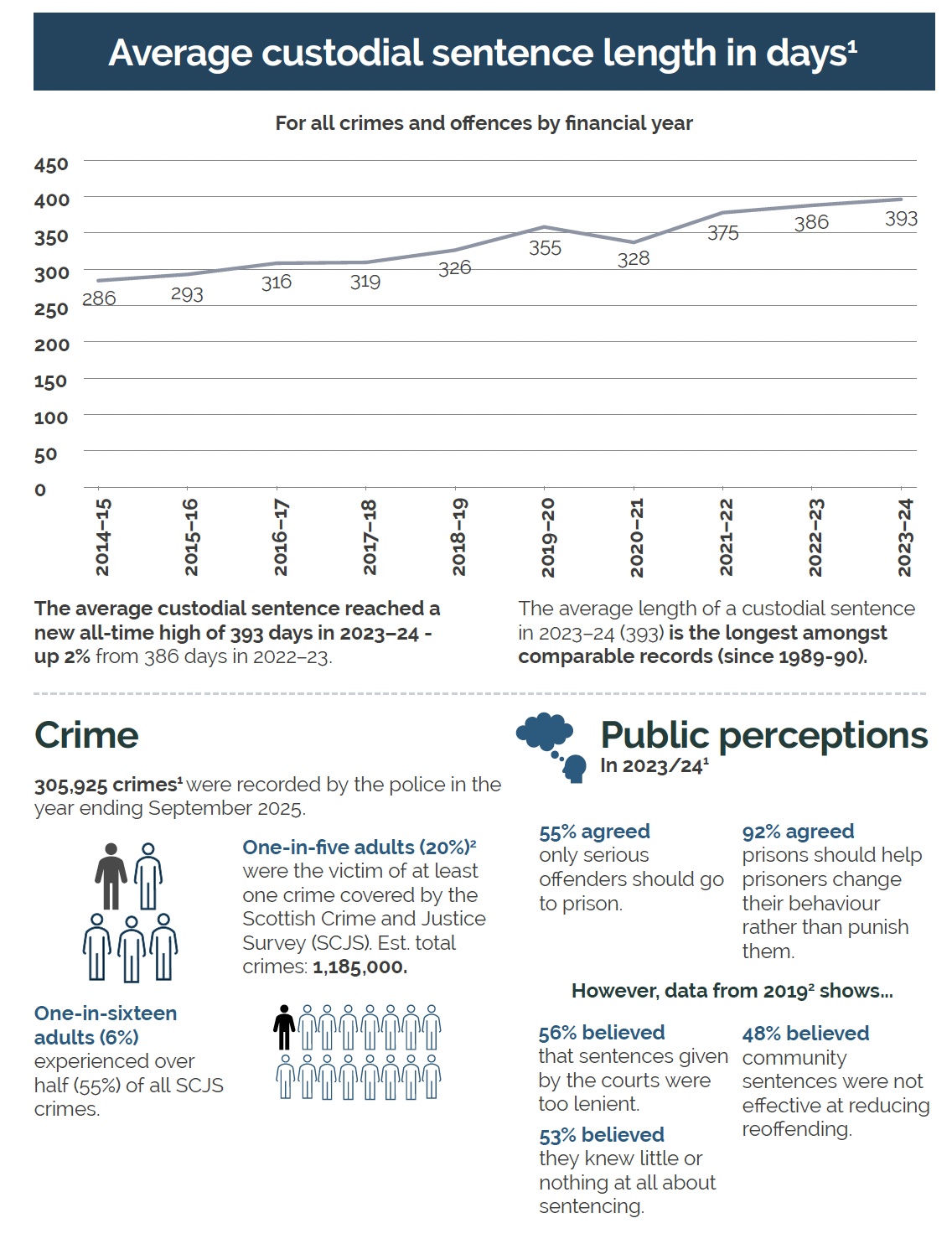
Average Custodial Sentence Length in days
- The average custodial sentence reached a new all-time high of 393 days in 2023-24 - up 2% from 386 days in 2022-23.
| Year | 2014-15 | 2015-16 | 2016-17 | 2017-18 | 2018-19 | 2019-20 | 2020-21 | 2021-22 | 2022-23 | 2023-24 |
|---|---|---|---|---|---|---|---|---|---|---|
| All crimes and offences | 286 | 293 | 316 | 319 | 326 | 355 | 328 | 375 | 386 | 393 |
- The average length of a custodial sentence in 2023-24 (393) is the longest amongst comparable records (since 1989-90).
Crime
- 305,925 crimes were recorded by the police in the year ending September 2025.
- One-in-five adults (20%) were a victim of at least one crime covered by the Scottish Crime and Justice Surve (SCJS). Est. total crimes: 1,185,000.
- One-in-sixteen adults (6%) experienced over half (55%) of all SCJS crimes
Public Perceptions (2023–24)
- 55% agreed that only serious offenders should go to prison.
- 92% agreed prisons should change their behaviour rather than punish them.
Earlier data from 2019 shows:
- 56% believed that sentences given by the courts were too lenient.
- 53% knew little or nothing at all about sentencing
- 48% believed that community sentences were not effective at reducing reoffending.
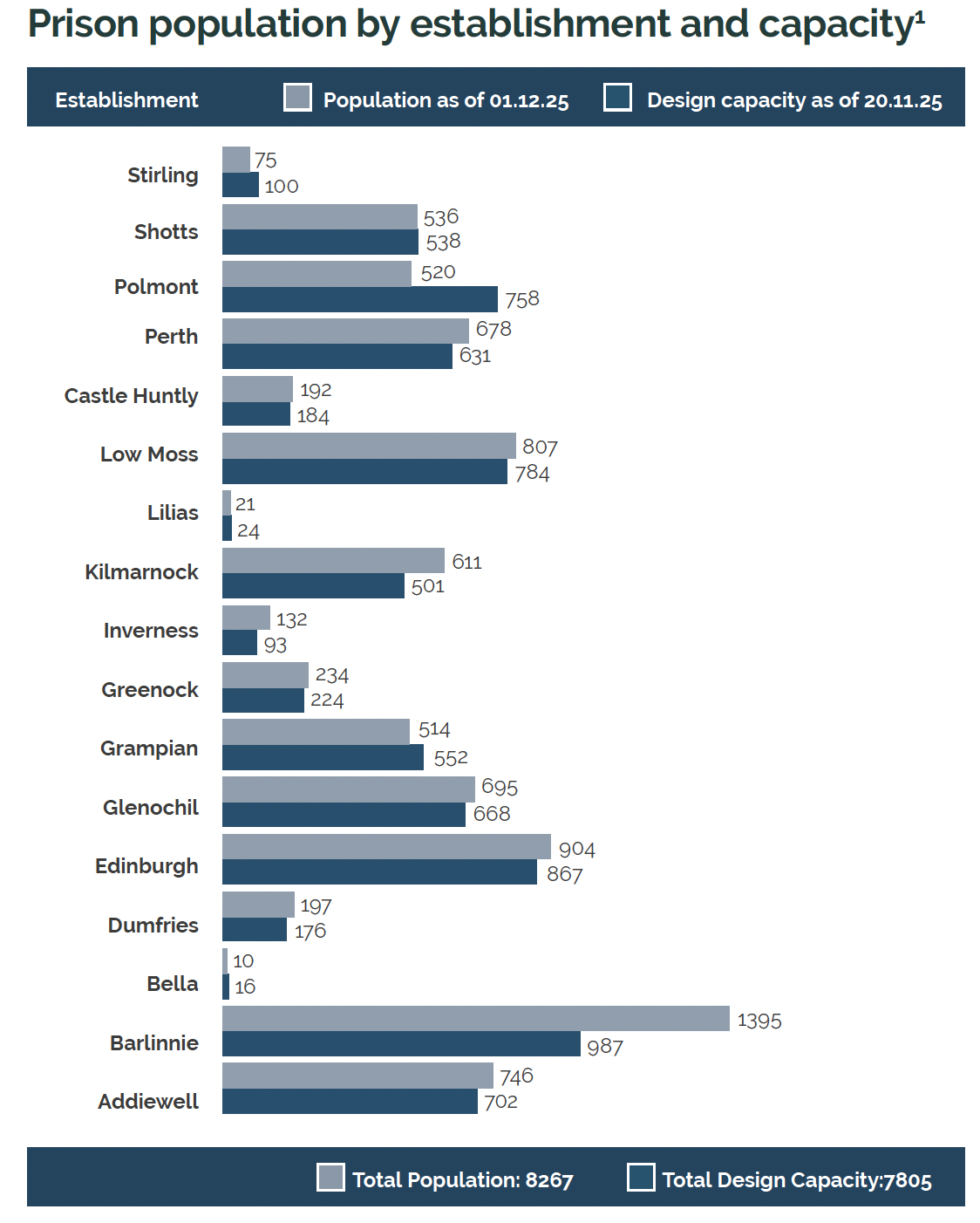
Prison Population by Establishment and Capacity (Dec 2025)
Total population as of 1.12.25: 8267
Total design capacity as of 20.11.25: 7805
| Establishment | Current Population as of 1.12.25 | Design Capacity as of 20.11.25 |
|---|---|---|
| Addiewell | 746 | 702 |
| Barlinnie | 1395 | 987 |
| Bella | 10 | 16 |
| Dumfries | 197 | 176 |
| Edinburgh | 904 | 867 |
| Glenochil | 695 | 668 |
| Grampian | 514 | 552 |
| Greenock | 234 | 224 |
| Inverness | 132 | 93 |
| Kilmarnock | 611 | 501 |
| Lilias | 21 | 24 |
| Low Moss | 807 | 784 |
| Castle Huntly | 192 | 184 |
| Perth | 678 | 631 |
| Polmont | 520 | 758 |
| Shotts | 536 | 538 |
| Stirling | 75 | 100 |
| TOTALS | 8267 | 7805 |
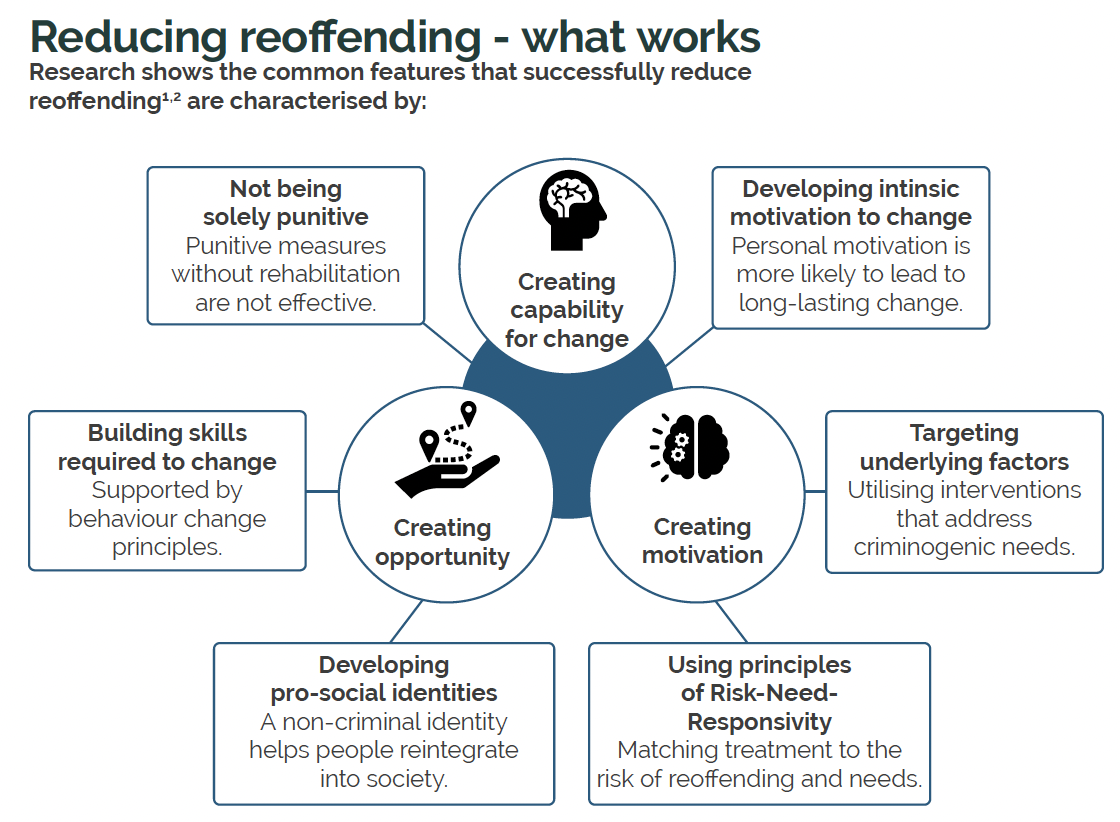
Reducing Reoffending – What Works
Research shows the common features that successfully reduce reoffending are characterized by:
- Creating capability for change
- Creating opportunity
- Creating motivation
- Not being solely punitive: Punitive measures without rehabilitation are not effective.
- Building skills required for change: Supported by behaviour change principles.
- Developing intrinsic motivation to change: Personal motivation is more likely to lead to long-lasting change.
- Targeting underlying factors: Utilizing interventions that address criminogenic needs.
- Using principles of Risk‑Need‑Responsivity: Matching treatment to the risk of reoffending and needs.
- Developing prosocial identities: A non-criminal identity helps people reintegrate into society.
Sources
Prison population in September 2025. 1. Scottish Prison Service. Prison Population – Updated 5 December 2025. 2025. Custodial sentences by length. 1. Scottish Government. Criminal Proceedings 2023-24. 2025. European Incarceration Rates. 1. World Prison Brief Europe. World Prison Brief data - Europe. 2025 Average prison population by financial year, 2022-2025. 1. Scottish Government. Scottish Prison Population Statistics 2024-25. 2025. 2. Scottish Parliament. Written question and answer. Question reference: S6W-42026. 2025. 3. HMIPS. Letter to Cabinet Secretary – Overcrowding – September 2025. 2025. Prison Population by overall sentence bands, 2022-2025. 1. Scottish Government. Safer communities and justice statistics monthly reports: Scottish Government SPS Management Information collection. 2025. Criminal Proceedings 2023-24. 1. Scottish Government. Criminal Proceedings 2023-24. 2025. 2. Scottish Government. Community Payback Orders – Unpaid Work or Other Activity Requirements – February 2025. 2025. 3. Scottish Government. Justice Social Work Statistics in Scotland: 2023-24 – Part 2. 2025. Journey through the Justice System. 1. Scottish Government. Journey Times through the Scottish Justice System. 2025. Reconviction rate. 1. Scottish Government. Reconviction rates in Scotland 2021-22 Offender Cohort. 2025. Justice Social Work 2024-25. 1. Scottish Government. Justice Social Work Statistics in Scotland: 2024-25 – Part 1. 2025. Prison Population by age. 1. Scottish Government. Scottish Prison Population Statistics 2024-25. 2025. 2. Scottish Government. Criminal Proceedings 2023-24. 2025. Gender. 1. Scottish Government. Criminal Proceedings 2023-24. 2025. 2. Scottish Government. Scottish Prison Population Statistics 2024-25. 2025. Average custodial length in days. 1. Scottish Government. Criminal Proceedings 2023-24. 2025. Prison population by Establishment and Capacity. 1. Scottish Parliament. Question reference: S6W-42026. 2025. Crime. 1. Scottish Government. Safer Communities and Justice Statistics Monthly Data Report: September 2025. 2025. 2. Scottish Government. Scottish Crime and Justice Survey 2023/24: Main findings. 2025. Public Perceptions. 1. Scottish Government. Scottish Crime and Justice Survey 2023/24: Main findings. 2025. 2. Ipsos Mori. Public Perceptions of Sentencing by Scottish Courts. 2019. Reducing reoffending – what works. 1. Ministry of Justice. Reducing Reoffending: A Synthesis of Evidence of Interventions. 2025. 2. Scottish Government. What Works to Reduce Reoffending: An update of the evidence on Imprisonment and Community Disposals. 2025.
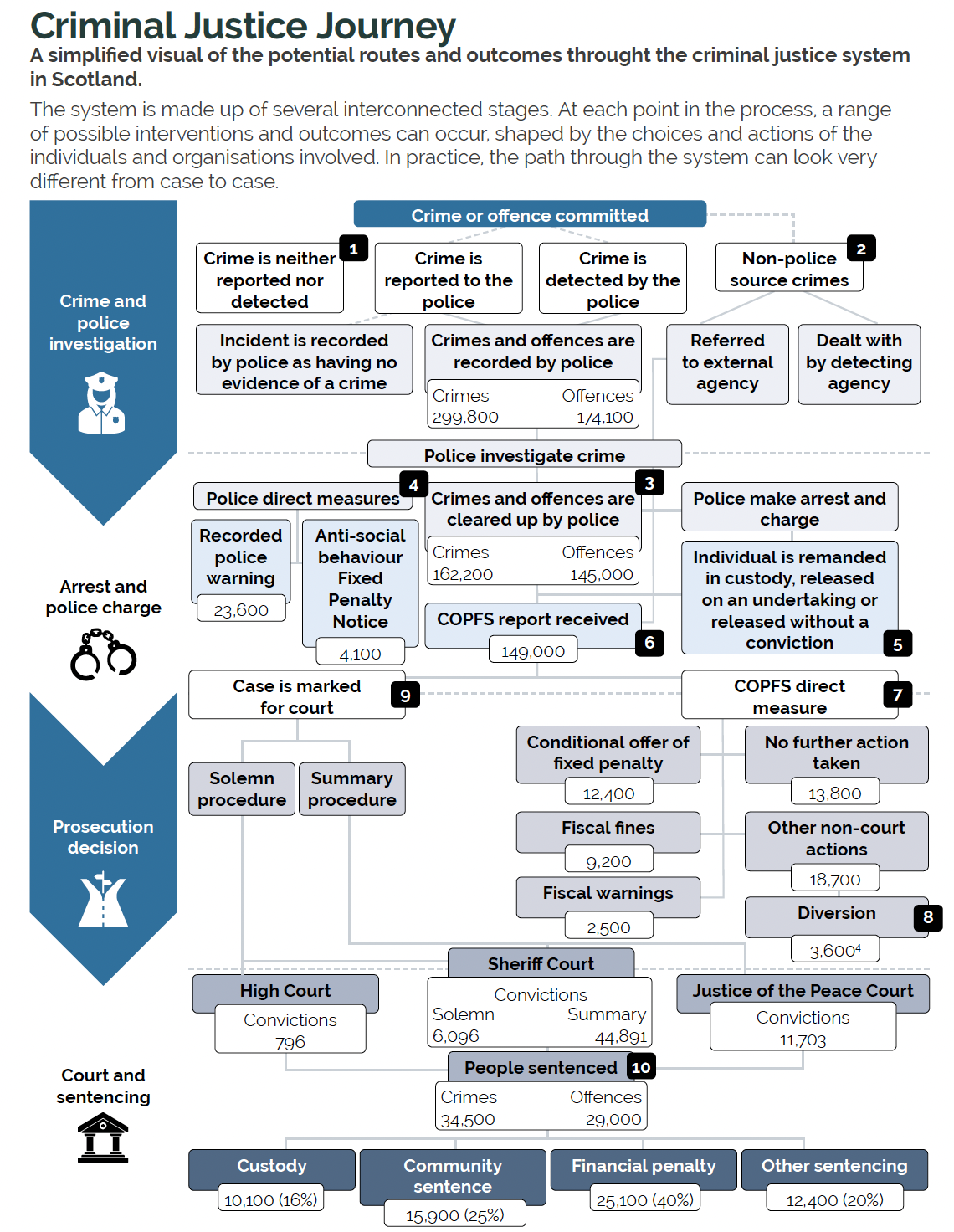
Criminal Justice Journey Summary
A simplified visual of the potential routes and outcomes through the criminal justice system in Scotland.
The system is made up of several interconnected stages. At each point in the process, a range of possible interventions and outcomes can occur, shaped by the choices and actions of the individuals and organisations involved. In practice, the path through the system can look very different from case to case.
Crime and police investigation
A crime or offence is committed.
Crime is neither reported nor detected; crime is reported to the police, crime is detected by the police, non-police source crimes (referred to external agency; dealt with by detecting agency)
Incident is recorded by police as having no evidence of a crime; crimes and offences are recorded by police (299,800 crimes, 174,100 offences).
Arrest and police charge
Police investigate crime
Crimes and offences are cleared up by police
- Crimes (162,200); Offences (145,000)
Police make an arrest and charge
- Individual is remanded in custody, released on an undertaking or released without a conviction
Police direct measures
- Recorded Police Warning (23,600); Anti-social behaviour fixed penalty notice (4,100)
COPFS report received (149,000)
Prosecution and decision
Case is marked for court
- Solemn Procedure
- Summary Procedure
COPFS direct measure
- No further action (13,800)
- Other non-court actions (18,700)
- Diversion (3,600)
- Conditional offer of fixed penalty (12,400)
- Fiscal fines (9,200)
- Fiscal warnings (2,500)
Court and Sentencing
- High court convictions (796)
- Sheriff Court convictions (Solemn 6,096; Summary 44,891)
- Justice of the Peace Court convictions (11,703)
People sentenced
Crimes (34,500); Offences (29,000)
Custody (10,100 – 16%)
Community sentence (15,900 – 25%)
Financial penalty (25,100 – 40%)
Other sentencing (12,400 – 20%)
Criminal Justice Journey (continued)
1. It is estimated that around 21% of crimes are reported.²
2. Examples of non-police source crimes are tax evasion or customs offences.
3. A crime is regarded as “cleared up” where there is sufficient evidence for criminal proceedings.
4. Police direct measures are at the discretion of the police and are not mandatory. It does not result in a criminal conviction for the offender. ASB FPNs can be issued by the police for a limited range of offences, such as antisocial behaviour and alcohol related offences. 5 W here an individual with a vulnerability is identified, such as substance dependence or poor mental health, there is an opportunity for arrest referral.³
6. If a report is sent to Crown Office and Procurator Fiscal Service (COPFS), the prosecutor will “mark” the case to decide how it proceeds.
7. Where the procurator fiscal considers that action is necessary but that prosecution may not be required, a COPFS direct measure can be taken.
8. A diversion may be utilised when the offender is identified to have an underlying need that has contributed to offending.
9. Cases marked for court can either be solemn, reserved for more serious criminal cases, or summary, reserved for less serious cases. The High Court deals with the most serious solemn cases.
10. A custodial sentence can be determinate i.e. for a specified period, or indeterminate, for example a life sentence or an Order for Lifelong Restriction (OLR). The main form of community sentence is a Community Payback Order (CPO). Most financial penalties in 2023-24 were fines. “Other sentencing” includes admonition,⁵ which is recorded as a conviction.
Sources: 1. Scottish Government. Criminal Proceedings in Scotland 2023–24. 2025; 2. Scottish Government. Scottish Crime and Justice Survey 2023/24. 2025; 3. Community Justice Scotland. Arrest Referral – Template for Completion by Community Justice Partnerships. 2020; 4. Scottish Government. Justice Social Work Statistics in Scotland: 2024–25 – Part 1. 2025; 5. Scottish Government. Self-disclosure of previous convictions and alternatives to prosecution: guidance. 2020.
For a more detailed overview of every stage of the Scottish Justice System, see Scotland’s Justice System – Community Justice Scotland.