
International review of approaches to tackling child poverty: Denmark
A historical review of evidence on Denmark's approach to tackling child poverty, drawing out the key lessons for Scotland.
2. Overview of child and family policy in Denmark
Denmark has a comprehensive social welfare system, with child and family policies forming a key element of several areas of social insurance and Government provision. There are three main components of universal family policy in Denmark:
- comprehensive childcare provision for children between 0-5 years of age;
- parental leave; and
- child and youth benefit.
Additionally, at-risk groups receive additional support through three other tax and benefit policies:
- child supplements that recognise the additional cost of specific circumstances and vulnerabilities, including single parents, parents with multiple births, older parents, the death of a parent, unknown paternity and adoption;
- an employment allowance for single parents; and
- a temporary child subsidy for those impacted by the social assistance benefit ceiling (which has since become permanent).
Alongside this, social assistance provides comprehensive – but conditional – support to ensure a minimum standard of living for residents who are unable to work. This system includes additional supports for parents.
As well as family policy through the social welfare system, Denmark also combines a system of collective bargaining within a flexible, unregulated labour market. This sits alongside a generous insurance-based unemployment benefit and well-developed active labour market policies to support and maintain high labour market participation rates. Together, these policies are the three pillars of Denmark’s so-called Flexicurity Model.
This section provides details on these policies and their relevance to reducing and/or preventing child poverty in Denmark today. Where relevant, the wider historical context for the introduction and / or reforms of these policies over time is also explored.
Childcare
Denmark was an international frontrunner in formal childcare provision in the mid-1960s. As a result of this long history, Denmark is renowned internationally for providing high-volume, high-quality childcare for children between 0-5 years of age that is universally available and affordable. Within Denmark, the childcare system is a flagship policy with broad cross-party political consensus and high levels of support among the public and key stakeholders.[41]
Childcare policy has been in a constant state of development and reform since the first comprehensive national legislative framework on childcare in 1964. However, the four core aims of this initial national framework continue to underpin policy development and approaches. The four core aims are to:[42]
- advance children’s well-being and learning;
- give families the flexibility and options of distinct forms of childcare along with financial support to organise their work–life balance according to their needs;
- prevent negative social inheritance and social exclusion; and
- ensure that age-appropriate childcare matches children’s needs.
Since 2006, Danish parents pay no more than 25% of total childcare costs for children between 0-5 years of age, with at least 75% covered by a municipality subsidy (which is funded by central Government). This was reduced from an initial 35% cap introduced in 1976.[43] In 2024, only families with a household income above DKK 622,200 paid the 25% upper limit fee. This is broadly in line with the average post-tax income of a family with children (DKK 696,400).[44] For families with a household income below this upper limit, an income-based subsidy is provided. This is a complex system that is not only based on pre-tax household income which is annually uprated, but it also takes into account family circumstances, as outlined below:[45]
- Those on the lowest incomes (below DKK 200,301 in 2024) have the cost of childcare fully subsidised.
- Incomes of DKK 200,301 to DKK 204,741 pay 5% of fees.
- Incomes from DKK 204,741 to DKK 622,200 see their payments increase by 1 percentage point for every income increment of DKK 4,441.
- Single parents receive an additional discount on the above income limits of DKK 67,719.
- Families with multiple children also receive additional support, with the income limits increasing by DKK 7,000 for each child living at home under the age of 18. Additionally, if a family has more than one child in childcare, the full price is charged for the child in the most expensive childcare facility and half the price is charged for all remaining children.
As a result of the subsidy scheme, 2021 OECD data suggests that a Danish couple spends 9% of their family income on net childcare costs, while a single parent in Denmark spends just 2% of their income. In contrast, as a proportion of their income, a UK couple spends more than double on net childcare cost compared with a Danish couple (22%). That gap widens even further when comparing British and Danish single parents’ net childcare costs as a proportion of their income. A UK single parent spends seven times as much (14%) as a Danish single parent (2%) does on net childcare costs.[46]
The universal nature of the childcare system in Denmark has developed since the mid-1970s. In 1976, Denmark introduced a childcare guarantee that placed an obligation on municipalities to provide childcare for working families, with the explicit aim of helping parents reconcile work and care responsibilities.[47] This was especially beneficial for mothers as, by the end of the 1970s, Denmark had already met existing EU targets on childcare coverage and female labour force participation.[48] In 2004, the childcare guarantee was legislatively updated to provide all children from 26 weeks old – regardless of their parents’ employment status – the right to a full-time childcare place. This 2004 legislation formalised arrangements many municipalities had already put in place since the 1990s to expand their childcare provision beyond just working parents.[49] This 2004 legislation has provided the basis for Denmark’s universal childcare offering to this day.
Alongside the guarantee, changes were introduced during the 2000s to expand parental choice over what childcare provision they could access. This included a 2003 Free Choice scheme which legally obliged municipalities to provide the subsidy for any childcare provision that parents opted for, including private childminders, private daycare or cash-for-care/home-based care schemes in additional to public childcare facilities.[50] However, the size of the private and home-based childcare sector in Denmark is small. In 2023, just 9,456 children were in subsided private childcare facilities and 2,437 children received subsided home-based care,[51] compared with the 262,501 children in public childcare facilities in 2023.[52]
Thanks to its extensive subsidy and the guarantee, the Danish childcare system’s affordability and universality mean that participation rates are high. In 2024, 81.6% of one- to two-year-olds and 94.4% of three- to five-year-olds were in formal childcare for at least 25 hours a week – the highest coverage rates in the EU.[53] In addition, the universality and affordability of the Danish childcare system mean it is well positioned to support low-income families, with 82% of children at-risk of poverty receiving at least 25 hours a week of formal childcare in 2023 – significantly above the EU average of 59%.[54]
Denmark’s public spending on childcare has consistently been one of the highest in the EU and OECD. This is unsurprising given the generosity of the subsidy scheme and the extent of the childcare sector. Denmark’s public spending on childcare has consistently been above 1% GDP on childcare since at least the early-1990s, with 1.1% of GDP spent in 2022.[55] By contrast, latest OECD figures from 2019 shows that the UK’s public spending on childcare was just 0.04% of GDP.[56]
Before and after school provision[57]
Following on from childcare for children 0-5 years of age, schools in Denmark provide an optional before and after school programme (BASP) to support parents of school-age children enter or remain in full-time work. The school day in Denmark begins at 8am and finishes at 2pm, and the BASP operates from 6.30am until 8am before school, and from 2pm until 5pm after school. Typically, more children make use of after school provision than before school provision.
The BASP is divided into four age categories:
- Kolefritidsordning (SFO) for children 6-10 years.
- Fritidsklub for children 10-11 years.
- Juniorklub for children 12-14 years.
- Ungdomsklub 14-18 years.
Each programme provides staff-led, age-appropriate activities and care for children that includes sports, indoor crafts and games, music and reading. Children also receive drinks and snacks. The BASP also operate as a holiday club outside of term time, which can involved day trips in addition to regular activities. Most schools usually have specially designed areas for BASP, and activities are provided by special educators, not school teachers.
Parents have to pay for their child to attend BASP, with the exception of Ungdomsklub which is provided for free. Fees varies between schools and municipalities, but typical monthly fees are:
- SFO afternoon club: DKK 1,665-DKK 2,000.
- SFO Morning club: DKK 150-DKK 400.
- Fritidsklub and Juniorklub: No more than DKK 450.
- Holiday club: No more than 470 kroner per month, although fees in July are usually higher.
As with childcare for 0-5 years olds, a subsidy is provided for low-income households and additional discounts for families with multiple children or who are single parents.
Parental leave
Parental leave laws in Denmark have a long history stretching back to 1901, when women working in factories were entitled to four weeks of leave.[58] In 1960, the statutory right to maternity leave was extended to almost all women in the workplace, and the leave entitlement itself was extended to 14 weeks.[59] Maternity leave was expanded again in 1984 to 26 weeks, and a series of other parental leave reforms extending the leave entitlements and levels of compensation were enacted throughout the 1990s and early-2000s, which ultimately saw a family’s paid parental leave extended to one year (52 weeks).[60]
While on parental leave, all employees and self-employed people are entitled to a cash benefit paid by the Government based on former earnings, up to a limit of DKK 4,695 per week in 2024. However, under collective agreement or individual work contracts, full earnings for employees can be paid during leave.[61] As discussed in more detail below, coverage by collective agreements is high in Denmark.
A significant reform to the parental leave system was introduced in 2022, with the intention of simplifying and equalising the parental leave system by providing each parent with 24 weeks of parental leave after the birth of a child. Before the birth of a child, mothers are also entitled to an additional four weeks of leave. Following birth, both parents have two weeks of non-transferable leave (compulsory for the mother) and another nine weeks of non-transferable leave that may be taken at any time up until the child’s first birthday. Each parent then has up to 13 weeks they can use themselves, or transfer to the other parent if they wish.[62]
The 2022 reforms also introduced a different parental leave system for single parents. In the case where a single parent does not have shared custody of their child, they have the right to 46 weeks of leave. From January 2024, single parents have also been able to transfer up to 13 weeks of leave to another close relative (for example, a grandparent) who is termed a ‘social parent’. If parents separate during a child’s first year, they have the same parental leave rights as when they were a couple.
The total number of weeks of leave per family since the 2022 reform is the same as the previous system (48 weeks), but the reform is designed to increase the number of non-transferable weeks for the father. This has had an impact, with the average number of days of parental leave fathers took in August-December 2022 increasing compared to the same period in 2021 from 37.9 days to 62.4 days.[63] Until these reforms, Denmark was unusual among Nordic countries for not having earmarked parental leave for fathers.[64] Indeed, two weeks’ paternity leave introduced in 1998 was abolished in 2002 in favour of extending the total parental leave period from 26 to 52 weeks. This was on the grounds that this allowed parents greater flexibility and autonomy in deciding how they divided the leave.[65]
The Danish parental leave system is also notable for a high degree of flexibility. For example, each parent can request that parental leave is extended to 40 or 46 weeks, and it is possible to return to work on a part-time basis over this extended period of leave. This extension does reduce the cash benefit payment. In addition, each parent has the right to postpone five weeks of parental leave that can be taken at any point until their child is nine years old, with up to five weeks also transferable to the other parents.[66] This flexibility is designed to allow parents to make the right choices for them in balancing home and work life, and at different stages of their child’s life.
Child and youth benefit
Since 1986, families with dependent children have received child benefits in Denmark. The benefit was introduced as part of wider tax reforms to improve the living standards of families with children, and it was originally intended to act as a form of tax relief for families with children who were subject to income tax.[67]
Child benefit has developed since then. All families in Denmark with children below the age of 18 are now eligible for child benefit. Currently, the amount of child and youth benefit is age-dependent, with higher awards for younger children. This recognises the additional cost of raising young children. For children aged from 0-14, the benefit is paid out in quarterly amounts, while for children aged 15-17 the amount is paid out monthly.[68]
Age group |
DKK quarterly amount (2024) |
|---|---|
0-2 |
5,124 |
3-6 |
4,056 |
7-14 |
3,192 |
15-17 (youth benefit) |
3,192 |
Child benefit in the UK is administered differently to Denmark; the payment level is not differentiated by age, but varies depending upon the number of children, with a higher amount for the first child and a lower amount for additional children. From April 2025, the amount of UK child benefit for the first child is equivalent to DKK 3,072 per quarter and for additional children is equivalent to DKK 2,000 per quarter. Both of these amounts are lower than the lowest child benefit paid in Denmark for children aged over seven years.
To qualify for full award of child benefit in Denmark, parents need to have lived or worked in Denmark for at least six of the previous 10 years. The benefit amount is tapered depending on the length of time lived or worked in Denmark.[69]
Total period in which you have lived or worked in Denmark (within the past 10 years) |
Percentage of the benefit which you are entitled to receive |
|---|---|
6 months |
8.3% |
1 year |
16.7% |
1.5 years |
25% |
2 years |
33.3% |
2.5 years |
41.7% |
3 years |
50% |
3.5 years |
58.3% |
4 years |
66.7% |
4.5 years |
75% |
5 years |
83.3% |
5.5 years |
91.7% |
6 years or more |
100% |
Child benefit has been through several significant reforms since its introduction, some of which have since been repealed. They are summarised here:
- The benefit was originally a flat payment regardless of the age of children, but in 1990 the rate was divided into a rate for 0-3 years and a rate for ages 4-17. In 1995, the current three-rate system was introduced for 0-2 years, 3-6 years and 7-18 years. In 2011, a new youth benefit was introduced that effectively split the 7-18 rate into a 7-14 rate and a 15-17 rate with different payment structures.[70]
- As part of austerity measures introduced in 2011 in light of the economic impact of the Great Recession, the Government imposed an annual cap of DKK 35,000 (increased from the original DKK 30,000 proposal) and a 5% cut in child benefit.[71] The cap was set at this level to, effectively, introduce a two-child limit within the child benefit system: in 2011, the mean level of benefit for a three-child family was DKK 35,027.[72] The cap was intended to be implemented gradually over three years, with affected families facing a cut of a third in 2011, two-thirds in 2012, and a full cut in 2013. However, the cap was repealed in 2012 by a newly-elected centre-left Government due to the disproportionate impact on large families.[73] Despite only being in effect for a short period of time, an economic analysis found that the reform led to a significant increase in the labour supply of mothers.[74]
- In 2014, child benefit was means-tested so that high-income families would see their award reduced by 2% of the portion of income exceeding a threshold. In 2024, this amounted to DKK 882,700 for each parent (the top tax base).[75]
- In 2022, child and youth benefit was reformed so that both parents received an equal split of the benefit. This includes separated parents who had joint custody agreements. Statistics Denmark has noted that this almost doubled the number of recipients of the benefit, but effectively halved the average benefit paid compared to the previous years.[76]
Additional support for single parents
In Denmark, 29% of households with children are single parents. This is one of the highest shares of single-parent households in the EU.[77] We have already seen how Denmark’s childcare, parental leave and child benefit have tailored elements to support single parents. In addition, single parents in Denmark are supported additional through the social security system with a specific child supplement, but also through the tax system as a way to encourage labour market participation by single parents.
Ordinary and extra child supplement
In the early-2000s, a series of child supplements were introduced to recognise the additional costs faced by parents with specific circumstances and vulnerabilities.[78] Single parents are the primary focus of the child supplement system. Analysis of data from the Luxembourg Income Study by CPAG shows that in Denmark, social security transfers reduce the single parent deep poverty rate by around 60%.[79] This is one of the highest impacts of social transfers to single parents in Europe, after Ireland and Poland.
Support for single parents is provided by an ordinary child supplement, provided to all single parents who support their child (regardless of whether they live with them) for each child under 18. In 2025, single parents receive DKK 1,666 per quarter per child. Furthermore, an extra child supplement is an additional payment provided to single parents who receive the ordinary child allowance and whose children live with them. In 2025, the annual payment is DKK 1,698 per quarter (irrespective of the number of children).[80]
As with the child and youth benefit, to qualify for the full award of these supplements, parents need to have lived or worked in Denmark for at least six of the previous 10 years. The benefit amount is tapered depending on the length of time lived or worked in Denmark (as outlined in Table 2 above).
Higher employment allowance for single parents
A series of tax reforms was introduced in 2012 to encourage people in the labour force to work more, and to increase the jobseeking incentive for those not working.[81] These reforms increased the level of the general employment allowance (equivalent to the UK’s income tax personal allowance), but they also introduced a special, higher employment allowance for single parents who receive ordinary child allowance. In 2025, the general employment allowance is 12.3% (or a maximum of DKK 55,600). On top of this, single parents receive an additional 11.5% reduction (or a maximum of DKK 48,300).[82]
In part due to the impact of the Great Recession, employment rates were declining before the 2012 introduction of this employment allowance for single parents. Since then, however, the employment rate of single parents has increased, with more than 72% of single mothers and 69% of single fathers in employment in 2023. This increase compares with the 2011 employment rates of 64% (single mothers) and 59% (single fathers) from before the allowance was introduced (see Figure 13). It is notable that since at least 2008, the employment rate for single mothers has been consistently higher than for single fathers, albeit by a small margin. The opposite case is true in the UK, where single fathers have a significantly higher employment rate than single mothers – 75.4% compared to 63.5% on data for the last quarter of 2024.[83]
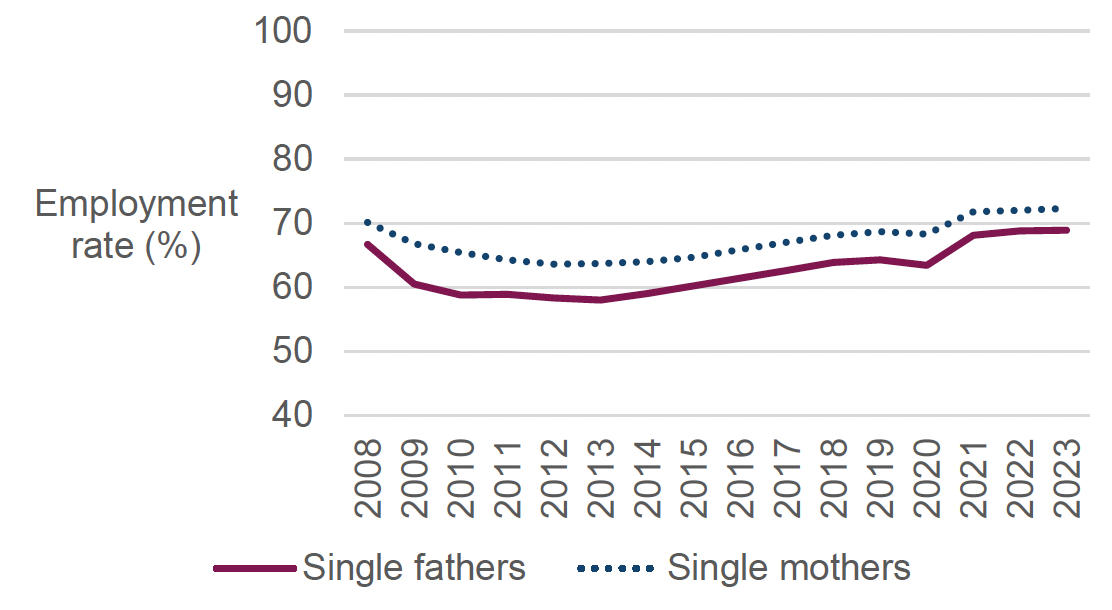
Source: Statistics Denmark, Gender equality indicator of activity and employment rates (16-64 years) by frequency, family type, indicator and time, 2008-2023 (LIGEAI2)
Additional support for other vulnerable groups
As well as single parents, the Danish social security system recognises and supports other at-risk groups.
Special child supplement
The special child supplement is an umbrella benefit that covers a range of additional circumstances or vulnerabilities that accrue additional costs, including parents with multiple births, older parents, the death of a parent, unknown paternity and adoption.[84] The amount of the special supplement depends on the specific circumstances:[85]
- Parents with multiple births: In 2025, parents of twins receive DKK 2,750 per quarter. For parents of triplets, DKK 5,500 per quarter is paid. The special child supplement for parents with multiple births is paid up to and including the quarter in which the children reach the age of seven.
- Parents who are pensioners: Parents who are on old-age pension or disability pension can receive additional support. If both parents are pensioners, they receive the ordinary child supplement detailed above as well as a special child allowance of DKK 4,809 per quarter in 2025. If only one parent is a pensioner, the special child allowance is DKK 4,257 per quarter in 2025. For pensioners, the special child supplement is means-tested so only those receiving pension credit receive the full supplement. Those above the pension credit threshold see the supplement reduced by 3%.
- If one or both parents are deceased: A special child supplement is automatically paid in the circumstances of a parental death. If one parent is deceased, the special child supplement is DKK 4,809 per quarter in 2025. If both parents are deceased, the supplement is doubled and is paid to the child’s legal guardian. This special child supplement is paid until the child is 18.
- Single parents with an unknown father: Where paternity cannot be determined, DKK 4,809 per quarter in 2025 is payable, in addition to the above supplements for single parents. The supplement can be claimed if a paternity case is in progress or it has been determined by the Agency of Family Law or the courts that a child’s father is unknown. The supplement can also be claimed if a child is born via artificial impregnation using a donor. This special child supplement can be paid until the child is 18.
- Single parents who adopt a child: If a person adopts a child as a single adopter, the special child supplement of DKK 4,809 per quarter in 2025 is automatically paid until the child is 18. This is in addition to any other single parent supplements. Couples who adopt a child from abroad can apply for a lump sum adoption grant of DKK 75,000 to help cover expenses.
No equivalently targeted payments exist in Scotland (or in the rest of the UK), although in Scotland low-income families can also apply for a means-tested Scottish Child Payment which from 1 April 2025 is £108.60 every four weeks per child.
Compensation for loss of income for parents of children with disabilities
Denmark also has a generous compensation scheme for parents who give up work to care for children with a disability, and the provision of home-based care by a parent is the only option.[86] Receiving the lost earnings compensation is based upon an individual assessment by the municipality of the child’s condition and parents’ circumstances. There is flexibility in how this assessment is administered by municipalities.
On a broad level, the assessment must consider a child's overall disability, life situation, health and well-being, and their participation in school, home life and social and leisure activities. A child’s circumstances must be considered a significant and permanent physical or mental impairment or an invasive or chronic condition.
The assessment considers whether it is most appropriate for the parents to provide home-based care for their child. It also examines whether the parents have a documented loss of income or inability to access the labour market because of their caring responsibilities. Parents who need to give up their job to fully, or partially, to care for a disabled child can receive up to DKK 34,055 per month in lost earnings compensation. This ceiling was introduced in 2011. The exact amount is calculated based on previous income and the hours necessary to care for a child that prevent a parent from working. Those receiving the lost earnings compensation can usually claim up to 37 hours a week of lost earnings.
In addition to monthly earnings compensation, an annual extra cost subsidy of up to DKK 5,348 per year is provided to cover any necessary extra costs (such as medicine or transport) a family faces as a result of a child’s disability.[87]
Social assistance
Denmark has a comprehensive system of social security support which is one of the biggest contributing factors to low child poverty rates. This is demonstrated by a before-transfers relative child poverty rate that is more than twice as high as the post-transfer rate (22.5% of before transfers, compared to 10.1% after transfers in 2024), whereas the before transfers rate for the UK is less than double the post-transfer rate (41.1% before transfers compared to 23.5% post-transfers).[88]
The primary element of this system is social assistance, a non-contributory, means-tested benefit of last resort. Social assistance is accessible to non-insured Danish people as well as those who do not qualify for unemployment benefits or who have exhausted their unemployment benefit rights.[89] Unemployed individuals can receive social assistance as long as they:
- register with the public employment service as a jobseeker and be available for work;
- register jobseeking activity and have an updated CV on “jobnet” continually throughout the unemployment spell; and
- make themselves available for interviews on request.
Those who require social assistance because of sickness or disability may not be required to be available for work (depending upon the requirements of the municipality) but will have to meet other requirements, such as participating in rehabilitation activities.[90]
The social assistance system is set to be radically reformed from July 2025, and here we provide an outline of both the pre-2025 and post-2025 systems.
The social assistance system until July 2025
Full social assistance is only available to Danish citizens over the age of 30 with a minimum period of residency in Denmark for nine of the last 10 years, and who have been in regular employment for at least two-and-a-half of the past 10 years (introduced in 2019). Under-30s can access a reduced rate of social assistance if they have a vocational education, or, if not, are supported through educational assistance. In addition to being a lower payment, this places an “educational duty” on unemployed young people to take part in training or education to become job-ready. Those who do not meet the work or residency criteria are supported by the self-sufficiency and return benefit or transition benefit.[91] The age threshold was raised to 30 from 25 in 2014 (the lower rate for 25-year-olds had been introduced in 1996) to strengthen work incentives among young people.[92]
The level of support is calculated on an individual basis, with consideration given to family status, age and education level.[93]
Family status[94] |
With children (monthly amount in DKK, 2024) |
Without children (monthly amount in DKK, 2024) |
|---|---|---|
Single adult, 30+ |
16,382 |
12,326 |
Single adult, under 30, with a vocational qualification |
15,658 |
7,945 |
Single adult, under 30, without a vocational qualification |
13,509 |
6,754 |
From 2016, the Danish Government reintroduced a minimum work requirement for people to receive social assistance and a benefit ceiling, which had both been in place between 2005 and 2012.[95] The reintroduction of both these reforms was designed to increase conditionality to accessing social assistance, encourage labour market participation and avoid a situation where the total amount of all benefits is higher than the level of unemployment insurance benefits or low-waged work.[96]
The minimum work requirement is known as the ‘225-hour rules’ and requires those on social assistance to demonstrate they have worked at least 225 hours in the previous 12 months. If a person receiving social assistance does not work these minimum hours, their social assistance is reduced. In 2024, these reductions were set at DKK 1,125 for those over 30 and DKK 561 for those under 30. In couple households, the benefit is reduced to the level of a single-person household.[97]
The benefit ceiling does not reduce or cap a household’s social assistance, rather it caps any housing benefit or additional child payments. In total, 29 additional benefits and allowances within the social assistance system were subject to the benefit ceiling but a 2023 reform saw this reduced to 11.[98] The level of the benefit ceiling is dependent upon your age, number of children, educational level and whether you live alone or in a couple.[99] Notably, rates for couples are lower than rates for single people with the same circumstances.
Family Status |
Monthly amount in DKK for single adult (2024) |
Monthly amount in DKK for couple (2024) |
|---|---|---|
30+ without children |
14,909 |
12,236 |
30+ with one child |
17,080 |
16,282 |
30+ with two or more children |
17,483 |
16,382 |
under 30, without children, with a vocational qualification |
11,414 |
10,623 |
under 30, with one child, with a vocational qualification |
16,742 |
13,987 |
under 30, with two or more children, with a vocational qualification |
17,146 |
13,848 |
under 30, without children, without a vocational qualification |
10,963 |
10,179 |
under 30, with one child, without a vocational qualification |
15,930 |
13,339 |
under 30, with two or more children, without a vocational qualification |
16,331 |
13,159 |
Temporary child subsidy within social assistance
The benefit ceiling had an especially pronounced negative impact on larger families. This was recognised by the Danish Government, which in response introduced a targeted intervention with a temporary child subsidy in January 2020, retrospectively reapplied to August 2019. The temporary child subsidy was introduced specifically as a “short-term measure to help alleviate child poverty” while the Commission for Social Benefits developed recommendations for a new longer-term solution to mitigating the impact of the benefit ceiling.[100]
The temporary child subsidy was awarded in circumstances where one or both parents with children under 15 were impacted by the benefit ceiling. The subsidy was set at DKK 700 per child for those on educational assistance, self-sufficiency and return benefit or transition benefit; DKK 600 per child of single parents; and DKK 550 per child of other social assistance claimants. In addition to the per child payments, single parents received an additional supplementary subsidy of DKK 650 per month irrespective of the number of children.[101]
The legislation for the temporary child subsidy expired in January 2023 and the last half of the annual payment from 2022 was paid out in January 2023.[102] However, the measure became a permanent integrated feature of social assistance in January 2023 on the recommendation of the Commission for Social Benefits, in recognition of the ongoing impact of the benefit ceiling.[103]
Social assistance reform from 2025
Following the 2023 election, the new coalition Government announced widespread reform to the Danish social assistance system to be introduced from July 2025 based on recommendations from the Commission for Social Benefits. This reform package is orientated around three aims: to introduce a simpler system, to support children in low-income families and to get more people into work.[104]
A simplified system
The new social assistance system will comprise three rates and a single-person supplement:
- Minimum rate: for people who do not meet the same residency or employment requirements as the previous system. The rate will be set at DKK 6,553 per month.
- Basic rate: for people under 30 years of age who do not have the equivalent of two-and-a-half years of full-time work within the past 10 years. The rate will be set at DKK 6,955 per month, benchmarked to student grants provided to those in higher education.
- Increased rate: for people over 30 years of age or younger people with at least two-and-a-half years of full-time work completed within the past 10 years. The rate will be set at DKK 12,064 per month.
- Single-person supplement: A single person on the basic and increased rate will also receive a supplement of DKK 1,054 per month.
These rates will be set at a level that means that when total benefits are taken into account, a social assistance recipient will not receive more than 85% of a minimum wage employee. As discussed below, a clear purpose of the simplified system is to incentivise work as far as possible.
The Government has recognised that this simplified system will particularly reduce the social assistance provided to those on the basis rate. As a result, a temporary adjustment allowance of up to DKK 2,000 per month will be available until 2027 to aid adjustment onto the new system for those under 30.
The previous benefit ceiling that impacted on several benefits and supplements has been replaced by one simpler, targeted cap of DKK 350 per month on the housing benefit received by couples and cohabitants on the new increased rate of social assistance. The Government argues the benefit ceiling needed replacing as “many welfare recipients do not realise what consequences the benefit ceiling has for them”.
Supporting children in low-income families
A key aim of the new social assistance system is to ensure that children in the social assistance system grow up under “reasonable conditions”. In keeping with the aim for simplification, the child allowance will be set at DKK 2,687 per month per child regardless of the rate level. In addition, single parents on the minimum or basic rate will also receive an additional supplement of DKK 1,581 per month.
Parents on social assistance will receive a medicine subsidy that covers 100% of the cost of the cheapest prescription medicine eligible for them and their child.
An innovative measure will be the introduction of a leisure allowance to address issues of social exclusion among children who live in families receiving social assistance. This allowance will be DKK 450 per child per month (with a maximum of three children per family). As single parents already receive an additional supplement, the leisure allowance for single parents will be at a lower amount of DKK 113 per child per month for a maximum of three children per family. The leisure allowance should be used for sports clubs, school trips, cultural activities and school equipment.
The leisure allowance will only be available after three months of receiving social assistance, and parents will have to document that the money has been spent on the child's leisure time. To simplify this process for both parents and municipality administration, parents will only have to submit documentation for the use of one third of the leisure allowance every three months. However, if the parents do not provide sufficient documentation, the payment will stop. The right to the leisure allowance will continue for three months after leaving social assistance, to give parents time to finalise payment for their child's leisure activities when they start working.
Getting more people into work
The 225-hour rule will be replaced, with the Government outlining that the “225-hour rule has given rise to a large number of errors in the municipalities, where several citizens have had their benefits unfairly reduced”. The replacement system has yet to be announced, but will be designed to incentivise work through a clearer, simpler process for both claimants and caseworkers.
The new social assistance system will incorporate a work allowance to incentivise people on social assistance to take on some form of part-time work alongside their social assistance and therefore create a closer connection to the labour market. Under the old system, social assistance was reduced on a like-for-like basis which disincentivised the take-up of paid employment.
The new work allowance will mean that:
- anyone receiving the minimum rate or new basic rate will receive a work allowance of DKK 5,000 per month.
- anyone receiving the increased rate will get a work allowance of DKK 2,500 per month.
Above the exemption amount, those on social assistance will keep 35% of earned income, with this limit set to ensure there is an incentive to taking full-time, low-wage work rather than receiving cash benefits.
Boosting the employment of young people will be a clear focus of the new system. There will be a DKK 150 million three-year fund that municipalities can access to design employment and support schemes for those on the basic rate. There will also be a DKK 103 million per year fund to help set up support, training and employment services for vulnerable young people and young people with mental health challenges within the social assistance system. Moreover, a new special youth allowance is designed to support those with challenges beyond unemployment and who will otherwise struggle to access employment or training in the short-term. This allowance is set at DKK 1,000 for 18-24-year-olds without children and DKK 2,500 for 18-24-year-olds with children and 25-29-year-olds regardless of whether they have children.
Flexicurity Model
Internationally, Denmark’s labour market policy is associated with a so-called Flexicurity Model. This model seeks to combine what has been categorised as a golden triangle of high levels of social security for employees (comparatively generous unemployment benefits compared to other parts of Europe), a flexible labour market with limited labour market regulation and high levels of support for people to find new roles through active labour market policies.[105]
Here, the three sides of the Flexicurity Model are explored and how they support and reinforce each other.
While the Flexicurity Model has been noted for allowing Denmark to combine economic growth, low unemployment and social stability, some assessments have suggested that in recent decades the model has placed a greater emphasis on flexibility over security, especially given restrictions and conditionality applied to unemployment benefit and active labour market policies.[106] We have already seen how these tensions between security and conditionality exist within the social assistance system.
Unemployment benefit
In Denmark, it is the norm to join a voluntary unemployment insurance scheme which provides a contributory, non-means tested and insurance-based unemployment benefit. Today, around four in five Danish workers are members of an employment insurance scheme.[107]
To be eligible for unemployment benefit, a worker has to have been a member of an insurance scheme for at least 12 months, accrued 1,924 of working hours over the last three years, and to have been earning an income of at least DKK 263,232 within the past 36 months. However, a ceiling of DKK 21,936 per month applies, in effect meaning that at least 12 months of employment are needed before accessing unemployment benefit.[108]
Unemployment benefit can be claimed for a maximum of two years, following a series of reductions to the duration of time someone can claim unemployment benefit. This process began in 1993, with the duration a worker can receive unemployment benefits reduced from eight to seven years. Further reductions were made in the 1990s: to five years in 1996 and four years in 1999. Finally, in 2010 the duration was reduced to two years, which remains the case to this day.[109]
In general, unemployment benefit can cover up to 90% of former earnings, up to a ceiling of DKK 20,359 per month in 2024. However, a worker can receive 118.86% for the first three months if the recipient has been a member of the unemployment fund for four years or more and employed for at least 24 months before claiming. [110] Those under 25 receive 50% of their maximum award if they have received unemployment benefit within the last six months. As Tables 5 and 6 show, the unemployment benefit replacement rate for the average worker with two children – both those in a couple and single parents – in 2024 was significantly higher in Denmark than both the UK’s and the OECD’s average at three months, 12 months and 24 months of unemployment respectively.
3 months’ unemployment |
12 months’ unemployment |
24 months’ unemployment |
|
|---|---|---|---|
Denmark |
68% |
61% |
61% |
UK |
34% |
34% |
34% |
OECD average |
64% |
48% |
36% |
Source: OECD, Net replacement rate in unemployment database, 2024
3 months’ unemployment |
12 months’ unemployment |
24 months’ unemployment |
|
|---|---|---|---|
Denmark |
65% |
58% |
58% |
UK |
38% |
38% |
38% |
OECD average |
62% |
45% |
33% |
Source: OECD, Net replacement rate in unemployment database, 2024
As part of their entitlement, there are a series of behaviour requirements that must be complied with:[111]
- Registration with the public employment service as a jobseeker and being available for work;
- Registering jobseeking activity and have an updated CV on “jobnet” continually throughout the unemployment spell; and
- Being available for interviews on request.
Unregulated labour market
Denmark’s labour market is largely unregulated. The lack of legislative regulation of the Danish labour market is exemplified by the fact that, in Denmark, there is no statutory minimum wage. Instead, minimum wages are set in collective agreements between unions and employers’ associations. It is estimated that in 2018, collective agreements cover 100% of employees in the public sector, 73% of those in the private sector and 87% of those who work for companies that are members of the Confederation of Danish Employers.[112] Within Denmark, there is a broad consensus among unions and employers (as well as the Government itself) that the state should not intervene in wage-setting matters and, as a result, calls for a statutory minimum wage are relatively unpopular in Denmark.[113]
As well as a lack of statutory regulation on minimum levels of pay, Denmark lacks extensive regulations on employment conditions and protections. It is relatively easy to hire and fire workers in Denmark. According to the OECD’s Employment Protection Index, Denmark had the 10th most flexible hiring and firing practices in the OECD, broadly similar to the liberal labour markets seen in the Anglosphere.[114] As a result, labour market turnover in Denmark is high, with approximately 800,000 job changes per year – equivalent to around a quarter of (27%) of the labour force.[115] Job security in Denmark has therefore been assessed as low, but this is accepted politically and socially due to the social security system providing generous financial support for the unemployed (as outlined above), and active labour market policies helping people return to work (discussed below).[116]
Active labour market policies
Where the Danish Government has increasingly played a role is through policy reform to actively incentivise labour market participation rather than through the regulation of pay and conditions. Key here is an increased emphasis on the role of active labour market policies, which since the 1990s have been a core component of Denmark’s Flexicurity Model. A newly-elected Government in 1993 began the process of shifting labour market policy from ‘passive’ support to ‘active’ support, and this was solidified by the passing of the Active Social Policy Act in 1997.[117] Since then, as Figure 14 shows, Denmark has substantially increased its spending on active labour market policy to one of the highest in the OECD – spending at least 1.5% of GDP for most of the period between 1993 and 2022.
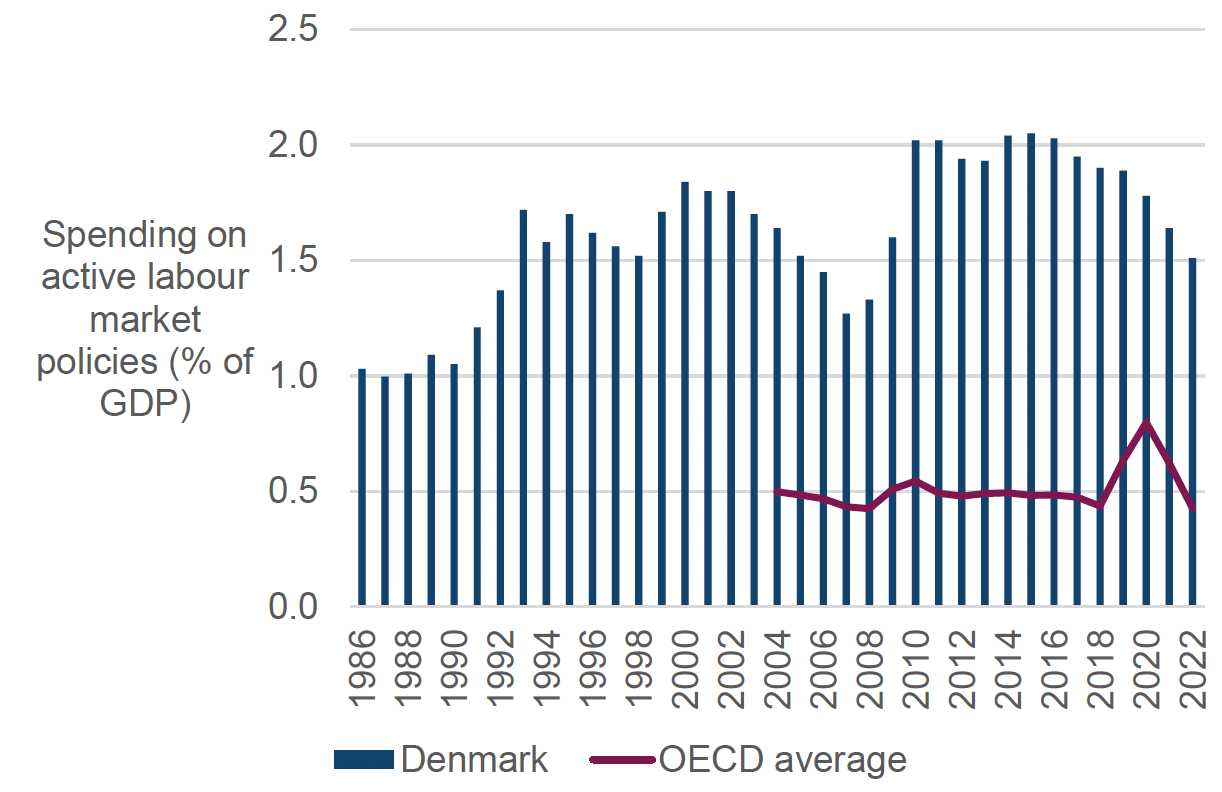
Source: OECD Labour Market Programmes Database, 1986-2022
The Danish Agency for Labour Market and Recruitment outlines that the active labour market policy falls into three core areas:[118]
- Education, guidance and upgrading of skills: This can consist of brief guidance and clarification activities, ordinary education and training (certified informal educational institutions, specifically arranged projects and training periods). Historically, the majority of participants take part in so-called “other types of counselling and training” which is a diverse category covering different municipal activation projects and job search training.
- Jobs subject to wage subsidy at public or private employers: These can be used to retrain the professional and social competences of unemployed people. Wage subsidies (both in the private and the public sector) are provided to employers when they hire a person who has been unemployed for at least six months. Public and private companies are eligible for a wage subsidy to hire an unemployed person for a period of four or 12 months.
- Practical work training at public and private enterprises: These can be used to retrain jobseekers and upgrade their qualifications. The jobseeker continues to receive unemployment insurance benefit for the duration of their retraining.
Since 2002, active labour market policies have been decentralised to municipalities, with the aim of allowing them to develop specialised services to cater for local needs.[119] Further reform took place in 2007 which combined the services provided for people claiming unemployment insurance, social assistance and disability benefits into 94 jobcentres in each municipality.[120] This is based upon a one-stop-shop principle whereby all jobseekers are handled by the same organisation to simplify the employment support system, improve cost effectiveness of delivery and make service provision more beneficial for jobseekers regardless of their circumstances.[121] This approach has been termed decentralised centralisation.[122] Jobcentres are responsible for the reception, initial diagnosis, support, compensation, control and sanctions of jobseekers. The jobcentres are set up to ensure continuity of support for a jobseeker, and their policy priority to guide jobseekers towards vocational training and integration jobs.[123] This highly decentralised approach has been noted as somewhat exceptional in both the EU and OECD, with municipalities not only delivering active labour market policies, but also having significant freedom to design active labour market policies to meet local need.[124]
As a result of this decentralised approach, there is a wide variety of approaches to labour market activation in Denmark, at different levels of scale. France’s General Inspectorate of Social Affairs conducted a comparison of European public employment services in 2022, and highlighted the approach taken in the Danish municipality of Høje-Taastrup as a case of good practice. Within the municipality, a return-to-work programme is organised around a list of three employment plans. ‘Plan A’ is focused on the jobseeker's ideal job, but this must remain a realistic target; ‘Plan B; is focused on the right job given the jobseeker’s skills and past employment history; and ‘Plan C’ is a job of last resort if the search for Plan A or B is unsuccessful, and will be a job in a sector with local recruitment shortages.[125] On a smaller scale and targeted at a specific group, the municipality in Copenhagen funded a local college to provide up to 11 young single mothers access to training and education qualification, social guidance and employment support. These places were costly, but they had a 100% success rate upon completion.[126]
Active labour market policies are critical to supporting the other sides of the Flexicurity Model. They are an important part of ensuring a well-functioning, dynamic labour market and also to safeguarding the generosity of the social security by reducing the length of time people are unemployed. Long-term unemployment rates in Denmark are extremely low. As Figure 15 shows, since 2009, long-term unemployment in Denmark rates (individuals who have been unemployed for 12 months or more) have never exceeded 1.5% of the labour force. Since 2015 this has been below 1% of the labour market, declining to just 0.3% in 2023.
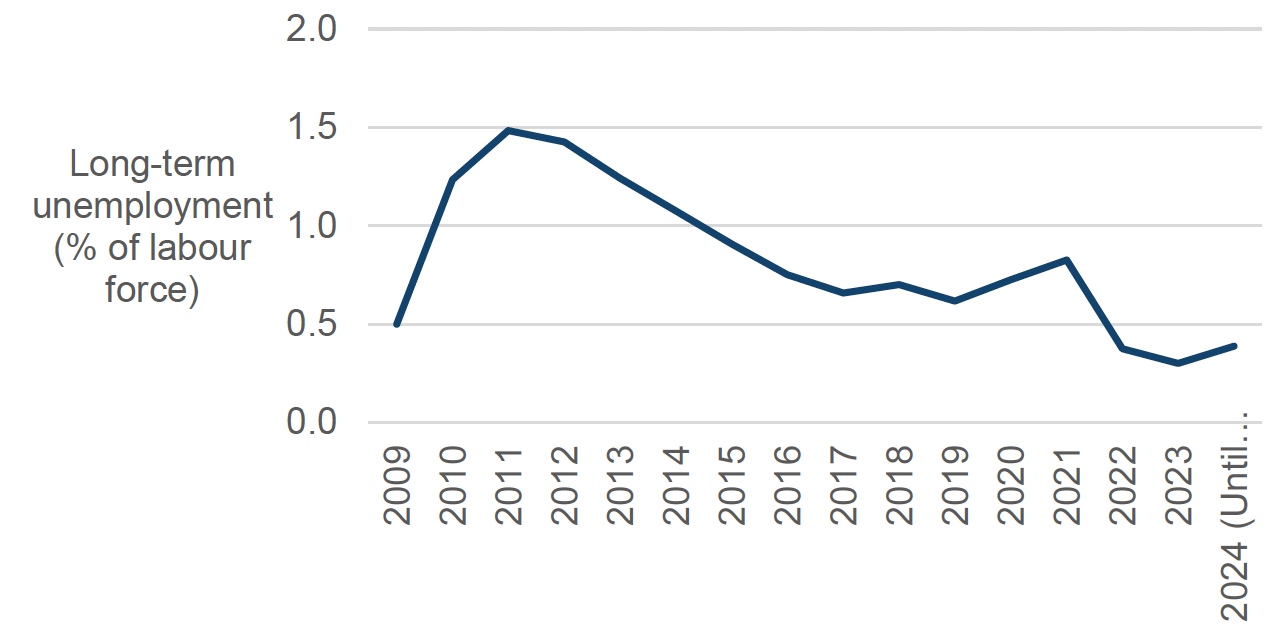
Source: Statistics Denmark, Long-term unemployed persons by unit and time 2009-2024 (AULK04)
A policy highlight: Activation policy reform for disabled people
Since Denmark’s shift in focus towards active labour market policy, disabled people have been a key target group for activation. This has mostly been through ongoing reform to the disability pension system. Disability pensions are granted, following a municipal assessment, if a person’s working capacity is permanently reduced in a way that means they are unable to work under ordinary terms. The disability pension is typically paid for life, as long as the recipient's work capacity remains significantly reduced. In 2025, single people receiving the disability pension are awarded DKK 21,103 and a person in a couple DKK 17,938.
Since the late-1990s the general policy direction of the disability pension has been one of determining ability to work rather than identifying incapacity in line with the general policy trend towards activation.[127] The major policy tool of this shift has been the flex-job system which was created in 1998 as a reform to the disability pension. The flex-job system is designed to ensure disabled people with working capacity enter employment by offering a wage subsidy to employers.[128] Most flex-jobs are part-time – with a disabled person working reduced hours or performing specific job functions – meaning the employer only pays for the work provided and a municipal subsidy provided to ensure a minimum income in line with maximum unemployment benefit.[129]
There was a widespread reform to the disability pension and flex-job system in 2013. The new system was designed to ensure that those under 40 years of age could not be granted a disability pension except in exceptional circumstances where they were incapable of any work.[130] For individuals below 40 years of age, they are assessed through a rehabilitation model that focuses on providing support for health, education, social services and business sectors with the intention of moving younger disabled people closer to the labour market. A reassessment take places after five years to create a new plan.[131] Additionally, all of those under 40 years of age are offered a flex-job for up to five years, upon which the ability to work is reassessed through their rehabilitation programme.[132] Other changes to the flex-job system saw the wage subsidy reformed to increase the subsidy for lower paying jobs and those with the least working capacity[133] – indeed, those with a working capacity of less than a third were for the first time made eligible for a flex-job.[134]
There have been unintended impacts of flex-jobs and the 2013 reforms. The reform, in effect, turned the flex-job system into a time-limited scheme that incentivised the uptake of lower paid work except for those over 40 years of age where a permanent flex-job is still possible.[135] One OECD analysis concluded that the reform to the wage subsidy therefore had the unintended consequence of incentivizing disabled workers to opt for part-time over full-time work where they could make that choice.[136] A number of studies have concluded that there is no evidence that the flex-job system has increased employment in general for people with a disability.[137] Moreover, 2024 was the first year where there was a fall in new disability pension applicants under 40 years of age despite the 2013 reforms to tighten eligibility for under 40s.[138]
Contact
Email: TCPU@gov.scot