
International review of approaches to tackling child poverty: Denmark
A historical review of evidence on Denmark's approach to tackling child poverty, drawing out the key lessons for Scotland.
1. The historical trajectory of key metrics
Economic and demographic data
Denmark experienced an economic crisis during the late-1980s and early-1990s, before substantial economic growth from the mid-1990s into the 2000s until the financial crisis and Great Recession in 2008. During the 2010s, Denmark recovered and saw stable growth. In current prices, its Gross Domestic Product (GDP) increased from US$70.8 billion in 1980 to US$429.5 billion in 2024. GDP per capita also rose significantly from US$13,820 to US$72,040 during the same period.[11] The most recent data available shows Denmark GDP per capita is 27% higher than the UK’s GDP per capita, which was US$52,650 in 2024.[12]
Since the mid 1960s Denmark has had a tax-to-GDP ratio above the OECD average, as seen in Figure 1. The periods of sustained economic growth since the mid-1990s have coincided with Denmark having a tax-to-GDP ratio of above 45% between 1993 and 2021. Although Denmark’s tax-to-GDP ratio has fallen since 2021, it still had the second highest tax-to-GDP ratio in the OECD in 2023 with 43%.[13] By contrast, the UK’s tax-to-GDP ratio in 2023 was 35.3% and the OECD average was 34%.[14] Denmark’s experience highlights that high tax levels are not incompatible with high levels of economic growth, productivity and better living standards.[15]
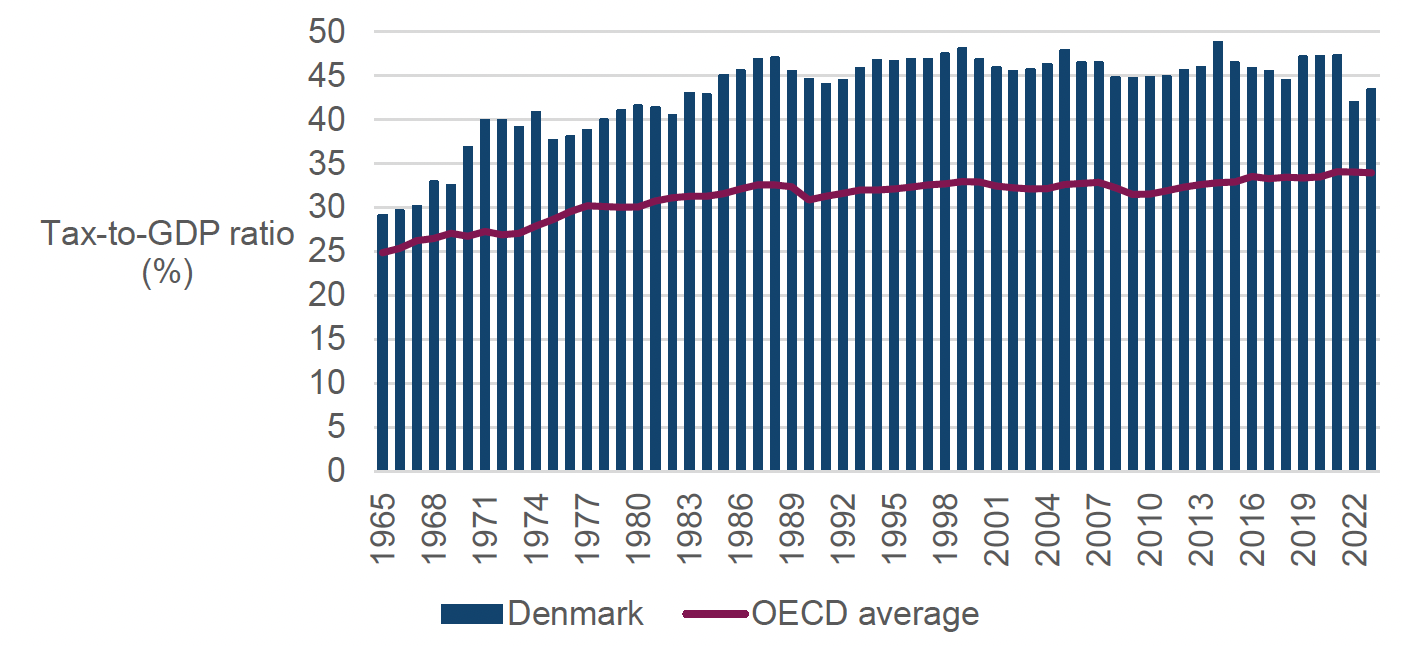
Source: OECD Global Revenue Statistics Database, 1965-2023
Denmark has seen an increase in its population from 4.8 million people in 1965 to 5.9 million people in 2023.[16] Like other Western countries, Denmark has an ageing population. The share of the population aged 0-14 years old declined from 24% in 1965 to 16% in 2023, whereas the share of the population over 65 has increased from 11% to 21% across the same period. This trend has lowered the age dependency ratio for working age to young people in Denmark to 25% in 2023 from 37% in 1965.
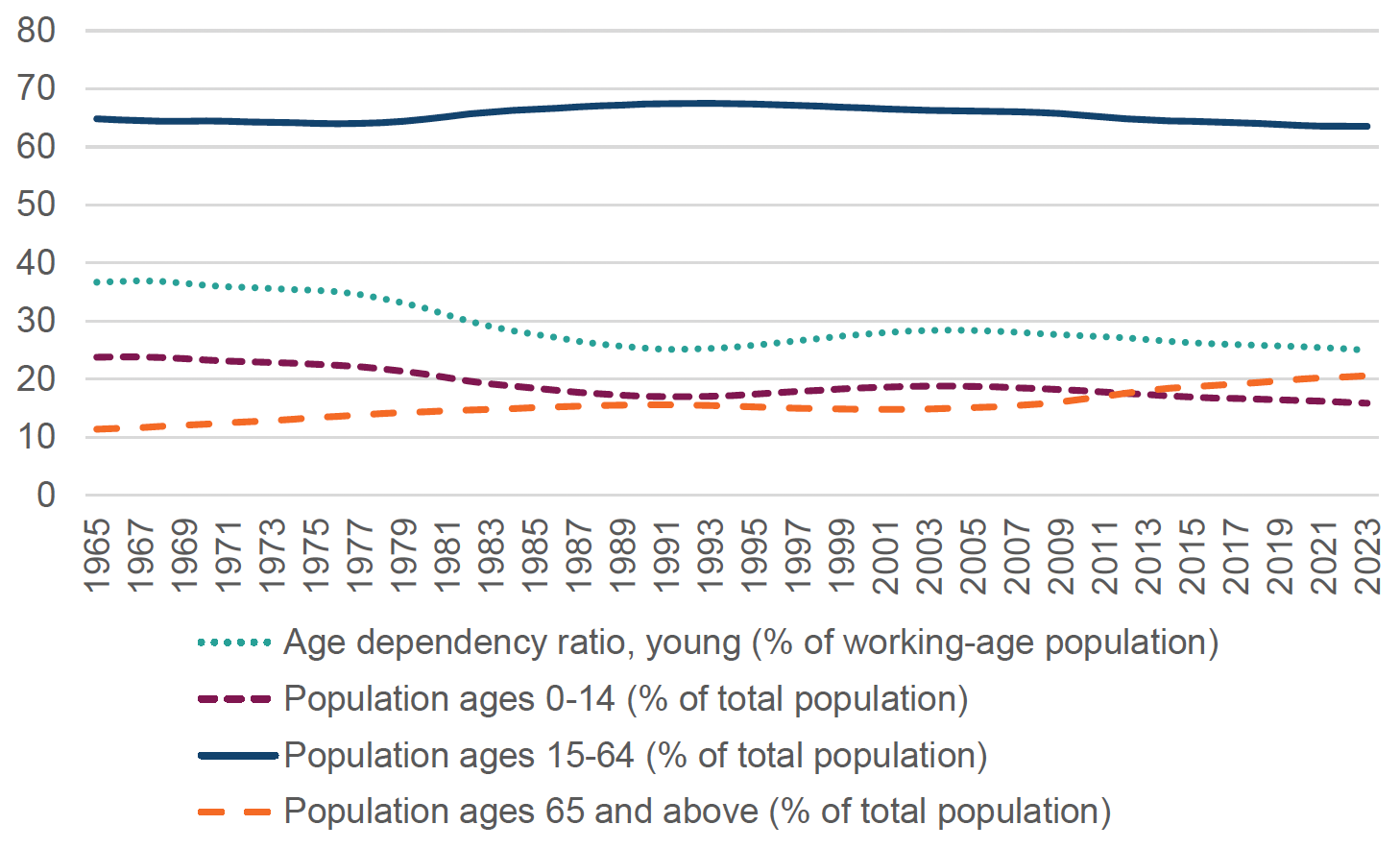
Source: World Bank World Development Indicators, 1965-2023[17]
Poverty trends
The most recent EU-SILC data from 2024 shows that 10% of children (under-18s) in Denmark live in relative poverty. That is defined as living in a household with equivalised household income below 60% of the median income after social transfers and before housing costs. As shown in Figure 3 child poverty has remained low and remarkably stable since 2003, fluctuating by only a couple of percentage points (between 9% and 11%). By contrast, poverty among working-age people increased from 10% in 2003 to a peak of 14.5% in 2018, before decreasing to 12% in 2024.
Denmark is, in fact, one of a small number of EU countries where working-age adults are at higher risk of poverty than children, demonstrating the high value of family-orientated policies.[18] In Scotland the reverse has been the case, with child poverty rates consistently above the poverty rates of working-age adults since 1994/1995 (both before and after housing costs).[19]
EU-SILC data only allows for poverty trends to be assessed since the early-2000s. However, data collected by the Luxembourg Income Study (LIS) allows Denmark’s poverty trends to be explored across a longer period of time, with data first collected in 1987. The methodology used by LIS is different to EU-SILC, in that it does not account for social transfers and has a different equivalisation scale. This methodological difference means poverty rates reported by LIS are higher.[20] In addition, LIS data was collected in waves across three or five year periods until 2016. Despite these differences, the trends observed in EU-SILC data are also evident in LIS data with child poverty being consistently below overall poverty rates since 1987, although child poverty rates have fluctuated across a wider range in LIS data (between 8% and 12%) compared to EU-SILC data.[21]
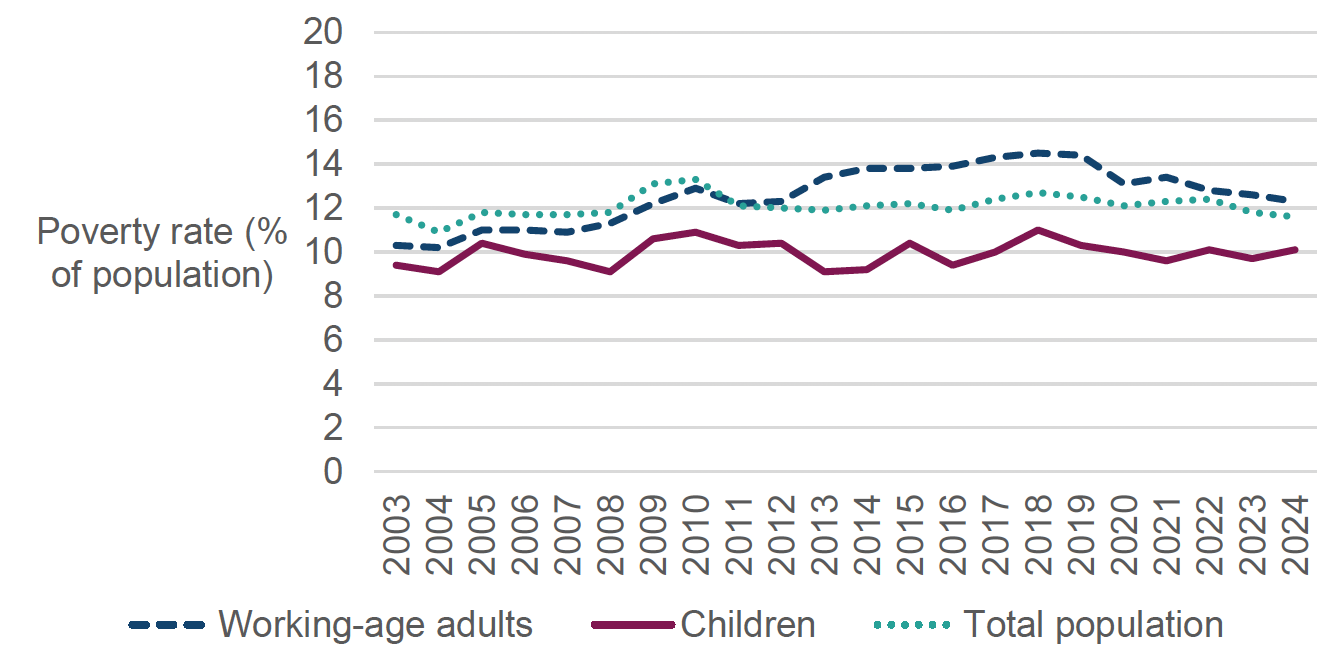
Source: Eurostat, At-risk-of-poverty rate by poverty threshold, age and sex, 2003-2024 (ilc_li02)
As in other European countries, single-parent families and large families (those with three or more children) are the household types most at risk of poverty in Denmark. As Figure 4 shows, poverty among single parents has been consistently above the poverty rate of coupled parents since at least 2003. At times, the difference in the poverty rates has been substantial. In 2024, for example, poverty among single parents was more than five times higher than two-parent families – 28% compared to 5.5%. Moreover, poverty rates for single parents in Denmark have more than doubled since 2001 from 12% to 28% in 2024. By contrast, poverty rate for two-parents families has remained stable and low, fluctuating by no more than three percentage points since 2003. In Scotland, the three-year average after housing costs (AHC) poverty rate amongst single parents has decline from 62% in 1994-97 to 26% in 2021-24.[22] By contrast, AHC poverty rates amongst couples with children has remained relatively constant over the period at between 16-20%.[23]
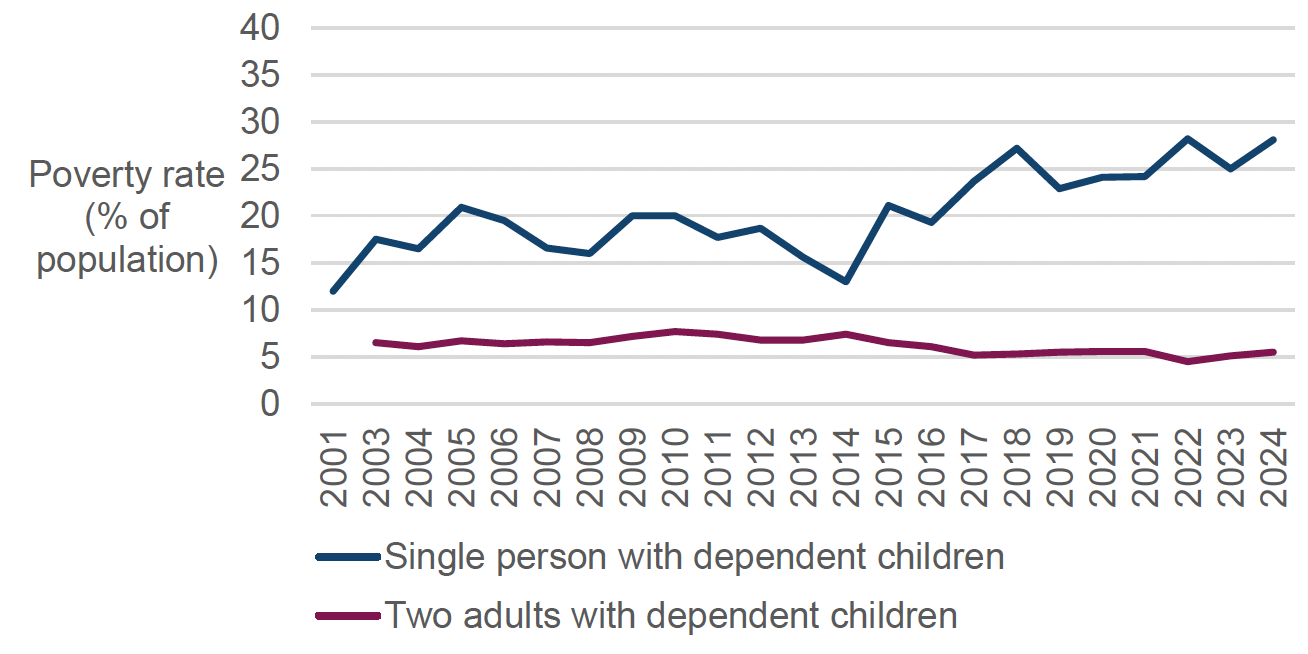
Source: Eurostat, At-risk-of-poverty rate by poverty threshold and household type, 2001-2024 (ilc_li03)
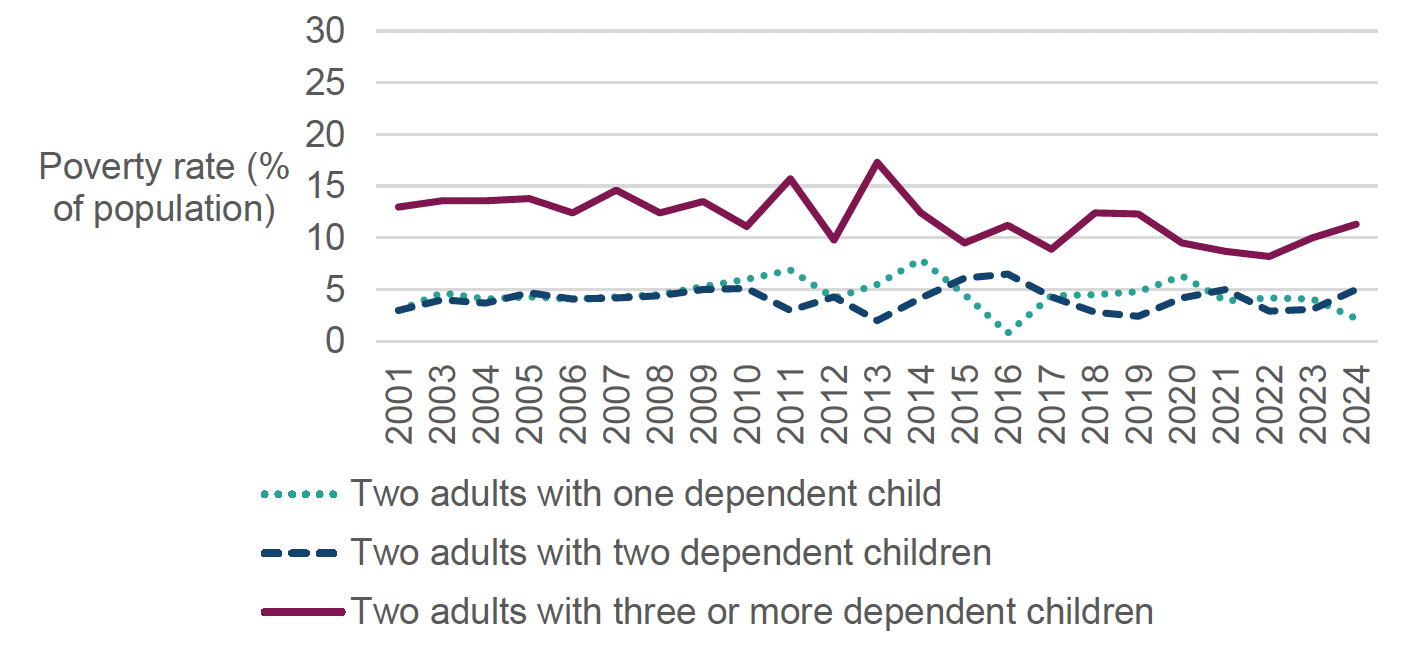
The poverty rate in Denmark of families with one or two children has been following broadly similar trajectories since 2001, with consistently low poverty rate (see Figure 5). Those families with three or more children have seen consistently higher rates of poverty than those with less children. In 2024, 11% of families with three or more children were in poverty compared to 5% with two children and just 2% for one child families. A similar trend is observable in Scotland’s three-year average AHC child poverty rates. In 2021-24, 40% of large families were in poverty compared to 22% of families with one child and 14% of families with two children.[24]
Source: Eurostat, At-risk-of-poverty rate by poverty threshold and household type, 2003-2024 (ilc_li03)
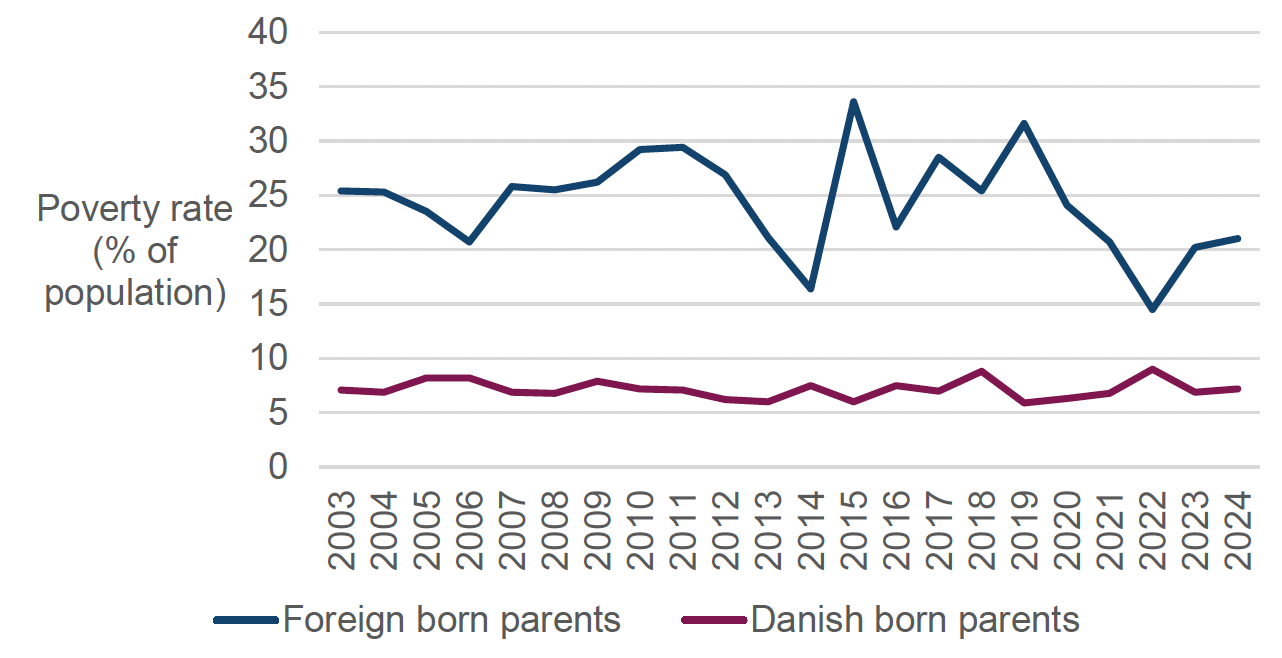
Children from migrant families are also more likely to be in poverty than children born to Danish nationals (see Figure 6). Since 2003, the poverty rate among the children of Danish nationals has been relatively constant – between 6% and 9%. In contrast, over the last two decades the poverty rate among migrant children has fluctuated significantly but has always been higher – peaking at 34% in 2015, more than five times the rate among children born to Danish nationals (6%). In 2024, poverty rate for children of foreign-born parents was three times higher than children born to Danish nationals – 21% compared to 7%. Comparative data for Scotland is not available, however research by the IPPR found that in 2022/23 almost half (46%) of children in families with parents born outside of the UK are in poverty, compared to a quarter of children of UK-born parents.[25]
In particular, Denmark faces an especially acute problem of high levels of deep poverty (under 50% of the median income) among children of “non-western” migrants.[26] Analysis by Statistics Denmark in 2021 found that 36% of children aged 10-14 from “non-western” migrant families were living in deep poverty compared with only 2% among Danish children of that age.[27]
Source: Eurostat, At-risk-of poverty rate for children by country of birth of their parents, 2003-2024 (ilc_li34)
Inequality trends
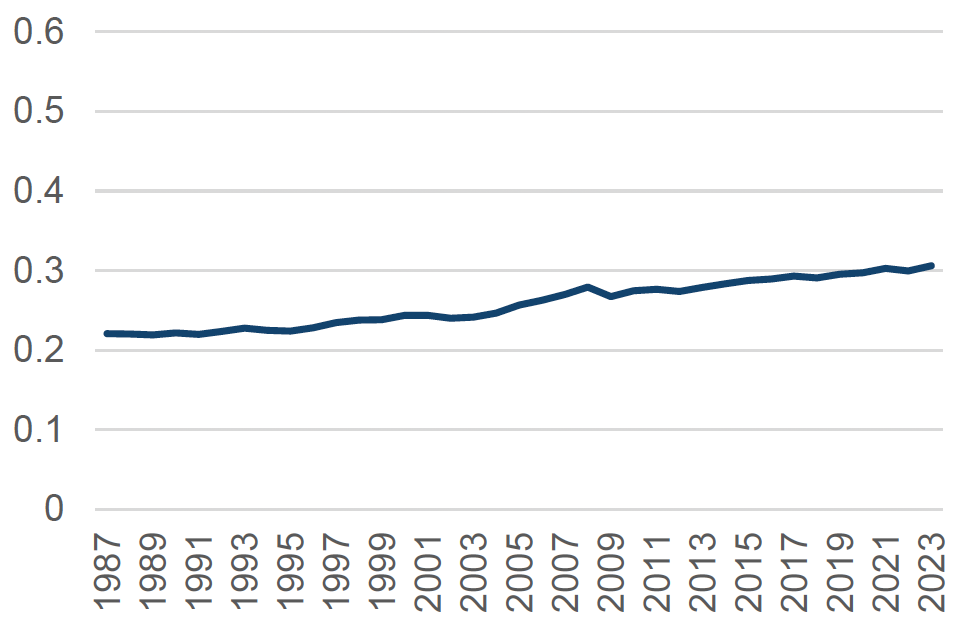
There are different ways of assessing income inequality in the population. The most common measure is the Gini coefficient, where 0 indicates perfect equality. By this measure, Denmark has relatively high income equality by international standards, and that this equality is increased by the country’s tax and welfare policies. However, Figure 7 shows that the Gini coefficient in Denmark has increased by almost 0.1 between 1987 and 2023 from 0.22 to 0.31 – marking a period of growing income inequality. As measured by the Gini coefficient, Scotland has slightly higher levels of income inequality than Denmark, but its levels of income inequality have remained relatively constant since 1994-97. In 2021-24, the Gini coefficient in Scotland was 0.32 compared to 0.31 in 1994-97.[28]
Source: Statistics Denmark, Inequality indicators on equivalised disposable income by indicator and municipality, 1987-2022 (IFOR41)
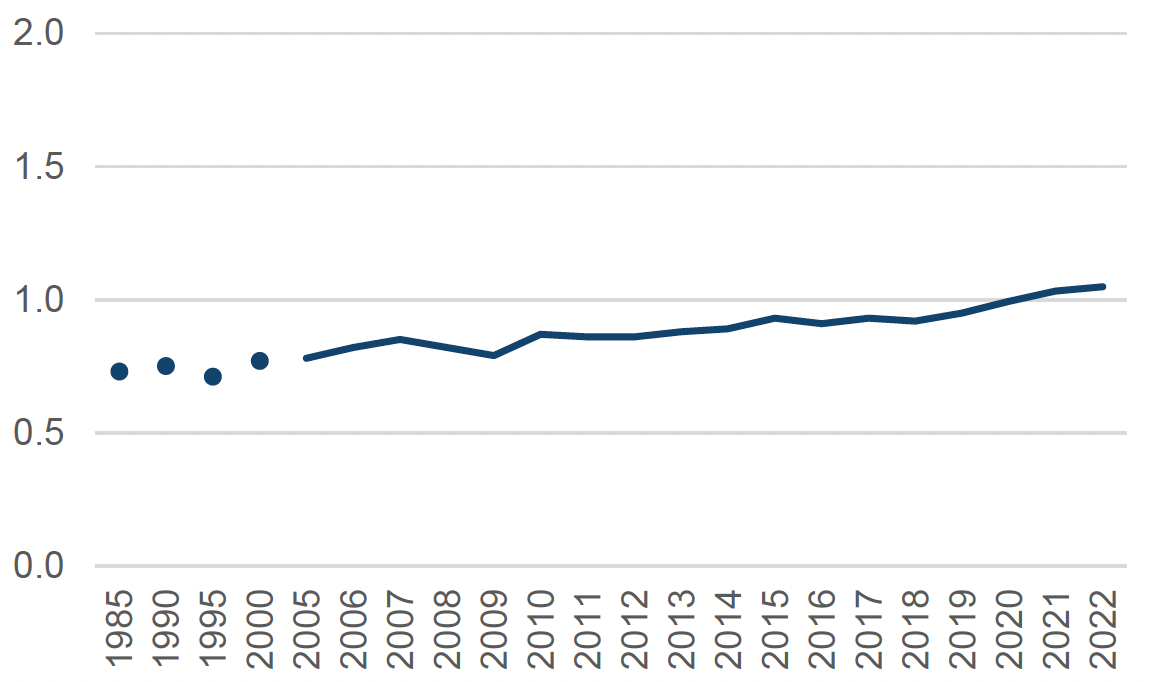
The Palma index, which represents the pre-tax income inequality between the top 10% and bottom 40% of a country’s population, has also shown an upward trend in Denmark since 1995 (see Figure 8). That said, income inequality measured by the Palma ratio is higher in Scotland and has also shown an upward trend since 1994-97. In 2021-24, the top 10% of the population in Scotland had 23% more income than the bottom 40% combined (a Palma ratio of 1.23), whereas the top 10% of earners and bottom 40% of earners in Denmark had around the same combined income (a Palma ratio of 1.05 in 2022).[29]
Source: OECD Income Distribution Database, 1985-2022
Labour market trends
Labour market participation in Denmark is high among both men and women. In 2023, 79.2% of men and 75.8% of women were employed. The employment rates of women have been around or above 70% since 2008.[30] By contrast, in 2023, 77% of men and 73% of women were employed in Scotland – around three percentage points below Danish levels.[31]
Interestingly, as Figure 9 shows, the employment rate of fathers and mothers has been consistently above the employment rate of men and women without children since 2008. In 2023, the employment rate for fathers (85%) was around 10 percentage points higher than it was for men without children (74.8%). Similarly, the employment rate for mothers (79.6%) was around eight percentage points higher than it was for women without children (72.1%). As set out in the next chapter, key reforms that underpinned increased labour market participation for parents in Denmark (and especially mothers) have made dual-earner families the norm which in turn has supported low child poverty rates. Although reducing child poverty was not the stated aim of the labour market policies, they have nonetheless contributed to boosting household income and reducing the risk of families falling into poverty.[32]
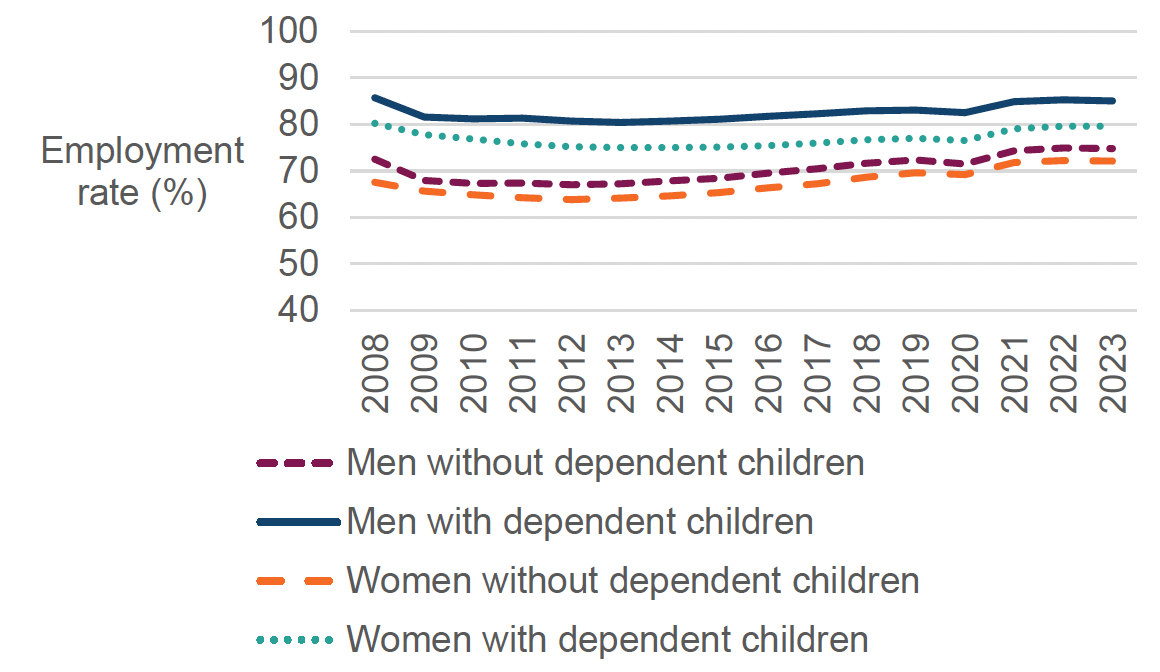
Source: Statistics Denmark, Gender equality indicator of activity and employment rates (16-64 years) by frequency, family type, region and age, 2008-2023 (LIGEAI2)
The employment rate of parents in Scotland is similar – or higher in the case of fathers – to Denmark, but the employment rate among Scottish working-age adults without children is considerably lower. This means that the gap between the employment rate of parents and the rate for those without children is greater in Scotland than in Denmark. The latest data for Scotland shows that in 2024 the employment rate for fathers (92.9%) was around 22 percentage points higher than for men without children (70.2%), while the employment rate for mothers (79.6%) was around 15 percentage points higher than for women without children (65.2%).[33]
In Denmark, parents with young children (under six years old) work longer hours on average and on a more full-time basis compared to parents of older children (six+) or workers without children living at home. Both of these trends have been consistent across both men and women since at least 2008. As we will discuss in the next chapter, Denmark’s universal and affordable childcare provision for 0–5-year-olds is a key reason parents of young children are able to work longer hours and on a more full-time basis.
As Figure 10 shows, on average between 2008 and 2023, fathers with young children worked 38.5 hours a week, compared to 34 hours of fathers with older children and 35 hours for men without children living at home. For women, mothers with young children worked 36 hours on average a week, compared to 31 hours for mothers with older children and 32 hours for women without children living at home.
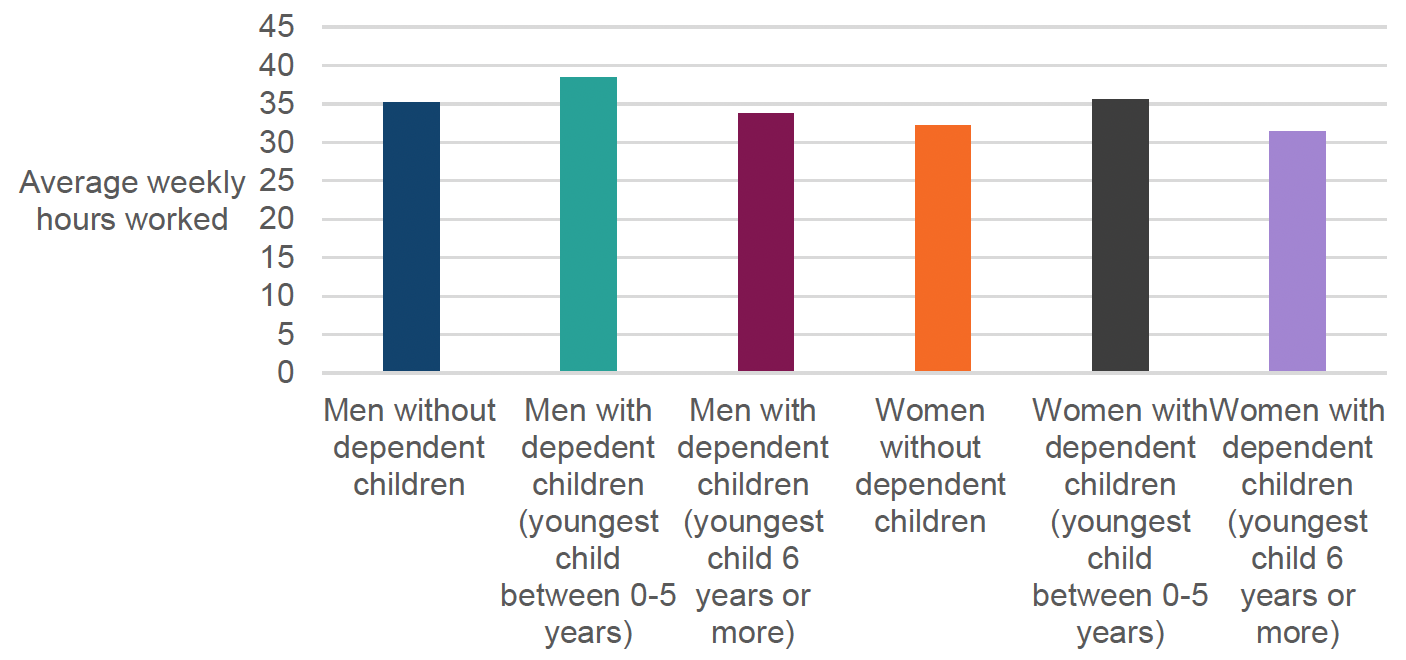
Source: Statistics Denmark, Gender equality indicator on working hours for employed salary earners (average) by indicator, family type and time, 2008-2023 (LIGEFI5)
For part-time working, Figure 11 shows that on average between 2008 and 2023, around a quarter (26.6%) of mothers with young children worked part-time compared to four-in-10 of women without children (39.1%) and women with children aged over six (40%). Similarly for men, only 11.4% of fathers with young children worked part-time compared to more than a quarter of fathers with older children (26.5%) and men without children (25.3%). Women from all family types are more likely to work part-time than men but the percentage of women in part-time employment has fallen across all family types since 2008.
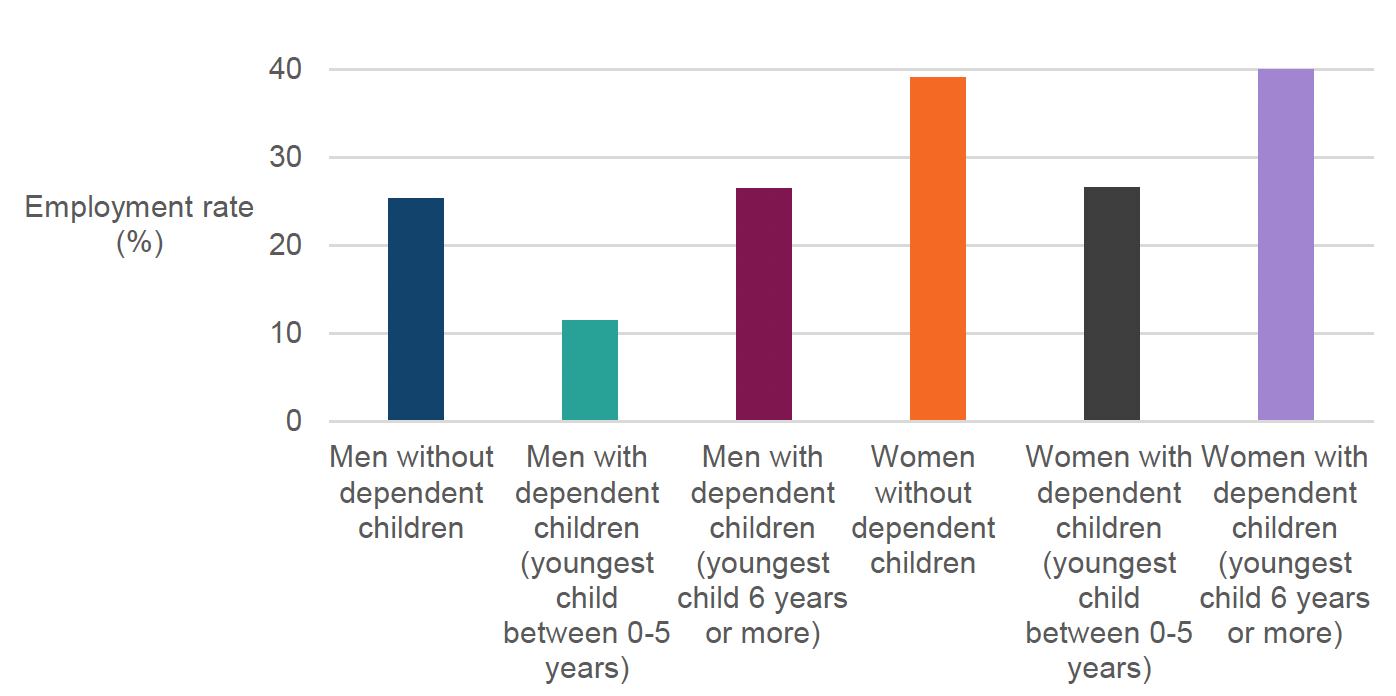
Source: Statistics Denmark, Gender equality indicator on employed salary earners by extent of working time, indicator, family type and time, 2008-2023 (LIGEAI8)
Denmark has one of the lowest in-work-at-risk-of-poverty rates in the EU at around 6% of workers.[34] As we have seen, Denmark’s high employment rate, preference for full-time working with sufficient hours is a key reason for this. However, earnings are also important to minimising the risk of in-work poverty. Denmark has the highest median gross hourly earnings in the EU and less than 10% of the workforce are classified as low-wage earners (defined as earnings below two-thirds of the national median gross hourly earnings).[35]
Denmark’s high labour market participation is not impacted by a high tax burden on workers, which for both single workers and workers with children is one of the highest in the OECD:[36]
- The average single worker had a net average tax rate of 36% in Denmark in 2023, compared to 23.7% in the UK and an OECD average of 24.9%. This is the fourth-highest single person tax rate in the OECD.
- For an average married Danish worker with two children, the net average tax rate was 26.7% compared to 18.8% in the UK and an OECD average of 14.2%. This is the third-highest married worker with children tax rate in the OECD.
By international standards, Denmark has good levels of gender equality within the labour market. For example, the gender pay gap in 2023 was 12.3%, falling from 16% in 2004.[37] Scotland, however, has better gender pay equality than Denmark (and the UK more widely), with a gender pay gap of 9.2% in 2024 (the UK’s gender pay gap in 2024 was 13.1%).[38] Moreover, among Danish parents, fathers only worked on average 2.7 hours more per week than mothers in 2023 – a level that has remained relatively constant since 2008.[39]
During the economic crisis Denmark experienced during the late-1980s and early-1990s, unemployment rapidly increased and peaked in 1993 at 10.7%. From this peak until 2008, unemployment declined substantially to 3.7% (see Figure 12). The decline in unemployment during this period correlated with the increasing use of active labour market policies from the mid-1990s in Denmark, which is discussed in more detail in the next chapter. However, there is debate around how much impact active labour market policies had on reducing unemployment during the 1990s and early-2000s compared with the general economic upturn Denmark experienced during this period.[40]
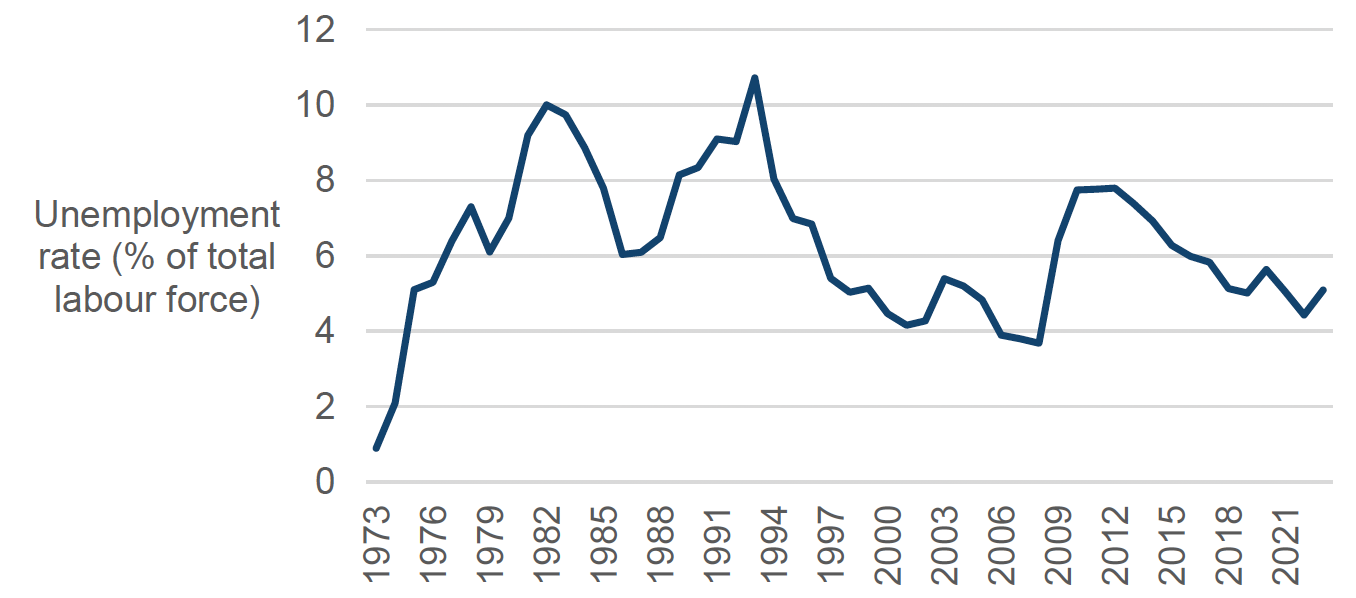
Source: World Bank, total unemployment % of total labor force – national estimate, 1973-2023 (SL.UEM.TOTL.NE.ZS)
Contact
Email: TCPU@gov.scot