
Humanitarian Emergency Fund: annual report 2025-2026
A summary of the report on the impact of projects funded through the Humanitarian Emergency Fund in 2025 to 2026.
Executive Summary
Introduction
The United Nations (UN) has estimated that in 2026, 239 million people around the world require humanitarian assistance totalling $33 billion[1], as a result of protracted and escalating conflict, ongoing displacement, and recurring climate shocks.
Sudan remains one of the world’s most devastating humanitarian crises, with millions displaced by conflict, hunger, and collapsing essential services. In Gaza, catastrophic levels of suffering and the destruction of civilian infrastructure have contributed to overwhelming humanitarian needs, while escalating instability across the Middle East continues to force families from their homes and deepen regional insecurity. Protracted crises in Syria and Ukraine continue to drive urgent humanitarian need, compounded by severe food insecurity, economic collapse, and limited access to basic services. Climate-related disasters, including droughts, flooding, and earthquakes, have intensified existing vulnerabilities for already fragile communities in countries such as Afghanistan and Myanmar. Despite these rapidly escalating needs, deep global funding cuts and chronic shortfalls are severely constraining the humanitarian response, leaving millions of people without access to critical, life-saving assistance.
The Humanitarian Emergency Fund (HEF) was set up by the Scottish Government in 2017 to ensure that its humanitarian funding is used effectively and transparently. The HEF awards a minimum of £1 million every year through an expert panel comprising representatives of eight Scottish humanitarian charities. The panel meets regularly to assess global crises and advise the Scottish Government where this funding can have the greatest impact. This enables the charities to respond swiftly and appropriately to both sudden onset emergencies as well as protracted crises. The HEF uses a rigorous peer review process to select the most appropriate projects. Supported by the Disasters Emergency Committee[2] (DEC) who administers the Fund, this process brings greater accountability whilst also fostering a culture of continuous improvement and innovation in humanitarian response.
In the financial year April 2025 to March 2026, £1 million was allocated across five countries in response to four humanitarian crises. These were the Myanmar earthquake (March 2025), Democratic Republic of Congo crisis (June 2025), Sudan and regional response crisis (September 2025), and Afghanistan crisis (December 2025).
The Scottish Government allocated an extra £400,000 in February 2026 to support Malawi’s ongoing acute food crisis.
In total, the Scottish Government provided £1.4 million of humanitarian funding through the HEF mechanism.
This report details the impact and key learnings of the HEF responses in the past year, which are summarised below.
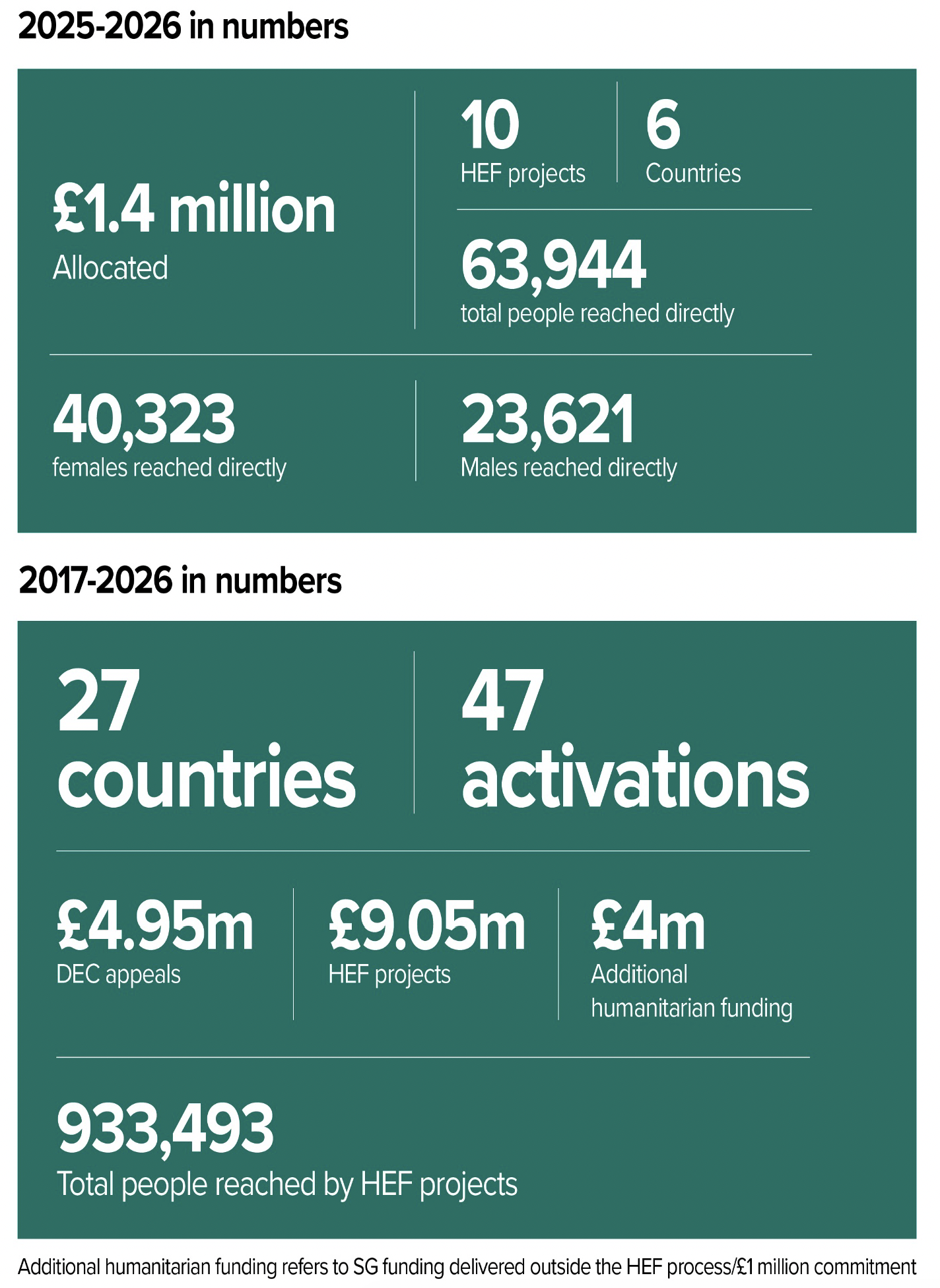
Infographic summarising Humanitarian Emergency Fund (HEF) activity. In 2025-26, £1.4 million was allocated across 10 projects in 6 countries, reaching 63,944 people directly, including 40,323 females and 23,621 males. Since the HEF was established in 2017, it has supported 47 activations in 27 countries, contributing £4.95 million to DEC appeals, £9.05 million to HEF projects and £4 million in additional humanitarian funding, reaching 933,493 people in total.
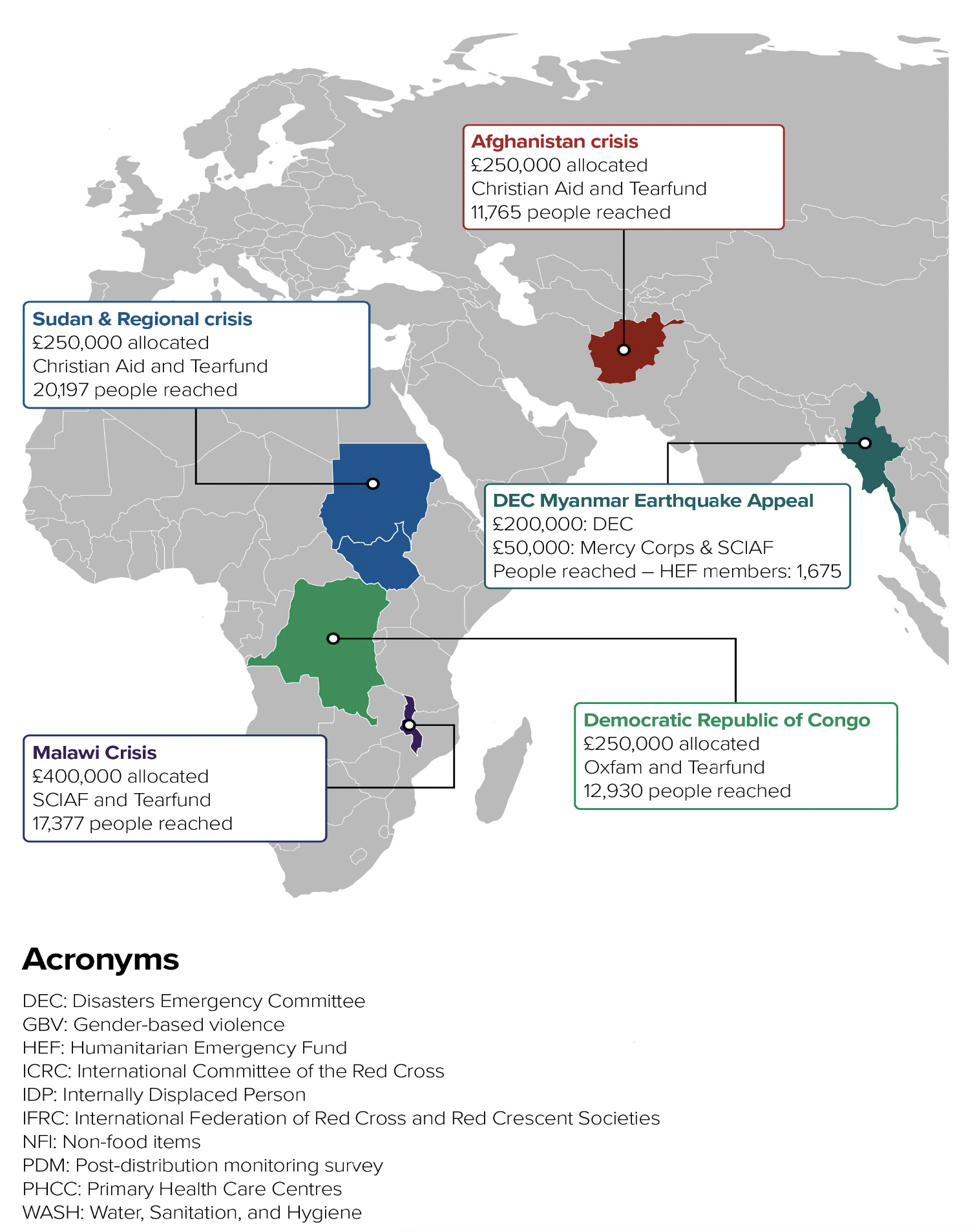
Map showing countries supported by the Humanitarian Emergency Fund in 2025-26. Funding allocations included: Myanmar earthquake appeal (£200,000 through DEC plus £50,000 through Mercy Corps and SCIAF, reaching 1,675 people); Democratic Republic of Congo (£250,000 through Oxfam and Tearfund, reaching 12,930 people); Sudan and regional crisis (£250,000 through Christian Aid and Tearfund, reaching 20,197 people); Afghanistan crisis (£250,000 through Christian Aid and Tearfund, reaching 11,765 people); and Malawi crisis (£400,000 through SCIAF and Tearfund, reaching 17,377 people).
Contact
Email: steven.thistleton@gov.scot