
Housing Need and Demand Assessment (HNDA): practitioners guide 2026
Updated guidance for Housing Need and Demand Assessment practitioners, published in 2026.
Chapter 1: Introduction
Legislation
1.1 The Housing (Scotland) Act 2001 places a responsibility on Local Authorities to prepare a Local Housing Strategy (LHS) supported by an assessment of housing need and demand and the provision of related services. An HNDA serves to provide this assessment.
1.2 The Town and Country Planning (Scotland) Act 1997 (as amended by the Planning (Scotland) Act 2016), requires local authorities or groups of local authorities to plan for land use in their area, including the allocation of land for housing. The HNDA evidence-base supports both these processes.
1.3 The HNDA Tool calculates housing need and in doing so gives practitioners more time to consider which scenarios to run in the Tool and what the findings mean for the LHS and LDP. The Tool enables local authorities to develop long-term strategic views of housing need and demand based on nationally produced data sets. Whilst the CHMA would strongly advise its use, it is not mandatory. If alternative approaches are used they must be explained and satisfy the core criteria (see Annex A) for robust and credible status.
Robust and Credible Appraisal
1.4 On completion, the CHMA appraise the process and methodology used to produce HNDAs using the core criteria set out at Annex A. The CHMA provides a narrative against each criterion in its appraisal.
1.5 It should be noted that the appraisal process does not extend to agreeing the estimates themselves. There are four core outputs and a six point process checklist.
1.6 The CHMA appraise HNDAs as being either robust and credible or as having the potential to be so, subject to an authority satisfactorily implementing the recommendations of the appraisal. Copies of HNDA Tool (Excel) containing the raw data should be submitted to the CHMA to facilitate the robust and credible appraisal.
1.7 The Directorate for Planning and Environmental Appeals has commented that, where the CHMA has confirmed that an HNDA is robust and credible, the approach used should not be subject to any further procedure at an LDP examination.
1.8 Any discussion at examination is therefore expected to focus on issues raised in representations that relate to the proposed LDP. It should be noted however that the HNDA guidance and appraisal process do not supersede Part 4 of the The Town and Country Planning (Development Planning) (Scotland) Regulations 2023.
1.9 Authorities are encouraged to be fully transparent about the processes and decision-making that underpin the HNDA. In this spirit, the Scottish Government would encourage authorities to publish as much material as possible, for example, minutes of meetings, copies of the HNDA Tool, robust and credible appraisal letter etc.
Existing and Future Housing Need & Demand
1.10 Estimates of housing need and demand fall into two categories and HNDAs must evidence both. These are:
- future housing need for households yet to form, and
- existing housing need experienced by households at the present time
1.11 Future need is driven by future household formation (household projections). By its very nature this has to be met through the provision of additional housing units. This is what the HNDA Tool outputs. Most additional housing units will be delivered through new build, but delivery should also be considered through changes in housing stock such as conversions and bringing empty properties back into use.
1.12 Existing housing need is driven by several factors such as homelessness, overcrowded households, concealed families, care and support needs, poor quality housing etc. Existing housing need can be met using in-situ solutions e.g. adaptations, transfers, stock improvements, etc. However, a proportion of need must be met through additional housing units where an in-situ solution cannot be found.
1.13 The default existing need figure in the Tool comprises the number of homeless households in temporary accommodation and those households who are both overcrowded and concealed families (HoTOC). This represents the minimum existing need figure only based on national data sets. If local authorities decide to use HoTOC the expectation is that local authorities will augment HoTOC with additional items of existing housing need such as care and support needs, poor quality housing etc.
1.14 Equally, local authorities may decide not to use HoTOC (because it is a minimum existing need figure only) but use their own estimate including items such as homelessness, overcrowded households, concealed families, care and support needs, poor quality housing etc. In all these cases, there must be clear evidence that this existing need cannot be met in-situ and will require and additional unit of housing to be provided. Care must also be taken to avoid double counting across categories, for example, in relation to overcrowded households and concealed families and the method used to avoid double counting must be explained in the HNDA write-up.
1.15 Another Tool default is to clear existing housing need over a 5 year period. However authorities are able to change this to a more appropriate figure for their local circumstance and where they can evidence this. For example, selecting a longer period will smooth the existing housing need over more years rather than it being concentrated in the first five years of the projection period.
Using HNDA Evidence for Housing Policy and Planning Decisions
1.16 As the purpose of an HNDA is to provide an evidence-base to inform the LHS and LDP, there should be a clear read across between all three documents. Any HNDA evidence that is used in LHS or LDP must be properly referenced including the HNDA page number, table number etc. Housing and planning officials should work together on HNDA production to achieve this.
1.17 To support this, key issues tables are provided at the end of each chapter. Together, these set out the key HNDA issues that colleagues with responsibility for LHSs and LDPs may wish to consider for housing policy and land planning purposes.
1.18 Specifically, it is expected that the HNDA should underpin the following key areas of housing policy and planning:
- Stock management - to assist understanding of the current and future demand for housing by size, type, tenure and location in order to optimise the provision, management and use of housing stock. This in turns feeds into policy decisions about future stock in the LHS.
- The HNDA Tool does Not estimate the size or type of stock that is required in future but instead the tenure. Evidence on the size and type of current stock are set out in Chapter 3 of the HNDA and this should go on to inform future size and type of policy decisions in the LHS.
- Housing investment priorities - to inform priorities for housing investment, for example through the Local Housing Strategy and Strategic Housing Investment Plans (SHIPs).
- Specialist Provision - to inform the provision and use of specialist housing and housing-related services to enable independent living for all, as expressed in policy in the LHS and to inform planning decisions e.g. land for Gypsy/Travellers. See Chapter 5 for more information on Specialist Provision.
Timetabling
1.19 Given that the HNDA is used to inform the LHS and LDP, it is important that these documents are timetabled to take account of the HNDA findings. Housing and planning teams should work together to achieve this. Local authorities are expected to update the HNDA every 5 years to support the LHS (undertaken every 5 years) and LDP (to be reviewed at least every 10 years).
1.20 It is expected that HNDAs should be undertaken in good time to inform the development of the both the LHS and LDP.
Governance and Consultation
1.21 HNDA production and sign-off will be overseen by a Housing Market Partnership (HMP).
1.22 Members should include housing and planning officials from within the authority. It will also be useful to invite the following to sit on the HMP: National Parks (as appropriate), colleagues from Health, Care and Social Work Departments (bearing in mind housing, health and social care agenda) and colleagues with expertise in economics or statistics.
1.23 The HMP must ensure consultation with all appropriate stakeholders during the development of the HNDA. Good practice would see HMP members working together and addressing issues throughout the HNDA production process. The final HNDA will then include details of the consultation, feedback and action taken.
1.24 To achieve robust and credible status, the completed HNDA must be signed-off by the Head(s) of Housing and Planning or the designated senior official at the point of submission. Should Local Authorities have jointly produced an HNDA, all constituent authorities must agree the core outputs and include a statement to this effect as part of the official sign-off document.
1.25 External stakeholders are central to the HNDA process. Stakeholders are likely to include a mix of those with interests in housing e.g. developers, RSLs, tenant organisations, estate agents, letting agents, community representatives and those people who require Specialist Provision including Gypsy/ Travellers and Travelling Showpeople (or their representatives e.g. equality or support groups). Local authorities will also wish to engage with Regional Economic Partnerships in the development of their HNDAs including consideration of any economic projections. All stakeholders should be engaged in a way that best suits all parties. The HNDA should detail what stakeholders have told authorities and show this has been taken into account in the HNDA.
1.26 Methods of consultation can include participation in the HMP, online consultation with specific questions, focus groups or other appropriate community engagement. Hard to reach groups may require particular consideration at the start of the process. Methods of engagement that could be considered for particular groups include the Place Standard Tool.
Narrative Content and Report Length
1.30 The following bullet points provide examples of good practice for determining the content and size of HNDAs:
- use the Key Findings Template provided by the CHMA to summarise key findings and include this at the start of the HNDA. This is required to satisfy Core Process 5,
- focus on evidence and analysis, Not policy or contextual descriptions
- explain all decisions, assumptions, choices and scenarios in full
- avoid statements that are not factual e.g. anecdote or inference
- keep the contents closely aligned to what is required by the core outputs and process checklist and as laid out in this guidance
- use the proof-reading stage to strip out any unnecessary content and use annexes to minimise the main body of the report
- place supporting documents on websites using hyperlinks e.g. local stock condition surveys, minutes of HMP/ stakeholder meetings
- there is no need to explain methodologies that have been explained robustly elsewhere, for example household projections are explained fully on the NRS website and a link to these is sufficient.
Quality Assurance
1.31 The CHMA has a general role to support authorities with HNDA production and a formal role to appraise HNDAs as robust and credible.
1.32 To a large extent this involves working with authorities to quality assure both the process and the content of the report. This is reflected in Core Process 3.
1.33 Some of the quality assurance procedures that are essential for robust and credible status include:
- Triangulation. Where there are several competing data sources compare each to decide which is the best quality and document this process in the report. This provides a level of assurance that the data used in HNDA calculations are fit-for-purpose.
- Substantive quality assurance statement. A full statement (two or three pages) should be included in the report setting out each quality assurance procedure.
- Methodologies set out in full. As HNDAs are technical and analytical in nature it is essential that methodologies are explained in full, to an extent that would allow close technical scrutiny of findings.
- Proof-reading. Final draft HNDAs must be thoroughly proof-read. This includes that figures in the narrative match those in tables, figures are arithmetically correct, figures are rounded consistently, data are fully sourced and figures/ charts are labelled in full and consistently - including any footnotes, caveats or health warnings.
1.34 Some additional measures include:
- Using official or recognised data sources wherever possible; and
- ensuring that local data have been checked and cleaned and that this has been described in the HNDA.
National Park Authorities
1.39 Although National Parks are the Planning Authority for their areas, Local Authorities remain the strategic housing authority. To plan for housing and create a park-level evidence-base for this purpose, parks and Local Authorities should work in partnership to prepare HNDAs.
1.40 Unlike Local Authorities, National Parks do not have a Duty to prepare an LHS, however LDPs for the Parks should draw on the evidence provided in the HNDAs of the relevant housing authorities. National Park Authorities should work with neighbouring authorities to deliver housing within the park.
1.41 The HNDA Tool has been set-up in such a way as to estimate housing need and demand in each local authority section of the National Parks. This was designed with the above requirement in mind. However, it would be advisable for National Parks to work jointly with local authorities on deciding what scenarios to run in the Tool and to understand how the Tool works. It would be helpful for National Park representatives to sit on the HMPs of constituent authorities.
1.42 It is suggested that National Parks use the estimates of housing need and demand set out in local authority HNDAs; and write this up in a concise analytical report. Support and advice on this will be provided by the CHMA.
Equality Considerations
1.43 The Equality Act 2010 introduced a public sector Equality Duty in April 2011 to:
- eliminate discrimination, harassment and victimisation
- advance equality of opportunity
- foster good relations.
1.44 The Statutory Duty requires consideration of the above in respect of the following protected characteristics:
- age
- disability
- sex
- pregnancy and maternity
- gender reassignment
- marriage and civil partnership
- sexual orientation
- race
- religion and belief.
1.45 The HNDA should give due consideration to the requirements of the Act, particularly around evidence on the Specialist Provision requirements of local populations. Several aspects of the above duties will be addressed in Chapter 5 on Specialist Provision.
Engagement and consultation
1.46 The 2001 Act requires that local authorities consult on their LHS, and the statutory Equality Duty on public bodies requires the involvement, consultation and engagement of as wide a range of residents and tenants and communities of interest as possible.
1.47 The Scottish Government encourages local authorities to plan for and conduct early engagement to enable people to have a greater opportunity to understand the process and issues, have their say and influence the future of their communities, including the delivery of housing and housing related services. Argyll and Bute Council prepared a comprehensive consultation plan for its HNDA and LHS.
1.48 Participation is an umbrella term used to describe how people get involved in decisions which affect or are important to them. Local authorities are encouraged to ensure that participation methods are designed with equality, equity and inclusivity at their core. Consideration should be given to different methods of participation including, amongst others:
- surveys
- public opinion polls
- qualitative interviews
- roadshows or public meetings
- social media
- focus groups
- workshops
- roundtables
- working groups
1.49 This should include consideration of engagement with protected groups or groups or individuals who are less able or likely to participate. This should also include children and young people who will also have an important contribution, given the long-term impacts of housing and housing related services. We encourage local authorities to consider publishing an easy read format of documentation for sharing with people.
1.50 The National Standards for Community Engagement are Scotland’s good practice principles designed to support and inform the process of community engagement and improve what happens as a result. They describe the main elements of effective community engagement and set out detailed performance statements that everyone involved can use to achieve the highest quality results and the greatest impact.
1.51 Local authorities may find it useful to draw on the National Standards for Community Engagement VOiCE software, designed to support the planning, delivery and review of well-constructed, managed and evaluated engagement. It is important as part of the development of a LHS that local authorities conduct internal consultation with colleagues including Planning, Business and Economic Development, and Health and Social Care.
Alignment Between Housing and Planning
1.52 It is vital that there is strong collaboration between local authority housing, planning, and economic development officials to ensure close joint working in support of housing, economy, and place ambitions. The diagram below sets out key links between housing and planning.
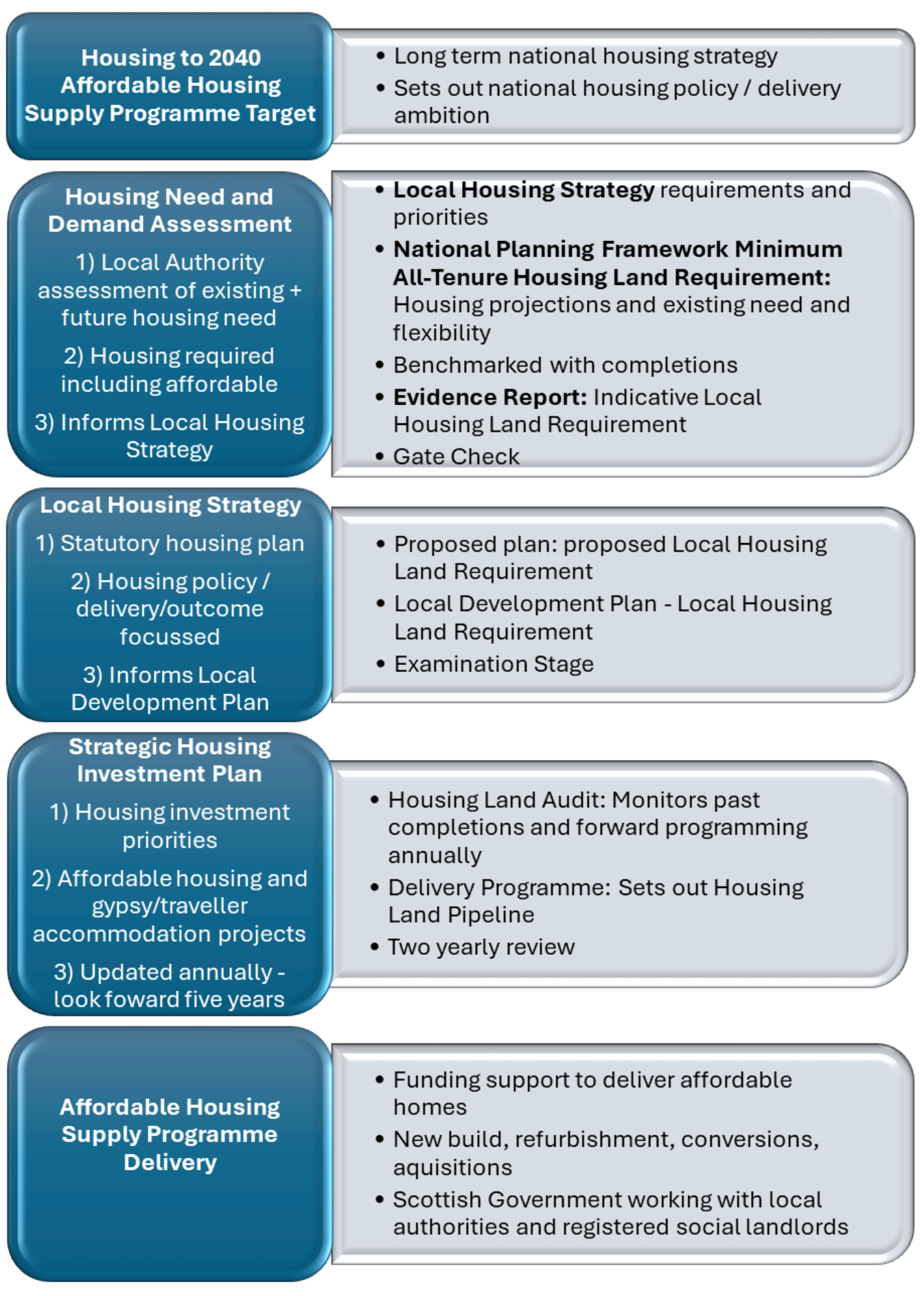
Graphic text below:
Housing to 2040 Affordable Housing Supply Programme Target
- Long term national housing strategy
- Sets out national housing policy/delivery ambition
Housing Need and Demand Assessment
1) Local authority assessment of existing and future housing need
2) Housing required including affordable
3) Informs Local Housing Strategy
- Local Housing Strategy requirements and priorities
- National Planning Framework 4 (NPF4) Minimum All-Tenure Housing Land Requirement: Housing projections and existing need and flexibility
- Benchmarked with completions
- Evidence Report: Indicative Local Housing Land Requirement
- Gate Check
Local Housing Strategy
1) Statutory housing plan
2) Housing policy/delivery/outcome focussed
3) Informs Local Development Plan
- Proposed plan: proposed Local Housing Land Requirement
- Local Development Plan – Local Housing Land Requirement
- Examination stage
Strategic Housing Investment Plan
1) Housing investment priorities
2) Affordable housing and Gypsy/Traveller accommodation projects
3) Updated annually – look forward five years
- Housing Land Audit: Monitors past completions and forward programming annually
- Delivery Programme: Sets out Housing Land Pipeline
- Two-yearly review
Affordable Housing Supply Programme delivery
- Funding support to deliver affordable homes
- New build, refurbishment, conversions, acquisitions
- Scottish Government working with local authorities and registered social landlords
Further Advice
1.53 For advice about this guidance or HNDAs in general, please contact the Scottish Government CHMA using the CHMA Mailbox.
1.54 For those Local Authorities who are a member of Scotland’s Housing Network (SHN) you will have access to the relevant analysis and data which SHN produce. This can be accessed on their website at Scotland's Housing Network.
Contact
Email: chma@gov.scot