
Homelessness in Scotland: 2024-25
This statistics bulletin provides information on homelessness in Scotland in the period from 1 April 2024 to 31 March 2025, alongside historical data.
Part of

Temporary accommodation
Key points in 2024-25
- Households spent an average of 238 days in temporary accommodation.
- Households with children spent longer in temporary accommodation than those without
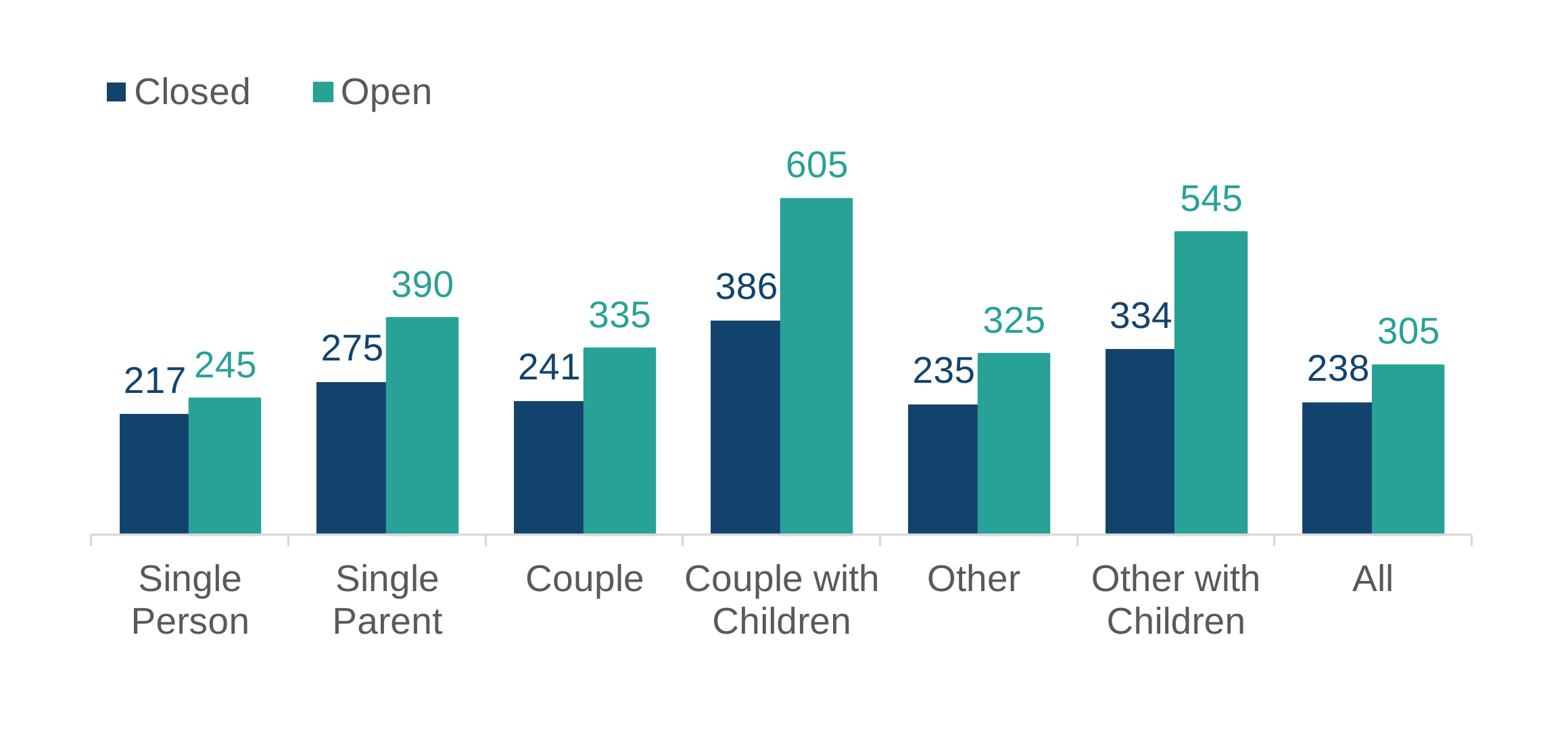
- Higher average times for open cases than closed cases
- Large increases in the number of cases not offered temporary accommodation.
- Large increases in the number of breaches of the unsuitable accommodation order
Sources of temporary accommodation data
Since 2002, local authorities have provided aggregate snapshot information relating to households in temporary accommodation. While this allows trends to be explored over time, understanding around individual placements and how these relate to assessed households is not possible from the snapshot data. Therefore, since 1 April 2016 placement level information on households in temporary accommodation has been provided to enable a more rounded picture of the use of temporary accommodation.
The snapshot data shows 17,240 households in temporary accommodation as at 31 March 2025. The placement level returns show that there were 18,327 temporary accommodation placements open at 31 March 2025 – higher (1,087, 6%) than the snapshot returns. Differences may be explained by the returns including different types of temporary accommodation and the placement level returns experiencing a lag in cases being closed.
Both of these figures show households in temporary accommodation at a point in time and, as such, will include those who have recently entered temporary accommodation as well as those who have been in temporary accommodation for a longer period of time (including prior to the reporting year).
Reporting of temporary accommodation
Over 2024-25, 48,292 temporary accommodation placements were entered and 47,266 were exited. This is a net difference of 1,026. This is not quite the same as the increase of 910 households in temporary accommodation between 31 March and 2023 and 2024 from the HL2 data, however, this is likely due to the differences in the collections outlined above. Total number of placements is a useful measure for showing the overall scale of temporary accommodation usage. However, placement level analysis alone provides limited insight due to the often very transient nature of the use of temporary accommodation. It is not unusual for households to enter and exit multiple placements, with or without gaps in between.
When considering certain aspects of temporary accommodation such as number of placements, average time spent in temporary accommodation etc., the true extent of this can only be fully understood once a household’s homelessness application has been closed.
How many households entered temporary accommodation for the first time? How many exited for the last time?
In 2024-25, 23,447 households entered a first (ever) temporary accommodation placement. This may include households who made a homelessness application prior to this year. Over the same period, 20,110 households exited their last (ever) temporary accommodation placement. A household is considered to have ‘exited’ temporary accommodation in a reporting year only if their homelessness case has closed and their last associated temporary accommodation placement is within that year.
These figures give a net difference of 3,337 more households entering temporary accommodation for the first time than exiting for the last time. This relates to the increase in the number of households in temporary accommodation which can be seen in the snapshot figures. Although the numbers will not match given the differences outlined above.
The largest net increase was in Edinburgh with 1,058 more households entering than exiting. This the next largest was Glasgow, with a net difference of 838.
How commonly is temporary accommodation used?
Chart 8: Three fifths of homelessness applications take up temporary accommodation
Number of temporary accommodation placements for applications closed in 2024-25
There is variation in the number of placements between local authorities with 93% of homeless households in Shetland having at least one temporary accommodation placement compared to 29% in Scottish Borders. In Edinburgh and Glasgow, 12% and 7% of homeless households, respectively, had five or more placements. Caution should be applied for local authorities where findings are based on small numbers.
What types of temporary accommodation are used?
Chart 9: Social sector accommodation is the most common type of temporary accommodation, in particular for households with children or pregnant women
Households in temporary accommodation, by type of accommodation, as at 31 March 2025
There has been a decrease in the use of Bed & Breakfast temporary accommodation. For all households, this has decreased from 16% of all placements at 31 March 2024 to 14% in 2025. For households with children this has remained constant at 3%.
Data from the placement level data collection can provide further insight into the total use of temporary accommodation over the course of homelessness cases. However, it is difficult to make direct comparisons with the snapshot data (shown in Chart 9) as different categories of temporary accommodation are used between the two returns.
There was a total of 45,190 temporary accommodation placements associated with cases that closed in 2024-25. Of which, 36% were in local authority or housing association/registered social landlord (RSL) accommodation; 16% were in hostel accommodation; and 36% were in bed & breakfast accommodation.
The higher proportion of hostel and bed & breakfast accommodation in the placement level returns (16% vs 36%) indicates that these types of temporary accommodation are more frequently used than the snapshot data suggests. However, this can be explained by the fact that the average duration for stays in these types of accommodation is much shorter - for example, 45 days in bed & breakfast compared to an average of 116 days for all temporary accommodation – and therefore they account for a much smaller proportion of the overall use of temporary accommodation. See Chart 11 for average durations by accommodation type.
Data on the number of placements and average length of time will help improve understanding of the ways in which different types of temporary accommodation are used.
How long do households spend in temporary accommodation?
The average time households that took it up spent in temporary accommodation was 238 days for cases that closed in 2024-25. This has been increasing year on year since 176 days in 2017-18, the start of the time series.
Note that total duration is calculated by summing the time a household spends in individual placements, excluding time between placements when a household is not in temporary accommodation. As a result, the time a household spends in temporary accommodation may not be continuous.
Edinburgh has the highest average time at 538 days. Other notably high durations in temporary accommodation are in East Lothian (357 days), Shetland (353 days), Stirling (310 days) Midlothian (309 days) and Orkney (305 days).
Aberdeenshire is the local authority with the lowest average time in temporary accommodation (66 days), followed by Perth & Kinross (79 days).
Average total time spent in temporary accommodation also varies by household type.
Chart 10: Households with children spend longer in temporary accommodation
Time households with and without children spent in temporary accommodation (for cases closed in 2024-25)
[To note: information about individuals within temporary accommodation placements is not available from the placement level data. Household type has therefore been derived from the information provided on the homelessness application. This accounts for the difference in the number of households with children compared to the snapshot data return.]
Chart 11: Households spend the longest, on average, in private sector lease and housing association accommodation
Average duration (days) in temporary accommodation, by type of accommodation (for cases that closed in 2024-25)
What about households that are still in temporary accommodation?
The time spent in temporary accommodation up to 31 March 2025 can also be calculated for homelessness cases that are still open.
Chart 12: Average time in temporary accommodation is longer for open cases than closed cases for all household types
Average total time (days) spent in temporary accommodation, for open and closed cases, by household type
 How often do applicants refuse temporary accommodation?
A household can choose to refuse an offer of temporary accommodation made by the local authority. However, a household that has refused an offer of temporary accommodation may accept a subsequent offer.
In 2024-25, there were 6,295 cases of households refusing offers of temporary accommodation. This is a decrease of 485 (7%) compared to 2023-24. The largest numerical decrease was in Glasgow (from 1,910 to 1,570) and the largest numerical increases were in Edinburgh (from 740 to 890), Scottish Borders (35 to 135) and South Lanarkshire (from 225 to 320).
How often do local authorities fail to provide temporary accommodation?
A local authority is required to indicate when they do not offer temporary accommodation to a household and are therefore acting unlawfully. During 2024-25, there were 16,485 instances of households not being offered temporary accommodation. This is more than double 7,955 in 2023-24. Large numerical increases were experienced for Glasgow (from 6,270 to 12,800) and Edinburgh (from 1,515 to 3,245), as well as Fife (from 140 to 310), albeit on a different scale of magnitude.
How often do local authorities breach unsuitable accommodation legislation?
Between April 2024 and March 2025 there were 7,850 reported breaches of the unsuitable accommodation order (UAO) across twenty-one local authorities. This compares to 7,440 reported in 2023-24.
Glasgow had the largest number of breaches (3,180), followed by Edinburgh (1,945), Aberdeen city (430), Dumfries & Galloway (415) and West Lothian (380).
Important! There is still a degree of caution to be exercised when considering these figures due to reporting anomalies and inconsistencies. These are still inherent in the data as a result of uncertainty caused by the extension of the Unsuitable Accommodation Order (UAO) legislation in May 2020.
See known data quality issues for further details.