
Heat in Buildings: progress report 2025
Annual update on progress against our Heat in Buildings Strategy and Monitoring and Evaluation Framework.
Reporting structure
Monitoring map and indicators
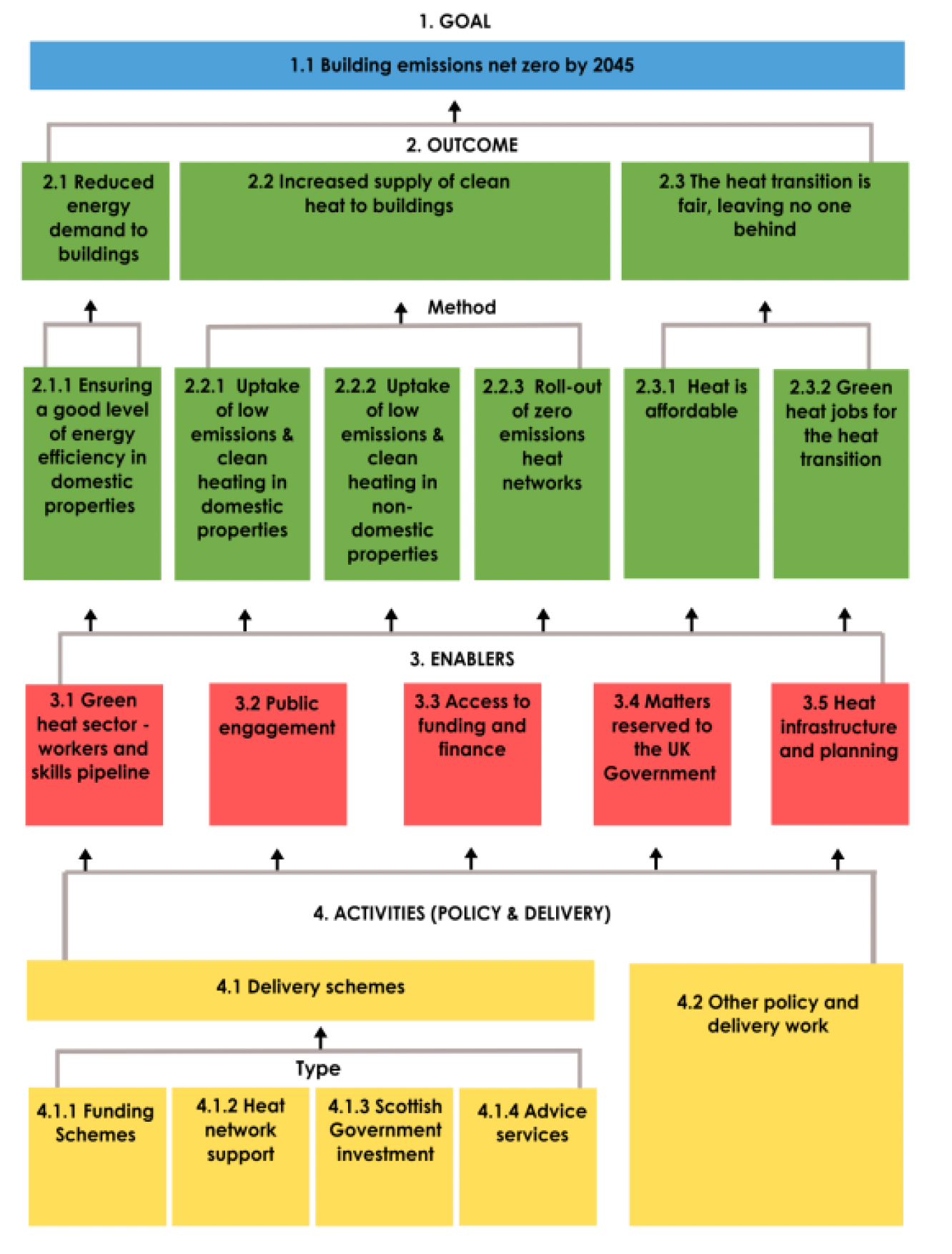
This report is structured around the monitoring map (Figure 1), published in our Monitoring and Evaluation Framework. It is designed to show how we expect our policy and delivery activities, supported by ‘enabling factors’, to contribute towards the emissions reduction goal in the Heat in Buildings Strategy. The different levels of the map are described below:
- Goal: the overarching target (to achieve net zero buildings emissions by 2045)
- Outcome: what the project or activity expects to accomplish, which together bring about the heat transition. The Heat in Buildings Strategy has three outcomes
- Enablers: enabling factors that overcome barriers to achieving outcomes in the Heat in Buildings Strategy
- Activities: policy and delivery activities that support the enablers of the Heat in Buildings Strategy
1. GOAL
1.1 Building emissions net zero by 2045
2. OUTCOME AND METHOD
2.1 Reduced energy demand to buildings
2.1.1 Ensuring a good level of energy efficiency in domestic properties
2.2 Increased supply of clean heat to buildings
2.2.1 Uptake of low emissions & clean heating in domestic properties
2.2.2 Uptake of low emissions & clean heating in non-domestic properties
2.2.3 Roll-out of zero emissions heat networks
2.3 The heat transition is fair, leaving no one behind
2.3.1 Heat is affordable
2.3.2 Green heat jobs for the heat transition
3. ENABLERS
3.1 Green heat sector - workers and skills pipeline
3.2 Public engagement
3.3 Access to funding and finance
3.4 Matters reserved to the UK Government
3.5 Heat infrastructure and planning
4. ACTIVITIES (POLICY & DELIVERY) & TYPE
4.1 Delivery schemes
4.1.1 Funding Schemes
4.1.2 Heat network support
4.1.3 Scottish Government investment
4.1.4 Advice services
4.2 Other policy and delivery work
Baselining and latest data
As with last year, where data exists, the baseline position for indicators remains as 2019. This allows for comparison with a 'typical' year before the Heat in Buildings Strategy was published, prior to the coronavirus (COVID-19) pandemic in 2020.
The Scottish House Condition Survey (SHCS) is used for several indicators. The latest SHCS data set is for 2023.
Multiple indicators are based on new or emerging data sources and for these the baseline will be the point at which data is available. Depending on the indicator and data source, the most recent data range is from 2022 to a date in 2024. We make clear what date this refers to for each indicator.
Data from earlier years (pre-2019) is presented where this provides useful context.
Limitations
The Framework aims to illustrate the extent to which our policies and programmes are contributing to emission reductions and achieving wider outcomes. We acknowledge, however, that it is not currently possible to directly attribute policy intervention to the impact on outcomes. This is because the Framework cannot capture the effect of all the drivers, especially non-policy drivers, of the heat transition.
Figures for previous years may differ from those published in earlier reports due to revisions made to the underlying data sources. These updates tend to reflect improved methodologies, corrections, or the incorporation of late returns.
Finally, gaps in data make reporting on some areas challenging, particularly heat networks, non-domestic properties, and jobs. However, we continue to provide best available data for indicators and will continue to evolve the Framework by incorporating further data in future reporting as it becomes available.
On non-domestic buildings specifically, the Energy Saving Trust, on behalf of the Scottish Government, has developed new metrics to support Heat in Buildings monitoring. This has allowed us to report on the number of non-domestic properties recently installing heat pumps for the first time (indicator 2.2.2B) and improve our reporting for indicator 2.2.2C.
While we have gone as far as possible to ensure that the data presented is accurate, we may need to update and amend some data post-publication as we continue the process of improvement and verification.
Contact
Email: heatinbuildings@gov.scot