
Food (Promotion and Placement) (Scotland) Regulations 2025: implementation guidance
Guidance to support the implementation of the Food (Promotion and Placement) (Scotland) Regulations 2025.
4. What food is in scope
Food products are only within the scope of the regulations if they are ”specified food” sold by a qualifying business.
Specified food is food (including drink) which is:
- prepacked;
- falls within one of the categories in the schedule of the regulations; and
- determined to be ‘less healthy’ or HFSS, according to its nutrient profiling model (NPM) score.
Food is not within scope and therefore not subject to restrictions if it is:
- non-prepacked (for example, loose bakery items), except for free refills of sugar-sweetened beverages in the out of home sector
- prepacked for direct sale (as defined in Annex B: Definitions of this guidance) such as food packed on the sale’s premises (whether or not at the consumer’s request) – for example, freshly prepared pizza that is deemed HFSS packed on site
- not included within any of the categories of food and drink in the schedule of the regulations (see ‘ What food is in scope ’ section).
- included within the categories of food and drink in the schedule but not deemed to be HFSS or ‘less healthy” according to its NPM score
- sold by businesses exempt from the regulations (see ‘ Businesses exempt from the location and volume price promotion restrictions ’).
4.1 How to determine if a product is in scope
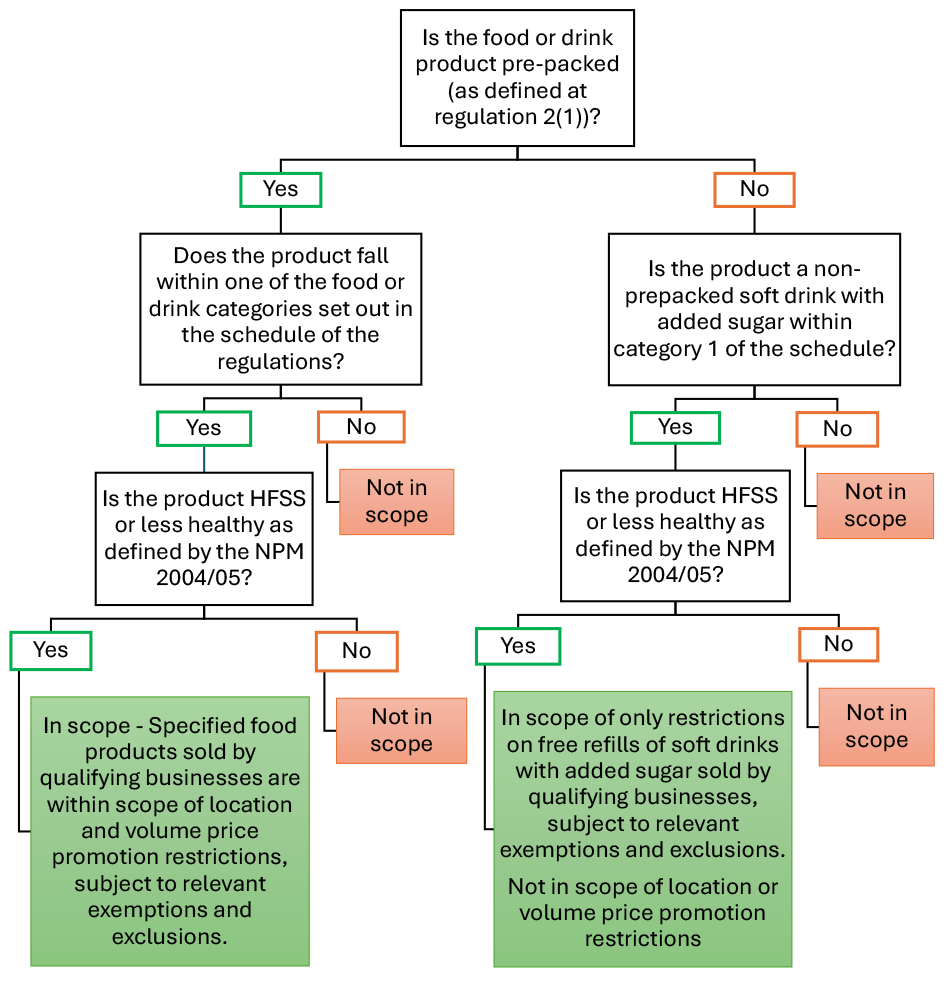
This flow chart is for illustrative purposes only and is intended to show the process for determining if a product is in scope of the regulations.
4.2 Product categories in scope
The food and drink categories within scope of restrictions are set out in the schedule of the regulations.
‘Schedule food’ means food or drink products that fall within a category specified in the schedule (categories of specified food) of the regulations.
The products listed below are examples of what may be in and out of scope of the regulations.
The lists of examples and exclusions are not exhaustive, unless otherwise stated.
While the categories of food in the regulations do not overlap, some types of food product may have multiple ingredients or features potentially capable of falling under more than one category. If it should be necessary to determine which category the product falls under, this is done by an objective overall assessment of the ingredients and features of the specific product being offered for sale, in order to determine which category best describes the product in question.
Category 1
The regulations describe category 1 as:
Prepared soft drinks containing added sugar ingredients (other than exempt soft drinks).
The regulations also make further provision to define what that means in more detail.
Examples of (category 1) products that may be in scope
- soft drinks with added sugar, including lemonades, colas and fruit-based squash drinks
- milk-based drinks with added sugar or sweeteners, and milk substitute drinks with added sugar or sweeteners (for example, soya, almond, oat, hemp, hazelnut or rice and so on)
- juice-based drinks with added sugar
- fruit juices or smoothies (including smoothies with dairy) with added sugar
- breakfast drinks with added sugar
- ready-to-drink tea and coffee containing added sugar before sale
- coffee or tea powders with added sugar (sachets, pods or syrups). Note: for powders, the NPM score should be calculated based on 100g of the drink as reconstituted according to the manufacturer’s instructions. As with all products, please refer to the NPM technical guidance 2011 for support calculating the NPM scores.
- 2 in 1 (coffee and milk powder) or 3 in 1 (coffee, milk powder and sugar) containing added sugar
- hot chocolate powders, pods, syrups and ready-to-drink products containing added sugar
- malt drink powders with added sugar
- milkshake powders and milkshake syrups with added sugar
- flavoured and unflavoured milk substitute drinks with added sugar
- chai latte with added sugar
- kombucha with added sugar
- energy drinks with added sugar
- protein powders with added sugar
Examples of products that may not be in scope
- drinks without added sugar, including milk (as defined in regulation 7 of the Soft Drinks Industry Levy Regulations 2018)
- unsweetened milk-based drinks and unsweetened smoothies
- drinks with no added sugar and sweetened only with milk, fruit or vegetable juice, or any combination of these
- alcoholic drinks and alcohol substitute drinks with more than 1.2% alcohol by volume (ABV)
- ‘infant formula’, ‘follow-on formula’, ‘processed-cereal based food’ and ‘baby food’ as defined in assimilated Regulation (EU) No. 609/2013 of the European Parliament and of the Council
- total diet replacements as defined in assimilated Regulation (EU) No. 609/2013
- meal replacement products which use an approved ‘health claim’ provided in the annex to assimilated Regulation (EU) No. 432/2012 food for special medical purposes as defined in assimilated Regulation (EU) No. 609/2013 of the European Parliament and of the Council
Category 2
The regulations describe category 2 as:
1. Savoury snacks whether intended to be consumed alone or as part of a complete meal including -
(a) products made from potato, other vegetables, grain or pulses,
(b) extruded, sheeted and pelleted products,
(c) bagged savoury crackers, rice cakes or biscuits, such as crisps, pitta bread based snacks, pretzels, poppadums, salted popcorn and prawn crackers (but not raw, roasted, coated or flavoured nuts).
2. Pork rind-based snacks whether intended to be consumed alone or as part of a complete meal.
In general, this is intended to cover all crisps and products eaten as alternatives or eaten on the same eating occasion as crisps.
Examples of products that may be in scope
- crisps
- savoury crackers, rice cakes and biscuits sold and eaten as alternatives to crisps
- corn puffs
- potato hoops
- tortilla chips
- chickpea or lentil-based crisps
- fried flavoured or seasoned chickpeas
- seaweed-based snacks
- Bombay mix
Examples of products that may not be in scope
- raw, coated, roasted or flavoured nuts and seeds (or mixes of these products – for example, a mix of nuts and seeds)
- fruit-based snacks such as dried fruit, fruit crisps or chips (includes both sweetened and unsweetened fruit ingredients)
- trail mix made up of dried fruit and nuts or seeds
- meat jerky
- ‘dunker’ type products, which include breadsticks and a dip
- savoury pressed seed bars
- larger packs of breadsticks which are not intended to be eaten in the same way or on the same eating occasion as crisps
Category 3
The regulations describe category 3 as:
Breakfast cereals including ready-to-eat cereals, granola, muesli, and oat-based cereals.
In general, this is considered to cover products predominantly found in the “breakfast cereal” aisle.
Examples of products that may be in scope
- granola
- muesli
- ready-to-eat cereals
- oat based cereals
Examples of products that may not be in scope
- plain porridge oats
Category 4
The regulations describe category 4 as:
Confectionery including chocolates and sweets.
Examples of products that may be in scope
- sweet popcorn, and mixed sweet and salty popcorn
- chocolate-coated nuts, peanuts, seeds and fruit
- white, milk and dark chocolate
- cooking chocolate
- chocolate bars and boxed chocolates
- bagged slabs or tubed sweets
- jellied fruit sweets
- chewing gum
- marshmallows
- chocolate-covered products – for example, chocolate-covered pretzels
Examples of products that may not be in scope
- all dried fruit
- sweet coated nuts (other than chocolate-covered nuts) – for example, honey coated, syrup coated, carob coated, sweet chilli flavours, and mixes of sweet and salty or savoury
- sugar-free sweets and sugar-free chewing gum
Category 5
The regulations describe category 5 as:
Ice cream, ice lollies, frozen yogurt, water ices and similar frozen products.
Examples of products that may be in scope
- ice cream tubs
- handheld ice cream
- ice lollies
- choc ices
- frozen yoghurt
- vegan ice cream
- sorbets
- gelato-style ice cream
- lactose-free ice creams
- ice cream desserts – for example, arctic roll
- alcohol-flavoured products – for example, rum and raisin-flavoured ice cream – that are below 1.2% ABV or alcohol-free
Examples of products that may not be in scope
- ice cream ‘accessories’, such as sauces, sprinkles and other similar cake-type decorations or toppings
- ice cream wafers (these are referred to under category 7)
- roulade and gateaux (these are referred to under category 9)
Category 6
The regulations describe category 6 as:
Cakes and cupcakes.
Examples of products that may be in scope
- all sponge cakes
- cupcakes
- cake bars and slices
- doughnuts
- American muffins
- flapjacks
- swiss rolls
- brownies
- tray bakes
- cream cakes
- mini rolls
- éclairs
- frozen cakes
Examples of products that may not be in scope
- cake decorations, including icing and sauces
Category 7
The regulations describe category 7 as:
Sweet biscuits and bars based on one or more of nuts, seeds or cereal.
In general, this includes all sweet biscuits (filled and unfilled) and chocolate bar biscuits, including flour-based and ‘free from’ products. Also includes sweet bars based on one or more of these ingredients: nuts, seeds or cereal.
Examples of products that may be in scope
- cereal bars (cereal bars may be similarly shaped to a chocolate bar, made of cereals and typically other ingredients such as fruits and nuts, but can also include nut and seed-based bars)
- filled and unfilled sweet biscuits
- breakfast biscuits
- shortbread
- ice cream wafers or cones
- coated chocolate biscuit bars
Category 8
The regulations describe category 8 as:
Morning goods, including croissants, pains au chocolat and similar pastries, crumpets, pancakes, buns, teacakes, scones, waffles, Danish pastries and fruit loaves.
Examples of products that may be in scope
- Danish pastries
- croissants
- pains au chocolat and similar pastries
- crumpets
- pancakes
- buns
- teacakes
- scones
- waffles
- English muffins
- bagels (plain and sweet)
- fruit loaves
- hot cross buns
- fruited and sweet non-fruited buns (including iced buns)
- brioche
- malt loaf (both sweetened with sugar or fruit)
Category 9
The regulations describe category 9 as:
Desserts and puddings, including pies, tarts and flans, cheesecake, gateaux, dairy desserts, sponge puddings, rice pudding, crumbles, fruit fillings, powdered desserts, custards, jellies and meringues.
Examples of products that may be in scope
- sweet pies – for example apple pie, mince pies and so on
- tarts and flans
- cheesecake
- gateaux
- dairy desserts
- sponge puddings
- rice pudding
- crumbles
- fruit fillings
- roulade
- powdered dessert mixes
- custards
- jellies
- meringue desserts
- choux pastry desserts
- mousses
- Christmas pudding
- trifle
- roly poly
- dessert pizzas
Examples of products that may not be in scope
- creams such as whipped cream and flavoured or sweetened creams
- syrups
- condensed caramel
- dessert toppings and sauces
- tinned or canned fruit
Category 10
The regulations describe category 10:
Sweetened (whether with sugar or otherwise) yoghurt and fromage frais.
In general, this includes dairy and non-dairy alternatives (such as soya, oat, goat or sheep products).
Examples of products that may be in scope
- sweetened flavoured Greek-style yoghurts
- sweetened probiotic yoghurts
- sweetened split yoghurts or twin chamber pots
- sweetened kids’ yoghurts
- sweetened fat free and low-fat yoghurts
- sweetened dairy-free yoghurts
- sweetened fromage frais
- sweetened drinking yoghurts – for example, a drinkable yoghurt, with no additional liquids (such as milk, water or fruit juice)
Examples of products that may not be in scope
- natural yoghurt and unsweetened yoghurt and fromage frais, including plain Greek yoghurt
Category 11
The regulations describe category 11 as:
Pizza (except plain pizza bases).
Examples of products that may be in scope
- deep pan, deep dish, thin crust and stuffed crust pizzas
- all topping varieties and all sizes
- flatbread pizzas
Examples of products that may not be in scope
- plain pizza bases
- garlic bread and cheese garlic bread, and ‘loaded’ varieties
Category 12
The regulations describe category 12 as:
Roast potatoes, potato and sweet potato chips, fries and wedges, potato waffles, novelty potato shapes (such as smiley faces), hash browns, rostis, crispy potato slices, potato croquettes.
Examples of products that may be in scope
- as listed above in the category description
Examples of products that may not be in scope
- plain potatoes or sweet potatoes that are not treated, cooked, cut or shaped
- potato salads
Category 13
The regulations describe category 13 as:
1. Products that are marketed as ready for cooking or reheating without requiring further preparation and intended to be consumed as a complete meal.
2. Products, other than products that contain pastry, in or with a sauce (but not a marinade, glaze, dressing, seasoning or similar accompaniment) that are marketed as ready for cooking or reheating without requiring further preparation and intended to be consumed as the main element of a meal.
3. Breaded or battered—
(a) vegetable, fish, shellfish, meat, or poultry products,
(b) substitute fish, shellfish, meat or poultry products,
including fish fingers, fish cakes, chicken nuggets and breaded meat substitute.
Examples of products that may be in scope
- ready meals: prepared meals (often suggested for heating in the microwave or oven), such as Chinese, Thai, Italian, traditional and so on, with carbohydrate accompaniment (potato, rice, noodles, pasta and so on) made from meat, poultry, fish, meat alternatives or vegetables. Filled or stuffed pasta (for example, ravioli and tortellini) whether chilled or tinned. Includes dishes such as vegetable curries, dhal and other dishes that can be consumed as a meal. Potato-topped pies (for example, shepherd’s pie), burgers in a bun, and fries, chips or wedges with toppings (often referred to as ‘dirty fries’ or ‘loaded fries’), and filled jacket potatoes;
- fresh pasta, rice or noodles with added ingredients and flavours, including filled or stuffed pasta (for example, ravioli and tortellini);
- meal centres: prepared meal centres (often suggested for heating in the microwave or oven), such as Chinese, Thai, Italian, traditional and so on, made from meat, poultry, fish, meat alternatives or vegetables. Products of this type are in scope where they are served in a sauce or with a sauce as part of the product – for example, in a packet or sachet intended to be poured on during or after heating;
- battered or breaded products (fresh, chilled or frozen): a number of products that might be consumed as the main element of a meal such as fish fingers, chicken nuggets, battered fish, fish or chicken goujons, breaded meat substitutes, scampi, kievs, breaded chicken fillets, ‘lightly dusted’ products, cereal-coated products and gluten-free alternatives.
Examples of products that may not be in scope
- retail meal kits – for example fajita or enchilada meal kits or other kits that contain ingredients requiring preparation and combining for cooking a meal
- breaded or battered cheese-based products intended to be consumed as a starter or side
- cooked breaded ham or charcuterie products
- savoury pastry products: ambient, chilled and frozen processed and ready-to-eat or on-the-go products such as meat, fish, vegetable or meat alternative pastry pies, pasties, sausage rolls, tarts, tartlets, quiches, slices, lattices and plaits.
- meat, poultry, fish, shellfish or meat alternatives, either served plain, smoked or with a marinade (a marinade differs from a sauce as it is intended to be absorbed into the food before or during cooking so that, after cooking or heating the food product, no significant liquid remains to be poured over the food), glaze, dressing, seasoning rub or similar accompaniment. ‘Meat’ includes meat and processed meat products such as ham, salami, chorizo, bacon, gammon, chicken thighs, grills, burgers (without a bun), sausages, haggis, skirlie, black pudding and steaks.
- meats, fish, shellfish or meat alternatives that are plain (for example, raw plain chicken breasts) or have been smoked (for example, smoked meat and fish) or are processed meats (such as ham, salami and bacon)
- savoury pies made with pastry
- quiches
- sandwiches
- sushi
- cullen skink
- other foods that are not cooked or reheated before consumption
- party food (other than breaded or battered food) that is not intended to be consumed as a main meal – for example, mini quiche or mini sausages (this is not an exhaustive list).
4.2.1 Individual products vs composite meals
There may be products that, when sold as a single item, are out of scope of the promotions restrictions, but when they are included within a ready meal or whole product, they are in scope of the restrictions (for example, sausages are out of scope of the promotions restrictions, but a sausages and mash ready meal is in scope).
This is due to evidence showing that product categories such as ‘ready meals’ are a contributor to children’s calorie intake and are heavily promoted.
4.2.2 Seasonal products and seasonal promotions
There are multiple seasonal promotion points running through the year including, but not limited to, Christmas, Diwali, Valentine’s Day, Easter, Mother’s day, Father’s Day and Halloween.
Products in scope of schedule categories are subject to the restrictions, regardless of whether they are branded as ‘seasonal’. However, businesses are able to promote seasonal products that are in schedule categories if they are not ‘less healthy’ in accordance with the NPM.
4.2.3 Selections, platters, hampers and gift sets
If an item of prepacked food comprises more than one type of food and contains a specified food within it, the whole item is to be treated as specified food.
This includes examples such as selections or platters, hampers and gift sets that include multiple different items of food.
4.2.4 Food to go
Specified food sold in qualifying businesses will be in scope of the restrictions irrespective of being marked as ‘food to go’.
Contact
Email: DietPolicy@gov.scot