
A fish counter network for monitoring Scottish salmon stocks
This report outlines the SG's need for data on salmon returning to rivers, and the different types of in-river fish counter that are currently available. The report identifies the locations of existing fish counters and some other sites that may be suitable for new optical or resistivity counters.
6. Current data sources
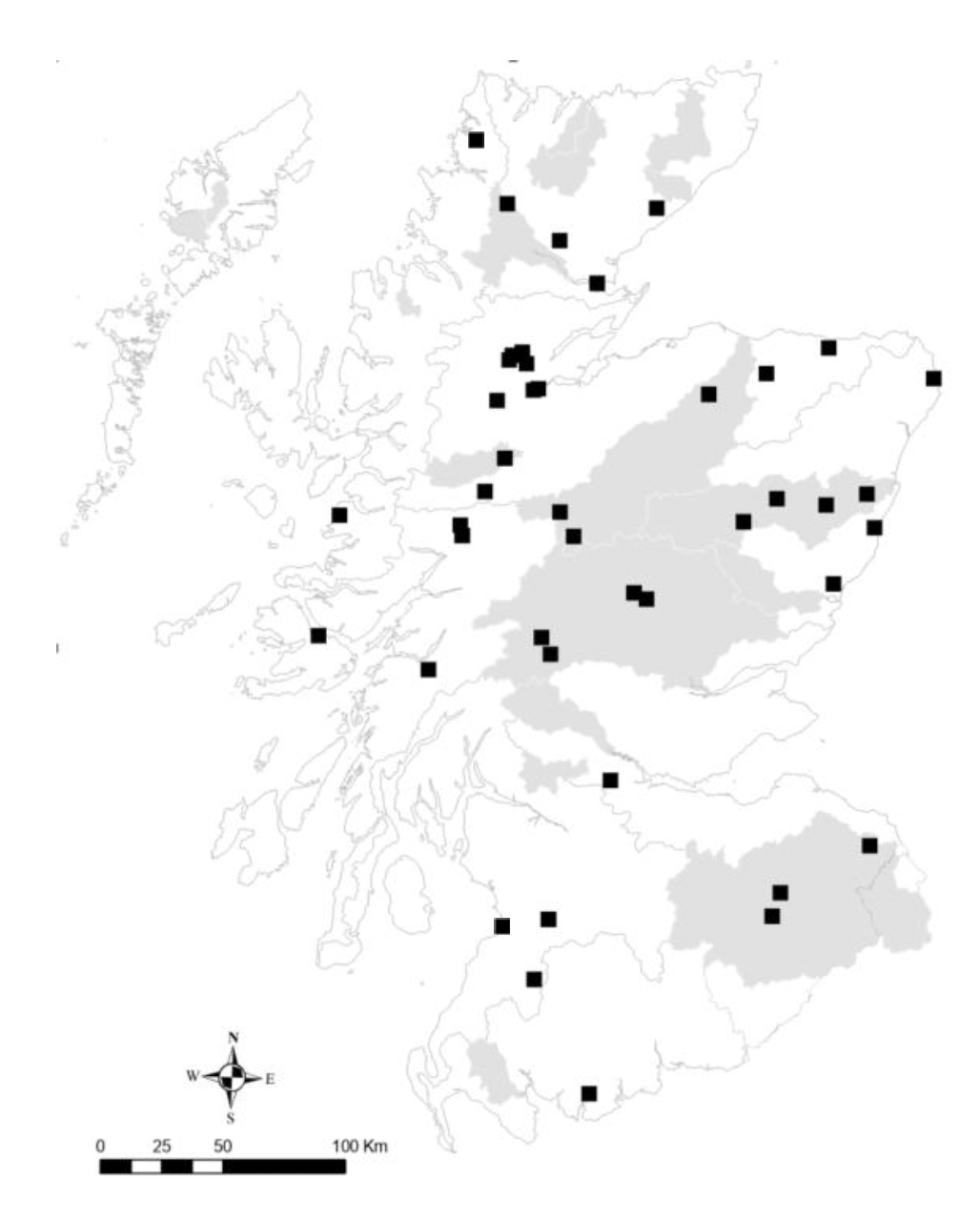
In 2003, there were 29 fish counters operating in Scotland (Simpson, 2003). Since then, the number of counters has increased and there were 41 fish counters in Scotland in 2022 (Figure 1; Appendix A). However, not all were opertional and only a small number produce data useful for stock assessments in a national context. This is because most were constructed for specific local purposes e.g. to confirm that salmon passed through fish ladders incorporated into hydroelectric schemes, or to assess the effectiveness of barrier easement. To be of use in producing data for use in assessing stocks under the Conservation Regulations, a fish counter should distinguish between salmon and other species of fish, estimate the abundance of salmon in the whole of the assessed river catchment and produce data of known reliability.
The number of fish counters providing salmon abundance data to the Marine Directorate has been variable in recent years. Count data were available for two rivers in 2022, four in 2023 and three in 2024 (of 215 salmon rivers). For comparison, count data are collected from 12 of 64 principle salmon rivers in England and Wales, from 6 of 24 salmon rivers in Northern Ireland, and from 31 of 144 salmon rivers in the Republic of Ireland.
The Conservation of Salmon (Amendment) (Scotland) Regulations 2023 detailed the river gradings and fishery conservation measures for the 2024 season, based on stock assessments that made use of catch and count data from the 2022 fishing season. Two fish counters (at Logie Mill on the North Esk and at Tongland dam on the Kirkcudbrightshire Dee) provided data used in that assessment.
From 1980 to 2023, the Marine Directorate ran a resistivity counter at Logie Mill, on the North Esk. From 2019 to 2023, the counter produced a partial count, from which a whole-river count could be derived using information from earlier years; however, the counting weir was destroyed by record flooding during Storm Babet (October 2023) and counting on the North Esk ceased.
The 2024 Conservation Regulation amendments, for the 2025 fishing season, used count data from three rivers: the Kirkcudbrightshire Dee counter and new hydroacoustic cameras installed by the Marine Directorate on the rivers Laxford and Deveron. All three are operated by local fisheries interests. The counter on the Dee is run by Galloway Fisheries Trust on behalf of Drax Ltd., whilst the Laxford and Deveron counters are owned by the Marine Directorate and operated by charitable Trusts. The Directorate has also recently installed new counters on the rivers Ayr and Helmsdale which are operated jointly by the Directorate and the local fisheries Trust or Board; the reliability of data from these two counters is currently being validated.
Validation of a counter is usually multi-layered, involving determining its ability to distinguish between fish and non-fish events, differentiating between salmon and other species and identification of the false positive and false negative count rates. This usually requires the (temporary) use of a second counting technology. Individual counts also need to be verified on an ongoing basis, to ensure that the counted event was a salmon. Increasing the degree of levels of validation reduces the uncertainty in the count but increases the cost of obtaining the data. A balance needs to be struck between the level of uncertainty that is acceptable and the resource that is available (Braun et al., 2016). Developments in the application of machine learning algorithms to improve the assignment of events as fish or non-fish, or to automate image analysis to allow categorisation, sizing and species identification can be expected to reduce staff costs arising from the human component of fish counter validation and operation (e.g. Mackiewicz et al., 2023).
Contact
Email: craig.robinson@gov.scot