
Just Transition Fund for the North East and Moray: final evaluation report
Independent evaluation report of the Just Transition Fund for the North East and Moray. The evaluation assessed the impact of the Fund in its first two years of operation (2022-2024), during which it supported a package of skills interventions, community-based projects and innovative technologies.
4. Discussion
4.1 In Chapter 3 we described the economic, social and environmental impact of the JTF projects along with some of the delivery challenges that were faced. In this chapter, we discuss the effectiveness of JTF administration, the enabling role of the Fund, its strategic impact in progressing diversification, net-zero and equitable economic growth and JTF alignment with Just Transition principles, regional strategies and priorities.
Summary of achievements
4.2 The Just Transition Fund has been widely recognised as an impactful mechanism supporting the North East and Moray’s shift to a net-zero economy. It has enabled early-stage innovation in hydrogen, offshore wind, and marine renewables, while helping unlock opportunities in sectors like food production and tourism. The JTF has supported workforce transition through skills development and job creation, particularly for those moving from oil and gas into green industries. It has also empowered communities through initiatives like participatory budgeting and locally led projects such as NESCAN and Hydroglen, ensuring that the transition is inclusive and community-driven.
Effectiveness of the JTF
4.3 The JTF has played an important role in supporting the North East and Moray’s transition to a low-carbon economy, offering financial backing for projects focused on energy transition, skills development, infrastructure, and community-led initiatives. However, feedback from stakeholders—project leads, local authorities, and community organisations—highlights several areas like funding processes, administrative structures, and strategic planning that could increase the fund’s effectiveness, accessibility, and long-term impact.
Strengthening the application, decision-making and monitoring processes
4.4 The most common and recurring issues raised by the projects was the short application window and unpredictable funding cycles. Several projects indicated that the expression of interest (EOI) phase was hurried, meaning that they had little time to prepare detailed applications. It was reported that the lack of a structured application template was confusing and there were expectations of a follow-up application.
4.5 It also meant that there were no standardised documents that could be used to monitor progress and understand project achievements against the intended outcomes.
4.6 Others noted that initial meetings about funding opportunities were not widely publicised which meant that potential applicants were unaware of eligibility criteria, fund scope, and deadlines. Given these challenges, several recommendations were identified and included:
- Extending the application window to give organisations more time to prepare high-quality, detailed proposals;
- Providing earlier notice of funding rounds so organisations can plan ahead, reducing the pressure of last-minute applications;
- Providing clarity of the decision-making process; and
- Robust central monitoring of project’s progress.
4.7 Additionally, projects emphasised the need for a hybrid funding model that included both capital and revenue funding. Whilst capital funding was available for infrastructure development, operational support was limited, making it difficult to sustain long-term projects. It was suggested that organisations should be able to receive resources not just to build infrastructure but also to maintain and expand their projects over time.
Funding uncertainty and lack of transparency
4.8 Uncertainty regarding future funding rounds created difficulties for projects that required long-term investment to succeed. Several project leads highlighted confusion over the availability of additional funding phases, with some initially expecting further opportunities to apply. However, resources were allocated to meet legally committed financial obligations for multi-year projects, limiting the availability of new funding opportunities. Across multiple sectors, project teams suggested that greater transparency in funding timelines, clearer eligibility criteria for future rounds, and multi-year funding commitments would improve project planning, delivery, and long-term impact.
4.9 Several project leads reported that unclear guidance, inconsistent engagement, and slow responses created barriers to effective project execution. Some organisations struggled with uncertainty about eligibility, application procedures, and funding scope. With greater clarity some projects would have submitted a multi-year proposal. Post-award communication and actions like the timing of grant payments also impacted project delivery.
4.10 Project leads suggested that greater transparency in decision-making, better publicised engagement opportunities, and a clearer roadmap for funding rounds would improve the JTF’s accessibility, predictability, and overall effectiveness.
Addressing financial administration and payment delays
4.11 A recurring frustration was the delayed funding decisions and processing of grant payments, which affected cash flow and created financial uncertainty particularly for small organisations who needed timely payments to support their operation and cover ongoing expenses such as staff wages. Some project leads explained that delayed funding decisions left insufficient time for planning and execution with truncated timescales that limited procurement processes and project delivery. This was exacerbated by the lack of rollover options, resulting in unspent funds. The process for claiming JTF monies was through quarterly drawdowns in arrears and this also posed challenges for some organisations, regardless of size. Seasonal factors also added to the challenges, with projects that operated or could only carry out activities at particular times of the year, e.g. planting trees, construction work restricted by some of the funding deadlines.
4.12 To improve and address these challenges, suggestions included:
- Allowing for upfront payments particularly for projects involving small community organisations or early-stage initiatives;
- Providing more flexible payment schedules tailored to the needs and operation of each project;
- Ensuring faster processing of grant claims to minimise financial hardship for organisations relying on JTF for day-to-day operations; and
- Introducing rolling or multi-year funding cycles to ensure project continuity and reduce uncertainty.
Improving communication and engagement
4.13 While some JTF recipients praised the responsiveness of the JTF team, others highlighted the gaps in communication particularly around funding decisions, strategic priorities, and reporting expectations. They had several suggestions as to how this could be improved through hosting regular information sessions and workshops to clarify funding criteria, application processes, reporting requirements and answering questions from potential applicants. They also felt that this support could be reinforced by clearer and more accessible JTF documentation.
4.14 For successful applicants, they sought structured networking opportunities among JTF-funded projects. They felt that this could occur in several ways:
- The creation of a centralised platform to connect JTF projects with potential partners, investors, and policy initiatives;
- An annual event, e.g. Just Transition Summit, where project leads could share findings, discuss challenges, and identify opportunities for collaboration; and.
- More frequent opportunity for the projects to connect through thematic working groups, e.g. Energy, skills development, and community engagement.
Enabling role of JTF
4.15 JTF has been key in enabling projects that support the North East and Moray’s transition to a low-carbon economy. Without this funding, many would not have happened at all, others would have been delayed or significantly reduced in scope, showing that JTF support was often the only viable source of funding, filling critical gaps that would have otherwise hindered progress.
Projects that would not have happened
4.16 For some projects, the absence of JTF funding would have meant they never got off the ground. The CNER Buchan Sustainable Transport Study, for example, claims that they would have remained a small volunteer-led initiative with no formal backing, making it difficult to engage businesses, local government, or national policymakers in discussions about sustainable transport solutions.
4.17 The Digital Innovation Lab and the Energy Skills Passport faced similar realities; project leads were clear that without JTF, these initiatives simply would not have happened. For the North East Adventure Tourism (NEAT) project, JTF provided the essential funding to complete the first phase establishing a foundation for future investment. Without this support, the project would not have been able to create jobs, develop infrastructure, or advance plans for further site investment.
Funding to overcome delays and strengthen delivery
4.18 Even when alternative funding might have been available, securing it would have introduced significant delays. The Cabrach Distillery, for instance, had already raised £3.5 million but still faced a £500,000 shortfall. JTF provided finance at a key moment, ensuring the project stayed on track. Without it, securing additional funds could have taken months or even years, delaying the distillery’s progress and economic impact. Similarly, the Moray Council JT Masterplan depended on JTF funding to move key projects forward. While some elements, like the Buckie Harbour redevelopment, might have progressed, the Just Transition elements of the plan would likely have been weaker or fragmented, missing the opportunity to integrate economic and environmental goals effectively.
Enabling feasibility and future investment
4.19 In some cases, projects would have stalled at the feasibility stage, preventing them from securing future investment. The NESS Carbon Capture FS project in Aberdeen, for example, required a feasibility study to explore its viability. Without JTF, that study would not have been completed, delaying further funding applications and slowing progress toward carbon capture solutions. The Net Zero Tech Centre Hydrogen Offshore Production (HOP2) project might have proceeded in a limited capacity, but without JTF support, the project’s scope would have been reduced, potentially altering its focus and limiting its impact.
4.20 The challenge many projects faced was the lack of alternative funding sources for early-stage transition initiatives. The ETZ Pilot Energy Skills and Supply Chain Pathway and Energy Transition Challenge Fund projects illustrate this issue well. Both initiatives focus on preparing the North East’s workforce and supply chain for the shift from oil and gas to renewables, but the private sector was not yet willing to fund such early-stage work. Without JTF, these projects would likely have struggled to progress, leaving critical gaps in efforts to build a skilled workforce for the future green economy. Similarly, the TSI Moray Participatory Budgeting scheme highlighted how difficult it is for grassroots community projects to attract funding, particularly in areas like Moray, where national funds have a low success rate. Without JTF, many of these groups would not have been able to implement their ideas, limiting local engagement in the Just Transition process.
4.21 The JTF financial transactions handled by SNIB in Year 2 combined the Bank’s commercial acumen with strategic public sector goals, resulting in impactful investments in Aurora, Orbex, and Trojan Energy. The bank sought projects with potential for sustainable financial performance while addressing market gaps and catalysing additional private investment. SNIB suggested that future financial transactions should have a clearer investment pipeline to help transition projects from grant-funded pilots to commercially viable investments and there should be better coordination with commercial investors to amplify impact.
Attracting further investment
4.22 JTF also played a catalytic role in unlocking further investment for several projects. The JT Hub, for example, secured an additional £1.6 million from the Department for Science, Innovation, and Technology (DSIT), which they attribute to the credibility provided by its initial JTF funding. Without this backing, they felt it would have been much harder to attract further investment, delaying progress on the Hub’s immersive engagement space designed to help stakeholders visualise Scotland’s energy transition. Similarly, in the education sector, JTF funding allowed NESA’s partner institutions to develop 15 new training courses in renewable energy, providing fee-waivers for over 700 individuals who might not have been able to afford training otherwise. Without this investment, many employers would have struggled to train their staff in renewable technologies, delaying their ability to transition away from fossil fuel-based industries.
4.23 The impact of JTF is again illustrated by the Seedpod project, which aimed to establish a regional food and drink innovation hub. This initiative had already secured funding through the Aberdeen City Deal but rising costs due to COVID-19 and inflation created a £6.5 million shortfall. JTF was instrumental in closing this gap, allowing Seedpod to move forward as planned. Without this funding, project leaders noted that Seedpod would have faced major challenges in securing the additional funds needed, with borrowing not an option due to the project’s structure. The project’s regional significance meant that abandoning it entirely was unlikely, but its progress would have been delayed indefinitely, limiting its ability to support the North East’s food and drink sector during an important period of economic transition.
4.24 Across all these examples, a consistent theme emerges: JTF did not just provide funding, it provided momentum. Whether enabling entirely new projects, accelerating existing ones, or unlocking further investment, the JTF ensured that the just transition agenda moved forward at pace. Without JTF, progress on many of these initiatives would have been slow, fragmented, or non-existent, delaying the goal of supporting the North East and Moray to transition to a sustainable, low-carbon future.
JTF alignment with Just Transition principles, regional strategies and priorities
4.25 JTF has been an important driver in supporting industries to diversify beyond oil and gas and ensuring inclusive economic growth. Insights from the projects highlight the Fund’s impact in enabling new energy technologies, workforce development and fair economic opportunities for businesses and communities.
Decarbonisation and energy transition
4.26 JTF-funded projects are directly contributing to Scotland’s net-zero goals by developing renewable energy technologies, hydrogen infrastructure, and low-carbon solutions. These projects span multiple industries, from offshore wind and hydrogen production to battery recycling and community-led decarbonisation initiatives.
4.27 The Moray Council JT Masterplan aligns with this agenda through hydrogen economy development, brownfield regeneration, and nature restoration, helping to establish the region as a key player in Scotland’s low-carbon transition.
4.28 The Seaweed Wave Energy Converter project represents innovation in marine-based renewables, aiming to generate clean energy while creating green jobs and supporting Scotland’s blue economy.
4.29 Other projects are advancing energy transition efforts at scale. The Net Zero Technology Centre’s Hydrogen Offshore Production (HOP2) project is exploring the feasibility of offshore hydrogen production, helping to decarbonise the North Sea energy system. Meanwhile, Ripcell’s EV Battery Recycling project is developing a sustainable method for recovering critical minerals, reducing reliance on virgin materials and lowering emissions in the battery supply chain.
4.30 Additionally, projects such as the Energy Transition Skills Hub and ETZ Supply Chain and Energy Transition Challenge Fund are ensuring that businesses and the workforce are equipped for the shift to renewables, providing the training and investment needed to accelerate Scotland’s decarbonisation journey.
Industry diversification and regional economic strategies
4.31 A key principle of just transition is about capturing the economic opportunities of net zero, ensuring that regions historically dependent on fossil fuels can develop new, sustainable industries. Several JTF-funded projects demonstrate direct support for economic diversification:
- Pilot Energy Skills Project has helped transition the North East’s workforce from oil and gas to renewable energy sectors; and
- Seedpod- a regional food and drink innovation hub, in combination with the City Deal builds on pre-existing investment in regional economic development.
4.32 The James Hutton Institute Hydrogen Project has collaborated with regional partners to meet regional and sectoral priorities. These include stakeholders such as the National Farmers Union Scotland (NFUS), Scottish Agricultural Organization Society (SAOS), Energy Transition Zone (ETZ) and Aberdeenshire Council and Scottish Enterprise.
4.33 These partnerships ensure that JTF investments are leveraged alongside broader regional economic development initiatives.
Empowering communities in the transition process
4.34 As already discussed in Chapter 3, a just transition must ensure that local communities have a voice and can actively participate in shaping the future of their regions. The NESCAN project is a good example of community-led planning enabled by JTF funding and alignment with Just Transition principles.
4.35 However, a few projects highlighted that some communities remain sceptical about the Scottish Government’s commitment to supporting grassroots Just Transition priorities and this could lead to disengagement and apathy.
4.36 As already mentioned, projects identified changes that would further support community empowerment with examples including £1m ring fenced annually for participatory budgeting which gives residents a direct say in funding. This creates a structured participation framework so that community voices are included in funding decisions.
Social enterprises and inclusive economic growth
4.37 Beyond energy and industrial decarbonisation, JTF has also supported social enterprises and third-sector organisations, ensuring that Just Transition principles are embedded across different sectors. The Social Enterprise Just Transition Fund provided funding for 14 social enterprises in North East helping to:
- Develop sustainable business models;
- Create local employment opportunities and strengthen community wealth-building initiatives; and
- Engage with naturescot’s Ferns program supporting nature-based investment and biodiversity-focused social enterprises.
4.38 A few key JTF projects that have contributed to low-carbon solutions:
- Hydroglen, a community-led hydrogen demonstrator site, is exploring the use of green hydrogen for farm vehicles and rural transport applications, offering a potential model for decarbonising agricultural machinery;
- The Buchan Sustainable Transport Study assessed feasibility options for improving public transport links in Fraserburgh and Peterhead, with an emphasis on reducing transport-related emissions; and
- The JTPB Fund enabled community organisations to purchase electric vehicles (EVs) for sustainable local transport and shared mobility initiatives.
4.39 However, stakeholders noted that while the JTF has supported these initiatives, its main focus remains on large-scale energy transition projects. To continue to address just transition principles around equity and fairness, stakeholders highlighted the need to ensure funding eligibility for social enterprises, cooperatives, and other non-traditional economic models.
Integration with national and regional policies
4.40 The breadth of the Just Transition outcomes has meant that the JTF can easily integrate with pre-existing policy frameworks. The UHI Moray Net Zero Bottlenecks report highlights that JTF-funded research is actively informing future campus developments, including: The Moray Growth Deal Business Enterprise Hub, the Elgin City Centre Masterplan and other regional Moray Development Plans. JTF investment alongside Growth Deal projects, such as Seedpod, a food and drink innovation hub that aims to drive sustainability and innovation in Scotland’s food and drink sector, complementing JTF’s objectives of economic diversification and low-carbon growth.
4.41 Similarly, the Findhorn Watershed Initiative engaged with national environmental networks, ensuring that findings from the project contribute to wider nature restoration strategy. Despite these successes, some stakeholders highlighted that JTF priorities could better align with regional priorities and strategies so that rather than open calls for funding, the money is allocated strategically similar to the approach in and models for City Region deals, Investment Zones and Freeports.
4.42 To improve policy coherence and alignment, projects and stakeholders suggested that there should be a formal mechanism for integrating JTF priorities into regional plans, more structured engagement between JTF-funded projects and national policy bodies and the development of clear success metrics that measure the Fund’s impact across different policy areas. Overall projects broadly agreed that JTF has played a unique role in addressing funding gaps left by other national schemes, particularly in supporting early-stage innovation, industrial transition, and equitable regional economic strategies. However, some areas for improvement have also been identified, including the need for longer-term funding, improved integration with national policy, and expanded access to smaller-scale projects and community-led initiatives.
Strategic impact - progress towards diversification, net-zero and equitable economic growth
4.43 JTF has played a role in expediting the North East’s energy transition, funding projects that advance hydrogen production, offshore renewables, and low-carbon infrastructure.
Hydrogen and renewable energy development
4.44 The Hydrogen Offshore Production (HOP2) project highlights the scale of JTF’s contribution to the hydrogen economy, identifying 12 offshore platforms that could be repurposed for hydrogen production, ensuring that existing infrastructure is retained and adapted. The project aligns with wider ambitions for Scotland’s hydrogen sector, which is expected to generate significant employment opportunities as it scales up towards 2045. Much of this development is concentrated in Aberdeenshire and Aberdeen City, where JTF funded projects are enabling workforce transition from oil and gas to hydrogen production, offshore wind, and carbon storage.
4.45 Similarly, the James Hutton Institute Hydrogen Project reports that JTF has been instrumental in networking and knowledge-sharing for rural hydrogen production, raising awareness and demonstrates farm-scale green hydrogen production. This collaboration is crucial for embedding hydrogen as a viable energy alternative across Scotland.
4.46 Other key projects demonstrating JTF’s role in advancing low-carbon technologies include Seaweed Wave Energy Converter which is pioneering marine renewable energy solutions that could become a model for clean energy efforts.
Bridging the funding gap for innovation and early-stage projects
4.47 A recurring theme across the projects feedback is that JTF has filled a critical funding gap for early-stage green energy projects that private investors are often hesitant to support and the willingness to fund high-risk, early-stage innovation has been invaluable in bringing new clean energy solutions to market faster than would have otherwise been possible.
4.48 In contrast, some stakeholders argue that changes in JTF’s distribution model have made it more difficult for smaller projects to receive direct funding, with a perceived shift toward centralised funding models in Year 2 (following the allocation of financial transactions) limiting accessibility. As already identified in Chapter 3, a request for a flexible funding approach to support smaller-scale and community-led projects that contribute to the energy transition.
Diversifying the economy beyond oil and gas
4.49 A just transition must ensure that regions like the North East and Moray, historically reliant on fossil fuel industries, have viable alternatives. JTF has helped stimulate economic diversification, ensuring that new job opportunities emerge across multiple sectors.
4.50 The James Hutton Institute Hydroglen Project demonstrates how energy infrastructure and engineering expertise can be repurposed for hydrogen production, ensuring that skilled workers and businesses can shift toward a green economy without losing economic momentum.
4.51 The North East Adventure Tourism (NEAT) project provides a non-energy example of diversification, supporting Scotland’s growing outdoor tourism sector. As traditional funding sources for tourism decline, JTF has stepped in to ensure that alternative industries receive necessary investment.
4.52 Further evidence of JTF’s impact on the North East and Moray’s economic resilience includes the Seedpod project which is transforming the food and drink industry in Scotland, driving automation and innovation while creating high-value skilled jobs and the CNER Buchan Sustainable Transport Study which has identified an opportunity for improving green freight infrastructure, reducing reliance on road transport, and enabling supply chain sustainability.
4.53 However, while JTF has successfully supported economic diversification, as mentioned earlier in the report, projects have raised concerns that JTF remains overly focused on energy-related projects. They have encouraged broadening the scope of JTF funding to include more support for agritourism, circular economy initiatives, and creative industries so that the North East and Moray’s economic transition is balanced across multiple sectors.
Supporting workforce transition and job creation
4.54 The JTF has supported significant workforce development efforts. Several JTF-funded projects have reskilled and retrained workers for green jobs, including:
- Pilot Energy Skills Project which train oil and gas workers in hydrogen, offshore wind, and carbon storage;
- Energy Skills Passport, which supports oil and gas workforce transition into offshore wind; and
- Findhorn Watershed Initiative which helps estate staff transition from gamekeeping to conservation-based land management.
4.55 Despite these successes, projects have raised concerns about gaps in workforce transition efforts with training not always leading to job placement, creating uncertainty for workers, and the limited support for non-energy workforce transitions, leaving gaps in industries such as sustainable agriculture and conservation. Projects have identified that more structured employment pipelines would connect workers to real job opportunities in renewables, conservation, and sustainable manufacturing.
Opportunities for policy and funding adjustments
4.56 As already outlined, JTF provided critical financial support and acted as a catalyst for the North East and Moray’s transition towards a low-carbon economy, but there are clear opportunities to refine its structure and administration to maximise impact. Key improvements include:
- Extending application windows and increasing transparency in funding availability;
- Long-term, strategic investment model with rolling or multi-year funding cycles to support greater project stability and encourage co-investment from private and third-sector sources;
- Improving financial administration, including faster payments and upfront funding options;
- Enhancing communication and engagement through regional liaisons, networking events, and thematic working groups;
- Ensuring that JTF continues to fund a breadth of projects both within and beyond the energy sector, to support industry diversification and community-led initiatives;
- Considering hybrid funding model with capital and revenue streams; and
- Considering whether JTF could be administered through existing regional infrastructures that are well versed on the needs and priorities for the North East e.g. A Regional Assembly/NE Regional Action Group.
4.57 By exploring these improvements JTF could become a more effective and impactful tool for supporting the transition in the North East and Moray.
4.58 JTF has made important contributions to workforce development, however the projects identified the need for longer-term planning, targeted workforce policies, and structured employment pathways to continue to support workers from all backgrounds so that they can benefit from or retrain for sustainable jobs in renewables and other low carbon industries. Examples of the policy changes that support the workforce transition and could be explored included:
- Expanding paid apprenticeships in net-zero industries;
- Providing financial incentives for businesses hiring transitioning workers; and
- Ensuring long-term funding for workforce development programmes.
Measuring impact
4.59 A recurring challenge across multiple projects was the difficulty in assessing impact at this stage particularly using metrics like job creation and carbon emissions savings. Many initiatives remain in early development or construction phases, making it too soon to evaluate key outcomes such as green job creation, emissions reductions, or economic benefits.
4.60 While the JTF has created at least 110 jobs, assessing its full employment impact remains difficult. Many projects are still in the early stages, and long-term job creation depends on future funding and economic conditions. The “jobs created” metric has limitations, as many roles are temporary, project-based, or contingent on further investment. Research and development positions are often fixed term, while infrastructure projects primarily generate short-term employment. This is particularly evident in construction-focused initiatives such as the JT Hub. Without sustained funding and private sector engagement, some roles may not transition into lasting opportunities. A more comprehensive approach—tracking jobs sustained over time, workforce retention, and sectoral growth—will be needed to fully evaluate JTF’s long-term economic impact.
4.61 Several projects, including the JT Hub, Seedpod, and the Energy Skills Passport, noted that their full benefits would only be realised after project completion. Similarly, the Digital Innovation Lab, Hydroglen and the ETZ Supply Chain Pathway and Energy Transition Challenge Fund acknowledged that data collection and impact assessments would take several more years and remain difficult to quantify. Some projects have attempted preliminary modelling to estimate future impact, like the James Hutton Institute’s Hydrogen Project, which has developed theoretical frameworks for job creation and emissions savings.
4.62 Overall, while the foundations for long-term impact are in place, it is too early for most projects to provide substantive evidence of their effectiveness and alternative metrics of progress should be considered in these early stages of development and implementation.
5. Summary and recommendations
5.1 The evaluation of the JTF for the North East and Moray examined the Fund’s impact over its first two years (2022-2024). Established as a £500 million commitment over ten years, the JTF was designed to facilitate economic, social, and environmental transition away from fossil fuel reliance while fostering new opportunities in renewable energy, skills development, and community-led sustainability projects.
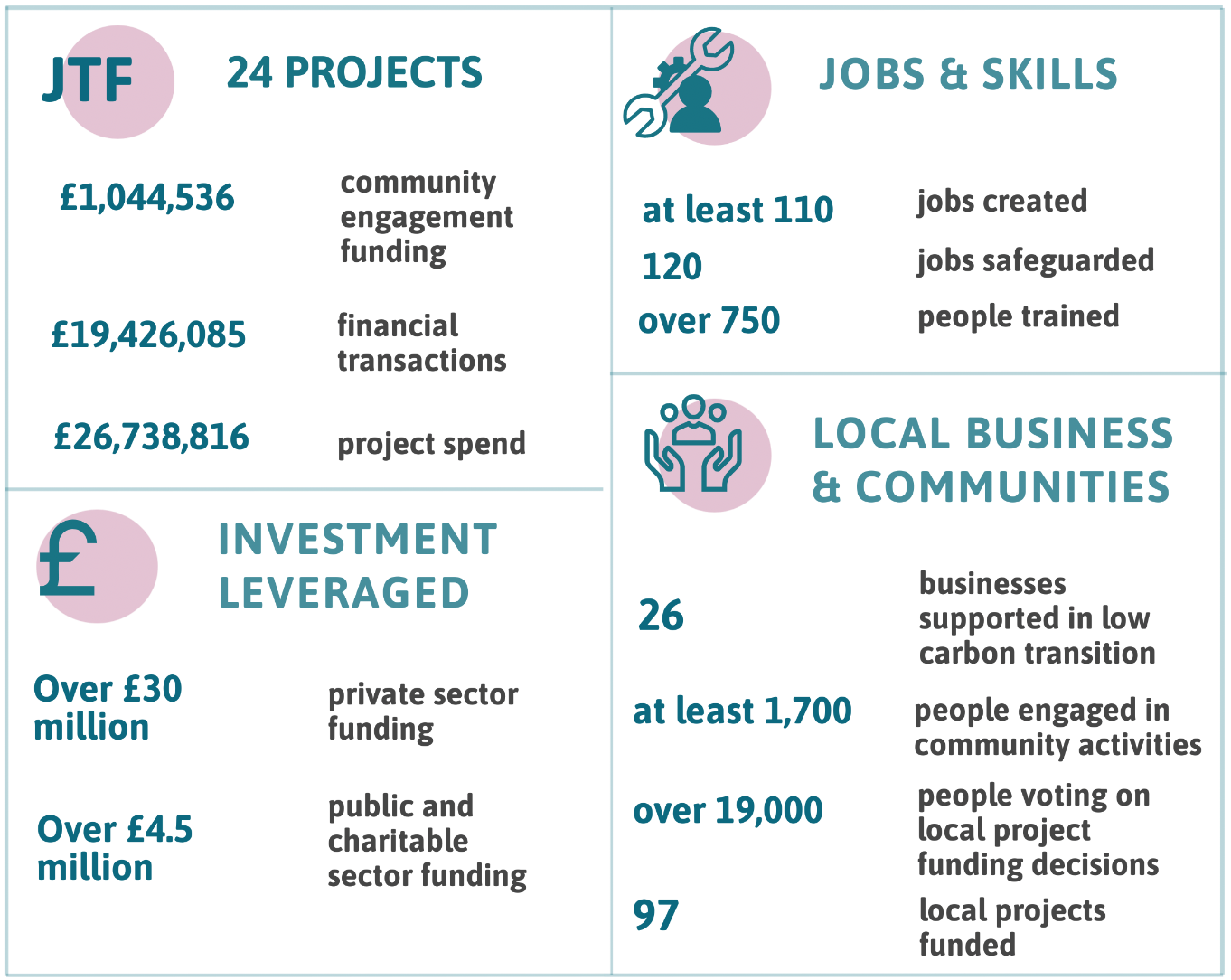
24 JTF projects
- £1,044,536 community engagement funding
- £19,426,085 financial transactions
- £26,738,816 project spend
Investment leveraged
- Over £30 million private sector funding
- Over £4.5 million public and charitable sector funding
Jobs & Skills
- At least 110 jobs created
- 120 jobs safeguarded
- Over 750 people trained
Local Business & Communities
- 26 businesses supported in low carbon transition
- At least 1700 people engaged in community activities
- Over 19000 people voting on local project funding decisions
- 97 local projects funded
5.2 This evaluation focused on the Fund’s impact across four key outcome areas: employment and skills, communities and places, equity and social inclusion, and environmental sustainability. The findings highlight both successes and challenges in implementation, as well as key lessons to enhance the effectiveness of future funding.
Enabling role of JTF
5.3 The evaluation has shown that the JTF has played a pivotal role in unlocking new opportunities, bridging financial gaps, and supporting innovation by funding projects that:
- Would have struggled to attract private sector investment due to high initial risk;
- Required early-stage funding to prove viability before securing further backing;
- Facilitated economic diversification; and
- Empowered communities, allowing them to take ownership of the transition process.
5.4 Alongside the two-year JTF monies of just over £47 million, additional investment across the public, third, charitable sector and the private sector has totalled just over £34 million with additional future funding commitments.
5.5 In doing so it has provided momentum for long-term economic and environmental gains that support the region’s just transition ambitions but for this to be sustained a more strategic approach to the Fund’s administration is required in the future.
Economic Impact
5.6 The JTF has been instrumental in fostering economic resilience and job creation in the North East and Moray. Over 110 new jobs have been created through JTF-funded projects, with additional roles safeguarded across a diverse range of industries. The Social Enterprise Just Transition Fund and the ETZ Supply Chain Pathway and Energy Transition Challenge Fund have been particularly significant in workforce expansion, creating opportunities in renewable energy, social enterprise, and community-led sustainability initiatives.
5.7 Many projects have also positioned themselves for long-term workforce transformation. The Energy Skills Passport and the Pilot Energy Skills Project have provided valuable workforce transition and reskilling opportunities for oil and gas workers, supporting them to become equipped for the growing demand in offshore wind, hydrogen, and carbon capture industries. These initiatives are helping to address provide pathways for career transition in line with Scotland’s net-zero ambitions.
5.8 Future job creation projections indicate potential for continued economic development. The Hydroglen project and Hydrogen Offshore Production (HOP2) project anticipate significant employment opportunities, however, these projections remain speculative, with actual job creation dependent on factors like private sector engagement, and infrastructure development.
Community and social impact
5.9 Beyond economic growth, the JTF has empowered communities by fostering active participation in decision-making. Projects such as the JT Participatory Budgeting and the NESCAN Just Transition Communities Project have facilitated direct community involvement in shaping the transition process, ensuring that local priorities and lived experiences inform initiatives.
5.10 Through these efforts, communities have had a voice in climate action planning, infrastructure improvements, and energy efficiency projects. The JTF has enabled groups to undertake retrofitting activities, improve public spaces, and develop sustainable transport options. Notably, participatory democracy has been at the heart of these initiatives, allowing local people to directly influence funding decisions, helping to strengthen community engagement and collective ownership of the just transition agenda.
5.11 The JTF has also supported social equity by ensuring that traditionally underrepresented groups—such as rural communities, low-income residents, and social enterprises—have access to resources. The Social Enterprise Just Transition Fund has enabled organisations to build capacity, develop sustainable business models, and create employment opportunities for vulnerable groups. Similarly, targeted outreach efforts within the JT Participatory Budgeting have ensured that minority communities and youth have had a say in funding allocations, breaking down barriers to participation in the transition process.
Environmental impact
5.12 Environmental sustainability is a core part of Just Transition outcomes and a few projects are delivering tangible carbon reduction benefits with investments in energy efficiency, green infrastructure, and renewable energy technologies.
5.13 The notable environmental initiative is the Findhorn Watershed Initiative, which has undertaken large-scale land restoration and biodiversity conservation efforts. Through riparian woodland restoration, carbon sequestration, and community-led environmental education, the initiative has demonstrated the potential for nature-based solutions to contribute to both climate adaptation and local economic development. The project is expected to restore 125 hectares of woodland by 2025, with an estimated carbon savings of over 5,000 tco2e.
5.14 Additionally, JTF has enabled pioneering developments in renewable energy technology. The Seaweed Wave Energy Converter project has advanced marine-based energy production, while the Ripcell EV Battery Recycling initiative has successfully piloted green solvent technology to recover critical minerals from batteries. These projects demonstrate the potential for innovative, low-carbon technologies to play a transformative role in the future energy landscape.
5.15 Despite these successes, challenges persist in quantifying long-term carbon savings and emissions reductions. Many JTF-funded projects remain in early implementation phases, and as such, long-term environmental benefits will require continued tracking and evaluation.
Challenges and lessons learned
5.16 While the JTF has been a successful catalyst for economic and environmental change, several administrative and logistical challenges have emerged:
- Funding processes: projects highlighted issues regarding tight application windows, limited communication, and short funding cycles, which restricted the ability of organisations to undertake long-term planning and create stronger links to wider economic development strategies;
- Administrative barriers: delays in grant disbursement and lack of clarity in funding criteria created financial uncertainties;
- Stakeholder engagement: coordination across multiple sectors proved challenging, with some projects struggling to align priorities among various partners requiring time to build agreement; and
- Measuring Impact: many projects remain in early stages, making it difficult to fully assess employment outcomes, carbon savings, and long-term economic benefits.
Conclusions and recommendations
5.17 The JTF has played a valuable role in shaping the economic and environmental future of the North East and Moray. By supporting job creation, empowering communities, and fostering innovation in renewable energy, the JTF has laid a strong foundation for the transition to a sustainable, low-carbon economy. However, ensuring its long-term success will require further investment and policy adjustments which have been identified throughout the report and echo some of the recommendations made by the EFW committee. For this evaluation the recommendations include:
Strengthening JTF administration and disbursement
- For future funding rounds allow ample time and a more structured application process so that robust bids can be developed and submitted and improve transparency in funding decisions to allow for better strategic planning;
- Ensure that JTF priorities integrate or better align with regional plans like City Deals and Investment Zones and national policy bodies;
- For financial transactions consider how they can act as a pipeline between grant funding and commercial viability and also improve co-ordination with commercial investors to leverage private capital effectively;
- Introduce rolling or multi-year funding cycles to enhance financial stability for funded projects;
- Provide structured pre- and post-award engagement to ensure clarity in reporting expectations and monitoring project progress and achievements;
- Consider the development of clear success metrics that measure JTF impact across different policy areas;
- Streamline grant processing to ensure timely disbursement, particularly for smaller organisations reliant on JTF for operational costs; and
- Consider hybrid funding models that combine capital investment with operational funding to support sustainable long-term initiatives.
Expanding community and social engagement
- Develop a structured participation framework to ensure grassroots perspectives inform funding decisions; and
- Increase investment in social enterprises and cooperative business models to strengthen inclusive economic growth.
Supporting workforce transition and skills development
- Strengthen pathways between training programmes and employment opportunities to ensure that workers gain access to green jobs;
- Expand financial incentives for businesses hiring transitioning workers to support job retention; and
- Provide long-term funding for skills development programmes in renewable energy and sustainability sectors.
Advancing environmental and economic diversification
- Continue investment in renewable energy innovation, such as hydrogen production and marine renewables;
- Expand support for non-energy sectors, including sustainable agriculture, circular economy initiatives, and creative industries; and
- Develop structured metrics for tracking long-term economic and environmental impact.
Contact
Email: justtransitionfund@gov.scot