
Just Transition Fund for the North East and Moray: final evaluation report
Independent evaluation report of the Just Transition Fund for the North East and Moray. The evaluation assessed the impact of the Fund in its first two years of operation (2022-2024), during which it supported a package of skills interventions, community-based projects and innovative technologies.
2. Context and methodology
2.1 Established as part of Scotland’s 2021-22 Programme for Government , the Just Transition Fund is a £500 million ten-year commitment designed to support the North East and Moray in transitioning to a net-zero economy and mitigate the economic and social challenges associated with reducing dependence on carbon-intensive industries.
The North East and Moray
2.2 The region plays a key role in Scotland’s economy, largely due to the oil and gas sector in Aberdeen and Aberdeenshire. However, the transition to renewable energy as part of Scotland’s broader journey to net-zero by 2045 poses economic and social challenges that require targeted support.
2.3 Aberdeen and Aberdeenshire, historically reliant on the oil and gas sector, face economic vulnerability as the energy sector shifts to net-zero.
2.4 Moray, with its rural economy based on agriculture, distilling, and tourism, faces different challenges, including low wages, limited skilled jobs, and youth outmigration.
Challenges of the Just Transition in the North East and Moray
2.5 The Scottish Government’s approach to climate change is underpinned by a commitment to a just transition. It has set a target of reaching net zero by 2045 and its Climate Change Act 2024 maintained a commitment to just transition principles. A just transition is principally about ensuring managed change to a net zero economy via inclusive decision-making processes and active planning with impacted communities, workers and businesses.
2.6 The shift to a low-carbon economy presents several specific challenges for the region that must be addressed to ensure an equitable transition. Obstacles include:
- Workforce transition, as many oil and gas workers require retraining for roles in renewable energy, making targeted education and reskilling efforts necessary;
- Infrastructure limitations, particularly in rural Moray, where inadequate transport links make it difficult for residents to access jobs and training opportunities. Digital connectivity also remains inconsistent, restricting remote work and online education;
- Ensuring community participation is another critical challenge. A just transition must be inclusive, giving a voice to rural communities, lower-income workers, and underrepresented groups in decision-making processes.
Opportunities and strategic importance of the JTF
2.7 The Scottish Government’s long-term vision is for the North East to successfully transition to net-zero while emerging as a global hub for green energy innovation, securing sustainable economic growth for future generations. While the transition to a net-zero economy presents challenges, it also offers significant opportunities that the JTF is designed to unlock. The region is well-positioned to lead in offshore wind, hydrogen production, and carbon capture technologies, creating high-value jobs and reinforcing Scotland’s role as a global leader in renewable energy. Economic diversification is another key aspect of the transition.
2.8 To date, the JTF has sought to address the challenges and identify the opportunities associated with transition in the region. For example, the JTF is investing in targeted training programmes, supporting small businesses, and funding sustainable infrastructure projects that facilitate economic diversification and regional resilience. By investing in green sectors, the JTF is also fostering new industries in sustainable transport, construction, and nature restoration to support long-term economic resilience of the region. Nature-based solutions play a crucial role in climate adaptation and mitigation. The JTF supports peatland and woodland restoration, flood prevention, and coastal ecosystem protection, ensuring that environmental restoration efforts also generate economic and social benefits.
2.9 The JTF should also be considered within the broader funding landscape of the region. For instance, the 2021-2022 North East Economic Recovery and Skills Fund (NEERSF) which facilitated employment transitions, the Aberdeen City Region Deal, which drives energy sector innovation and low-carbon infrastructure, and the Moray Growth Deal, which focuses on skills development, infrastructure, and sustainable business growth.
The Just Transition Fund
2.10 First launched in 2022, the JTF was announced in recognition of the particular need to diversify the regional economy away from carbon-intensive industries and to capitalise on the opportunities, including jobs and prosperity, that the transition to net-zero will bring. To date, there has been one open bidding round into the JTF.
2.11 The JTF is designed to align with Scotland’s broader policy framework, ensuring that its investments support both national and local strategic goals. At the national level, the JTF contributes to the Just Transition Planning Framework, which prioritises climate action alongside social justice, and the National Performance Framework, which emphasises inclusive economic growth, sustainability, and community empowerment.
2022 funding call (Year 1)
2.12 The funding call in 2022 adopted the following impact objectives:
- Ensure that the investment is targeted in such a way that can create good, green jobs now and throughout the transition to net-zero;
- Ensure communities directly benefit from the Fund, including through the ability to decide on and drive spend;
- Work in partnership with the private sector, especially shaping opportunities to crowd in private sector finance; and
- Collaborate at a local and national level on the decisions that impact the North East and Moray.
2.13 To be eligible for funding, projects needed to demonstrate delivery against the Just Transition Outcome on ‘decarbonisation, and efficiencies’ and at least two of the other seven JT outcomes as outlined in the National Just Transition Planning Framework. There was guidance available on the delivery model, eligibility, assessment criteria and weighting, and just transition outcomes. Capital projects needed to also show financial feasibility and activities and benefits that would be realised within the North East. For pilot projects that were exploring new or innovative solutions they needed to evidence scalability and replicability.
2.14 Financial additionality was important for all applicants to ensure that government intervention was filling a funding gap that could not be met by private sector investment.
2.15 Applicants submitted an expression of interest (EOI) outlining how their projects aligned with Just Transition outcomes. While some guidance was provided, there was no set template or required format for submissions. As a result, the EOIs varied significantly in structure, length, and level of detail. Some applicants submitted concise proposals focusing primarily on high-level project objectives and anticipated benefits, while others provided extensive background information, financial projections, and in-depth feasibility studies.
2.16 In Year 1 the application window was 31 May until 15 July 2022. 92 eligible applications were received and funding requests ranged from £50,000 to £10.685 million.
2.17 In the first year up to £20 million in funding was available comprised of up to £10 million in capital and up to £10 million in financial transactions (fts). In Year 2 of the JTF, there was up to £50 million in funding, this comprised of up to £25 million in capital and up to £25 million in fts.
2.18 Fts represent loans from HM Treasury to the Scottish Government and can only be used for investments beyond the public sector boundary, such as private sector entities or private individuals intended for specific purposes. They must be repaid over a 30-year period. In Year 2 fts were handled by the Scottish National Investment Bank (SNIB).
2.19 Programme spend across the first two years is detailed in the table below.
- |
2022-23 (£) |
2023-24 (£) |
|---|---|---|
Capital |
9,923,478 |
16,815,338 |
Resource |
491,148 |
553,388 |
Financial Transactions |
488,085 |
18,938,000 |
2.20 The project spend for the first two years is detailed in the tables overleaf. Several projects received multi-year funding that went beyond the first two years of the JTF, this is indicated in brackets next to the project name.
Project name |
2022-23 (£) |
2023-24 (£) |
|---|---|---|
Energy Transition Skills Hub (formally known as: Advanced Skills Manufacturing Hub) (2022-25) |
1,180,000 |
470,000 |
Cabrach Distillery |
361,767 |
N/A |
CNER Buchan Sustainable Transport Study |
N/A |
250,000 |
Digital Innovation Lab |
313,982 |
1,026,495 |
Energy Skills Passport (funding provided to OPITO) |
1,871,967.88 |
1,831,642 |
Findhorn Ecovillage |
226,775 |
N/A |
Findhorn Watershed Initiative (2022-25) |
139,972 |
434,098 |
Hydrogen Offshore Production (HOP2) (2022-26) |
126,000 |
514,000 |
Hydroglen (2022-26) |
262,270 |
1,248,413 |
JT Hub (2022-25) |
243,601 |
667,000 |
Moray Council JT Masterplan |
250,545 |
215,968 |
NESS Carbon Capture FS |
96,750 |
N/A |
North East Adventure Tourism (NEAT) |
397,000 |
1,293,674 |
JT Participatory Budgeting (2022-25) |
1,000,000 |
1,500,000 |
Pilot Energy Skills Project |
39,960 |
960,040 |
Seedpod |
500,000 |
2,600,000 |
Social Enterprise Just Transition Fund |
488,085 |
528,000 |
Sustainable Solvent Recovery/EV Battery Recycling |
457,559 |
169,715.00 |
ETZ Supply Chain Pathway and Energy Transition Challenge Fund (2022-26) |
1,280,000 |
2,840,000 |
Shine Engineering Tidal Rotor Generator |
71,200 |
96,000 |
UHI Moray Net Zero Bottlenecks |
41,596 |
140,193 |
VSA Easter Anguston Farm |
504,447 |
N/A |
Seaweed Wave Energy Converter |
70,000 |
30,100 |
Total Capital £M |
9,923,478 |
16,815,338 |
Total Capital Spend 2022-24 |
26,738,816 |
|
2.21 JTF included financial transactions which are summarised in Table 3.
Organisation |
2022-23 (£) |
2023-24 (£) |
|---|---|---|
Social Enterprise Just Transition Fund |
488,085 |
538,000 |
Scottish National Investment Bank – JTF allocation |
N/A |
18,400,000 |
Total Financial Transactions |
488,085 |
18,938,000 |
Total Financial Transactions 2022-24 |
19,426,085 |
|
2.22 Additionally, resource funding for community engagement and participatory budgeting was also provided and is summarised in Table 4.
Project name |
2022-23 (£) |
2023-24 (£) |
|---|---|---|
NESCAN Hub - Community Capacity Support (2022-25) |
23,968 |
48,892 |
NESCAN Hub - Just Transition Communities Project (formally known as: Community Assembly Pilot) (2022-25) |
240,000 |
172,096 |
Participatory Budgeting (2022-25) |
200,000 |
300,000 |
Social Enterprise JT Fund |
27,180 |
32,400 |
Total Resource £ |
491,148 |
553,388 |
Total Resource 2022-24 |
1, 044, 536 |
|
2.23 From 2022-24, the total combined JTF spend during the operational period of those projects was £47,209,437.
2.24 In Year 2 the changing financial climate limited the funding available for the JTF and, with no additional capital allocation to support a further bidding round for new projects, the focus was on delivery of JTF’s existing programme of projects.
Just Transition Fund projects
2.25 Whether through large-scale capital investments or smaller, experimental pilot programmes, funded projects needed to contribute to a just, fair, and inclusive transition to a low-carbon economy.
2.26 The successful Year 1 projects (see list in Appendix 1) covered a diverse range of initiatives, reflecting the Fund’s commitment to economic diversification, skills development, community-led action, and low-carbon innovation. These included:
- Feasibility studies/research: assessing the viability of carbon capture, rail infrastructure, tidal energy, hydrogen production, and net-zero housing to inform future investment (NESS Energy Carbon Capture, CNER Buchan Sustainable Transport, Seaweed Wave Energy Converter);
- Skills and workforce development: establishing skills hubs, training academies, and workforce transition programmes to equip workers for careers in renewables and low-carbon industries (Energy Transition Skill Hub);
- Capital investments: funding various smaller projects including physical infrastructure, including hydrogen pilot projects and sustainable food and drink innovation (Energy Transition Zone); and
- Community-led and nature-based projects: Supporting local regeneration initiatives, habitat restoration, and participatory climate action. (Findhorn Watershed Initiative).
2.27 By funding both large-scale infrastructure and smaller-scale pilot initiatives, the JTF has sought to balance immediate economic opportunities with long-term sustainability goals.
JTF and the Economy and Fair Work Committee
2.28 There has been significant interest in the JTF, particularly from the Scottish Parliament’s Economy and Fair Work (EFW) Committee, which conducted an inquiry on a just transition for the North East and Moray. The inquiry assessed how well the Fund was supporting workforce retraining, economic diversification, and community-led projects, while also examining funding allocations, accessibility, and governance structures.
2.29 The EFW Committee highlighted its concern about the reduction in JTF funding for 2024/25, queried the reliance on financial transactions that limit accessibility for smaller organisations, and emphasised the lack of a clear, long-term investment strategy. The report drew attention to delays in the Scottish Government’s broader just transition planning, including the Energy Strategy and Just Transition Plan, which it identified as creating uncertainty for businesses, investors, and communities.
2.30 In its report, the Committee concluded that while the JTF has supported positive steps, further improvements are needed to ensure long-term impact. To provide greater clarity and coherence in funding decisions, it recommended improved alignment with wider economic and just transition strategies, such as the Regional Economic Strategy and the Green Industrial Strategy. The inquiry also called for a mix of capital and revenue funding to make projects financially sustainable, particularly for smaller organisations and community groups. It encouraged the Scottish Government to introduce multi-year funding to support long-term planning and expansion of workforce transition initiatives through targeted skills development.
2.31 In January 2024, the Scottish Government made a commitment to the Committee to carry out an independent evaluation of the impact of the JTF. Due to the timing of the commitment to deliver this work during 2024-25, ahead of Just Transition Fund project delivery for that year concluding, the evaluation focused on the first two years of JTF delivery using the project monitoring and evaluation which had already completed as its starting point.
Methodology
2.32 In the remainder of this chapter the evaluation approach is described. The diagram overleaf summarises the methodology and further detail of the key elements is provided in the rest of the section.
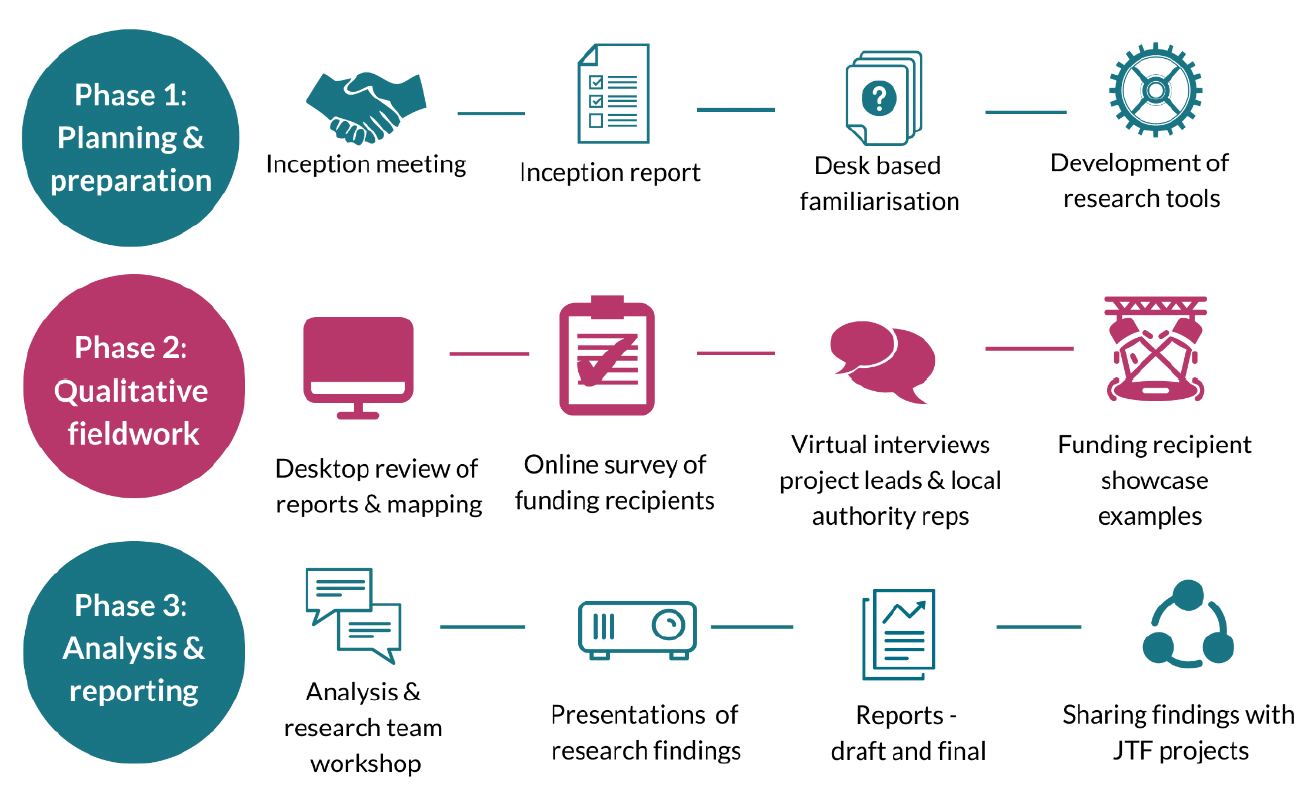
Desktop review of reports and mapping
Phase 1: Planning and preparation
Inception meeting
Inception report
Desk based familiarisation
Development of research tools
Phase 2: Qualitative fieldwork
Desktop review of reports and mapping
Online survey of funding recipients
Virtual interviews with project leads and local representatives
Funding recipient showcase examples
Phase 3: Analysis and reporting
Analysis and research team workshop
Presentation of research findings
Reports – draft and final
Sharing findings with JTF projects
2.33 The desktop work took place alongside the fieldwork elements and involved in-depth review of End-of-Year reports and supplementary information to map outputs against the national Just Transition outcomes.
Survey of funding recipients
2.34 An online survey was conducted to increase understanding of the impact of the JTF on funded projects and third-party recipients of the JTF, for example participatory budgeting (PB) funded projects. The survey was conducted using Snap surveys and the online link was distributed by the Scottish Government team and the JTF projects (who had been JTF beneficiaries). The survey was live for seven weeks and 24 responses were received from a combination of JTF projects (nine) and PB projects (15).
Interviews with JTF project leads and local authority representatives
2.35 Interviews with local authority representatives and project leads enabled detailed discussions about the projects’ experiences and their views on JTF’s governance and accountability, strategic alignment and role in accelerating the net-zero transition. These interviews were conducted via Microsoft Teams or Zoom depending on interviewee preferences. All three local authority contacts were interviewed and 21 out of the 24 project leads.
Showcase examples
2.36 These examples are designed to illustrate the impacts of particular projects and any wider local impacts by using the survey responses, discussions with the project leads and supplementary information. The examples are in Appendix 2 of the report.
Analysis and reporting
2.37 The extensive qualitative data gathered from the interviews, the end-of-year reports and the surveys were analysed in line with the evaluation questions. This involved a process of coding responses to identify key and recurring themes as well as any differences in viewpoints and experiences among different projects. The survey data was also reviewed using Snap Survey analysis functions and then collated and analysed using nvivo, a qualitative data analysis software.
2.38 An internal team meeting to discuss the key emerging themes was held before producing the report outline. This was shared with the Scottish Government for comment before the draft report was produced. The results of the analysis are presented in this report.
Challenges and limitations of the approach
2.39 There were some challenges during the evaluation. The timeframe for undertaking the work was sub-optimal as it fell over the festive period which impacted participants’ availability and the completion of the online survey. Although the survey deadline was extended the responses from third party fund recipients was low.
2.40 The evaluation focused on 2022-2024 of JTF but took place in Year 3 of the JTF when there was still a commitment to delivering a just transition in the North East and Moray but no additional funding beyond what was already committed to the existing programme of projects. This was a frustration for some of the one-year funded projects and was raised during the discussions. It also meant that interviewees were recalling their experiences from a few years since their involvement.
2.41 The evaluation was tasked with reporting on metrics that included jobs created and carbon emission savings, but it was often too early in the development of the projects for these outputs to have been realised.
2.42 The intention was also to map achievements against the relevant Just Transition outcomes, however, as already described there was great variety in the EOIs and the majority of projects identified delivery against all Just Transition outcomes rather than a selection of the most relevant outcomes. This meant it was not possible to systematically assign progress against each one without making assumptions about where the achievements should be categorised, and overall measuring progress was sometimes challenging with the variety in the details of what had been proposed and what was being delivered.
Contact
Email: justtransitionfund@gov.scot