
Environment strategy: transformative changes for sustainability
Independent report by Professor Valerie Nelson on behalf of the Scottish Government to inform the development of the forthcoming Scottish Government environment strategy.
7. Exploring approaches with more transformative potential
It is more appropriate to describe approaches that have transformative potential, due to evidence challenges. To some extent what is transformative or not is continually changing, not least in contexts are changing, but there are some key aspects of the underlying causes of contemporary challenges that require attention, which help to indicate whether an approach or policy lever has transformative potential. In other ways, there is a need for situated processes in which sustainability is debated and responses are co-designed. However, there are also broader structural challenges which may require higher scale actions, e.g. through inter-governmental agreements.
Explaining why something has transformative potential is important, however, because otherwise there is no clarity about how a change is being assessed, as well as by whom, and given the continuing support for market-based mechanisms. given that many earlier sustainability initiatives have not been successful, and to avoid status quo or reform-oriented approaches which may block deeper change.
What might be the criteria for assessing transformative sustainability potential? IPBES currently defines Transformative Change as involving goals, values and paradigm shifts across systems, and states that they should have the capacity to shift economic paradigms and recognise other values of nature, which involves moderating market values and amplifying ethics of care (IPBES, 2022). On this basis the criterion for a transformative intervention would be that it challenges the underlying causes of unsustainability, by focusing upon deep leverage points (e.g. shifts in goals, values and paradigms). In this report, we suggest that deep leverage point shifts involve even more than this, it also involves changes in the very nature of reality, such relational philosophies which challenge dominant understandings and life-worlds. An example shift in goal might be a shift from a growth to a post-growth economy or (even more deeply) from a controlling one world approach, to a ‘many worlds in this world’, towards multi-species ethics of care.
Table 3: Summary of Deep Leverage Points for More Transformative Change
Leverage Points: Broad Recommendations
Economic and financial policy levers
Reimagine economics toward post-growth & conviviality
- Expand visions of future diverse economies in which material, social and spiritual and mental wellbeing have equal importance and moving beyond the anthropocentric to embrace human and non-human needs and agency via community engagement, micro-deliberative democracies, arts.
- Ensure a safe space for contestation and exploration of sustainability futures for civil society and the public (e.g. protecting right to protest, funding civil society organisations and movements to create alternatives and hold companies and governments to account, free press, supporting environmental and human rights defenders internationally).
Expanding participation in economic decision-making
- Expand economic participation, i.e. civil society participation in decision-making via micro-deliberative democratic approaches.
Addressing growth dependency
- Address growth dependency (demand side) to promote environmental sustainability (e.g. work-time reduction initiatives, job guarantees, universal basic services and variations on basic income, plus measures to raise revenue to fund these.
- Redesign economies (supply side) via taxation, equitable ownership, action on rent-seeking in public service provision, preventative healthcare approaches, scaling back ecologically destructive industries and bringing under public control, cutting advertising, ending planned obsolescence, improved urban planning.
- Explore options for redesigning financial architecture, build international support for measures that prevent banks and financial systems funding unsustainable production and consumption, anti-trust measures etc.
- Curb high consumer impacts (e.g. private jets, luxury goods).
- Limit long-distance trade to improve economic sovereignty, especially in agro-food systems. Promote substitutions and reductions in international trade especially of unnecessary products in the light of changing climate.
- Support measures for countries in global South to develop sustainably, through measures such as debt reduction, but also addressing need for abundant sufficiency amongst elites and growing middle classes.
Prefigure & expand alternative economies in practice
- Amplify notions of abundant sufficiency and philosophies of a good life in harmony with nature and care labour of non-humans amongst citizens, to enable nation states to move beyond glass ceilings on post-growth shifts.
- Identify and support the expansion of existing examples of diverse, post-growth economies through diverse measures (e.g. financing, public procurement).
- Land redistribution to benefit local communities and non-humans and stemming privatization of public spaces.
- Promote assessment of wellbeing (human, non-human) in national indicators, foregrounding indicators such as autonomy and solidarity, with economic wellbeing assessed through abundant sufficiency.
- Supporting territorial / biocultural region approaches that support autonomous regeneration, including access to and ownership of land, engaging local (human, non-human) communities in collective action, with expansion theories (not replication) and assessed qualitatively.
- Support ‘commoning’ policy levers to create an enabling environment for the expansion of cooperatives, social enterprises, public-cooperative models (e.g. public procurement, public-community partnerships, non-speculative community currency and credit approaches).
Changing economics
- Mobilise public support for and research on post-growth economic redesign via education initiatives in schools and universities and mobilizing civil society.
Legal and regulatory policy instruments
Rights of Nature
- Create changes in the justice system (e.g. support Rights of Nature through legislative means at national scale, combined with Ecocide, restorative justice and environmental courts. Explore granting naturehood to person).
- Support civil society to create public support for Rights of Nature combined with legislative reforms recognizing rights of citizens and civil society to bring environmental lawsuits, e.g. standing to sue for environmental harms, legal frameworks for environmental rights and strengthening access to justice in environmental matters, including capacity building and legal assistance.
- Ensure transparency and accountability mechanisms e.g. public hearings, environmental ombudspersons to enable public access to relevant information.
- Sign up to and observe international treaties on climate and environment, and support progress on Rights of Nature at global scale.
Legal support for community land ownership & access
- Support local communities to gain greater access to and ownership of land for sustainable management.
- Especially support for Indigenous community customary governance recognizing biodiversity and climate benefits of their stewardship.
- Expand legal support to protect environmental and human rights defenders around the world.
Other indirect legal measures
- Legal measures to tackle large corporate concentration such as anti-monopoly regulation.
Social and cultural policy instruments
Revitalising Indigenous cultures and learning from Indigenous Peoples and relational philosophies
- Supporting indigenous revitalisation and rights.
- Learning from Indigenous cosmologies and other relational philosophies.
Embed environment across education
- Embed considerations of the environment and non-human across different areas of education.
- Revitalise approaches to environmental education by drawing upon relationality philosophies and insights from more-than-human research such as interdependencies and entanglements of humans and nature, agency and labour of non-humans.
- Linked to the above, promote experiential approaches and embodiment to explore different senses, spirituality and emotional connections with nature.
- Promoting celebration, awe and spirituality with respect to nature to advance ethics of care.
Engaging communities, building awareness of relationality and ethics of care
- Mobilizing arts for engaging communities in deeper ways e.g. through emotional connection, engaging and exploring senses and affects.
- Employ relationality insights on human-nature relations in community arts for resilience and transformation.
- Support for creative and critical arts in exploring speculative sustainability futures.
Place-based approaches for autonomous regeneration
- Support place-based approaches that can support locally developed, tailored approaches to sustainability.
- Embed relational insights to place-based approaches that promote autonomous regeneration of all life.
- Consider and promote economic redesign proposals at sub-regional scale and in grassroots initiatives (see above).
- Expand access to nature for all communities, especially marginalised communities.
- Rethink conservation to tackle capitalist relations,
- Celebrate and promote joy, awe and empathy for everyday nature rather than the spectacular through extended visitation, arts-methods, experiential learning and volunteer.
- Building skills and capacities for place-based work.
Radical and speculative future-making
- Support speculative futures exploration by artists and environmental humanities.
- Explore plural and relational ways of thinking, being and knowing in exploring futures, e.g. Indigenous conceptions.
- Give active voice to ‘nature’ in decision-making processes through support for political representation of ‘nature’ actors.
- Support arts-based and participatory engagement of local communities in collective action.
- Create sustainable future political position(s) that represents future generations, including non-human nature and more than human worlds.
- Engage with future-making initiatives on sustainability e.g. UN Summit on the future to embed relationality and post-growth thinking and concerns.
Mobilizing relationality insights in research and action research
- More support for transdisciplinary research, especially involvement of more marginal disciplines e.g. critical social sciences, environmental humanities and arts in tackling environmental challenges and sustainability transformations.
- Mobilise public engagement through citizen arts, journalism as well as science, supported by action-researchers.
- Engage Indigenous scholars and community representatives, based on Free, Prior and Informed Consent, and Indigenous research methodologies (e.g. two-eyed seeing).
Rights-based and customary instruments
Invest in and expand Indigenous and local peoples’ customary land rights and land governance
- Support UNDRIP
- Changing people’s values and expectations of nature amplifying a relational understanding.
- Internationally, support convivial conservation and post-development approaches.
- Make efforts to decolonise international aid by redesigning fundamental aspects of ‘cooperation’ shifting to reparations, conviviality and inter-governmental cooperation.
Political instruments
Micro-deliberative democracy
- Support micro-democracy initiatives on a wider range of issues e.g. climate change, food sustainability, nature futures.
- Represent non-human interests in participatory decision-making processes.
- Link to creative arts (see above) to give nature the active voice.
Changing the nature of democratic states & inter-governmental cooperation
- Build public support for more far-reaching changes in democratic states e.g. taking ownership of highly damaging industries to mitigate impacts, shifting consumption philosophies to move from green state to post-growth states.
- Seek to revitalise inter-governmental cooperation for action on sustainability issues including more radical future-making processes and non-human representation.
- Protect and expand safe spaces for environmental social movements and human rights / environmental defenders nationally and beyond.
7.1 Economic and financial policy instruments
Support for alternative economic models and mechanisms is urgently required. Alternative economic models already exist (Gibson-Graham, 2006). Well known examples of different philosophies underpinning a good life are Buen Vivir (Bolivia, Ecuador), Ecological Civilization in China, degrowth models, Satoyama in Japan. These all value material, social, spiritual/mental well-being as equally important (IPBES Values Assessment, 2022; Mabele et al, 2022). Ubuntu, an African philosophy, emphasises interconnectedness of humanity and the importance of community and relationships, and hence could form an important option for future conservation activities (Mabele et al, 2022). Beyond solely economic framings premised upon accumulation (Harvey, 1992) diverse philosophies envision prosperity as much more than individual wealth, but also focus upon good living – more than in individual concern, but they achieve collective well-being. Many Indigenous philosophies respect all living beings, not only humans. The concept of ‘living well together’ is captured by the concept of conviviality, i.e. a vision of a society where individuals are free to live meaningful and fulfilling lives, supported by tools, institutions and relations that foster autonomy, creativity and mutual respect (Illich, 1973).
How to achieve alternative ways of organizing our economy is not straightforward, given how most nation states are fully embedded in webs of capitalism. Democratic nations face a glass ceiling on reducing growth, because of imperatives to deliver increasing material wellbeing to citizens. The wellbeing economy approach is aligned with a sufficiency approach, finding growing support among Wellbeing Economy Governments or WEGo (New Zealand, Scotland and Iceland). Analysing these cases, Hayden and Dasilva (2022) find movement towards moderating economic growth and foregrounding wellbeing as the key societal goal, with new appropriate measures to inform policymaking, but that progress is hindered by requirements on economic growth to sustain goals required by electorates such as creating jobs and providing welfare state services, which are linked to wellbeing.
Stronger post-growth approaches simultaneously address growth dependency and expand sufficiency. Approaches implemented by the WEGos vary, but they have been termed ‘weak’ post-growth (Hayden and Dasilva, 2022). Tackling economic growth is intensely difficult; few nation states are adequately addressing this. In democratic states, invisible limits or a glass ceiling restrict action, i.e. the imperative to protect citizens from environmental harm and protect material states of living, leads to the outsourcing of impacts that have delayed effects. The impacts are ‘dispersed in time and space and…negative effects are mediated through several ecosystemic feedback loops’ such as Greenhouse Gas Emissions which do not harm people directly at source, but where the negative effects, via long delays, come back to impact all, via potentially catastrophic climate change (Raymond, 2004 cited by Hausknost, 2020, p2). Such impacts are not evenly experienced either, i.e. vulnerable groups are being most impacted by climate impacts, and have least resources to respond, despite least contribution to damage. These inequalities were, significantly generated, during colonial expansions and continue to inform notions of modernity (e.g. progress through growth) (Arora and Stirling, 2023). Thus, while the life-worlds of citizens and ecologies in higher income countries may be relatively protected or restored, this is based upon a fundamentally unsustainable reproductive system (Hausknost, 2020), which involves the distant exploitation of cheap nature and cheap labour (Moore, 2015) creating impacts elsewhere (Santika et al, 2023).
Key pathways to reducing growth dependency include reorienting welfare policies and economic systems. To reduce the demand side, not only the supply side of capitalism (the latter through more environmentally efficient ways of increasing output), means tackling entrenched habits of ‘consumer sovereignty, choice, lifestyles and identities’ (Barry and Eckersley, 2005, cited by Hausknost, 2020). Beyond work-time reduction initiatives, a stronger approach would link work-reduction to sacrifice of output, plus measures such as job guarantees, universal basic services or variations on a basic income, to reduce the growth dependency of the welfare state (Hayden and Dasilva, 2022). Büchs (2021, p327) suggests that ‘Sustainable steady state economies that prioritise social and environmental goals could prevent rising demands for ‘welfare’ that are currently generated by growth-based capitalist economies through a more even distribution of work, resources and opportunities; greater economic security; and improved community and family capacity for social support, care and social participation. Instead of aiming to promote growth, sustainable welfare policies would focus on guaranteeing needs satisfaction for everyone at minimal environmental impacts. The maximisation of work incentives would be replaced by a more even distribution of work and income; education could aim at facilitating critical participation in society (instead of maximising human capital and productivity); and health policy would seek to prevent rather than treat disease and to maximise the changes for everyone to lead a healthy and fulfilled life (instead of productivity and profits for healthcare industries).’ These are far-reaching shifts, but necessary for transformative paths to sustainability.
On the supply side, there is a need to redesign economies through taxation, equitable ownership, action on rent-seeking in public service provision, preventative healthcare approaches, scaling back ecologically destructive industries, cutting advertising, ending planned obsolescence, improved urban planning. Some measures can help to constrain consumption: taxation measures, equitable ownership, and action to tackle rent-seeking in provision of public services that enhance wellbeing so that costs can be reduced and preventative healthcare approaches (Hayden and Dasilva, 2022). Spreading the ownership of wealth is necessary through measures for more equitable ownership in steady state economies include public ownership of enterprises at multiple scales (e.g. from municipal to national), sovereign wealth funds, labour or community-owned enterprises and cooperatives, plus more equitable distribution of the rewards (Gough, 2017). In food systems, redistribution of land is required towards communities (Béné, 2022). The Scottish Government’s plan to expand social enterprises, employee-owned business and cooperatives’ is an important ‘step in the right direction’ in this regard (Hayden and Dasilva, 2022, p14). Koch (2021) proposes generating revenue will be necessary to have more equitable distribution and curb high consumption among wealthy social groups, such as through increasing wealth, inheritance and property taxes, plus taxes on luxury consumption, high environmental impact consumption such as consumption of meat and air travel, tackling tax evasion (Hickel, 2020; Koch, 2021). Additional measures (which would carry costs) including scaling down ecologically destructive industries and ending planned obsolescence (Hickel, 2020) and improved urban planning (Hayden and Dasilva, 2022). See Box 4.
Box 4: Systematic review of degrowth propositions
A systematic review found 50 goals, 100 objectives and 340 instruments for degrowth (2022).
Most recommended objectives for degrowth, based on a systematic review of the evidence were as follows:
1. Reduce time in paid waged labour.
2. Redistribute income, wealth, labour, land, knowledge, care work, infrastructure, resources and time within and between countries.
3. Guarantee the de-commodified and universal provision of fundamental human needs.
4. Decentralising decision-making.
5. Promote shared housing.
6. Support nonspeculative exchange systems like local currencies and credit networks.
7. Prioritise small, highly self-sufficient communities.
8. Create a culture of sufficiency and self-limitation.
9. Re-localise activities.
10. Defend and reclaim the commons.
Source: Fitzpatrick et al, 2022.
Transforming food systems will require more than techno-scientific solutions aimed at increasing green efficiencies: Breaking up corporate monopolies is also necessary. Béné, (2022) argues that the sheer concentration of power in the food and agriculture industry globally blocks efforts to achieve sustainability. Monopoly power of the largest corporations in the world has increased in a significant way over recent decades, with rising revenue, market capitalisation and asset ownership. This has implications for labour rights, intra- and inter-nation inequality, and undermined democratic structures and institutions.
A great deal of attention is focused upon unlocking financial capital for investment in biodiversity, but these are criticised for commodifying nature, which itself has inherent challenges for sustainability. While widely lauded, the UK government’s Dasgupta Review (2021) re-stated the argument that, essentially, it is necessary to value nature in economic terms to save it, ‘creating an analogy between biodiversity protection and financial assessment management. Destruction of Nature is blamed on the misallocation of capital investment, with too much going to produced and human capital relative to natural capital’ (Spash and Hache, 2021). However, this framing avoids questioning economic growth, ignoring the implications of limits to growth and planetary boundaries (Spash and Hache, 2021). Commodification of nature, through mechanisms such as PES and green bonds, such as the oversimplification of complex ecological processes, the undervaluing of nature’s intrinsic worth, risks of greenwashing, encouragement of speculative investments, exacerbation of social inequalities and privatisation of natural resources, and inadequate governance and regulations to support such schemes. Equity issues arise, because local communities rarely benefit, not having access to necessary capital, knowledge, expertise, technology and sometimes labour (Corbera and Brown, 2010), plus such mechanisms that allow commodification abstract nature for its contexts and enables global elite claims to the largest share of the earth’s biomass (McAfee 1999) allow for the appropriation of nature (Fairhead, Leach and Scoones, 2012).
Differing degrees of commodification can be distinguished in biodiversity policy instruments which could be used to shape policies, recognizing the socio-ecological concerns pertaining to commodification (Hahn et al, 2015). Hahn et al, (2015) assess such instruments with a scale ranging from 0 (low commodification) to 6 (high commodification), with the latter obviously being more problematic from equity and biodiversity perspectives. Such differences in levels of commodification may be helpful to bear in mind for policy-makers (Hahn et al, 2015):
- Moral arguments and regulations based on intrinsic value are associated with zero commodification (e.g. endangered species acts and nature reserves) (score of 0).
- Non-monetary regulations based on instrumental arguments such as nature reserves and other land use plans that focus on natures instrumental value to human well being are also low in terms of commodification (being given a score of 1).
- Non-monetary regulations based on physical metrics (e.g. units of nature) such as ecological compensation without roles for price signals or market transactions (score of 2).
- Non-monetary regulations designed to maximise economic efficiency such as city parks designed and managed to maximise calculated recreation values (score of 3).
- Economic instruments that are not traded (e.g. taxes and subsidies and subsidy-like PES paid by governments (Score of 4).
- Economic instruments (voluntary market trade) (e.g. market-like PES, markets for ecosystem services, such as biodiversity offsets trading conservation credits (score of 5).
- Financial instruments (e.g. forest bonds, biodiversity derivatives (score of 6).
The underlying need for a more equitable and just alternative financial architecture should be the priority for achieving post-growth economies. Measures to tackle monopoly power of global corporations is a key example. Intensification of market power is occurring, measure by asset ownership, market capitalisation and rising profits, contributing to intra-national and international inequalities, increasing lobbying power and thinning democracies (Standing, 2016). Various tools such as competition or anti-trust policies and regulations can be employed and expanded to create a more balanced economy, with benefits for consumers. Addressing funding by banks and financial systems for transformative change is also important to tackle unsustainable production and consumption (Béné, 2022)
Expanding notions and practices of sufficiency is the more creative side of achieving post-growth economies. There is growing evidence of how non-material social factors shape wellbeing. Philosophies for living well together and having a good life in harmony with nature already exist. While currently sidelined by dominant economic systems, there is significant potential for wider learning from such ethics of care-based philosophies. Efforts to show that the consensus that strong materialistic values and economic growth would lead to a better quality of life, is increasingly not the case in high income countries, with high levels of inequalities and rising levels of distress in advanced economies (Blanchflower and Oswald, 2020) despite rises in GDP (depression, suicide rates, addiction ‘deaths of despair’ (Case and Deaton, 2015). Non-material dimensions of wellbeing such as social supports and networks, freedoms and notions of fairness can play a critical role in shaping future human well-being (Barrington-Leigh and Galbraith, 2019). Helliwell (2019) finds that happiness is primarily driven by social factors such as generosity and social connections. This new emerging evidence validates Ivan Illich’s earlier proposals from 1973 (Illich, 1973) – see Box 1 below on plural philosophical conceptualisations of the good life as alternatives to materialism and consumerism. As well as reducing work-time to support wellbeing, tackling advertising is important (Hickel, 2020), beginning with limits on ads for GHG intensive goods and services Hayden and Dasilva, 2022). Alternative philosophies, including those of ancient traditions such as many Indigenous cosmologies, and more recent conceptualisations which build on them, such as frugal abundance or radical sufficiency, are sidelined by dominant political economies, yet have plenty of relevance to high consumer countries, which have growing inequalities, unsustainable reproduction systems and growing levels of distress. See Box 5.
Box 5: Support for commoning
Small-scale institutional innovations such as cooperatives, participatory budgeting, social ownership of key assets, worker self-management can prefigure economic change (Wright, 2017).
Supportive policy actions are needed to support commoning (Bollier, 2020):
- supportive legal frameworks
- intellectual property reform
- governance
- supportive economic models e.g. community-supported agriculture and cooperatives
- digital platforms using open source software and education.
Scottish Government’s support for social enterprise, cooperatives under the Wellbeing Economy initiative is a positive step and could be expanded (Hayden and Dasilva, 2022).
Design of regionally based food systems, for example, and promotion of commoning is essential for alternative, sustainable food (Béné, 2022).
New imaginaries of the economy at their deepest in terms of leverage points involve goal, value and paradigm shifts. Post-growth economies require goal shifts (towards wellbeing), values shifts (from individualism and consumerism to solidarity, care and sufficiency) and paradigm shifts, challenging notions of progress and the assumption of unending accumulation with insights from decoloniality scholars who disengage from the logic of coloniality and modernity (Wanzer-Serrano, 2015; Mignolo, 2007; Arora and Stirling, 2023).
Box 6: Philosophical conceptualisations and proposals for the ‘good life’, oneness with nature and living well together.
- Indigenous conceptions commonly embrace living well and oneness with nature / living in harmony with nature. Such ways of living, being and knowing recognise interdependencies and reciprocities in a central manner. Andean Indigenous cosmologies such as Sumak Kawsay, have been the inspiration for a now widely known concept – that of Buen vivir. Quechua and Aymara cosmologies assume and respect relations among humans and with non-humans, recognizing the agency and labour of plants, animals and phenomena or places (Merino, 2016; Blaser et al, 2010). These concepts have now been translated into normative principles in national constitutions in some Latin American countries, such as Bolivia and Ecuador. Rights of Nature are inscribed within a National Plan for Good Living 2009-2013. These developments have opened space for the expression of Indigenous concerns, facilitating policies and legislation for Indigenous Peoples (Sieder, 2011), but despite new institutions and plans, these have not successfully challenged the political economy more broadly, as yet, which is trapped into logics of extracting (Merino, 2016).
- An African philosophy – Ubuntu: This is based upon ethical principles of promoting life through mutual caring and sharing between and among humans and nonhumans (Mabele, Krauss and Kiwango, 2022) and thus provides a potential guide for conservation that is delinked from protectionist approaches and instead embraces solidarity and respect (Mabele, Krauss and Kiwango, 2022; Buscher and Fletcher, 2020).
- Frugal abundance: A concept developed by Latouche (2009) as a means for challenge the pervasiveness of market-based relations and to create space for generating a grassroots imaginary of degrowth and autonomous determination (Latouche, 2010)
- Conviviality: Modern industrial societies become over-reliant on technologically complex tools and systems, exceeding their utility and becoming oppressive forces with respect to human freedom and autonomy, calling for alternatives that prioritise human wellbeing and social relations above and beyond unlimited growth and efficiency, and avoiding the need for reliance on excessively centralised, bureaucratic systems, with more decentralised, participatory approaches to technology that foster autonomy, creativity and conviviality in everyday life, including in conservation and eco-tourism (Büscher and Fletcher, 2019).
- Prosperity without Growth / Degrowth: Various authors have been developing such concepts, notably Tim Jackson, Manuel Naredo (‘better is less’) and Jason Hickel (2021) ‘less is more’, all pointing to the possibilities of reducing growth, but sustaining or even enhancing human wellbeing.
- Eudimonia: Aristotle argued that this concept relates to the state or condition of 'good spirit', and which is commonly translated as 'happiness' or 'welfare.
- Radical simplicity does not mean poverty, which is involuntary and full of suffering and anxiety, and thus universally undesirable. Rather, it means a very low but biophysically sufficient material standard of living. A ‘sufficiency economy’ – structured to promote ‘simple living (Alexander, 2019).
Relational philosophies and the arts can support expanded notions of sufficiency. Instead of trying to simply engage people cognitively on notions of sufficiency linked to well-being and living in harmony with nature, there are potential ways to engage with communities and decision-makers utilising arts-based methods, to engage with people’s emotions and to make more visible the care labour that is undertaken by other species.
Mobilising political support is crucial for achieving post-growth economies and may be underestimated. The Wellbeing Economy concept is useful in being seen as post-ideological and hence easier to mobilise actors around, but political mobilisation for contentious actions is necessary (Hayden and Dasilva, 2022), which points to the need for micro-deliberative democracy approaches such as citizen assemblies mandated by governments, national conversation on national universal basic dividends, and improved economic and wellbeing indicators, plus more progressive taxation and closure of international loopholes to tackle luxury carbon and biosphere consumption (Earth4all.life).[16]
Alternative measures of wellbeing are widely proposed as being important for guiding national policymaking, but they also have limitations. Qualitative assessment of solidarity, ethics of care and autonomy are needed at more territorial scales. Various countries have adopted human wellbeing as a key measure, but frequently this sits alongside continued support for economic growth. The Bhutan Gross National Happiness Index is a holistic measure, with other proposals including a solidarity indicator and an agency indicator, alongside material gain and environmental sustainability (Shower and Lima de Miranda, 2020), which is helpful in expanding measures to a more holistic perspective, but it remains ultimately locked into economic growth. Bhutan’s GNH Index includes 33 indicators measuring 9 domains (psychological wellbeing, health, education, time use, cultural diversity and resilience, good governance, community vitality, ecological diversity and resilience, and living standards.[17] More radical measures would involve an assessment of solidarity and autonomy at localised levels for sustainability, broadly defined, delinked from economic growth.
Embracing more sophisticated notions of development is necessary in the post-SDGs for transformative sustainability. The Sustainable Development Goals represent a remarkable achievement in developing a consensus and mobilizing higher income nations to assess their own progress. However, progress is less than expected and the design has inherent challenges: SDG 15, for example, follows dominant perspectives of conservation, cementing blindness to non-human agency and human-nature entanglements, and is essentially not people-centred, lacking mechanisms to protect and respect indigenous and local communities’ lands, rights and knowledges (Krauss, 2022). It only recognises quantitative indicators, rather than lived experiences and enables continued injustices with respect to protectionist conservation and local peoples (Krauss, 2022). SDG 8.4 embraces economic growth, and while there is a governmental commitment to decoupling, the evidence suggests that this is not happening on required scales, durations etc, and there is no commitment to constraints on consumption by higher consuming nations. A more transformative approach to leaving no place or people behind, would be to recognise the ‘legacies and histories which have produced the uneven geographies, ontologies and epistemologies of development, and requires an active dismantling of oppressive power structures, which are aligned to mainstream neoliberal development’[18] (Kumar et al, 2024).
Tackling the impacts of global supply chains, means identifying pathways and measures that can both re-territorialise economies and reduce damaging trade. Reducing consumption requires demand side measures, more than the reform-oriented approaches currently employed. Tele-coupled value chains have grown in complexity and magnitude, but the socio-ecological impacts, e.g. deforestation and child labour, in sourcing localities are hidden and significant. Ultimately, tackling global supply chains, means identifying pathways and measures that can re-territorialise economies and tackle demand side issues. Carmenta et al (2023) suggest that with respect to centres of wealth there is need for more accountable and regulated trade, supported by gratification (i.e. sufficient abundance philosophies) as opposed to growth, as well as improvements in biocultural landscapes, with improved local governance, rights and self-determination and respect and learning from diverse knowledge and plural values. However, while accountable and regulated trade is desirable, it is difficult to achieve, and Carmenta et al (2023) give limited insights, including addressing the potential blocking outcome of reform-oriented measures, not only their weaknesses e.g. voluntary standards which clearly fail to shape corporate behaviour. Decades of efforts involving reform-oriented weak supply chain measures in agrifood systems involving voluntary codes and standards, have had limited or mixed impacts (Santika et al, 2023). Research is needed on the effectiveness of new reform-oriented measures such as mandatory supply chain deforestation due diligence and mandatory human rights and environmental due diligence (HREDD), but these are likely to face similar sets of challenges, although at least a more demanding one for companies.
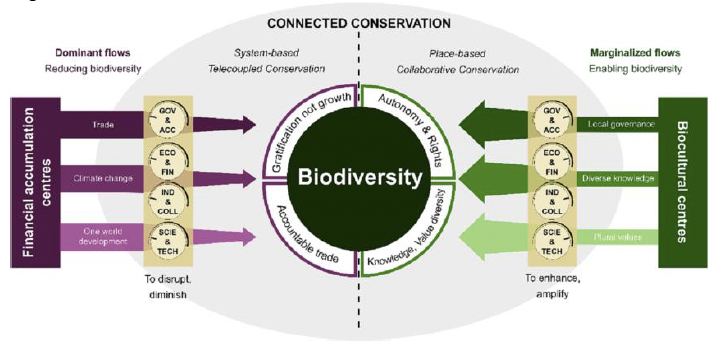
Fig 2: Conceptual overview of Connected Conservation. Three dominant negative flows from centres of wealth and reduce biodiversity: one world development model, climate change and trade (legal and illegal). Meanwhile three positive, yet presently marginalised flows, stem from biocultural centres and enhance biodiversity: local models of biocultural governance, diverse knowledge, and plural values and conceptions of good life. Connected Conservation operates through dual processes of diminishing and disrupting the negative flows from centres of financial accumulation in ‘telecoupled conservation’ and enabling and amplifying the positive flows in ‘collaborative conservation’. Connected Conservation actions are operated through a fourfold set of levers: Governance and Accountability (GOV & ACC; e.g. environmental law, meaningful participatory decision making; transparent value chains and trade flows; embedding multi-dimensional wellbeing in national development indicators); Economy and Finance (ECO & FIN; e.g. fading out perverse subsidies, true pricing of assets); Individual and Collective action (IND & COLL; e.g. education raising social awareness of the impact of conventional wealth; social movements, protest and mobilisation for policy change; experimenting recognizing and legitimising alternatives) and Science and technology (SCIE & TECH; e.g research to inform evidence-based action, monitor and evaluate impacts).[19]
Trade is inadequately covered in the degrowth or postgrowth literature. Proposals focus on limiting long-distance trade and fundamentally changing agreements on trade and intellectual property rights. Restricting long distance trade approaches would focus on reducing ‘unnecessary intra-industry trade between nations of similar affluence, applying export quotas, and limiting the use of international aviation and shipping’ (Fitpatrick et al, 2022, p7-8). The second proposition is renegotiating trade agreements such as TRIPS Agreement at the World Trade Organisation. Circular economy approaches as an economic model to minimise waste and resource use by keeping products and materials in use for as long as is viable, via recycling, reuse and remanufacturing, and thus reducing the need for new resource extraction and consumption. However, critics argue that such approaches do not tackle the underlying issues of overconsumption and resource depletion, i.e. it may prioritise economic growth and industrial interests over socio-ecological goals and merely prolong the lifespan of products in a fundamentally unsustainable economic system (Parrique et al, 2019). This returns us to proposals to amplify autonomous territorial economies and less reliance on international trade, through substitution of products, changing diets to reduce meat consumption etc.
7.2 Legal and regulatory policy instruments
Changes in justice systems present important possibly pathways to transformative change. There are practical challenges in terms of enforcement and resources, but promising examples include Earth jurisprudence, Rights of Nature, and wild law, environmental courts and restorative justice. These are interconnected concepts that share a common theme of redefining the relationship between humans and the natural world within a legal framework. They all seek to shift away from an anthropocentric perspective towards eco-centric ones, but differ in their terminology, specific foci, and applications in philosophy and environmental law. Earth Jurisprudence is the legal philosophy emphasizing the need for human laws to be aligned with the natural laws and ecological principles that govern the Earth i.e. a legal system that recognises the interconnectedness of all life and ecosystems. This approach seeks to advance a shift away from anthropocentric perspectives to eco-centric ones, i.e. that recognise the intrinsic values of nature. The terms Rights of Nature and Wild Law address specific legal recognition and protection of nature’s rights. Ecocide is based on specifically addressing severe ecological harm, often in the context of legal consequences for such harm. Rights of Nature emphasise the legal standing of nature, whereas Earth jurisprudence and wild law may also encompass broader ecological principles in legal systems.
The concept of ‘Rights of Nature’ is based on the idea that nature, including ecosystems, species and natural entities, should have legal rights, such as those afforded to individuals. It represents a shift from conceptualizing nature as property, to recognizing it as a subject with inherent value and rights. The Rights of Nature (RoN) movement has gained traction in various legal and environmental discussions and was identified as a potentially transformative pathway in the IPBES Values Assessment (2022). Some legal systems and local jurisdictions have incorporated or considered the incorporation of RoN into laws and regulations. Another effort is seeking to set a legal precedent through the creation of an artwork in collaboration with a forest in Ecuador in 2021, a forest that has already been recognised as possessing legal personhood and rights. The aim is then to establish creative rights for the ‘Song of the Forest’ which mixes birds, animal and tree voices and those of several artists. See Box 7.
Box 7: Examples of Rights of Nature
In Canada, a local authority (the Minganie regional county municipality) and the Innu council of Ekuanitshit, Quebec assigned riverine RoN to the Magpie River. Nine rights were granted, including the right to be safe from pollution, the right to be safe from pollution and the right to sue, and the ability to assign legal guardians to ensure rights are respected. Ecuador (2008) was the first country to recognise RoN in its constitution, which recognises nature as a subject with the right to exist, flourish and evolve. Bolivia has also incorporated RoN into its constitution, with the law recognising 11 rights of Mother Earth, including the right to life, diversity, water, clean air, equilibrium, restoration and pollution-free living. New Zealand granted legal personhood to the Whanganui River in 2017, recognizing the river as a legal entity with its own rights and interests. Also in 2017, the Uttarakhand High Court, India, recognised the Ganges and Yamuna rivers as legal entities with rights similar to those of a person, however, the decision was later put on hold by the Supreme Court of India. In some local jurisdictions in the US, several local communities (E.g. Ohio, Pennsylvania, New York) have adopted local laws recognising the RoN, often to prevent environmentally damaging practices, such as fracking. Also in the US, the NonHuman Rights Project is seeking legal personhood for nonhuman animals.
To date, there have been two attempts to grant legal personhood to nonhuman animals in UK Parliament. Firstly, the petition to Grant All Sentient Animals Legal Personhood and, secondly, the petition to Recognise Animals As Nonhuman Persons and Grant Them Legal. Both were rejected. Nonhuman animals are thus still considered legal things rather than legal persons in the UK. Inspired by the Universal Declaration on River Rights,[20] there is increased focus on riverine rights. One, so far unsuccessful, effort was made to give a UK river – the River Frome –such rights, but this was not successful. Spearheaded by the NGO Nature’s Rights to try and create a test case and an important legal precedent, joint guardians were to be appointed from the council and a charity, to balance the interests of the river and meadow, with the interests and safety of local people, but this was turned down. More recently, a campaign has got underway to grant the River Ouse legal rights of nature, with Lewes District Council recognizing the need to consider human interactions with waterways, and a charter is under development.[21] Within the EU, work is advancing on developing an EU Charter of the Fundamental Rights of Nature’.[22] There are many challenges associated with Rights of Nature, such as enforcement, but they can raise awareness, as well as giving local communities greater opportunities to hold authorities to account. Practical guidance is available.[23]
While Rights of Nature are promising as a transformative approach, there are also proposals to go further than giving legal personhood to nature, and instead to develop naturehood for persons, i.e. recognizing that humans are a part of nature, akin to the relations Indigenous Peoples already have with nature (Garver, 2020). On this basis, such an approach could be potentially linked to environmental courts and restorative justice (Banwell and Nelson, forthcoming). Essentially this is about engaging relationality insights in western justice systems. Achieving success with Rights of Nature ultimately requires convergent political coalitions to drive changes in values and ways of understanding reality (Braverman, 2017). See also the role of the arts in relation to rights of nature.
Other legal pathways of importance for transformative change for sustainability are legal support for community and customary land ownership and access, especially that of Indigenous Peoples. See also Rights based and customary instruments section below. Co-management and stewardship by Indigenous Peoples and local communities can be highly successful. Indigenous Peoples have an especially key role to play that is increasingly recognised in conserving biodiversity. However, dispossessions continue and legal support is needed to enable them to sustain their legal rights under international human rights law. While the biodiversity conservation evidence points to greater effectiveness in land sparing contexts compared to land sharing, there is a need to balance conservation with local communities’ interests, and if combined with post-growth changes, it is entirely possible to promote regenerative, biocultural land sharing in the global North and South.
Indirect measures are legal measures that address excessive corporate power are also necessary, for example, or make other changes to the economy, which create conditions for sustainability transformations by making space for other forms of economies that are less highly resource intensive and less ecological damaging. An example is that of e.g. anti-monopoly legislation.
7.3 Social and cultural policy instruments
Dominant forms of futures exploration advance certain interests and marginalise more plural perspectives on future sustainabilities, but they can be expanded through arts and community engagement. Dominant approaches shape decision-making and advance the preferred methodological framings of more powerful actors, with implicit assumptions are often hidden. The risk of modelling and scenarios is that they advance the preferred methodological framings of the more powerful, assumptions often remain hidden, and they thus reinforce orthodoxies and can have significant unintended effects (Thompson, 2022, p. 222). Future-making is traditionally dominated by scientific modelling and scenario construction (Behagel and Mert, 2021), but more latterly, participatory approaches and foresight-type activities have expanded. Scientific scenarios and models can restrict future visions to fit within common sense norms and notions of what is plausible, effectively obscuring potentially more diverse future-thinking and speculation.
There is growing interest in the potential of the arts to explore sustainability futures in contexts of rapidly changing climates and ecologies, more creatively and in ways that can challenge common sense norms about what is plausible or acceptable. This is particularly the case with respect to shifts towards non-anthropocentric or even biocentric perspectives, to pluricentric ones, that recognise interdependencies between humans and non-humans. Speculative fabulation, combining speculation on what may be possible in a dynamic, uncertain future, and fabulation – creates stories beyond realist modes of storytelling, drawing on fantasy, myth and science fiction (Haraway, 2016) – is increasingly an option for imagining alternative futures and promoting attentiveness to everyday, symbiotic human and non-human interdependencies. Art can also support human capacity to respond to unrelatable stories, such as hyper-objects, that lie beyond immediate human comprehension, recognizing longer than human lifespans, animal sentience and invisibilities such as pollutants and animals sounds beyond human hearing. Storytelling can weave new worlds. Afrofuturism or Indigenous futurism is a good example of arts and decoloniality thinking exploring futurities. Artists, creative practitioners and community-facilitated arts can contribute to eliciting and re-imagining futures, including a deeper engagement of humans, non-humans and Inhumans in senses of place, recognizing broader definitions of community and enabling nature to speak in the active voice (Plumwood, 2013) for multi-species justice.
Box 8: Embassy of the North Sea
Inspired by Bruno Latour’s Parliament of Things, first proposed in 1989, an Amsterdam based initiative – Partizan Publik - is working to facilitate an Embassy of the North Sea, advancing the idea that the North Sea owns itself, and the sea and all life within (e.g. plants, animals, microbes and people) can be listened to, so that we can learn to speak with it, and can then negotiate on behalf of it and the life it encapsulates.
Developing a public space in which humans can communicate with non-humans on an equal basis, the aim is to create new politics of representation. Involving researchers, designers, policy-makers, biologists, artists, lawyers, philosophers and writes, the aim is that by 2030 the Embassy for the North Sea, founded in the Hague in 2018, will ‘emotionally, juridically, and political’ help us to relate to the North Sea in a fundamentally new way. (Embassy of the North Sea - Embassy of the North Sea;
Parliament of Things — Case — Embassy of the North Sea (theparliamentofthings.org);
Parliament of Things — The Parliament: a new public space (theparliamentofthings.org)
The importance of this work is that by accepting that the natural world owns itself, this can ‘redefine who are as humans….”terrestrial beings” who must align ourselves with a biosphere that has its own intentions and cannot be thwarted in the long run’ (The 'parliament of things': Redefining human - resilience).
Rather than assuming sustainability can be defined in a single, unchanging way with one pathway to achieving it, empowerment interpretations of transformative change argue that there are value differences and values contestations (Scoones et al, 2020. Giving plural forms of knowledge, beyond science, space and ascribing equal validity to non-scientific forms of knowledge, such as Indigenous knowledge, is important in considering and creating new futures. However, integration of Indigenous knowledge into scientific knowledge is not appropriate. Scientific scenarios and approaches which integrate Indigenous values and knowledge into the former, fail to recognise the incommensurability of these different forms of knowledge, and may thus become extractive, appropriating without acknowledgement, or scientizing Indigenous knowledge (Löfmarck and Lidskog, 2017).
Participatory approaches may have potential for articulating new future sustainability visions, but they can reinforce dominant perspectives. Participatory approaches can articulate ‘seeds of change’ (Raudsepp-Hearne et al., 2020), but more exploration is needed of their effectiveness in the absence of deeper state changes (McGeown, 2021). Recognizing historical injustices is important in justice-oriented future-explorations (Feola et al, 2023).
Revitalizing environmental education not merely by increasing coverage, but by changing the underlying philosophy. There is the possibility to revitalise approaches to environmental education by drawing upon relationality philosophies and associated ethics (Walsh et al, 2023), and insights from more-than-human research. Netherwood et al, 2006, p259) argues that relationality can be central to school practices to ‘deepen and broaden the children’s understanding of what it is to be human in relation to the world around them. At university level there are possibilities for similar shifts to occur: Adébísí, (2023) argues that universities should do this in the law schools. Intercultural education is needed (Narezo et al, 2023) to recognize Indigenous Peoples and local communities as legitimate sources of knowledge production.
More support for transdisciplinary approaches in research, but also recognition of inherent politics in knowledge production that could be reinforced in such processes, and the importance of increased support for more marginal disciplines, as well as public engagement. Transdisciplinary approaches are a common proposition for amplifying diverse values in research, and require greater support to address complex, sustainability challenges and transformation imperatives (see for example, O’Brien (2018). Recognizing the risks of transdisciplinary research and co-creation is important. Such processes can reinforce orthodoxies in contexts of intense power inequalities, which leads, for example to disproportionate funding flowing to global North researchers and natural sciences and economics above other disciplines. Research calls requiring pre-set outcomes constrain the ability of co-creation processes supported by responsive researchers to catalyse change without prejudging topics of engagement. Power inequalities cannot easily be ‘managed away’ (Turnhout et al, 2020) and decolonising research practice is important (Zimmermann et al, 2023). This means addressing which forms of knowledge are valued, giving more space to non-scientific forms of knowledge e.g. Indigenous and local community knowledge and ways of being and amplifying support for marginalised disciplines (e.g. critical social sciences, environmental humanities and arts) in addressing sustainability challenges, rather than understanding the environment as something that is solely relevant to environmental sciences.
Learning from the values and cosmologies of many Indigenous Peoples and supporting the revitalisation of Indigenous cultures for sustainability and biodiversity conservation. Storytelling about positive examples of applied relationality is a route to transformative change more broadly, ideally led by those living and being in harmony with nature. Initiatives such as living Territories, the revitalisation of canoe cultures amongst First Nations in the Pacific Northwest and work by an art, culture and language camp created by Indigenous peoples to bring youth and elders together, represent examples of how such revitalisations are both important and relevant for sustainability in the localities in question and beyond (See Box 9 below).
Box 9: Revitalising Indigenous cultures, languages and ways of life for sustainability
Revitalising Indigenous ways of life, cultures and languages is central to sustaining Indigenous ways of knowing and being and ultimately, lives.
A first example is that of the ‘territories of life’ approach supports ‘territories and areas to be governed, managed and conserved by custodian Indigenous Peoples and local communities. ICCAs — territories of life – ICCA Consortium Meanings and Resources
Another example is that of the rebirth of Indigenous canoe culture in the Pacific Northwest, in which the revitalisation of the creation of ocean-going canoes and shared journeys which carry First Nations through the interface with sacred worlds. The canoes have their own life and spirit. A recent project, Qatuwas ‘People Gathering Together’ festival, presented in a museum exhibition – Sacred Journey - was inspired by the ‘Paddle to Seattle’, through which communities have shared their stories, songs and dances, through a canoe journey and is now an annual event, connecting communities along the coast, involving 100 canoes. Thus, the journeys become transformative in multiple ways, transforming participants emotionally, spiritually, culturally and socially. https://royalbcmuseum.bc.ca/about/our-work/publications-news/latest-news/witness-resurgence-lost-tradition-sacred-journey-royal
A third example is the work conducted by the Onaman Collective in which they are co-creating Nimkii Aazhibikong, an Indigenous led camp to revitalise art, culture and language, involving a community of youth, Elders and organisers near Elliot Lake, Ontario within traditional Anishinaabeg territory. Nimkii Aazhibikong (pronounced Nim-key Ah-zh-ih-bih-coo-ng) is a place where youth and Elders come to connect to the land, each other and to pass down the language and traditional knowledge to the next generations. This work also supports the resurgence of sustainable Indigenous practices and restoration of Indigenous land and resource protection and management. Nimkii Aazhibikong | Onaman Collective.
Recent proposals suggest the reconceptualization of conservation towards more commons-based, less exclusionary approaches and that reconnect humans with nature / recognise entanglements. Convivial conservation promotes public and community solutions instead of market based ones (Buscher and Fletcher, 2020, p. 9). Key propositions include the following: creating promoted areas and conserved by and for local people based on public mechanisms, transitioning tourism from celebrating spectacle to the joy of everyday nature and longer-term engagement with the ‘wild’ replacing voyeuristic short-term visits, plus governance arrangements moving away from privatised conservation expert technocracy to common democratic engagement enabling all people to live with nature. Strategies include historic reparations, strengthening social movements, a conservation basic income, rethinking relations with companies, redirecting integrated conservation landscapes to degrowth and wealth sharing, effective polycentric governance and engaging asset holders, redistributive finance (e.g. public bonds, Robin Hood taxes) (Buscher and Fletcher, 2020). Such approaches must overcome path dependencies (Kiwango and Mabele, 2022), and immediate concerns about losses of endangered species.
Place-based approaches in general are important for achieving sustainable living, building on connection to and sense of place, stakeholder participation in multi-scale governance and the development of approaches tailored to local context. However, such approaches can range from stakeholder consultations to more radical approaches supporting autonomous regeneration and even linkages between such autonomous territories in interlinked mesh-works that resist the homogenizing forces of globalization and seek to reclaim agency over their own lives and environments (Escobar, 1995). There are limitations to place-based approaches, given the higher scale constraints pertaining to democratic nation state glass ceilings, for example, and the wider global political economy – the latter requiring redesign to enable places to flourish.
Decolonising aid is relevant to sustainability transformations, as it can reinforce dominant patterns of relations that undermine other ways of thinking and being including with respect to human-nature relations and biodiversity and climate funding. Growing arguments point to the lack of equity in donor-partner country relations and persistent challenges in how aid is designed and delivered, while ignoring wider questions about accountabilities for under-development and outsourcing of ecological damage. Existing research on Belgian development aid suggests that while procedural changes are needed, structural changes are even more important (see Box 5 below). Persistent effects of colonial legacies are evident from participatory research such as structural racism and different forms of discrimination and neglect of historical power imbalances, which keep international development anchored in western values and knowledge, devaluing other forms of living and knowing (Escoar, 1995). This reflects wider literature on post-development (Escobar, 1995) and pluriversal futures (Escobar, 1995; Quijano, 2000; Mignolo, 2007; Maldonado-Torres, 2016). Dialogues needs to be facilitated on how to decolonise aid, building upon greater humility among donor countries, and investment in collective envisioning of futures in which many worlds can fit (Escobar, 1995) and that involve values shifts towards ethics of care, including for Mother Earth / nature (Cely et al, 2022).[24]
Box 10: Decolonising aid: Proposals from Belgium
A participatory process involving workshops and interviews was undertaken to explore imperatives to decolonising aid and how to achieve this.
Participants identified the following:
Proposed procedural changes: Bidirectional MEAL systems, simplifying administrative procedures, and streamlining remuneration processes and national experts instead of foreigners; and improving communication.
Proposed structural changes: No development communication; Imagining other ways e.g. reparations, debt cancellation, and equal partnerships; Daring a change from within; Acknowledging and raising awareness among development aid actors of their (neo)colonial practices; A power shift towards civil society; Working together on a shared locally-led future; Collaboration based on partner needs.
Tacit assumptions, tensions and paradoxes were identified such as the need to move beyond semantic changes to address deep rooted systemic racism in development and challenging dominance of western science, which marginalises other forms of knowledge and the lack of awareness of privileges among development actors and / or an unwillingness to give them up.
Key recommendations include, amongst other things, facilitating conversations with partner countries co-create alternative futures beyond development, growth and dysfunctional values to ethics of care, addressing colonial modernities with unlearning of cultural habits of domination and tackling socio-economic inequalities, fostering transformative dialogues for change, replace traditional donor-recipient relations by moving to relational accountability, reciprocity and complementarity, amplifying grassroots collaboration and learning, sustain efforts despite the challenges and abandonment of privileges required, accepting policy heterodoxies if nations chart their own course of development.
Source: Moreno Cely, A., Vitantonio, C., Escobar-Vasquez, C., Lafaut, D., Sahli, H., Mugenyi, K. J., Mancilla Garcia, M., Nakabanda, N., & Vanwing, T. (2022, Jul 7). Imagine alternative future(s) of the Belgian development cooperation. Unpublished.
7.4 Rights based and customary instruments
Other legal pathways of importance for transformative change for sustainability are legal support for community and customary land ownership and access, especially that of Indigenous Peoples. See also Rights based and customary instruments section below. Co-management and stewardship by Indigenous Peoples and local communities can be highly successful. Indigenous Peoples have an especially key role to play that is increasingly recognised in conserving biodiversity. However, dispossessions continue and legal support is needed to enable them to sustain their legal rights under international human rights law. While the biodiversity conservation evidence points to greater effectiveness in land sparing contexts compared to land sharing, there is a need to balance conservation with local communities’ interests, and if combined with post-growth changes, it is entirely possible to promote regenerative, biocultural land sharing in the global North and South.
Strengthening democratic processes is essential to engaging communities in decision-making and improving decisions. Disconnects increasingly occur between citizens and their elected representatives, between citizens and public spaces, and between citizens and increasingly complex policymaking, all of which affects social solidarity and cohesion and public involvement in environmental decision-making. These disconnects (Hendriks et al., 2020), can be repaired through processes of participatory democracy. The latter can enhance ‘everyday connectivity’ or ‘associated living practices…communal practices, communication, civic engagement’ (after Dewey, 1996 cited by Metze, 2022, p. 225) in ‘doing democracy’ (Hendriks et al., 2020) to shift societal practices and ultimately shaping democratic structures (Metze, 2022).
Deliberative democracy (DD) approaches can help repair disconnects. Citizen assemblies, and other forms of ‘deliberative mini-publics’ could enhance the ‘transformability of democracies’ including with respect to sustainability. Citizen assemblies have been widely applied to climate change, with new approaches to sortition and protocols. There are limits to such mini-publics, but they merit support and can be applied to a wider range of topics than those chosen to date. They could be adapted to other environmental topics (Daw et al., 2022) or indeed, how to live together well and sustainably (after Illich, 1973) and desired sustainable futures, noting increasing interest in navigating the turbulence to come (UN report, 2022) which is part of the reason for investment in creating support for collaboration on progressive futures (e.g. the UN Summit of the Future)[25] at different scales. Sustaining space for civil society is also important to resist the de-connectivity actions of populists (Tops and Tromp, 2017) and given pressures on civic space[26]. Advisory deliberative forums (McGeown, 2021) would have greater efficacy if there were deeper shifts in the nation state e.g. if utilities and public services, and extractive, polluting and carbon intensive industries were democratically controlled (McGeown, 2021) and initiatives to tackle racism and its linkages to the causes and uneven impacts of environmental damage etc.
The arts can engage communities in deeper ways, by engaging with emotions and senses, as well as cognitive dimensions. Political representation innovations try to give active voice to nature, representing non-human interests and changing human understandings (Plumwood, 2013).