
Draft bioenergy policy statement: consultation analysis
An analysis of the responses to our public consultation on the draft bioenergy policy statement.
2. Analysis
2.1 Principles for use
The first question sought views on the principles for bioenergy use. The Draft BPS set out 6 guiding principles which include:
- use of biomass complying with stringent sustainability criteria;
- bioenergy sector prioritising available waste feedstocks;
- prioritising the use of biomass towards hard-to-decarbonise sectors;
- ensuring biomass use supports emissions reduction;
- biomass use complying with Scotland’s Environmental Protection Agency’s (SEPA) regulations; and
- biomass feedstock production and use of bioenergy technologies facilitating Scotland’s Sustainable Development Goals (SDG).
See Annex C for more detail on these principles.
Q1 Do you agree with the overarching principles for use of bioenergy, as set out in this document?
| Respondents | Number | Strongly agree % | Agree % | Neither agree or disagree % | Disagree % | Strongly disagree % | No answer % |
|---|---|---|---|---|---|---|---|
| All respondents | 59 | 15.25 | 57.63 | 10.17 | 6.78 | 3.39 | 6.78 |
| All answering | 55 | 16.36 | 61.82 | 10.91 | 7.27 | 3.64 | - |
| Organisations | 38 | 7.27 | 52.73 | 7.27 | 1.82 | 0 | - |
| Individuals | 17 | 9.09 | 9.09 | 3.64 | 5.45 | 3.64 | - |
Of those who responded to Q1, over 78% selected that they strongly agree or agree with the overarching principles for use of bioenergy, as set out in the Draft BPS. A further 10.91% neither agreed or disagreed, 7.27% disagreed and 3.64% strongly disagreed.
51 of 59 respondents provided a written response to the open question, where 39 and 12 of these came from organisations and individuals respectively.
Hard-to-decarbonise sectors
Some respondents set out the importance of explicitly acknowledging bioenergy’s role in a whole system approach to decarbonisation. Other respondents indicated that consideration should be given to the end use in order to maximise the decarbonisation and energy potential of bioenergy.
An additional sub-theme that emerged was around AD. Respondents highlighted that it is a scalable and cost-effective solution for hard-to-decarbonise sectors, particularly in rural areas. A few respondents added that, where possible, biogas should be generated from AD and used locally to avoid the potential need for fossil fuels being used in transport systems.
Waste feedstock
At a high level, many agreed with the intention to prioritise the use of available waste feedstocks. However, a few went onto qualify this by underlining the need to ensure these feedstocks are ‘genuine waste products’ and do not have another known purpose.
In reference to the ‘cascading use of biomass’ (defined at Annex C), some respondents highlighted the importance of recognising that nuances will exist within the hierarchy. Others outlined that the waste hierarchy should take into account the most effective carbon savings and reward the correct sector accordingly. Others indicated that the sector should ensure that creating a hierarchy does not result in unintended consequences, e.g. ‘rewarding certain uses might result in waste being channelled into specific sectors other than energy’.
Some respondents suggested that additional detail should be provided for this principle, describing it as ‘too open to interpretation’ and calling for it to ‘be unpacked further’. They welcomed clarity on what is intended by the concepts of a ‘circular economy’ and ‘no wider residual value in society’.
Sustainable biomass
Many respondents indicated that the sustainability criteria must guide both a sustainable production system and sustainable end uses, with a few adding that this can be achieved by optimising existing land use. Some respondents also agreed with the need to strengthen the existing sustainability criteria so that it includes a wider range of environmental factors, beyond only land and greenhouse gas emissions (GHG) reduction criteria.
Some respondents agreed that biomass should be independently monitored and verified, including through a wider assessment of the environmental and social risks associated with each feedstock. An additional aspect mentioned was the need for the compliance process to be simple and not penalise end users.
Support emissions reduction
Some respondents agreed that introducing carbon capture technology should neither distract from the need to reduce emissions across the economy nor displace investment for other solutions. A few respondents urged for other negative emissions solutions, including nature-based, to be considered alongside BECCS.
However, some respondents called upon Governments to be cautious if incentivising carbon capture technologies and highlighted the potential environmental risks that would arise from scaling up feedstock production in the Scottish context. A few respondents identified significant risks relating to ‘land use, biodiversity, water’ if feedstock demand cannot be met from waste and available by-products from other industries.
Some respondents highlighted the importance of considering the full lifecycle analysis of emissions across the different processes in order to achieve the greatest emissions reductions. To that end, respondents added that independent monitoring and holistic assessment of GHG emissions, through considering a wide range of environmental and social impacts, is necessary and policy should focus on supporting technologies that can achieve the highest GHG savings.
Facilitate Scotland’s SDG
A few respondents mentioned that this principle should be expanded to include explicit reference to climate mitigation and recognise the role of bioenergy in the rural economy.
A few further respondents also highlighted the opportunity for Scotland to be an international leader in the bioenergy industry through establishing a sufficient domestic supply of biomass and creating a business model that can be replicated in other countries.
Compliance with SEPA regulations
There was general consensus that the use of biomass should comply with SEPA’s environmental regulations. A few respondents commented that the regulations should be proportionate and effective for all the sector, with the acknowledgement that some regulations may be more appropriate for specific sectors than others.
2.2 Priority uses of bioenergy
Question 2 asked for views on the priority uses of bioenergy, as set out in the Draft BPS. It stated that the long-term priority use for bioenergy should be facilitating carbon removal via Bioenergy with Carbon Capture and Storage (BECCS) technologies, as they are the cheapest method of delivering engineered negative emissions, with a number of specific roles across power, heat, transport and industry. See Annex D for the full description on priority uses of bioenergy.
Q2 Do you agree with the priority uses of bioenergy, as set out in this document?
| Respondents | Number | Strongly agree % | Agree % | Neither agree or disagree % | Disagree % | Strongly disagree % | No answer % |
|---|---|---|---|---|---|---|---|
| All respondents | 59 | 10.17 | 47.46 | 18.64 | 8.47 | 5.08 | 10.17 |
| All answering | 53 | 11.32 | 52.83 | 20.75 | 9.43 | 5.66 | - |
| Organisations | 36 | 3.77 | 41.51 | 16.98 | 3.77 | 1.89 | - |
| Individuals | 17 | 7.55 | 11.32 | 3.77 | 5.66 | 3.77 | - |
Of the 53 respondents, over 64% indicated that they agreed or strongly agreed with the priority uses set out in the Draft BPS. A further 20.75% selected that they neither agreed or disagreed with 9.43% and 5.66% indicating respectively that they disagreed or strongly disagreed with the priority uses.
43 of 59 respondents provided a written response to the open question, where 37 of these represent responses from organisations and 10 from individuals. At a high level, the results above suggest that there is general agreement with the priority uses but nuances that came through the open question are identified under the themes below.
Generally, some respondents called for greater detail on how priorities would evolve over time and clarity on relationships between the principles for use and priority uses.
Some respondents highlighted that the priority uses should build on existing arrangements across the bioenergy sectors in Scotland including: biomass power, biomass heat in decarbonisation and homes and transport. These are covered in greater detail below.
BECCS
In the short to medium term, a few respondents urged that finite biomass resources be prioritised for decarbonisation with the possibility of being directed towards BECCS in the longer term once the technology is viable, resources are scalable and appropriate infrastructure is in place. Some respondents believed that any support for BECCS technology should prioritise activities which result in greatest emissions reduction overall. Other respondents highlighted the current risks around the deployment of BECCS relating to timescales, costs, technological viability and the environmental impact of scaling up biomass.
A few respondents also urged the Scottish Government to maintain focus on encouraging the development of a range of negative emissions technologies (NETs) and adopt a portfolio approach to deployment, which would reduce risk and capitalise on economic and environmental opportunities. One respondent cautioned that whilst BECCS may have a role in the medium to long term, other NETs may replace it as they become available. More broadly, a few respondents also urged the Scottish Government to provide clarity on a project pipeline of all NETs, including BECCS, to support industry plans to scale-up negative emissions capacity.
Heat
A few respondents called upon the Scottish Government to ensure continuation in their approach to heat decarbonisation, for example, allowing those who already have bioenergy heating systems installed to continue using them.
Some respondents pointed to the need for policy to support a variety of different heat options to enable the deployment of locally appropriate heat decarbonisation solutions. This includes allowing the use of local biomass resources and emissions abatement technology where that makes sense.
Some respondents highlighted the important role of renewable liquid fuels as a drop-in fuel for existing heating systems in the longer term, with a few suggesting this will continue to be the case even past 2045.
Industry
Some respondents noted the significant role of bioenergy in decarbonising industry in the short to medium term. A few respondents stated that any new policy must not adversely impact ongoing industrial decarbonisation projects. They believed that Government should also provide clear signals to support ongoing and new investment in decarbonisation projects, with one respondent noting ‘there is a risk that these types of [decarbonisation] projects could be delayed or cancelled if there is uncertainty over the potential lifetime of new biomass assets, delaying industrial decarbonisation’.
A few respondents also urged for the BPS to better recognise the role of small-scale bioenergy projects in supplying energy in rural areas, including through agricultural and horticultural contexts.
AD and biomethane
Many respondents called for better support for current off-grid AD and the expansion of AD generally. More specifically, some respondents highlighted the need for an effective policy framework for on and off-grid AD sites to address barriers around grid access, support mechanisms, feedstock supplies and uncertainty around licensing and standards for AD processes.
Some respondents also mentioned the important role of biomethane as an end product of AD in both the short and long term through its flexible application across different sectors, including heat, industry and transport. In that regard, some respondents called for greater recognition of its potential role in promoting a circular economy and supporting decarbonisation in hard-to-decarbonise sectors.
Additionally, a few respondents called for the policy statement to provide further clarity on the role of biomethane beyond 2035. They also urged the Scottish Government to support biomethane potential, including in the context of hybrid heating, as a means of providing energy security and affordability in rural areas.
Transport
A few respondents believed that the expansion of biofuels should be a priority in the short to medium term.
There was some divergence over priority uses for sustainable biofuels, with some respondents stating it should be used for the legacy fleet of road vehicles and others claiming it should be instead reserved for aviation and maritime applications in the long term. Some other respondents suggested that agricultural vehicles be included in the long-term priority uses.
Power
In the context of building on existing arrangements, some respondents agreed with the intention to maintain ongoing low carbon electricity generation from existing biomass power plants. In short to medium term, a few respondents also stated their agreement with focusing on the development of new combined heat and power (CHP) plants which utilise waste resources.
2.3 Bioenergy with carbon capture technology
Questions 3 – 6 sought views on phasing out unabated combustion of biomass; introducing a minimum threshold at which carbon capture must be considered for bioenergy technologies; when a mandate should be implemented for considering carbon capture; and whether other decarbonisation options should be considered as part of the decarbonisation requirements for biomass power plants.
Q3 Do you agree with the intention to phase out unabated combustion of biomass?
| Respondents | Number | Yes % | No % | No answer % |
|---|---|---|---|---|
| All respondents | 59 | 52.54 | 27.12 | 20.34 |
| All answering | 47 | 65.96 | 34.04 | - |
| Organisations | 32 | 48.94 | 19.15 | - |
| Individuals | 15 | 17.02 | 14.89 | - |
Of those who responded to this question, over 65% agreed with the intention to phase out unabated combustion of biomass whereas 34.04% disagreed. It should be noted that a fifth of total respondents did not answer this part of the question.
41 of 59 respondents provided a written response to the open question, with 32 of the responses coming from organisations and the remaining 9 from individuals. Many respondents qualified their agreement by indicating there must first be a practical plan with realistic timescales and clear pathways for various BECCS technologies to be deployed at scale and across different settings whilst delivering benefits to consumers and tax payers. One respondent specified that this must include clear information about plans for future CO2 infrastructure, including transport and storage infrastructure, to encourage upfront investment. One respondent also urged that a thorough review is undertaken before any ban be implemented.
Exceptions to phasing out unabated combustion of biomass
There were some further issues raised around the logistics of phasing out unabated combustion of biomass. Many indicated that their support of this intention was dependent on scale, sector or location. In this regard, many respondents highlighted that there are various contexts where carbon capture technologies are currently not viable or feasible, and some of these respondents urged that the BPS explicitly acknowledge these contexts.
Additionally, some respondents wanted reassurance that any policy would not adversely impact rural contexts where biomass use tends to involve sustainable local feedstock, promote the principles of a circular economy and offer a solution for rural decarbonisation. A few respondents explicitly stated that BECCS is not yet suitable for small, distributed AD facilities or smaller biomass systems.
Financial barriers to integrating BECCS technology
Cost considerations related to BECCS technology emerged as a prominent theme. Some respondents caveated their support of phasing out unabated combustion of biomass with the claim that financial support would be required from the Government. This included investing in carbon capture technology at a smaller scale and funding retrofitting and/or installation of more efficient equipment. Additionally, a few respondents urged for clarity around what type of support would be offered.
However, some respondents disagreed predominantly on the basis that currently it would not be financially or economically feasible to mandate the deployment of BECCS technology, with a few specifying this is particularly true for small-scale AD processes.
Opportunities related to phasing out unabated combustion of biomass
Regarding those respondents who expressed agreement, some described opportunities or benefits related to the phasing out of unabated combustion of biomass. Those mentioned included promoting a cleaner environment, maximising carbon savings, contributing to Scotland’s SDGs, encouraging early integration of CCUS technologies and supporting the potential for innovative technological developments in this sector.
Support to consider all solutions that result in emissions reductions
Across some responses, there was a desire to consider all potential solutions to reduce emissions, rather than solely focusing on BECCS. A few respondents suggested that the system should prioritise processes that do not involve combustion whilst others urged for biochar to still be considered as ‘a simple option that can be deployed widely at small-scale with minimal investment or technological risk’.
Q4a Should there be a minimum threshold at which carbon capture should be considered for bioenergy technologies?
35 respondents provided a written response to this question, with 28 and 7 responses coming from organisations and individuals respectively.
Support for a minimum threshold
Whilst many agreed that carbon capture should be considered as part of any installation or refurbishment, there were different views on which plant size or configuration should be subject to such mandates. Some respondents suggested that requirements be proportionate to the scale and configuration of plants with less stringent standards or alternative measures, such as nature-based solutions, for smaller scale installations.
Other respondents indicated that any mandate must balance cost effectiveness, technological viability and commercial readiness with potential decarbonisation impacts. A few respondents were of the opinion that ‘decarbonisation readiness requirements should be considered for projects of all sizes’ to ensure a fair and proportionate approach.
Opposition to a minimum threshold
A few respondents disagreed with implementing a minimum threshold and stated that the focus should instead be on encouraging early adoption of NETs to support growth in this sector and promote individualised, innovative solutions. Other respondents cautioned that it was too early to set a limit as most carbon capture technologies are untested at a larger scale and the necessary infrastructure, including storage and transportation, is not yet in place.
There were also concerns raised that setting a mandate could incentivise businesses to remain under that limit. Instead, those respondents suggested it would be more appropriate and effective to allow businesses to decide whether to integrate carbon capture technologies according to their own circumstances.
Policy requirements
Some respondents urged that any new policy mandating a minimum threshold be aligned with the UKG, including their proposal to remove the threshold, include refurbishment of plans and their proposed guidance that any bioenergy facility which requires an Environmental Permit should also be subject to decarbonisation readiness requirements. In line with this, a few respondents outlined the importance of greater collaboration across local and national government, businesses and the public. One respondent added that both environmental and planning sectors must work together to deliver maximum beneficial impact.
Other respondents stated the importance of policy setting clear and achievable targets for integrating carbon capture technology. Similarly, some respondents cautioned that without explicit policy signals, available infrastructure, and a route to market, many innovative solutions may not get the resources required to progress.
Q4b Should refurbishment of plants also be included?
11 respondents answered the second part of this question, equating to 7 organisational responses and the remaining 4 coming from individuals.
Across those that did respond, there were mixed views for whether refurbishment of plants should be included in mandates for carbon capture technology, with minimal evidence offered to support those views. A few respondents suggested conducting a feasibility study to understand whether the refurbishment is technologically and economically viable, and stated that this information would help to determine the threshold.
A few respondents evidenced different examples of retrofitted plants, across the UK, USA and Japan, to support their view. These case studies highlighted that retrofitting requires significant investment so any mandate should account for economic and technological feasibility, potential emissions reductions and wider environmental benefits.
Q5 From what date should any mandate to consider carbon capture technology be implemented for bioenergy plants?
34 respondents provided a written response to this question, where 25 and 9 respectively represent organisational and individual responses.
Where specific dates were mentioned, these ranged from immediately until 2045. In addition to the dates specified, further information provided by respondents has been grouped under the key themes below.
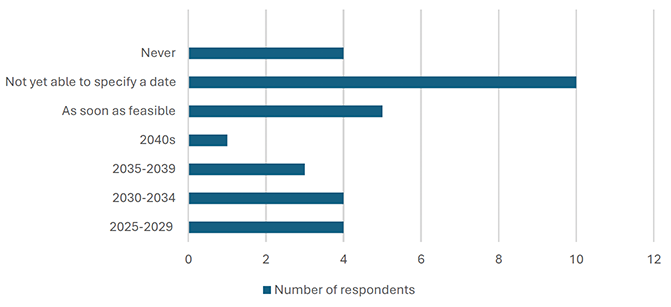
Please note that 28 respondents either did not respond or did not indicate a timeframe.
Plain text version of Figure 1:
From what date should any mandate for carbon capture technology be implemented?
- Never: 4
- Not yet able to specify a date: 10
- As soon as feasible: 5
- 2040s: 1
- 2035-2039: 3
- 2030-2034: 4
- 2025-2029: 4
Challenges must first be addressed
Many respondents who supported the introduction of a mandate believed that there was a number of financial, legislative and social challenges related to the deployment of BECCS which must first be addressed. A few respondents went onto explain that a specific date should be set only once BECCS technology is cost-effective, commercially ready and available at scale. Some further challenges relating to infrastructure were also mentioned including transport and storage systems for the captured CO2, as well as a developed and viable end market for CO2.
There was also some support for the Scottish Government to conduct further research to better understand available technology, skills and funding before introducing a mandate.
Phased approach
Some responses pointed to the need for a phased approach based on plant size, feedstock type, technological readiness and location of bioenergy plants (to ensure there is local demand for end products). A few other respondents suggested that, once the technology is commercially ready and a viable market exists, mandates should first apply to cluster-based emitters, who are more likely to already have the necessary infrastructure.
A few respondents also highlighted that smaller plants would still require financial support, even if subjected to a delayed mandate. One respondent also mentioned that bioenergy plants not connected to the gas grid should not be subject to a mandate because there is a need to boost the off-grid supply of bioenergy, particularly in rural areas.
No mandate
Some respondents opposed the introduction of a mandate due to various reasons, including the cost and variable feasibility of carbon capture technology. A few respondents stated that the approach should instead be based on fostering a supportive policy environment and driving technological innovation.
Other
Some respondents urged for policy alignment, specifically stating that the Scottish Government should look to align any mandate with Climate Change Committee’s (CCC) pathway for ‘the mass rollout of low-carbon technologies over the 2030s’ and the UK Government’s ambition for the deployment of carbon capture technology at scale in 2030s. Although, a few added that it would be worthwhile exploring if it would be feasible for Scotland to introduce mandates earlier.
A few respondents stated that the deployment of NETs should be based upon available, up-to-date and robust research with independent frameworks and criteria.
Q6 Should decarbonisation options other than fitting carbon capture and storage technology be considered suitable as part of decarbonisation requirements for biomass plants, for example use of waste heat as part of a combined heat and power (CHP) plant or heat network?
| Respondents | Number | Yes % | No % | No answer % |
|---|---|---|---|---|
| All respondents | 59 | 55.93 | 3.39 | 40.68 |
| All answering | 35 | 94.29 | 5.71 | - |
| Organisations | 21 | 54.29 | 5.71 | - |
| Individuals | 14 | 40 | - | - |
Of those who responded to this question, over 94% agreed that decarbonisation options other than carbon capture and storage technology should be considered as part of decarbonisation requirements for biomass plants. Although, it should also be acknowledged that over 40% of total respondents did not provide an answer to this question.
27 provided a response to the open part of this question, with organisations and individuals representing 21 and 6 of the responses respectively. Some respondents caveated their agreement by highlighting that decarbonisation efforts should not deter from the need to source biomass sustainably and reduce overall energy demand.
Using waste heat
Some respondents discussed the use of waste heat as a cost-effective way to promote resource efficiency and encourage the development of innovative technologies. Others agreed that waste heat is an efficient use of resources, but caveated this by explaining it is not an alternative to carbon capture and storage because it still produces GHG emissions. A few respondents suggested examples of using waste heat including in district heat networks, low-grade heat applications such as livestock farms or food processing facilities, and for maintaining optimal temperatures in greenhouses.
Flexible approach and coherent policy
Adopting a flexible approach and developing coherent policy to guide the decarbonisation of biomass plants was raised as an important issue. Specifically, some respondents believed that it would be necessary to explore and enable different decarbonisation options because this would promote innovative solutions that could be tailored to plants of various scales and configurations across both rural and urban settings. A few respondents also pointed out that the current regulatory frameworks and permitting processes can be complex and time-consuming so there is a need for more streamlined and coherent policy to facilitate decarbonisation and encourage collaboration across the sector.
Alternative solutions
Of those who agreed that other decarbonisation options should be considered, there was a range of alternative decarbonisation pathways (beyond only those for biomass plants) put forward including electrification, biochar production, producing sustainable aviation fuel (SAF), upgrading biogas to biomethane and the use of biomethane for transport and agricultural machinery as well as a potential dispatchable power source.
Many respondents also commented that the focus should be on monitoring, reporting and verification of the full carbon lifecycle across different carbon capture, storage and utilisation opportunities. Some others highlighted that this would enable decision making to be based on overall plant efficiency, including considering action around reducing CO2 and utilising waste heat.
One respondent suggested that carbon capture and utilisation should be prioritised over carbon capture and storage due to carbon being a valuable resource ‘with uses across many industries as a feedstock’. They explained this would be an efficient use of all resources and waste and would encourage circularity in material use.
Off-grid solutions
When considering decarbonisation requirements for biomass plants, some respondents urged for policy to also address the needs of bioenergy plants and processes in rural Scotland, particularly off-grid operations. Specifically, a few indicated that, if subject to decarbonisation requirements, existing plants would require a mix of financial incentives and support to offset high initial capital costs associated with carbon capture infrastructure. A few outlined that these plants should be supported with effective modular solutions for CO2 capture and a virtual pipeline for transport of CO2 to storage or usage.
2.4 Perennial energy crops
Questions 7-11 consulted on the amount of perennial energy crops (PECs) that could be planted in Scotland; encouraging the use of domestic PECs as a feedstock; opportunities and challenges around growing PECs; and encouraging planting at a commercial scale. This section also asked for best practice examples of integrating energy crops within the landscape and agriculture sector and of restoring and regenerating biodiversity, alongside energy crops.
Climate Change Committee (CCC) advise that the UK will need 700,000 hectares of perennial energy crops by 2050 to meet their pathway to net zero. How much could Scotland contribute?
18 out of a total 59 responded to the first part of this question, with 9 of these responses coming from organisations and the remaining 9 from individuals. However, it is worth noting that many of these respondents did not offer a figure. Suggestions ranged from 70,000 – 700,000 hectares, with more suggestions falling on the lower end of the range.
32 responses were recorded for the open part of this question, where 24 represented the views from organisations with the remaining 8 representing individual responses. In providing evidence, a few respondents highlighted that the scaling up of PECs for feedstocks should not distract the sector from prioritising the use of waste feedstocks and promoting a circular economy, where possible.
Competing demands for land use A prominent theme was around ensuring that competing demands for the land are balanced appropriately. Many respondents indicated that whilst there is likely sufficient land, it is important to consider other demands and priorities including food production, renewable energy, nature and peatland restoration, promoting biodiversity and implementing nature-based solutions to climate change.
Some respondents warned that subsidies should not adversely impact these wider environmental outcomes nor disrupt existing food production supply chains. Instead, they should be directed towards delivering wider public benefits.
Optimising land use and understanding local contexts
Some respondents indicated that any planting of PECs should be part of an integrated land use approach which ensures a whole-farm delivery of ecosystem, sustainability, carbon sequestration, profitability and biodiversity. A few highlighted that this also includes planting a broad range of crops and avoiding overdependency on one specific crop.
Many respondents also noted the importance of thorough engagement with local stakeholders, including farmers and landowners, to best understand how to tailor land use to local needs. They explained that this approach would help maximise local benefits whilst also optimising land use, particularly if the intention is to introduce a target.
Other respondents called for policy alignment with existing land use frameworks and wider Scottish Government policy, including on sustainable and regenerative farming, to ensure the most appropriate use of land. One respondent suggested that policy could include the targeting of incentives to ensure growth in the most appropriate areas.
Further assessment required
A few respondents would have liked to have seen further detail around the methodology for CCC’s research, including to understand whether the impact of future climate risks and land capability had been considered, in addition to energy requirements.
In order to accurately identify Scotland’s potential contribution, some respondents added that further assessment is needed to further understand the potential impact of changing the cropping system on carbon budgets. Some mentioned that further assessment is also required to consider land that is both available and suitable for planting PECs.
A few respondents also raised concerns with ClimateXChange’s research which proposed suitable land, including that it underestimates the extent of peat soils and also includes land required for grazing.
Practical considerations
Some practical considerations were put forward in addition to the evidence provided above. A few respondents pointed out that identifying suitable locations for the planting of PECs will require holistic planning that incorporates the availability and location of necessary infrastructure, as well as the end uses of PECs.
One respondent also stated that collaboration is required to adopt an evidence-based approach which allows the optimal expansion of PECs. Similarly, a few respondents underlined the importance of ensuring individual farmers make the final decision around how to use their land and any large-scale planting should be planned and undertaken in collaboration with them. Lastly, a few respondents underlined the importance of understanding the varied impacts that different species of PECs may have on the environment, according to where they are planted.
Q8 What would encourage you to use biomass from domestic perennial energy crops as a feedstock?
34 respondents provided a response to this question. This comprised 23 organisational and 11 individual responses.
Consistency of product
Another key theme was around ensuring consistency across the quality, supply, yield and energy efficiency of PECs. Some respondents pointed to the need to have security and reliability of supply before committing to using a specific quantity of this type of biomass.
Other respondents believed that if a high-yield, resilient variety of PECs was offered then this would maximise energy yield and justify higher costs associated with this type of feedstock. They suggested that a high-yield and resilient PEC variety could be achieved through research and development supported by the Government. Related to this, a few respondents called on the need for a consistent supply of high-quality PECs, which is currently variable due to different approaches to harvesting and handling of crops across Scotland.
Financial incentives
Many respondents felt that financial incentives would encourage them to use biomass from domestic perennial energy crops as a feedstock. Incentives mentioned included grants, subsidies and tax benefits. A few respondents expanded on this by explaining that financial support would enable domestic suppliers to compete with large-scale imports. A few respondents also indicated that local producers and local consumers should be incentivised in a joined-up way with one respondent highlighting that ‘the importance of local context was seen by stakeholders as a key factor influencing future growth of the industry’.
However, one respondent cautioned against the risk of market distortion and wholesale land use change which could arise as a result of expanding the PECs industry, and believed that policies must be implemented to prevent this.
Value and market certainty
Some respondents indicated that guaranteeing the value of PECs and supporting the development of a stable market would protect from price volatility and ensure a steady supply at a fair price. In addition to encouraging the use of this type of biomass, a guaranteed value would deliver the added benefit of encouraging more farmers to grow PECs.
One respondent added that in addition to stable market and costs, shortened supply chains would support the move to a more circular economy.
Wider environmental benefits
Many respondents indicated that they would be encouraged to use domestically grown PECs as a feedstock if their growth would deliver greater environmental benefits compared to other crops. The benefits mentioned included promoting biodiversity, reduced soil erosion, enhanced soil quality, flood mitigation and increased carbon sequestration. In line with this, a few respondents highlighted the importance of raising awareness around these wider environmental benefits to drive market demand and acceptance.
Strategic policy
Many respondents pointed to the need to implement clear and strategic long-term policy that accommodates local contexts, including prioritising the most appropriate areas for growing PECs and supporting existing bioenergy infrastructure. Some respondents also stated that urgency is needed to give policy direction, including providing some clarity around future support mechanisms for growing the crops, particularly given the timeframe for crops to be established.
Others mentioned that Scottish Government should look to officially commit to growing targets for PECs and other long-term commitments which would provide confidence and clear signals to the market.
Transparency of supply chain and suitable infrastructure
Some respondents believed that they would be more inclined to use biomass from PECs if they had a greater understanding of the environmental, social and economic impacts of the processes required to produce this type of feedstock domestically. They indicated that impacts could be demonstrated through lifecycle assessments or sustainability certification which would also support with reducing GHG emissions, establishing sustainable production systems and growing the sector. One respondent explained that ‘fully traceable supply chains would provide confidence and reassurance to end users’. A few also added that it would be helpful to have access to robust and independent information on the characteristics and quality of the feedstock.
Another related aspect, highlighted by a few respondents, is ensuring that the necessary infrastructure is in close proximity to the growing sites to guarantee clear routes to the market, including for processing and transportation of feedstocks.
Q9a Describe the opportunities or challenges to growing energy crops?
35 responses were received for this question, whereby 26 of the response is represented by organisations and the remaining 9 by individuals.
Environmental considerations
Many respondents commented on the environmental benefits related to growing PECs, particularly when they are strategically planted. These include improving biodiversity, promoting a circular economy and enhancing farm resilience through their potential for flood mitigation, water regulation, enhancing soil quality and promoting carbon sequestration.
However, some respondents were also clear that cropping systems need to be carefully managed because monoculture practice and intensive bioenergy crop production can damage biodiversity, ecosystems and the environment through the resulting emissions and runoff from fertilisers, soil erosion, habitat loss and other impacts on water quality.
Economic and financial considerations
Many respondents highlighted that the cultivation of PECs could stimulate local and rural economies by creating jobs, diversifying income for farmers, supporting local supply chains and increasing the environmental sustainability of local land. Particularly, a few respondents noted that building an economically and environmentally sustainable domestic PEC supply chain would enable farmers to additionally profit from producing biomethane and digestate from AD, on top of existing farming activities.
A few identified some financial challenges related to growing PECs including issues with cash flow due to 3-4 year wait before the return of capital, the need for long-term and up-front investment, market instability and the current low value of end products. Specifically, a few respondents indicated that the delayed financial returns from growing PECs are hard to justify for farmers without any initial support.
Land use
In terms of land use, some respondents commented that growing energy crops affords farmers the opportunity to simultaneously diversify cropping and increase the productivity of underutilised or low-quality land.
However, as previously mentioned, there is a challenge around identifying appropriate and sufficient land whilst balancing other demands, including forestry, food production and nature restoration. Related to this, other respondents warned that expanding the PECs industry could have a significant impact on protected areas, sensitive ecosystems or altering the landscape.
Agronomics and infrastructure
Some respondents pointed to crop specific opportunities including the speed of deployment and the scalability of PECs as well as the suitability of Scotland’s climate.
However, others commented on challenges related to crop establishment, ensuring the consistency of yield, and selecting the right varieties.
Further challenges mentioned by a few respondents related to infrastructure, including the availability and cost of equipment, ensuring an accessible growing site, logistics around harvesting and transporting the crops, and the cost of distribution.
Capacity-building and policy
Some respondents additionally highlighted challenges around the need to build PECs supply chain capacity through:
- improving farmers’ and the wider public’s perception of the benefits of various PECs, including wider environmental benefits, through impartial information and guidance;
- supporting growers to improve knowledge, skills and experience.
Moreover, a few respondents noted that policy is lacking clarity and long-term ambition, including targets, and that there is a lack of consistency between different government strategies in this area.
Q9b What would encourage planting of perennial energy crops at a commercial scale?
24 provided a response to this question, with organisations and individuals representing 15 and 9 respectively.
Many respondents mentioned that a range of incentives and a stable market would encourage the planting of PECs at a commercial scale. More specifically, some respondents suggested offering a combination of targeted interventions including subsidies, grants, tax breaks and planting schemes. A few also stated there was a need to support and secure the market through ensuring stable, fair pricing for biomass whilst rewarding domestic feedstock production. One respondent explained that this would give farmers ‘more confidence in the market’ whilst another stated it would ‘reduce financial risk’.
Additionally, a few respondents called upon policy to be consistent, clear, aligned and long-term to drive demand for domestic biomass feedstocks. Other respondents urged the Scottish Government to avoid introducing mandatory limitations on soil type, region or site. A few respondents suggested that the Scottish Government introduce programmes that promote and identify suitable areas for planting PECs.
Lastly, some respondents called upon the Scottish Government to fund independent advice on the benefits of PECs and promote further research on how to improve yield and ensure holistic land use.
Q10 Can you provide best practice examples which could help integrate energy crops within the landscape and within the agriculture sector?
23 provided a written response to this question, with 17 of responses coming from organisations and 6 coming from individuals.
Agricultural best practices
In highlighting best practice examples of integrating energy crops, many respondents pointed to sustainable land management approaches aimed at delivering holistic benefits including across soil health, carbon sequestration, water conservation, sustainable food and energy crop production whilst also minimising impacts on ecosystems. This approach also includes growing PECs on marginal or underutilised land which one respondent explained ‘could minimise competition with food crops and reduce the pressure on prime agricultural lands’.
Other best practices that some respondents mentioned included mixing crop species and structures, promoting crop rotation, and establishing riparian buffer strips and wildlife corridors. Some respondents also suggested cultivating PECs alongside trees to enhance carbon sequestration, biodiversity, soil health, flood tolerance, provide shelter for crops, support tree planting targets and provide additional revenue streams.
Scottish Government policy and action
Some respondents considered it important to have supportive and strategic policy which delivered on outcomes relating to sustainable land use, biodiversity conservation and efficient energy crop production. One respondent also indicated the need for the Scottish Government to invest in research and development to optimise the selection of suitable energy crops based on local conditions and market demand.
Another key theme mentioned was around establishing best practice guidance. Some respondents stated that this should draw on success stories and advice from independent organisations to support farmers to make informed choices about land use. Similarly, a few respondents thought it would be helpful if the Scottish Government promoted regional land use networks to facilitate knowledge transfer.
Q11 Can you provide best practice examples which could help restore and regenerate biodiversity, alongside energy crops?
21 respondents provided a written response, whereby organisations and individuals represented 15 and 6 respectively.
Regarding best practice examples, many respondents pointed to nature-based solutions and adopting regenerative farming practices, including integrating livestock grazing. Other examples provided were the use of nature corridors, including wildlife and grass margins, to provide habitats, attract pollinators and support water management. In addition, there were some suggestions that agroforestry systems could provide effective windbreaks, environmental protection, wildlife corridors and enhance biodiversity and the natural regulation of pests.
Some respondents also commented on diversifying the range of crops, mixing cropping systems, using cover crops as well as planting specific crops known to support a wide range of woodland and grassland species. Suggestions by other respondents focused on planting native and non-invasive species to maintain the ecological balance. The respondents went onto highlight that these best practices help to improve soil health and avoid agricultural intensification. Related to soil health, a few respondents also outlined the importance of good soil management to ensure erosion control and improve soil structure, stability and fertility. As well as promoting a healthy ecosystem, one respondent added that good soil management would ‘provide resilience for PECs’.
A few respondents also mentioned making use of best practice guidance as well as encouraging accurate carbon accounting, reporting, monitoring and evaluation on the production and sourcing of biomass in Scotland.
Contact
Email: onshoreelectricity@gov.scot