
Communities Mental Health and Wellbeing Fund for Adults: impact report - year 3 (2023-24)
This report reflects on information provided by projects funded through the Communities Mental Health and Wellbeing Fund for Adults in Year 3. It appears from these returns that projects who received funding managed to meet the aims set out within their applications.
Executive Summary
This report reflects on information provided by 90 projects funded through the Fund in Year 3. It appears from these returns that projects who received funding managed to meet the aims set out within their applications. It is also positive to see that there is a high level of people who have been supported.
The main challenges reported by projects were issues relating to a lack of resources reported by around a third (33).
Overall, respondents reported successfully using the funds they received to have a positive impact on the mental health and wellbeing of their communities.
Types of projects
Most projects aimed to address social isolation and loneliness (48) by offering spaces and activities where people could come together and socialise or connect with their local community. These often centred around conversational cafes or organised day trips and events.
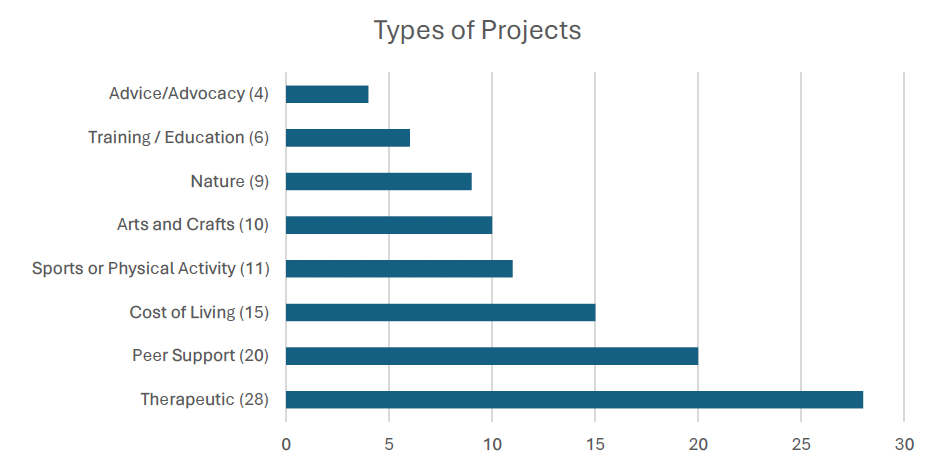
Bar chart below titled “Types of Projects” showing the number of projects by category. Therapeutic projects are the most common (28), followed by Peer Support (20) and Cost of Living (15). Other categories include Sports or Physical Activity (11), Arts and Crafts (10), Nature (9), Training/Education (6), and Advice/Advocacy (4), the least common. Overall, therapeutic and peer support projects account for the largest share of projects.
Some funds were used to enhance organisational capacity, employ new staff, upgrade facilities, and cover consumables, equipment, and staff training.
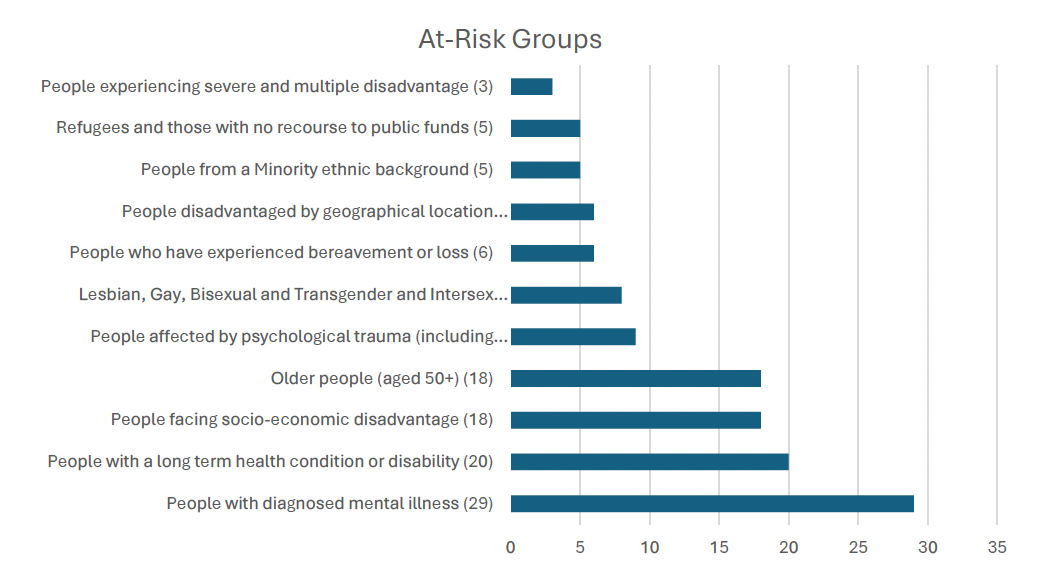
Horizontal bar chart below titled “At-Risk Groups” showing the number of projects supporting different groups. People with diagnosed mental illness are the largest group (29 projects), followed by people with a long-term health condition or disability (20), older people aged 50+ (18), and people facing socio-economic disadvantage (18). Smaller numbers of projects support people affected by psychological trauma (9), LGBT+ people (8), people experiencing bereavement or loss (6), those disadvantaged by geographical location (6), people from minority ethnic backgrounds (5), refugees and people with no recourse to public funds (5), and people experiencing severe and multiple disadvantage (3).
Challenges
Around a third of respondents (33) reported resource pressures, particularly funding constraints, as a challenge to project delivery. However, most were able to adapt their approach and continue to meet their objectives.
Other commonly reported challenges included:
- Maintaining participant engagement
- Promoting projects to target groups and
- Engaging people from under-represented communities.
Some organisations faced practical issues such as:
- Limited storage or venue space,
- Transport delays
- IT compatibility issues with partner organisations and
- Participants withdrawing due to changes in personal circumstances.
Despite these challenges, many projects successfully adapted their delivery models and reported no significant impact on their overall outcomes.
For those projects designed around outdoor activities the Scottish weather could often prove challenging. Though projects often had, or developed, contingency plans to allow for its changeable nature.
“One of the challenges encountered was weather preventing as many outdoor activities within some cohorts and activities could not be consistent across courses. However, alternative activities were identified but winter months will continue to have limits on external activities.”
Some projects referenced oversubscription of volunteering/membership causing difficulties.
“The growth of the project and the rising number of volunteers has, at times, made it challenging to provide consistent and effective tailored ongoing supervision for each volunteer. However, with the support of the Project Manager and an internal reorganisation, this has now been successfully addressed. Priority areas such as volunteer supervision are being managed more efficiently, ensuring continued support and development for all involved as the project moves forward”.
A lack of consistent engagement with the projects was cited by some respondents as being a challenge. These projects typically involved hard to reach groups or individuals dealing with substance use and mental health issues that made it difficult for them to regularly engage.
“Attendance is a challenge when working with this group. You just have to accept that counselling isn’t for everyone. There is going to be a higher drop out percentage at the start of the process , which does make the work challenging. It can be hard on staff and counsellors when so much effort is put in to get people free counselling, only for clients not to engage”
Several projects had issues with promoting or communicating their project to the groups they were trying to reach. Which lead to slower uptake than expected for some projects.
“A key challenge encountered was engaging our target group at the outset of the project. Our initial strategy focused on partnering with local football clubs to recruit participants. However, this approach did not generate the level of engagement we had anticipated.
In response, we worked with Angus Council to expand our reach to a wider network of sports clubs. This broader approach proved more effective and has also enabled us to work with frontline staff within local clubs.”
Some projects encountered specific issues when initially trying to engage with people from under-represented communities.
“At the start of the project, attracting participants from under-represented communities was more difficult than anticipated. Many individuals were hesitant to join due to a lack of familiarity with creative projects or concerns about their ability to participate. To overcome this, we adapted our outreach strategies by partnering with local organizations, providing more personal invitations, and offering a clear explanation of the group’s welcoming, inclusive nature. This shift in approach helped us engage more participants over time. Another challenge was the availability of resources, particularly when it comes to equipment and space for film production”. A few other projects noted issues around storage as many projects did not have their own location or venue and were using space in other community/third sector buildings:
“Our main challenge was space for storage, however we have limited what we store in order to keep the project moving, and progress was maintained throughout the year.”
Impacts
Respondents were often able to demonstrate the positive impact of their projects, with many highlighting the significant difference made to individuals lives and wellbeing.
While reported outcomes varied according to the nature of each project, the majority described positive improvements in participants mental health and wellbeing and strong levels of engagement from those who took part.
In addition, 48 projects reported reducing social isolation and loneliness, or increasing participants' sense of connection to their local community. These outcomes were evidenced through a range of formal and informal feedback and evaluation methods.
Overall, despite facing some delivery challenges, projects reported the Fund enabled them to make a meaningful and positive contribution to the mental health and wellbeing of people and communities across Scotland.
Findings
From the initial 90 responses received, 21 undertook supplementary evaluation activities, such as post‑session consultations and pre‑ and post‑intervention surveys. 14 of these provided detailed evidence to demonstrate their outcomes and impact.
Projects were asked to report on the ways in which their activities had affected participants’ mental health and wellbeing. Responses showed that projects often contributed to multiple dimensions of wellbeing rather than a single outcome.
Just under half of all projects (43) reported improvements in participants’ mental health, evidencing this through a variety of measures in a range of formats and degrees of formality. This included:
- Survey and questionnaire data
- Direct participant feedback
Collectively, the findings indicate that the funded projects delivered tangible, positive impacts on mental health and wellbeing across communities, through a range of different activities.
A summary of the findings from the analysis is presented below.
What did projects do?
Respondents were asked what they had expected to do with the funding and what they did do.
68 respondents reported that their projects met the goals set out in their original plans with 8 reporting that they managed to, at least modestly, exceed their goals. The remaining 14 projects did not provide enough information or evidence to determine if they met/exceeded their goals.
This is a small snapshot of the activities funded and should not be taken as representative of the activities of the fund on the whole.
Most projects aimed to address social isolation and loneliness
- By offering spaces and activities where people could come together and socialise or connect with their local community
- These often centred around conversational cafes or organised day trips and events.
Some projects offered some form of therapeutic support
- Including one on one or group counselling
- Engaging in therapeutic or relaxing activities such as yoga
Some projects facilitated peer to peer support groups
- These catered for a diverse range of people from new mothers to those in recovery.
- Many included elements of volunteer training to help facilitate peer to peer support
Some projects included specific elements to address the cost of living crisis
- A small number provided food and meals
- A small number covered some or all of their participants transport costs
- Many of these projects either offered direct advice and support or signposted participants to other groups or sources of support.
A few projects engaged with individuals in their local communities by offering access to sports and physical activity
- This ranged from providing mental health and wellbeing support to young people through football to supporting walking groups for older adults and individuals with dementia.
A few projects offered activities that can be broadly described as Arts and Crafts
- This encompassed a wide variety of activities including filmmaking, painting, woodworking, music, and knitting and sewing, among others.
- It includes groups as diverse as Men’s Sheds and folk music groups.
A small number of projects involved improving mental wellbeing by helping individuals connect with nature.
- These projects ranged from community gardening projects to nature walks, and bushcraft lessons.
A small number of projects offered training or access to education to participants to help them support themselves and others.
- This included helping individuals understand and live with their conditions
- Accessing training to improve skills for employment and volunteering
A small number of projects were concerned with providing advice or advocacy to those with mental health or related issues.
- Alongside these a few used the funding to cover running costs, maintenance, or to hire staff to deliver projects.
How many activities were planned/undertaken?
Respondents were asked how many sessions they had planned when applying for funding, how many they had managed to deliver, and to estimate how many people their project reached. Of those who completed the survey, most projects provided a return to this question.
The majority of projects delivered at least all of the sessions planned, some projects delivered more sessions than planned, and nearly all the projects that did not manage to deliver all planned sessions, managed to deliver most.
No project appears to have overestimated how much was realistically achievable with the funding received.
- 36 (40%) reported providing the planned number of activities.
- 28 (31%) reported exceeding the planned number of activities with the average (median) number of activities being undertaken being 135% of those planned. Therefore, these projects provided over a third (35%) more activities than originally planned.
- Of these, 9 (10%) reported not providing the number of planned activities with the average (median) number of activities being undertaken being 65% of those planned. Therefore, projects provided over a third less activities than originally planned.
Of those 17 (19%) projects who did not provide a return there were:
- 4 where funding was to provide increased staffing/training for staff/volunteers;
- And 3 did not set out to conduct a planned number of activities but to respond dynamically to demand.
The remaining projects did not provide enough information about the number of activities planned/undertaken to be able to address this question.
The respondents’ projects offered between 1-3,000 activities over the course. The majority either met or exceeded the number of activities planned.
How many people were reached?
In both the original survey and the supplementary request for information, respondents were asked to estimate how many participants had benefitted over their project’s course. Every respondent was able to provide an estimate - however, organisations responded in different ways. Some provided a specific number of people they reached, some provided a range, e.g. 35-40 or 300+, and others provided the number of interactions.
There were a broad range of projects with quite different focuses targeted at quite different groups. Those with larger numbers of participants tended to be less interactive and less intensely focused on helping individual participants than those with lower numbers.
Due to the nature of the data provided for this exercise, it is not possible to provide an estimate of the total number of people supported through the Fund. However, from the range of responses it is clear that the reach of the Fund is tens of thousands of people.
Who were the main beneficiaries?
Respondents provided information on who benefited from the projects. Most focused on one or more of the Fund’s at‑risk groups, including women, people with a long term health condition or disability, people from a minority ethnic background, refugees and those with no recourse to public funds, people facing socio-economic disadvantage, people experiencing severe and multiple disadvantage, people with diagnosed mental illness, people disadvantaged by geographical location, LGBTI+ communities, and older people.
Across the 90 surveyed projects, the largest beneficiary groups were people with diagnosed mental illness and people with long‑term health conditions or disabilities. Some supported groups including people experiencing socio‑economic disadvantage, older people, and women. A few focused on people affected by psychological trauma, LGBTQ+, bereavement or loss, minority ethnic communities, refugees, and those disadvantaged by geographical location.
A number of projects supported multiple groups of people. For example: The Memories Tearoom targeted people from multiple groups, including those with diagnosed mental illness, long term physical health conditions, older people and those who had been recently bereaved. Animals Supporting People at FRED provided support for young adults with autism or issues around gender/sexuality and older adults recovering from trauma. CASH - Community Advice, Support & Help supported people experiencing poor mental health and poverty from across various social groups including people with disabilities, carers, older people, lone parents and unemployed.
Some projects offered support to individuals experiencing specific health conditions such as Southend Menopause, supporting menopausal women, 'Gardening for mental health and wellbeing’, which supported those with learning disabilities, and Perinatal Mental Health, supporting women suffering from post-natal and ante-natal depression, and their partners.
What did you expect to do with the funding and what did you actually do against your original plan?
Most projects reported they either met the aims set out in their original plan or exceeded them, reporting that they helped to foster connections across the community, help build a sense of belonging and improve mental wellbeing.
Impact and outcomes
29 projects in the initial survey reported gathering data on outcomes. This ranged from referrals on to other services, pre and post Warwick-Edinburgh Mental Wellbeing Scale (WEMWBS) data collection (14-item self-report questionnaire designed to measure positive mental wellbeing, focusing on both feeling good and functioning well), to being able to show quantifiable changes in participants’ lives (more financially stable, moving on to further education, etc).
A small number of projects did not say how they measured whether outcomes were met.
The supplementary information provided in November asked about the impact of projects in more detail. This analysis is based on returns from 486 projects across 14 local authorities, with 226 providing usable qualitative responses. Data completeness and consistency vary, so findings should be treated as indicative. The key impact themes from responses were:
- Reducing Isolation and Strengthening Social Connections
The most prominent impact was reducing loneliness and improving social connection through safe, welcoming community spaces. Many participants described these as essential lifelines, often representing their only regular social interaction. Informal peer support and friendships frequently developed beyond structured sessions.
“For some of us it is the only outing we have each week.”
“Many have shared that it’s the only space they feel truly understood.”
“This group has been a lifeline… I finally feel like I’m not alone.”
- Mental Health and Emotional Wellbeing
Projects directly supported people with a wide range of mental health challenges, including anxiety, depression, trauma, bereavement, addiction, and neurodiversity, using approaches such as counselling, peer support, and therapeutic or creative activities.
Projects reported improvements in mental health outcomes, including reductions in anxiety, depression, stress, and, in some cases, suicidal ideation. A key outcome was helping individuals develop greater self-awareness and coping skills, enabling them to better understand and manage their own mental health over time.
“Those places in my brain that have been ravaged by depression and psychosis have found peace, restoration, and hope within its walls.”
"We have very shy men who have come who have over time been able to open up and confide in those of us running the group about areas they are struggling with or life situations that they just need to share with another man"
“I now recognise the effects of behaviour on mental health… I feel confident now to take responsibility and be supportive.”
- Inclusion and Accessibility
Projects focused on removing barriers and reaching underserved groups through free/subsidised services, outreach, and tailored delivery. This included rural communities, disabled individuals, and those unable to leave home.
“Some beneficiaries are no longer able to leave their homes… appointments in their own homes made a massive impact.”
“It reduces isolation, especially during the winter months.”
"One of the key achievements we are particularly proud of is the ability to offer increased home visits and consistent face-to-face support to clients… This has made a tangible difference to the mental health and wellbeing of individuals, particularly those living in remote or isolated locations with little to no access to transport."
- Confidence, Empowerment and Personal Growth
Participants reported increased confidence, skills, and independence. Many progressed into volunteering, leadership roles, or employment, reflecting strong personal development outcomes.
“all the volunteers have shown an increase in confidence from talking more, asking to learn more, talking to customers. Seeing a young person growing from a quiet shy individual to a bubbly person being part of the cafe team is a joy to see.”
“…each participant earned First Aid and Food Hygiene certifications, greatly boosting their confidence and employability. This resulted in several individuals returning to work or volunteering with local organisations."
" One of the most rewarding moments was when the Level 3 group hosted their first Community Meal Event … They distributed Growing Packs, shared their personal journey, and engaged with the public. The group also ran their own social media campaign, which was a new experience for many of them, and they took great pride in creating posts and interacting with the community.”
- Practical Support for Daily Living
Projects aimed to address basic needs such as food, transport, and financial advice, helping stabilise individuals facing financial hardship and reducing stress linked to poverty and crisis situations.
“financial worries can be a major trigger for suicide, but our advice can help people access additional funds to mitigate these worries."
"A particularly impactful case involved a young male with mental health issues and a learning disability who was recently released from prison. Upon release, his benefits had been stopped, he was without accommodation and was extremely distressed due to his experience in prison. We were able to intervene swiftly, securing emergency food and fuel vouchers through, enabling him to meet his basic needs."
- Family and Carer Support
Interventions were reported to have strengthened family relationships and supported parents and carers, particularly those facing complex challenges. This was felt to have led to improved confidence, stability, and wellbeing within families.
"To build better relationships with their partner, their children. To have improved confidence and self esteem, self worth think families moving on is something to be proud of. Recognising their own strength and ability, their confidence. "
" The main beneficiaries of our groups and events are the children but also it is a massive positive for parents. Being able to offer a safe space for parents to meet and discuss how they are feeling and how they are getting on is such a breath of fresh air. "
- Volunteer Development and Community Capacity
Volunteers played a central role in expanding reach and building sustainable community support. Volunteering also improved individuals’ wellbeing and sense of purpose.
"Some of the volunteers and paid worker had mental health issues so it was really good to see them take on key roles in running the soup stop. “
Additional information
Respondents were given the opportunity to share any additional information or thoughts about their projects and the fund and around two thirds of respondents took this opportunity. These responses typically reinforced respondents’ views on the importance or need for their projects and the impact that funding, or the lack thereof, could have on service delivery.
Many took the opportunity to offer thanks for funding received and stressing the positive and transformative impact it had on individuals attending projects and their local communities. A few respondents noted that the funding was important as financial and resources pressures were increasing and these tended to be established third sector organisations or groups. Some respondents used this space to outline learning from their projects and outline possible plans for future projects or funding.
Contact
Email: lucy.pullar@gov.scot