
Cash-First Programme: final evaluation report
Findings from a process and impact evaluation of the Scottish Government's Cash-First Programme. The Programme supported new local partnership work to deliver Cash-First interventions across eight delivery partner areas.
5. What difference has the Programme made and for whom?
Key findings
Impacts for service users
- There was a strong preference for Cash-First approaches among survey respondents when compared to using a food bank, with respondents noting the empathy of staff as being a particular highlight. The Programme service users generally reported feeling they were treated with dignity and respect.
- Survey responses demonstrated that the Programme reduced food insecurity amongst some service users, but this was inconsistent.
- The successful delivery of wraparound support as part of the Programme was limited, which also limited the prevention element of the Programme. For some individuals, wraparound support did not result in improved financial situations because their income was already maximised.
- Support with energy costs was the most commonly reported holistic support reported over the Programme lifetime, emphasising the link between food and fuel insecurity.
Impacts for stakeholders
- Improvements to the knowledge, awareness and understanding of Cash-First approaches were acknowledged across all of the Delivery Partner areas.
- All of the Delivery Partners improved data sharing protocols with partners, to varying degrees. Where data sharing was most successful, it enhanced service delivery for individuals and improved the data available to inform planning and strategy.
- The role of the Learning Partner was acknowledged as highly valuable by all of the Delivery Partners in supporting them from planning to delivery phases.
- Capacity was a sustained challenge to maintaining partnerships and knowledge-sharing.
Impacts on overall outcomes and sustainability of the programme
- The ability of the Programme to address the deep-seated issues and causes of poverty was limited.
- While the Delivery Partners and service users could evidence a reduction in worrying about food, they were less confident on the Programme’s ability to address longer-term pressures and prevent future hardship.
This chapter sets out the extent to which the Programme has achieved medium-term (to July 2025) outcomes. It also considers longer-term outcomes and the potential for these to be sustained, as set out in the Programme Logic Model.
Impact on Cash-First Service Users
This section outlines findings relating to the impact of the Programme on service users. It draws upon responses to the Stage 2 service user survey and interviews with service users of the Programme, supplemented by findings from interviews with the Delivery Partners, local core partners and wider stakeholders. It also draws upon findings from case studies, where appropriate.
The service user survey that was completed for the interim evaluation underwent significant revision for the second stage of the evaluation. Therefore, it should be noted that responses are not fully comparable between Stage 1 and Stage 2 of the evaluation. Due to simplifying the Stage 2 survey in order to make it more accessible to service users, it is not always possible to provide comparison between Year 1 and Year 2 in some of the results or findings. This has been stated, where relevant.
The profile of respondents in Stage 2 also varied greatly from that of stage 1. As with the interim reporting period, demographic breakdowns of the entire body of the Programme service users in each Delivery Partner area are not available. Therefore, it is not possible to comment on how representative survey respondents are of all Programme service users. The demographic breakdown of the Stage 2 survey, and how this differs from Stage 1, is provided in Appendix B.
In addition to this, as in Stage 1, a large proportion of respondents came from one Delivery Partner area. In Stage 2, 49% of responses were from North Lanarkshire, while other areas had a smaller proportion of respondents - Orkney at 21%, Aberdeen City at 13%, Fife, Edinburgh City and Aberdeenshire at 5% each, and West Dunbartonshire at 2% (see Table 2.1). There were no Glasgow City respondents as the Glasgow Delivery Partner had not engaged any service users at the time of the research. Feedback from the West Dunbartonshire Delivery Partner indicated that responses from their area were likely impacted by the Delivery Partner’s own local evaluation activity.
Accessing the Programme
When asked how easy or difficult they had found the Programme’s application process, over half of survey respondents (61%) found this easy or very easy (Table 2.2). This is slightly below the proportion of respondents that reported this in the Stage 1 survey, where 70% of respondents found it easy or very easy (Table 1.5). Four respondents in Stage 2 said it was helpful to be able to apply by telephone (where this was offered). The speed at which people were subsequently contacted about their initial application, and at which they received the money, were also positively reported. One service user said they received cash as follows:
Same day - getting the money in my account within 3 hours. (Service user)
Although many survey respondents found the application process easy, 17% of survey respondents in Stage 2 reported difficulty in applying, with almost half of these finding it very difficult (Table 2.2). When asked what about the process made it difficult to complete, survey respondents reported a range of challenges, such as:
[Not knowing] where to go, and how to ask for help.
Having to go through countless people and sometimes not getting a call back.
[It] took days to proceed.
(Service users)
One respondent had struggled with the application process due to health conditions:
I’m not good with forms, I have fibromyalgia [and] ADHD […]. (Service user)
Access to cash was the most common form of financial support that survey respondents in Stage 2 received (45%), followed by bank transfers (39%), shopping vouchers (18%) and being told about wider financial support they could apply for (16%) (Table 2.3). Other financial support that was mentioned by respondents included ‘cashout vouchers,’ which allowed people to draw out cash from a PayPoint.
This profile of financial support received was broadly similar to responses to the Stage 1 survey, where 51% of respondents received a bank transfer, 22% received access to cash, 22% of respondents received a shopping voucher, and 10% received a referral to other financial services (Table 1.3). The financial support that was available varied by Delivery Partner, reflecting different delivery models. The majority of Stage 2 respondents from Orkney (92%) Aberdeen City (88%), and Fife (67%), received a bank transfer. All respondents in Aberdeenshire and the City of Edinburgh, and the majority of those from North Lanarkshire (63%) received access to cash (Table 2.3). The single respondent from West Dunbartonshire stated they did not receive any form of financial support through the Programme.
Dignity and Choice
A key principle of the Programme was ensuring dignity for service users, and 82% of Stage 2 survey respondents agreed or strongly agreed that they were treated with dignity Table 2.13). This was also reported in interviews, with some service users associating this with the anonymity a cash payment gave them. For example, one service user said:
You could go and do a shop and not think about people seeing me. (Service user)
Others commented on the element of choice that the Programme provided, for example:
It allowed me to make choices to fill my cupboards and have food of my choosing.
Money was put into my bank, and I used it to the best of my abilities.
(Service users)
The Cash-First emergency payment was found to be preferable to using a food bank, with most of the Stage 2 survey respondents (77%) agreeing or strongly agreeing that they preferred a Cash-First payment to food bank use (Table 2.12).
The majority of survey respondents in Stage 2 said that the food they were able to access through the Programme met their or their family’s dietary preferences (61%) (Table 2.10) and cultural or specific dietary needs (71%) (Table 2.14). The majority of interviewees also stated that the Programme gave them access to food that met their individual needs including accommodating food intolerances.
The skills of staff and the design of the application process were key factors in creating a positive experience for service users, who commented in the Stage 2 survey open text option on staff “empathy and understanding” and stated that:
[I] didn’t feel like I was begging
The general friendliness of the person I was speaking to, [who was] non-judgemental. (Service users)
This was repeated in interviews with service users, most of whom reported positive experiences, saying for example:
Sometimes it’s all you need, to have someone listen and point to the right support.
I was treated with respect and empathy.
(Service users)
One service user reported having a more positive experience at a local food bank than when they engaged with the Programme’s money advice service. They stated that it was difficult to establish contact with the service, and that they felt judged due to the nature of the questions they were asked. This was reported in one interview only and was not a universal experience, but for the person who experienced this, they said it was:
Almost off-putting, I would almost rather go without. (Service user)
Wraparound and holistic support
In addition to the direct financial support that Programme service users received, they were also offered a range of wraparound and holistic support. The welfare rights and income maximisation advice and support element of Cash-First is referred to as ‘wraparound support’, while ‘holistic support’ refers to a joined-up approach to delivering services across sectors that is centred around wellbeing, through meeting the whole needs of an individual or household. This includes services that meet financial, health, social, and cultural needs.
Almost half (45%) of survey respondents in Stage 2 reported that they did not receive wraparound or holistic support beyond the initial Cash-First emergency payment (Table 2.4). This included respondents who stated they did not receive this support (16% of respondents) and respondents who said they could not remember or were not aware of receiving this support (28% of respondents).
A minority of interviewees reported they had not received or been offered wraparound or holistic support. It was sometimes difficult for interviewees to separate the immediate crisis intervention from the wraparound and holistic support they accessed. One interviewee described this as follows:
It’s all so interconnected so it’s difficult to say. (Service user)
This is consistent with the findings reported in the interim evaluation where it was reported that some individuals found it hard to recognise when they had received wraparound or holistic support.
The proportion of survey respondents that recognised that they had received wraparound or holistic support was higher in Stage 2 (55%) than in Stage 1 (42%) of the evaluation Tables 2.4 and 1.10). This increased recognition in Stage 2 may also reflect increased stakeholder awareness of the Programme and how this was communicated.
Stage 2 survey respondents received a broad range of wraparound and holistic support. Respondents could select multiple options when asked what support they received, across both wraparound and holistic support types. The most common wraparound support received was financial or money advice (43% of total respondents, 76% of those that reported receiving wraparound or holistic support), followed by benefits entitlement assessments (33% of total respondents, 59% of those reporting wraparound or holistic support) (Table 2.4).
The most common organisations or services which provided this support were local authority welfare rights and benefits advice teams (34%) and support from Citizens Advice Bureaux (CABx) (29%) (Table 2.5). The interim evaluation report highlighted the crucial role of CABx and money advice services in delivering the Programme and this finding suggests this was further embedded as the Programme progressed. However, as referenced above, almost half of the Stage 2 survey sample (49%) were from North Lanarkshire, and therefore this should be treated with caution and is not necessarily representative of the Programme overall.
Common holistic support received included housing support (17% of total respondents, 29% of those receiving wraparound or holistic support), help with the cost of fuel (15% of total respondents, 26% of those receiving wraparound or holistic support), and money and debt management support (14% of total respondents, 24% of those receiving wraparound or holistic support), employment advice (13% of total respondents, 24% of those reporting wraparound or holistic support) and mental health service referrals (10% of total respondents, 18% of those reporting wraparound or holistic support) (Table 2.5). Other forms of holistic support were also available, depending on the needs of the individual. For example, one service user reported they had been given a slow cooker by a local core partner to help them make meals, and one respondent said that they received help to arrange a visit to the hospital.
The Delivery Partners facilitated access to wraparound and holistic support in a number of ways, some of which are discussed in the accompanying Wraparound and Holistic Support case study.
Impacts of wraparound support
Survey respondents praised the wraparound support provided through the Programme. One respondent said that the financial advice provided had helped them to pay off their debt. Another service user reported feeling “more secure” and one person stated:
It helped at a time when I really needed it, and the lasting impact of the wider support is really good. (Service user)
Some commented on the combination of a cash payment and wraparound support being offered together, saying this enabled them to address other challenges, for example:
It was able to give me the space and time to get my financial situation sorted, waiting on [other support] at the time. [It] bridged the gap. (Service user)
The Delivery Partners reported that, within the short-term scope of the Programme, it was difficult to gather evidence about longer-term impacts, the extent to which benefits were sustained, and life circumstances improved. However, one Delivery Partner was clear about the positive impacts the Programme had on people seeking support, saying:
We are able to support people prior to getting into the crisis situation (Delivery Partner)
This demonstrates that the Programme has supported and strengthened preventative approaches in at least one Delivery Partner area. However, others reported a mixed picture and recognised that wider structural factors impacted on individuals’ needs. These included increasing costs of living, and the fact that in some cases it was not possible to maximise incomes any further, but people were still in need. It is clear from the evidence that a single intervention such as the Programme cannot effect the change from crisis response to prevention in isolation from the wider support system.
Impacts of holistic support
‘Holistic support’ refers to a collaborative approach to delivering services across sectors that is centred around wellbeing, by meeting an individual’s and household’s whole needs. Respondents reported a wide range of benefits from wider holistic support. The most common benefit, identified by 34% of the total Stage 2 survey respondents, was help with energy costs (Table 2.6). This was also the most commonly reported benefit by respondents in Stage 1 (42%). 16% of respondents acknowledged that the support accessed helped them resolve their housing issues (Table 2.6). Survey respondents also stated that they had improved their budgeting skills and were better able to manage their money, with one respondent stating that the support they received through the Programme enabled them to:
Sort my finances and debts out. (Service user)
It was highlighted by a Delivery Partner that the cash payment was often a secondary benefit compared to the holistic support. This was also recognised by local stakeholders, one of whom reported:
It has made a big difference. We can see positive changes in the people that we have supported. (Local stakeholder)
Service users also shared that accessing the Programme’s services delivered more than crisis intervention, and it was clear from the interviews that the cash payment was only one aspect of the support that was sought. For example:
I was able to get food and didn’t lose my car. It actually made sure my basic needs were met.
I got housing sorted. …and counselling every [week] – it helps me keep on top of everything.
(Service users)
However, the package of support available from the Programme was sometimes not able to address the complexity of issues people experienced. One survey respondent stated that the support was:
A sticking plaster over a wound which required surgery. (Service user)
In interviews, when asked what additional holistic support would have been helpful to them, many service users reported that they had received everything they needed or had asked for. Others identified that additional support with managing fuel costs, budgeting and health would have been helpful.
Not knowing what support might be available was identified as an issue. For example, one service user said:
I don’t know what support to look for so I haven’t got a clue. (Service user)
Tackling food insecurity
Survey responses demonstrated that the Programme reduced food insecurity amongst some service users, but that outcomes varied depending on the cohort.
Over half of survey respondents (54%) acknowledged that they were worrying less about running out of food because of lack of money or other resources (Table 2.7).
The need to address in-work poverty was raised in an interview with a service user, who stated that:
I know so many people that are struggling and are working, so [the need for support] does happen to people like us. (Service user)
Two thirds (66%) of Stage 2 respondents (Table 2.15), compared to one third (33%) in Stage 1 (Table 1.26), stated that without the Programme, they “would not have had enough to eat”. However, the Delivery Partners expressed that poverty was increasing generally in local areas. For example, it was reported that:
We’ve seen an increase in-work poverty.
We're delivering this project in a context of increasing poverty. So the demand for these services is going up anyway.
On ending the need for food banks - poverty and inequality have just increased massively over the last decade or more.
(Delivery Partners)
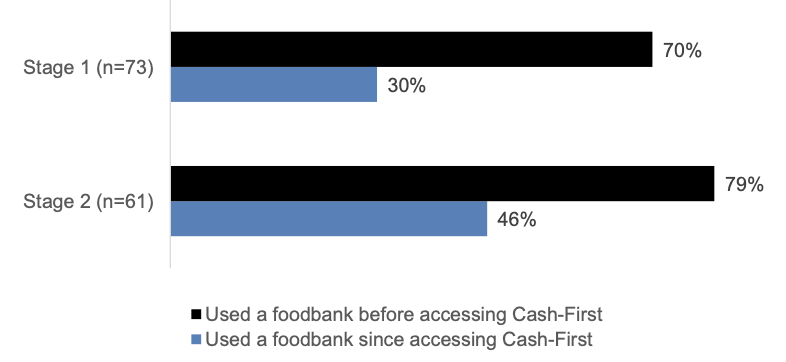
The Programme demonstrated an impact on food bank use among survey respondents. Figure 5.1 illustrates the percentage of respondents who accessed a food bank before and since engaging with the Programme, from both Stage 1 and Stage 2 surveys.
The majority (79%) of Stage 2 respondents had accessed a food bank prior to receiving support through the Programme, whereas less than half (46%) of the sample had accessed a food bank following support, representing a 33 percentage point decrease in usage amongst the sample. This decrease in food bank use after accessing the Programme was slightly lower than what was reported in Stage 1, where there was a 40 percentage point decrease.
Just under half (49%) of respondents in Stage 2 said that without the Programme, they would have used a food bank (Table 2.15). This is a slightly higher proportion than Stage 1 respondents (43%) (Table 1.26).
While respondents to the survey noted a reduction in food bank use, caution should be used in the interpretation of this data. The data was self-reported, and reflects only service users’ situations at the time when the survey was completed. This may have changed following completion of the survey. There is also very limited data available to evidence a reduction in food bank referrals, due to the various approaches to collecting data, or not collecting data, used by food banks in Delivery Partner areas.
One Delivery Partner also recognised a reduction in applications to the Scottish Welfare Fund, and stated:
For us, that’s a reduction in people saying they need money for food. (Delivery Partner)
Wellbeing
The research found that the Programme has delivered a number of measurable wellbeing outcomes for service users. Service users that received Cash-First support in Stage 2 reported feeling more confident about being able to look for future support and therefore were worrying less about running out of food. Service users stated in interviews that:
I feel a lot more secure in the knowledge I can get the things I need
[I am] not in a position where I feel so stressed and know that I can have that conversation in the future. I feel looked after! (Service users)
Service users also recognised positive impacts on their mental health. For example:
It took a lot of stress and pressure off me. It was affecting my mental health and had visions of power being cut off - there was no worry as I knew that part of things was dealt with. (Service user)
Another described the positive wellbeing impacts of the Programme as follows:
I’m not in a position where I feel so stressed, and know I can have that conversation in the future. (Service user)
Other interviewees were more cautious about the longer-term impacts of the Programme on their wellbeing, while recognising the immediate and short-term wellbeing benefits. For example, service users mentioned:
It gave me a mental and physical boost. It doesn’t take the world’s worries away, but it helps.
It took the worry off, for a small day or so.
(Service users)
Financial circumstances
The research showed that the Programme improved the financial circumstances for some individuals and that this was as a result of both the cash payment and the wraparound support. Over half (52%) of Stage 2 survey respondents agreed that the support offered by the Programme had helped improve their household income (Table 2.11), with 19% suggesting that the wraparound support had helped them to improve their household income.
Other service users recognised a temporary change in their financial circumstances but they did not identify any longer-term impacts. For example, it was disclosed that:
It got me out of a black hole but that’s about it.
[It’s] a good sticking plaster, but a sticking plaster, nonetheless. It’s not solved everything, but it’s been very good for that (Service users)
When asked what they would have done to access money without the Programme, a fifth (20%) of survey respondents in Stage 2 (compared to 25% of respondents in Stage 1) suggested that they would have looked for financial support from another source such as borrowing from friends or family, using a credit card or overdraft, or a bank or pay day loan (Table 2.15). When asked what they would have done without the Programme’s emergency payment, service users stated that:
[I would have] borrowed
I would have received more bank charges
I would have tried to find funding from another source. I don’t even know if I could get a credit card (Service users)
While accessing other means of financial support such as loans and credit could provide short-term solutions, these were unlikely to address the root cause of the difficulty and risked establishing a cycle of debt.
Some support had only limited impacts on individuals’ financial circumstance due to the extent of their needs. For example, West Dunbartonshire’s CAB reported that it was rare for unclaimed means-tested benefits to be identified through their Financial Capability Assessments, as people often already had their income maximised. However, this created opportunities to identify holistic services that were needed.
Insufficient income, even once service users had accessed income maximisation support, was frequently cited by some of the Delivery Partners, local core partners and stakeholders as being the main underlying issue that people faced. For example, one reported:
We’re seeing it’s not people that can’t cook or live within budget; they just don’t have the money to do either. (Delivery Partner)
A local core partner reported that, as people found sustainable work, they were less likely to require access to food banks:
We’re noticing a reduction on reliance on food banks and pantries as a result of getting into meaningful long-term work. (Local core partner)
It was disclosed in interviews with the Delivery Partners that when people had debt, cash was sometimes sent directly to creditors. For example, the Aberdeen City Delivery Partner stated that their risk matrix was able to identify whether respondents were capable of independent budgeting. If not, this was one way to support people in debt. Debt advice services were also mentioned by several interviewees as a vital holistic support. It was reported by a range of interviewees that:
[We] saw some individuals with debts and [the payment] would have been swallowed into them. So, we put more into looking at the types of debt they were facing and what support we could give for those specific types of debt. (Delivery Partner)
[The Programme] gives people choice and lets them get past things that have been going on for ages. The wraparound support helps with things like historical debt; we can look at other funds [if presenting] to support them. (Local core partner)
[If I had not accessed the Programme] I would still be in arrears, stuck in a cycle and not getting through my day-to-day. The cash I got, got me out of that circle of debt. (Service user)
Impact on the Delivery Partners, local core partners and stakeholders
Knowledge, awareness and understanding
Knowledge, awareness and understanding of Cash-First approaches improved in all of the Delivery Partner areas. Sustained and focussed efforts were made to share knowledge and learning between the Delivery Partners, and this was supported by the Learning Partner. The Delivery Partners also took active steps to share learning and raise awareness among wider stakeholders, as illustrated by the examples detailed in Chapter 4.
Some of the Delivery Partners and core partners recognised that people accessing the Programme had already used income maximisation services, as well as other supports, sometimes more than once. Local Cash-First approaches helped identify a ‘revolving door’ of accessing support in these areas, and this was a key learning point for these Delivery Partners.
For one Delivery Partner, a key benefit of the Programme was the added capacity it brought to existing Cash-First approaches. This Delivery Partner was experienced in administering these types of interventions and they acknowledged that they had:
Learnt more about the complex issues for single men and will continue to work with them; but it is a hard cohort to have a sustained impact on (Delivery Partner)
Collaborative working
The Programme has, in many cases, strengthened the local organisational infrastructure, and there is some evidence of culture shift and a move to embed and sustain the outcomes that the Programme enabled. The new and strengthened partnerships developed as a result of the Programme had a direct impact on how services were delivered and how effective they were.
For example, a local core partner in Glasgow reported that Thrive Under 5 is now piloting a holistic approach, with a focus on moving towards prevention, and stated that:
A lot of this could be attributed to the Programme. (Local core partner)
The Delivery Partners indicated that when building on established relationships, this helped improve service delivery, for example in Edinburgh where fast-tracked access to the Edinburgh Advice Shop was implemented. The North Lanarkshire Delivery Partner was also able to issue payments to eligible service users using an existing cash referral gateway. This meant there was no need for them to dedicate time and resources to setting up new systems and processes. Existing partnerships have been strengthened as a result. The Delivery Partners were broadly positive about the sustainability of new and improved organisational relationships and partnerships. while recognising the ongoing need to manage these relationships and dedicate staff time and resource to doing so.
Capacity in all the Delivery Partner organisations and local core partners was reported as an enduring challenge in sustaining partnerships and knowledge-sharing to support collaboration. For example, the Delivery Partners stated that:
It doesn’t take a huge amount of money - just a lot of partnership approach.
Capacity for trusted partners still an issue, but this has helped share the load.
I think a lot of the time people don't have the time to tell people about what they're doing. And I think that's pretty standard for a lot of organisations
Unless someone's got a dedicated post to do this, they're just never going to do it because they're never going to have time (Delivery Partners)
The reported need to prioritise crisis intervention over partnership development contributed to the challenge of ensuring longer-term sustainability of the Programme.
The Delivery Partners recognised the impact of improved data sharing between all local core partners, with one stating:
Having a trusted partnership allows us to be able to speak with each other and not duplicate or create unnecessary delays. (Delivery Partner)
As a result of the Programme data sharing protocols now exist between organisations and the flow of data between them has improved. This has laid foundations for continued collaboration between key organisations.
One example of this was the Orkney Delivery Partner who reported that focussing on data sharing, as outlined in Chapter 4, and having a structured approach to establishing appropriate protocols, had been transformational for case management approaches across local core partners. The Delivery Partner stated that:
It's given us a way to discuss it and find solutions more easily, because it's more of a hive brain rather than just each individual caseworker trying to figure out the best way forward. (Delivery Partner)
The Orkney Delivery Partner reported that, as well as facilitating a smooth journey through the system for individuals and empowering them to access wraparound support (which had been the original aim of this approach), the value of this work to date was in breaking down barriers to data sharing between organisations. However, more work was needed to ensure this could be sustained more widely, and the Delivery Partner recognised that buy-in from statutory services are key to this. The Delivery Partner identified:
There's a question of how it links in with the Council, Social Work, the NHS. We don’t have that yet. (Delivery Partner)
The role of the Learning Partner
The range of activities delivered by the Learning Partner are described in Chapter 3 and Appendix C. The Learning Partner’s Final Report details the “learning stories” of different Delivery Partners, and the various interactions with each Delivery Partner. It is clear from this and from the research more widely that the Learning Partner played a pivotal role in some key aspects of the Programme’s delivery. For example, the Learning Partner supported the Orkney Delivery Partner when the Delivery Partner was amending their Programme’s governance structure, and they were instrumental in developing how the Delivery Partners approached the ongoing challenge of supporting people with NRPF.
The Delivery Partners found the Learning Partner support helpful at different stages of the Programme, reflecting the variety of approaches and experiences of each Delivery Partner. For some, the support was most valuable during their local implementation phase, as they moved from planning to delivery, as it provided them with an opportunity to explore challenges and hear about other Delivery Partners’ experiences. Other Delivery Partners reported that the value of the Learning Partner increased over time, in their role as a facilitator of peer support, as peer relationships developed. This was also recognised in the Learning Partner’s Final Report, which stated that:
…it has been the relationships between the Delivery Partners that has most fostered an environment of learning... (Learning Partner Final Report, December 2025)
Some of the Delivery Partners were very clear on how support from the Learning Partner had impacted their approach. For example, one Delivery Partner stated it had encouraged them to consider their local project within the national context, and how their service users embodied and represented wider national trends. This influenced how they discussed the challenge of food insecurity locally.
Long lasting impact towards ending the need for food banks
This section sets out how the Programme has enabled long-term change and addressed the need for food banks. The Programme operated in a challenging context of rising demand, and evidence of longer lasting impacts is limited.
Food insecurity
As has been described, the Programme was delivered within a wider context of increasing poverty and a rising demand for food banks and other services. This was highlighted by the Delivery Partners in their local areas and in addition, the Poverty in Scotland 2025 report by the Joseph Rowntree Foundation, also highlights increased poverty, including in-work poverty, nationally. The Delivery Partners understood the challenges this created in assessing how and whether the Programme made a difference, particularly to food insecurity, and stated, for example:
… the demand for these services is going up anyway. So how can you prove this is making a difference? (Delivery Partner)
A lack of certainty about long-term reduction in food bank use was reported by a Delivery Partner who said:
The worry is seeing an increase in food banks – we know we’ve made the difference through crisis reduction. (Delivery Partner)
While service users reported a reduction in worrying about food, a key component of food insecurity, they were less confident that the Programme would have longer-term impacts on their individual circumstances. Service users reported:
Cash-First has gotten rid of some short-term worries about running out.
It’s relieved stress and helped an immediate situation, but I can’t tell if it’s changed anything since then or will change in the future. (Service users)
The Delivery Partners, throughout the Programme, sought to embed preventative approaches that fostered individual resilience and did not create dependency. Wraparound support was a core aspect of the Programme and the Delivery Partners sought to embed wraparound support in delivery, albeit with mixed results. Although 55% of Stage 2 survey respondents reported that they had received wraparound or holistic support, this indicates that 45% did not or did not recognise this support when it was offered. Where this was not accessed in the Programme, it was significantly more challenging for individuals to make progress towards a sustained move out of food insecurity.
There was also a perception that people who took up wraparound and holistic support were less likely to apply for a Cash-First payment more than once. As one Delivery Partner stated:
Cash-First is around the whole holistic approach and the use of other supports and services… A massive reason we have seen such good outcomes for people is that we work with the person based on their needs. (Delivery Partner)
It should be noted, however, there were also examples of people whose income was already maximised but continued to be in crisis. For example, one Delivery Partner stated:
Last quarter [three months of the project], 35 people were referred for a benefit check but only 4 made any financial gains. (Delivery Partner)
And a local core partner reported that they had noticed that:
[The Programme] was easing pressure rather than solving immediate crises. (Local core partner)
Sustaining impacts
It is too early to confidently state long lasting sustainable impacts of the Programme. Findings in this section provide an indication of expectations from stakeholders.
The Delivery Partners stated an intention to carry their knowledge and increased understanding of key local challenges into future decision-making and local programme and project design. Cash-First approaches have also been embedded in wider stakeholder practices, with one saying:
Sometimes you get new ideas and they’re a flash in a pan and this is absolutely not that. […] The ethos is going to stay with us moving forward. It has made a lasting impact. (Local stakeholder)
The Delivery Partners and local core partners recognised a clear role for statutory bodies in sustaining Cash-First approaches, including in areas where the Delivery Partner was the local authority, and many reported they had engaged wider statutory organisations in discussions as the Programme neared an end.
There was a general view expressed by the Delivery Partners that, without appropriate funding and support, it would be difficult to sustain impacts. The Delivery Partners expressed concerns about how short-term, focussed funding can constrain planning and delivery. One said:
…you're just jumping from new initiative to new initiative […] the whole stop/start thing - there's lots of reasons why that's not ideal; not for the partners, nor for the people that you're working with. (Delivery Partner)
The Delivery Partners also acknowledged that the Programme and their delivery models may not be suitable to sustain the levels and type of Cash-First support available. One described this as follows:
It strengthened our partnership – but they will need to change the models they’re working to. Will they be able to take on the same number? I doubt it when the funding finishes. Do they need to start referring back to food banks? That’s going backwards. (Delivery Partner)
There was a clear commitment from the Delivery Partners to continue engaging people with lived experience and to develop further the ways in which this was being done. This was also reported by the Learning Partner who stated that:
The Delivery Partners are, however, dedicated to continually improving their practice in this area and we have returned to this conversation many times during the programme of learning events. (The Programme’s Learning Partner Final Report December 2025)
Contact
Email: socialresearch@gov.scot