
Bringing Hope, Building Futures: Tackling child poverty delivery plan 2026-2031 – annex 6: Impact of policies on child poverty
This annex shows how policy contained within Bringing Hope, Building Futures: the third tackling child poverty delivery plan 2026 to 2031 links to the child poverty targets, via the drivers of child poverty, and indicates where policies are linked to particular outcomes for priority groups.
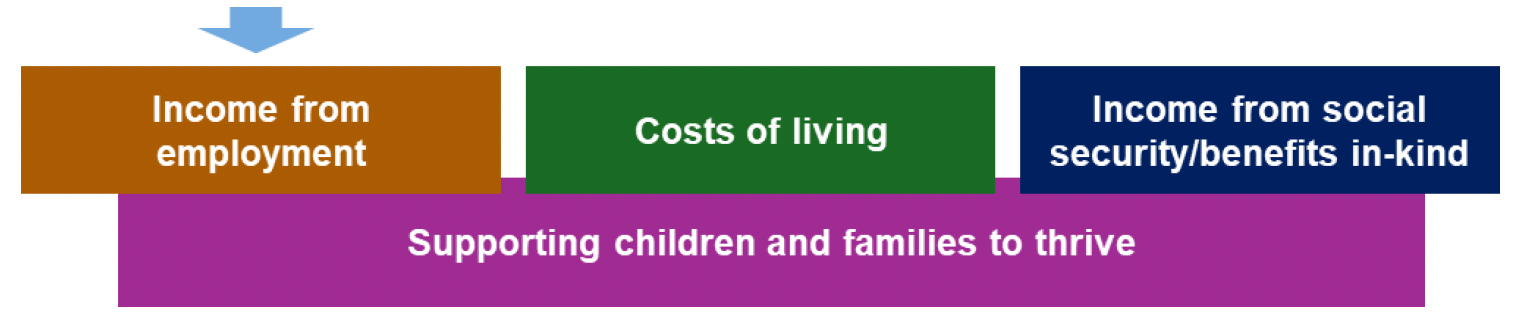
Driving positive change in labour market and workplace conditions
Using levers available under limited devolved powers over employment, we will support and seek to incentivise employers to implement Fair Work practices that will help parents and people from priority family groups to enter, sustain and progress in secure, flexible and fairly paid work. Support for labour market participation will help to increase family incomes through employment and reduce child poverty across Scotland.
Actions included
- Fair Work First (Continuation) - £N/A
- Real living wage and hours accreditation (Continuation) - £0.3m
- Flexible Workforce Development Fund (New) - £10m
Total investment in 2026/27 - £10.3m.
Impact of actions committed
Type of impact
These measures will have an indirect impact on drivers of child poverty through influencing employer behaviour to improve workplace practices and conditions for workers, and encouraging sectoral bargaining for low-wage sectors such as social care to standardise pay and conditions. However, employer behaviour will be influenced by future economic conditions, and by implementation of the UK Employment Rights Act.
Potential size
The policies in this area of focus are intended to encourage behavioural change among employers, and support organisations that promote behavioural change. Specific modelling for child poverty has not been undertaken.
Living Wage and Living Hours Accreditations: increasing earnings from work are an important contributor to sustainable exits from poverty. The wages of at least 72,000 workers have been uplifted since 2015, when the Scottish Government began support for the real Living Wage Accreditation scheme in Scotland. We anticipate at least 5,000 workers to receive pay uplifts to at least the real Living Wage, and an additional 20 employers accrediting as real Living Hours Employers in 2026/27.
Fair Work First: between April 2024 and March 2025, 5,234 grants (excluding non-discretionary funding) were awarded with Fair Work First conditions. These had a combined value of £3.42 billion. We anticipate continued significant reach from Fair Work First grants and contracts through 2025/26 and 2026/27.
Certainty
It is not possible to quantify the impact of Fair Work practices on child poverty, as they rely on employer participation. These practices are expected to have an indirect impact through potential increases to income and improved work practises.
Employer engagement with, and enactment of aspects of Fair Work policy, will be influenced by prevailing economic conditions and labour market regulations, including those affecting employment costs. They will also be affected by implementation of the UK Government’s Employment Rights Act. Labour market regulation is reserved.
The Flexible Workforce Development Fund is intended to support upskilling targeted at parents to enable progression opportunities over time. This is anticipated as positively impacting household incomes for people in or at risk of in-work poverty. This is an innovative approach and will require evaluation to quantify and tailor the impact, with the understanding that realisation of outcomes is likely to extend into future years beyond initial implementation.
Priority families targeted by the actions

Improving and embedding Fair Work practices that help provide secure, flexible and fairly-paid work are expected to support reductions in in-work poverty, including for people in priority family groups. Low wage and insecure sectors targeted by Fair Work activity, tend to have a predominance of female workers.
Tracking progress
We will continue to monitor the overall numbers of workers being paid the real Living Wage through monitoring of ONS Annual Survey of Hours and Earnings data. We will monitor the number of employers accredited as paying at least the real Living Wage and providing Living Hours in Scotland. We will also track the number of workers who have received an increase in pay as a result of employer accreditation.
We will continue to record the amount of public sector spending that is issued with Fair Work principles and conditions applied. Our future approach to monitoring implementation of the Fair Work First policy will be informed by the ongoing evaluation of the policy. This is due to report in Summer 2026.
Contact
Email: TCPU@gov.scot