
Bringing Hope, Building Futures: Tackling child poverty delivery plan 2026-2031 – annex 6: Impact of policies on child poverty
This annex shows how policy contained within Bringing Hope, Building Futures: the third tackling child poverty delivery plan 2026 to 2031 links to the child poverty targets, via the drivers of child poverty, and indicates where policies are linked to particular outcomes for priority groups.
Delivering whole family support
Whole family support means making sure families get the right support when they need it, where they need it, for as long as they need it. It is about breaking down barriers, building resilience and capacity, and helping families connect with the services that can make a difference. This will include both funding direct delivery to support children and families in or at risk of poverty and system change to enable place-based holistic support to be delivered by public and third sector partners.
Actions included
- Fairer Futures Partnerships (Continuation) - £6m
- Whole Family Wellbeing Funding Programme (Continuation) - £50m
- Communities Mental Health and Wellbeing Fund for adults (Continuation) - £15m
- Child Poverty Practice Accelerator Fund (Continuation) - £1m
- Third Sector Delivery Fund (New) - £20m
- Whole Family Support Programme (New) - £N/A
- Whole Family Support in General Practice Expansion (Strengthened) - £2.2m
Total investment in 2026/27 - £94.2m.
Impact of actions committed
Type of impact
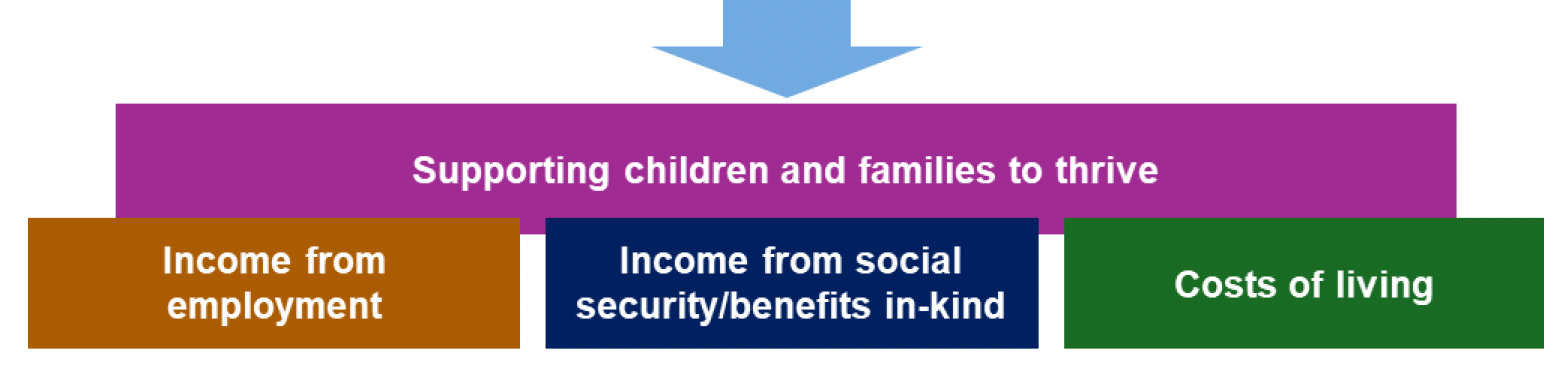
These measures will result in indirect impact. Primary impact intended to be improvements to the design and delivery of support for families at risk of poverty, resulting in long term increase in families taking up wider support and earlier identification of families who may benefit from preventative or early support rather than at the point of crisis. This is expected to improve families’ health, wellbeing, capabilities and material circumstances.
Potential size
Not possible to estimate at the current time because of the diverse and wide-ranging nature of activities within these commitments.
Certainty
Certainty of impact on enhanced life chances (wellbeing, capabilities) is high. Impact on child poverty reduction is anticipated, over the longer term, but not currently evidenced.
There are established theories of change which show the intended impact of system change on more effective provision of support and consequently improved outcomes for families. These are supported by evaluation evidence which demonstrates some of the causal pathways and shows positive early impacts for families.
Ongoing evaluations continue to build evidence (including a quasi-experimental pilot evaluation to estimate impact on household income in Dundee). However, it will not be possible to quantify the impact of these actions as a whole on the child poverty rate, due to the diverse nature of the activities and the wide-ranging and long-term outcomes for families.
Priority families targeted by the actions

Many of these initiatives are place-based, meaning that they may not target system change for one of the six priority family types. However, the places selected for tests of change are often those with high levels of poverty and we would expect priority groups to feature heavily in those communities.
Tracking progress
Ongoing evaluations monitor progress on: a) contribution to reforming public services and changing our systems to work in a more integrated and preventative way; and b) outcomes achieved for families. Over 2026/27, evaluation, learning and analysis across will be streamlined to support a new integrated Whole Family Support programme from 2027/28. The Whole Family Support Outcomes Framework, currently being developed, will form part of this streamlined approach.
Making best use of data to support children and families and improve public services
Working with local authorities and other partners to support the implementation of data sharing, to enable proactive support for families and improve public service delivery. This work will help to understand how local areas can more effectively use data to ensure families get support and understand how services need to be configured to maximise the opportunities data offers.
Actions included
- Expand data sharing with UK Government (Continuation) - £N/A
- Implementation of data sharing (New) - £3m
- ‘Once for Scotland’ data exchange programme (New) - £2m
Total investment in 2026/27 - £5m.
Impact of actions committed
Type of impact
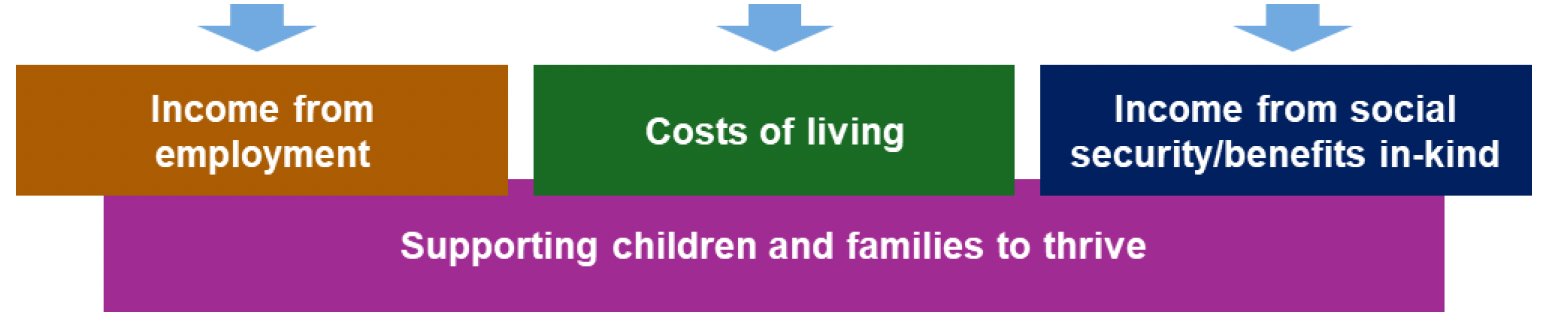
These measures will result in indirect impact on child poverty targets. Data has the potential to be used to proactively target households to help maximise their incomes, support them with household costs and ensure they are aware of other supports available to them.
Potential size
The potential size of impact has not been quantified yet. Work will continue with partners to better understand this. The work will generate learning on proactive approaches to families using data.
Certainty
Uncertain at this stage as specific plans still in development. However, the work will generate learning on how to make best use of data to support enhanced and more effective public service delivery. This work has the potential to enable highly targeted outreach, with clear offers of support, to families at greatest risk of poverty.
Priority families targeted by the actions

This policy has the potential to support all the priority groups. Data can be used to identify families at greatest risk of poverty, which will enable targeted and bespoke support to be put in place.
Tracking progress
We will monitor the implementation of data shares through a wide range of indicators around families reached and support provided, and how services are adjusting to meet need. Monitoring arrangements and frequency will be agreed with partners.
Contact
Email: TCPU@gov.scot