
Benefit Take-Up Strategy 2026-2031
Scotland’s Benefit Take-up Strategy 2026-31 aims to ensure people get the financial support they are entitled to through a more accessible and joined-up system. The strategy focuses on increasing awareness, access and take-up to reduce poverty and improve wellbeing.
2. Understanding the barriers totake-up
Benefit take-up in Scotland today
Take-up of most devolved social security benefits is high. Our latest estimate for the Scottish Child Payment finds take-up of 96%.
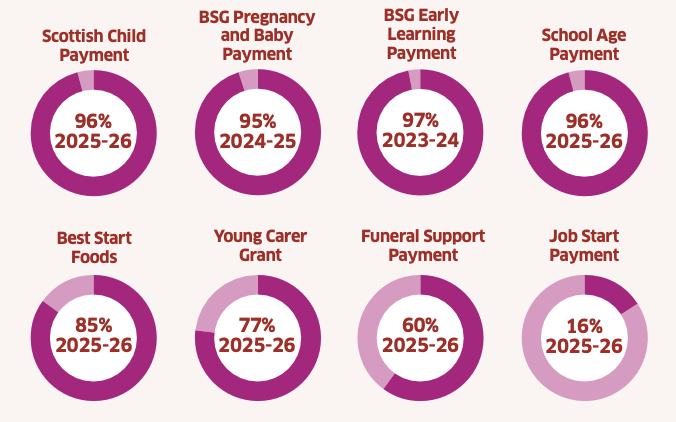
Graphic shows the take up rates of the following devolved benefits:
- Scottish Child Payment 96% 2025-26
- BSG Pregnancy and Baby Payment 95% 2024-25
- BSG Early Learning Payment 97% 2023-24
- School Age Payment 96% 2025-26
- Best Start Foods 85% 2025-26
- Young Carer Grant 77% 2025-26
- Funeral Support Payment 60% 2025-26
- Job Start Payment 16% 2025-26
A comprehensive examination of take-up rates is available in the accompanying analyticalpublication, Take-up Rates of Scottish Benefits: October 2026[6]. This publication sets outour estimated take-up rates for devolved benefits such as Scottish Child Payment. The publication also introduces modelled eligibility benchmarks for Adult Disability Payment and Child Disability Paymentas a first step to addressing an evidence gap for take-up of disability benefits. This is analysis in development which shows how benefit receipt has changed relative to a consistently constructed measure, but the benchmarks are not estimates of take-up.
Barriers to accessing support
The barriers to benefit-take-up are well known. The first Benefit Take-Up Strategy, published in 2019[7], identified the key barriers to take-up based on extensive evidence. These barriers included awareness of benefits, access to information and advice, the impact of stigma and a lack of trust in the system, and the complexity of applying for support. The 2021 Strategy[8] reaffirmed these findings and recognised that improving take-up requires action across the wider system, not just awareness raising or promotion.
In 2024, we commissioned research into seldom heard groups[9]. This research demonstrated that these systemic barriers to access remain relevant across the social security system and are most acute for groups who are most at risk of missing out on support (seldom heard groups). The research found that barriers are often experienced differently depending on people’s circumstances and that many individuals face multiple, overlapping barriers at the same time. It highlighted the importance of intersectionality, recognising that factors such as disability, ethnicity, age, gender, caring responsibilities, poverty, geography and previous experiences of public services can combine to shape how readily people access support and how easy it is for them to do so.
The research concluded that, rather than targeting action and focusing on individual groups, addressing the systemic barriers to access themselves is likely to be the most effective way of increasing take-up across the population, while also improving take-up among and outcomes for seldom-heard groups.
Psychological barriers
Psychological barriers include stigma, mistrust, fear of authority, previous negative experiences of public services, and the impact of trauma. These factors can discourage people from seeking support, identifying themselves as eligible, or engaging with the application process[10]. Stigma remains one of the most significant barriers to take-up, particularly where people feel embarrassed about submitting applications to benefits or fear being judged by others. Stigma is also reinforced by wider political, media and public narratives that misrepresent social security, its purpose, and the people who access and receive it.
The Get Heard Scotland Citizen Panel[11], facilitated by Poverty Alliance, also found that stigma remains one of the most significant barriers to benefit take-up. Participants described feeling ashamed of accessing support, fearful of being judged, and reluctant to discuss entitlements or eligibility with friends, family or their wider community. In some cases, people delayed submitting applications until they were experiencing severe financial hardship, despite being eligible for support. The research also found that poverty-related stigma often intersects with other forms of discrimination, including racism, ableism and gender-based stereotypes, creating additional barriers for some groups.
Compliance barriers
Compliance barriers arise where applying for or managing benefits is difficult, complex or burdensome. They can include inaccessible or difficult to understand application processes, difficulties in gathering and providing relevant evidence, challenges proving eligibility, delays between stages of the application process, limited support to complete applications and wider difficulties navigating the system. These barriers increase the effort and administrative burden required to access support, often at times where people are already experiencing distress or major life changes and can be particularly significant for people who already face disadvantage or additional support needs[12]. Our commissioned research into the barriers to take-up for seldom heard groups[13] found they are particularly acute for seldom-heard groups, increasing the “personal costs” of making an application and reducing take-up amongst them.
Social Security Scotland has sought to mitigate the impact of these barriers through delivering a more person-centred approach to applying for and receiving benefits. This includes simplifying processes, offering multiple application channels (online, phone and face-to-face), and embedding principles of dignity, fairness and respect at the heart of client interactions. However, complexity and administrative burdens remain a barrier to applying for benefits, particularly where people must navigate reserved, devolved and local systems to receive all the entitlements and support they are eligible for.
Learning barriers
Learning barriers include lack of awareness of benefits, uncertainty about eligibility, inaccessible or difficult to understand information, misinformation, language barriers, digital exclusion, and difficulty understanding how different benefits and services interact. These barriers can prevent people from recognising that they may be entitled to financial or other support, applying for it, or knowing where to go for trusted advice. This can be particularly challenging where devolved benefits, reserved benefits, local authority support and wider services are linked, but people are left to identify those connections themselves.
Evaluations of devolved benefits such as the Five Family Payments[14] emphasise that clear communication and understanding of eligibility are essential to increase take-up. However, Public Health Scotland research[15] highlights that awareness must be supported by trusted advice services and proactive engagement mechanisms.
Contact
Email: Tasneem.Irshad@gov.scot