
Awaab's Law: guidance for landlords in Scotland
Guidance to help social and private landlords comply with their duties under the Investigation and Commencement of Repair (Scotland) Regulations 2026 which come into force on 6 October 2026.
3. Awareness and assessment of damp and mould
3.1 Damp and mould can have a significant impact on the health and wellbeing of tenants and the fabric and structure of a property. The longer the damp or mould is left untreated, the greater the risk becomes.
3.2 Impacts to health and wellbeing can include respiratory affects, skin irritation or rashes, and poor mental health. This can be particularly acute for certain groups of people [see ‘People who may be more vulnerable to damp and mould’].
3.3 Unresolved damp or mould can also necessitate more extensive, and therefore costly repairs.
Defining damp and mould
3.4 Damp in a property is a result of excess moisture. This can cause a fungus called mould to grow. Awaab’s Law applies to all types of damp and mould.
Rising damp
3.5 Rising damp is the vertical movement of moisture from the ground into the fabric of a building. This can affect any part of the building in contact with the ground. Rising damp will not normally rise higher than around 1.2 meters above ground level. It will therefore only affect the ground floor of a building. This will typically be a structural issue and the responsibility of a landlord to resolve.
3.6 Example causes:
- Absence of a damp proof course in older houses, in chimneys and hearth areas and basements.
- Ground level raised next to wall, presence of material/earth against the wall.
- Damaged or deteriorated damp proof course.
- Inappropriate repair to damp proof course.
- Rising water table.
3.7 Potential indicators:
-
Exterior walls
- discoloured or crumbling bricks or stonework near the ground.
- moss growth near the bottom of the wall but above the damp proof course.
- flaking or bubbling on plaster, paintwork or wallpaper on lower wall surfaces.
- skirtings affected by rot.
- visible fungi or rot on lower surfaces.
- damp carpets.
- rotten, discoloured, crumbling or deteriorating wooden floor.
-
Interior walls
- horizontal tidemark.
- flaking or bubbling on plaster, paintwork or wallpaper on lower wall surfaces.
- skirtings affected by rot.
- visible fungi or rot on lower surfaces.
- damp carpets.
- rotten, discoloured, crumbling or deteriorating wooden floor.
-
House interior
- moist smelling odour possibly coming from the carpets.
- visible fungi or rot on lower surfaces.
- damp carpets.
- rotten, discoloured, crumbling or deteriorating wooden floor.
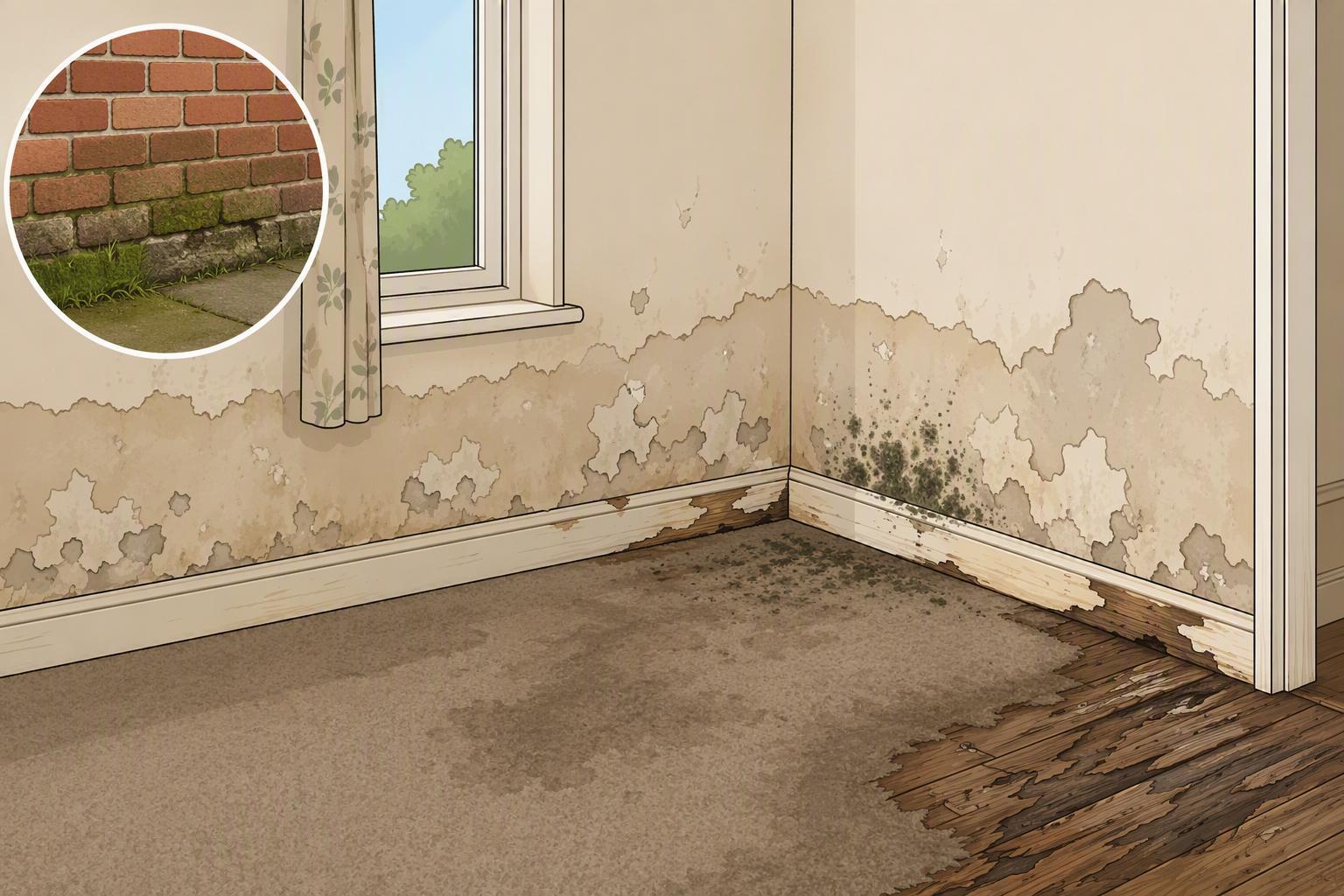
*This image has been generated using AI tools and is a representation of generic, potential indicators of rising damp/mould in a domestic setting.
Penetrating damp
3.8 Penetrating damp is moisture which enters a property from outside because of a defect in part of its structure. There may be defects in the roof, the exterior walls, rainwater gutters and down-pipes, or missing flashings. It is usually the responsibility of a landlord to fix. Penetrating damp can be more complex to identify.
3.9 Example causes:
- Damaged, displaced or missing roof tiles or flashings.
- Defective, missing or blocked guttering and down pipes.
- Crumbling, loose or missing pointing.
- Inappropriate repairs using concrete instead of mortar.
- Cracking which lets water enter the internal fabric.
3.10 Potential indicators
-
Exterior walls
- discoloured, darkened patches or mould growth on walls.
- plant growth from gutters, or in cracks in structure.
- loose or bubbling wallpaper, flaking paintwork, soft plaster.
- rot on internal roof-space and wooden structures.
- fungus growth on walls, carpets.
-
Interior walls and structures
- damp or discoloured patches on walls and ceilings.
- loose or bubbling wallpaper, flaking paintwork, soft plaster.
- rot on internal roof-space and wooden structures.
- fungus growth on walls, carpets.
-
House interior
- bad, musty odour.
- fungus growth on walls, carpets.
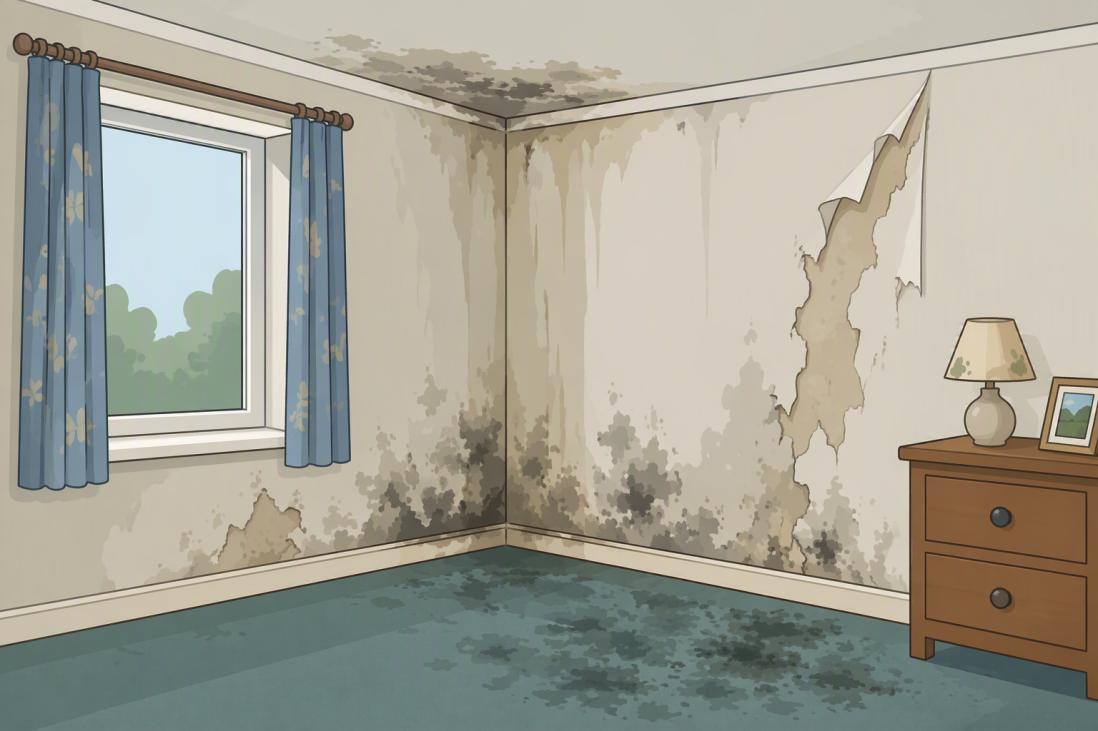
*This image has been generated using AI tools and is a representation of generic, potential indicators of penetrating damp/mould in a domestic setting.
Condensation
3.11 Condensation is caused by warm moist air coming into contact with a colder surface. The colder surface causes the amount of moisture the air can hold to be reduced, and as a result the moisture "condenses" out onto the wall. This process forms pure water which allows mould to grow. This can be caused by a combination of factors. There may be steps that a tenant can take to help reduce condensation in their home.
3.12 Example causes:
- Inadequate heating, ventilation or thermal insulation.
- Overcrowding.
- Poor air circulation.
3.13 Potential indicators
- Water droplets on windows, walls or ceilings.
- Visible fungi.
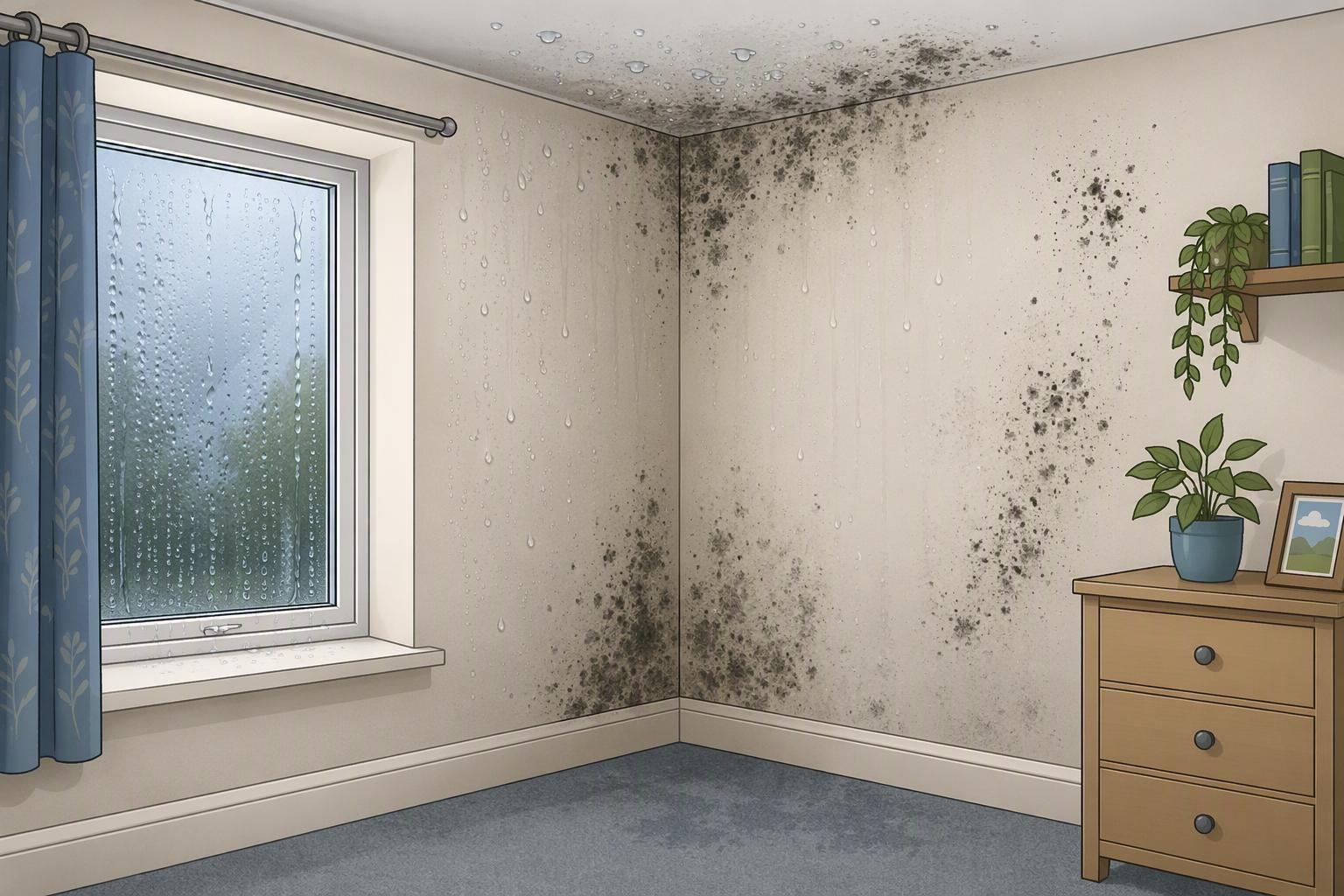
*This image has been generated using AI tools and is a representation of generic, potential indicators of condensation/mould in a domestic setting.
Traumatic damp
3.14 Traumatic damp is typically dampness caused by sudden and severe events.
3.15 Example causes:
- Leaking water from waste and heating pipes.
- Overflowing baths or sinks.
- Burst pipes.
- Defective water storage vessels.
- Flooding from another building.
- Environmental flooding.

*This image has been generated using AI tools and is a representation of generic damp/mould in a domestic setting that could be caused by a burst pipe or leak.
Becoming aware of an issue
3.16 Awaab’s Law duties begin as soon as a landlord becomes aware of a potential damp or mould issue. A landlord can become aware of an issue in a variety of ways; it is not solely dependent on a tenant making a report. For example, a landlord may become aware of a potential issue:
- During a routine inspection or visit.
- When conducting a separate repair issue, such as a dealing with a burst pipe or investigating any fixtures, fittings or appliances provided by the landlord.
- Being notified by a third party, including contractors and housing support staff.
- A tenant raising an issue, or someone raising an issue on their behalf.
3.17 Some landlords may already utilise environmental sensors to track temperature, humidity and carbon dioxide within rooms, helping to identify damp and mould risks. This technology is a valuable tool for identifying potential risks and prompting investigations. However, risk notifications and readings do not confirm the actual presence of damp or mould and therefore does not equate to a landlord being made aware of an issue. Landlords are encouraged to investigate consistent readings promptly.
3.18 It is important that landlords and tenants work in collaboration to ensure that damp and mould issues are swiftly raised. Early action helps to prevent health risks to tenants and damage to the property. Landlords should therefore support tenants to understand the importance of early reporting and the most effective way they can report issues. A standard information sheet for tenants is available at Annex E which landlords can utilise and supplement if desired.
3.19 Landlords must not make assumptions that reports of damp or mould are caused by the tenant’s actions. For example, landlords must not dismiss or fail to investigate a report on the assumption that the problem is condensation attributable to tenant behaviour. Everyday tasks, like cooking, bathing, washing and drying laundry are unavoidable and should not be blamed for substantial damp or mould growth.
3.20 If an investigation determines that household factors are primarily influencing the reported issue, landlords should work collaboratively with tenants to understand the circumstances, take any necessary action such as providing advice and support to manage this issue, as appropriate. For example, landlords may wish to signpost tenants to advice services for energy or bill support. Record keeping principles, as set out in chapter 2, would still apply.
Assessing whether a home is ‘substantially free’
3.21 Once a landlord has been made aware that a home may be affected by damp or mould, an investigation is required to determine whether the home is substantially free from damp and mould and whether any repair work is necessary. This must be conducted by a person with the necessary skills and experience within 10 working days.
3.22 A framework has been outlined below to aid an investigators assessment of whether a home is substantially free from damp and mould. This considers the exposure, persistence and the occupants’ vulnerability to damp and mould as an indication of potential severity; damp and mould do not affect everyone equally. Consideration is also given to the likelihood of reoccurrence without intervention.
3.23 This framework is intended to support consistency by outlining a common set of factors that investigators could consider and should not be used in a prescriptive way. Investigators are expected to use their skills and experience to make an informed judgement on whether a home is substantially free from damp and mould on a case-by-case basis, accounting for all relevant factors. The presence or absence of any individual factor outlined below is not, in itself, determinative.
Framework: Assessing whether a home is substantially free from damp and mould
Exposure and Extent:
- Does the damp or mould extend across a large surface area?
- Does the damp or mould extend across multiple patches or rooms?
- Is the presence of hidden moisture or mould suspected – i.e. is a damp, mouldy odour present?
- Is the damp or mould persistent?
If ‘Yes’ to any of the factors, this could suggest a risk of prolonged exposure to damp or mould.
Heightened Vulnerability:
- Is an inhabitant suspected to be more vulnerable to the effects of damp and mould?
If ‘Yes’, this suggests that the tenant may be more vulnerable to significant health impacts.
Underlying Cause:
- Is there evidence of structural issues or defects within the property?
- Is inadequate ventilation, insultation or heating issues suspected to be contributing to persistent dampness?
Whilst these factors do not determine severity in isolation, they indicate the likelihood of persistence or reoccurrence in the absence of action.
3.24 There is no set definition of a large surface area of damp or mould as the dimensions of each home differs. However, investigators may wish to consider existing guidance. For example, a house will normally be below tolerable standard if an assessor finds persistent visible penetrating damp which covers an area greater than approximately:
- 10% of the overall wallspace[2] in one apartment in the house; or
- 10% of the ceiling in one apartment in the house; or
- 20% of overall wallspace[3] or ceiling in one or more other spaces in the house.
3.25 Investigators should also be mindful of hidden mould which can grow behind a surface, such as on the back of wallpaper, panelling, ceiling tiles, carpets, vents and more. Caution should be exercised as disturbing mould sites can release a significant volume of spores. This should be addressed by someone with the appropriate expertise.
People who may be more vulnerable to damp or mould
3.26 Whilst everyone can be negatively affected by damp and mould, certain groups of people are more likely to be vulnerable to their effects. This includes but is not limited to:
- People with a pre-existing health and wellbeing condition that could be exacerbated.
- People who have a weakened immune system.
- Pregnant women and women who have recently given birth.
- Babies, children and young people.
- Older people.
- People who are bedbound, housebound or have mobility problems that make it more difficult for them to leave their home and get fresh air.
3.27 Whilst tenants may choose to provide medical evidence, they are not required to do so. Landlords should consider the information provided at face value and must comply with UK General Data Protection Regulation UK (GDPR) and the Data Protection Act 2018, noting that UK GDPR places special restrictions on the collection and recording of health data.
3.28 There are existing resources and support services that landlords can signpost their tenants to. This includes information on help with the cost of living crisis.