
Agricultural tenancy data collection for Scotland: findings report
This report summarises how agricultural tenancy data in Scotland can be improved, outlining key issues with past surveys, comparing revised question sets, and recommending the most effective approaches for future data collection.
Part of
Agricultural Tenancy Question Sets
This section provides an overview of the revisions made to the agricultural tenancy questions and presents the two final proposed routes for data collection.
Background
The tenancy questions used in JAC up to 2021 provided the starting point for the questions presented below. As described in the accompanying Methodology report, insights from stakeholder engagement were then used to refine the question terminology and designs.
Examples of the revisions made:
- To address respondent concerns about data confidentiality, introductory text is added to the agricultural tenancy section clarifying that personal or identifiable information would not be shared publicly or with third parties.
- To increase transparency, build trust, and encourage participation by providing a sense of purpose to respondents, the overall objective behind collecting agricultural tenancy data is briefly stated at the beginning of the section.
- To help respondents in providing accurate responses, additional guidance, such as checking written agreements or consulting with landlords, is included. Respondents are also reminded that tenancy types may change over time to encourage the most up-to-date reporting.
- To improve comprehension of technical aspects and enhance data accuracy, terminology relating to specific tenancy types was simplified or refined to align with real-world language.
These revisions have been applied consistently across the two proposed question sets.
Question sets
Following are the two agricultural tenancy question sets identified as most appropriate for future data collection following stakeholder testing and review:
1. Set A: JAC question set: This set is proposed for reinstatement in the JAC and retains the overall structure of the original 2021 questions. Targeted refinements have been made to terminology, clarity, and in-text guidance to improve respondent comprehension. The question set has been designed to operate independently from other sections of the current JAC, providing the Scottish Government with full flexibility over its placement and integration within the form. Responses are recorded to the nearest 0.01 hectare, consistent with the original JAC format. Sector experts found this level of precision to be potentially burdensome for respondents, even though it is administratively convenient. Adjusting the degree of precision was, however, outside the scope of this research. Further details are provided in the Usability Assessment section.
2. Set B: SAF question set: This set is designed for inclusion in the SAF and captures the same core information as the JAC version. The questions have been adapted to the SAF’s format, level of detail, and respondent profile. Following consultation with the SAF team, it was concluded that the most appropriate placement for these questions is within a new online tab (and a new form in the paper version). The new tab mirrors the structure of the existing ‘Land Declaration’ tab, with land parcel details prepopulated to minimise respondent burden. Responses are recorded to the nearest 0.01 hectare, consistent with both the JAC version and the measurement conventions applied throughout the SAF.
There are two key differences between the question sets described above. First, the data collection vehicle for Set A is the JAC, whereas Set B is administered through the SAF. Second, owing to the differing vehicles, the level of data granularity varies: Set A (JAC) collects information at the holding level, while Set B (SAF) is related to businesses and captures data at the land parcel level. It should be noted that both the JAC and SAF come under the Scottish Government’s purview, but are two separate data collection instruments.
Supplementary guidance material has been developed to accompany the two question sets, further supporting respondents in accurately reporting their tenancy arrangements. The guidance is designed for use alongside both approaches and is provided in Appendix A.
It should be noted that the scope of this research was to explore how the Scottish Government could improve the collection of tenancy data and strengthen data quality. Determining which specific variables should be amended, removed, or introduced was out of scope and remains a longer-term consideration for the Scottish Government based on data needs and policy priorities. Consequently, the revised question sets remain consistent with the original items included in the tenancy questions discontinued after the JAC 2021.
Further guidance on the usability of each question set and recommendations for selecting the most appropriate option are also provided in the following sections. The final section of this report also presents recommendations for additional or adapted items for consideration by the Scottish Government, drawing on stakeholder feedback.
Question Set A: June Agricultural Census (JAC)
All information you provide as part of the June Agricultural Census is treated in strict confidence. Responses will never be published in a way that could identify you or your business.
Providing accurate and complete information to all sections is important to give policymakers the strongest possible evidence to make decisions that support and protect Scotland’s agricultural sector. Responses should only relate to land that you farm in Scotland.
Section 1 – Area of location
Enter the area of land you own, or rent as a tenant, for 365 days or more (i.e., not a seasonal rent) at this location. Do not include land you own but lease to others for 365 days or more, as your tenant will report this on their form. Do not include land seasonally rented in or out (364 days or less), as this will be covered by Section 2.
If you are uncertain about the type of tenancy agreements you currently hold, please check whether you have a written agreement. If you are still unsure, your landlord may be able to provide this information.
The supporting guidance found [INSERT LINK] may also help you to identify your tenancy type(s) without the original lease. Please note that tenancy agreements can change over time, particularly if the lease has been renewed, surrendered, or transferred across generations.
Please remember to include woods, roads, yards, and farm buildings, bare fallow land, and any land potentially usable for agriculture, even if not currently used for agriculture.
Responses should be provided to the nearest 0.01 hectare.
| Questions on Land Owned and Rented | Question number | Area to nearest 0.01 hectare |
|---|---|---|
| Total area of land you own at this location (do not include land you own but rent out on a tenancy that lasts 365 days or more) | 1 | [Insert answer] |
| Total area of land you rent as a tenant for 365 days or more at this location (boxes 4 – 10 below) | 2 | [Insert answer] |
| Total area of this location (box 1 + box 2 above) | 3 | [Insert answer] |
| Questions on Tenancy Agreements | Question number | Area to nearest 0.01 hectare |
|---|---|---|
| Tenanted croft (valid for registration with the Crofting Commission) | 4 | [Insert answer] |
| Small Landholders Act Tenancy (a lease of land only found outside the crofting counties, where you, as tenant, have provided all equipment, including the house) | 5 | [Insert answer] |
| 91 Act Tenancy (also known as a ‘secure’ or ‘full’ tenancy; a written contract with full security of tenure and succession rights) | 6 | [Insert answer] |
| 91 Act Limited Partnership (a partnership tenancy where you, as tenant, are the general partner and your landlord or agent is the limited partner) | 7 | [Insert answer] |
| Short Limited Duration Tenancy (SLDT) (a tenancy lasting 5 years or less that began on or after 28 November 2003) | 8 | [Insert answer] |
| Limited Duration Tenancy (LDT) (a tenancy lasting 10 years or more that began between 28th November 2003 and 29th November 2017) | 9 | [Insert answer] |
| Modern Limited Duration Tenancy (MLDT) (a tenancy lasting ten years or more that began on or after 30th November 2017) | 10 | [Insert answer] |
Section 2 – Seasonal rents (364 days or less)
Enter the area of land you own, rent in, and/or rent out on a seasonal rent. These may be rough grazing or grass lets, potato lets, cropping lets, etc., and last 364 days or less (under section 3 of the Agricultural Holdings (Scotland) Act 2003) and be current at [INSERT DATE].
Responses should be provided to the nearest 0.01 hectare.
| Questions on Seasonal Rents | Question number | Area to nearest 0.01 hectare |
|---|---|---|
| Land seasonally rented in from another person – same location as last year | 11 | [Insert answer] |
| Land seasonally rented in from another person – did not rent this location last year | 12 | [Insert answer] |
| Total area of seasonal lets rented in (boxes 11 + 12) | 13 | [Insert answer] |
| Total area of land seasonally rented out to another person (area of land that you own but let out for 364 days or less to another person) | 14 | [Insert answer] |
Question Set B: Single Application Form (SAF)
All information you provide as part of the Single Application Form is treated in strict confidence. Responses will never be published in a way that could identify you or your business.
Responses should only relate to land that you manage in Scotland. Please remember to include woods, roads, yards, and farm buildings, bare fallow land, and any land potentially usable for agriculture, even if not currently used for agriculture.
Providing accurate and complete information to all sections is important to give policymakers the strongest possible evidence to make decisions that support and protect Scotland’s agricultural sector.
Instructions
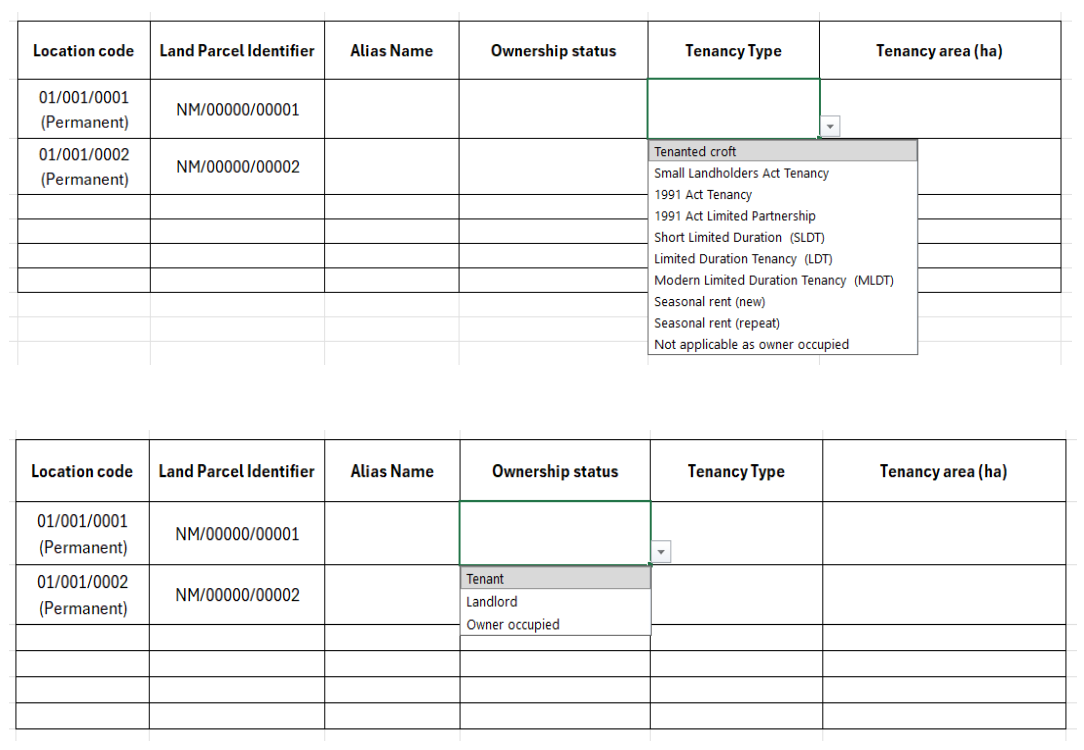
Please indicate your status in relation to the specified land parcel by selecting one of the following options in the Ownership Status column: Tenant, Landlord, or Owner-occupied.
Please provide the tenancy type and area details for land parcels where you are the tenant or landlord:
- If you are a landlord and uncertain about your tenancy type, please refer to your written tenancy agreement (if applicable).
- If you are a tenant and unsure of your tenancy type, please check whether you have a written agreement. If you are still unsure, your landlord may be able to provide this information. The supporting guidance found [INSERT LINK] may also help you to identify your tenancy type(s) without the original lease. Please note that tenancy agreements can change over time, particularly if the lease has been renewed, surrendered, or transferred across generations.
- If you are the owner-occupier, you do not need to provide tenancy type or area details for the land parcel.
Please note the details for different permanent and seasonal tenancy types:
- Tenanted Croft: Valid for registration with the Crofting Commission.
- Small Landholders Act Tenancy: A lease of land only found outside the crofting counties, where the tenant has provided all equipment, including the house.
- 1991 Act Tenancy: A written contract with full security of tenure and succession right (also known as a ‘secure’ or ‘full’ tenancy).
- 1991 Act Limited Partnership: A partnership tenancy where the tenant is the general partner and the landlord or agent is the limited partner.
- Short Limited Duration Tenancy (SLDT): A tenancy lasting five years or less that began on or after 28th November 2003.
- Limited Duration Tenancy (LDT): A tenancy lasting ten years or more that began between 28th November 2003 and 29th November 2017.
- Modern Limited Duration Tenancy (MLDT): A tenancy lasting ten years or more that began on or after 30th November 2017.
- Seasonal Rent (new): Land parcel seasonally rented out for 364 days or less to a new tenant, or seasonally rented in for 364 days or less from a new landlord.
- Seasonal Rent (repeat): Land parcel seasonally rented out for 364 days or less to the same tenant as last year, or seasonally rented in for 364 days or less from the same landlord as last year.
Reporting
Please indicate the ownership status and tenancy type for all eligible land parcels:
Contact
Email: agric.stats@gov.scot