
Towards a Scottish Minimum Digital Living Standard: Phase 2
This report documents findings from the second phase of research into the use of a Minimum Digital Living Standard (MDLS) for Scotland, building upon the interim report with further engagement with stakeholders and families via surveys and interviews.
4 Findings
4.1 Stakeholder survey
The Phase 1 findings resonated clearly with survey respondents, showing a strong consensus on their relevance to the Scottish context. The following results cover:
- MDLS definition
- Possible benefits of a Scottish MDLS
- Challenges
- Next steps for implementation
Descriptive findings with frequencies of responses are provided in the sections below, followed by a concluding section on the overall key takeaways from the survey. It is important to note that the reported findings are taken from the statements and responses of stakeholders; they do not represent the position or opinions of researchers or the Scottish Government. The survey occurred at a time of change when the focus of the Connecting Scotland programme had shifted after Covid.
4.1.1 MDLS Definition
The Phase 1 stakeholder interviews provided strong evidence of support for the concept of a Scottish MDLS (see https://www.gov.scot/publications/towards-scottish-minimum-digital-living-standard-interim-report/pages/5/). Participants were highly optimistic about the possibility of implementing a Scottish MDLS and the definition itself, reflecting on its added value and benefits. They emphasised that having an MDLS in place would enhance the profile of digital inclusion across Scotland, legitimising and recognising the digital inclusion work already undertaken. Stakeholders noted that an MDLS would support social inclusion by facilitating access to opportunities and services related to employment, learning, and social benefits, among others. The survey responses reinforced this position. Most respondents either agreed or strongly agreed that the definition of an MDLS:
1. is both valuable and timely (22 of 24 respondents, with 2 respondents neither agreeing nor disagreeing), and
2. can be explicitly applied to Scotland (20 of 24 respondents, with three respondents neither agreeing nor disagreeing and one disagreeing).
4.1.2 Possible benefits of a Scottish MDLS
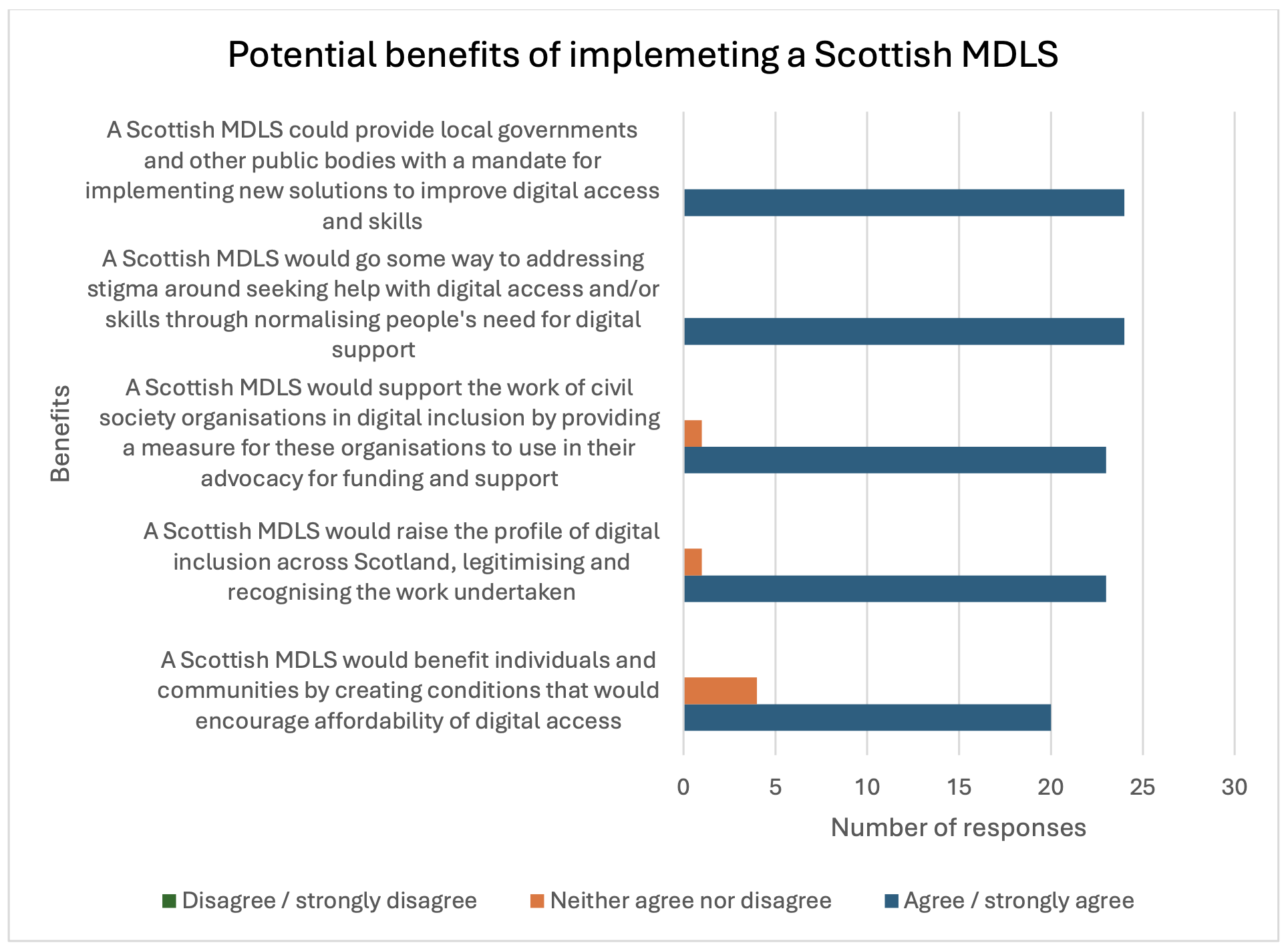
In Phase 1, stakeholders indicated that a Scottish MDLS might help those in the community who struggle to ask for what they need. It could create conditions that encourage greater affordability and better support the work of civil society organisations in digital inclusion. Stakeholders also believed that the MDLS would provide context for their work, aid in making cases for funding, and assist in addressing local needs. The survey findings reinforced these points. Almost all participants either agreed or strongly agreed that a Scottish MDLS would:
1. address stigma around seeking digital support (24/24 respondents)
2. provide public bodies and local governments with a mandate to implement new digital inclusion solutions (24/24 respondents)
3. legitimise the digital inclusion work undertaken in Scotland (23/24 respondents)
4. provide a benchmark that digital inclusion organisations can use in their advocacy work (23/24 respondents).
Four respondents were uncertain whether a Scottish MDLS would create conditions to encourage the affordability of digital access. However, twenty respondents either agreed or strongly agreed with this statement. Overall, there were no outright negative responses to any of the questions above, as the most negative being “neither agree nor disagree.”
A notable additional benefit of the MDLS was highlighted in the open-ended free text responses from the survey. The MDLS could help break down barriers between the public, private, and third sectors in relation to frontline delivery. A key development that the MDLS could help support is the focus on digitising services by considering the necessary interventions to provide digital inclusion support. The Scottish Government is already developing Digital First approaches. The No One Left Behind commitment in the Scottish Government Digital Strategy seeks to ensure services are accessible and usable, regardless of a person’s geography, background, or ability. This issue did not emerge from the Phase 1 interviews. However, it is important to note that the MDLS work has strong engagement from the user support and design communities of Scottish, Welsh, and UK government (e.g., DWP, Home Office, NHS) departments.
4.1.3 Challenges
During the stakeholder interviews, many participants remarked on key challenges in the Scottish context, with five being most prominent:
1. Issues of rurality
2. Links between digital exclusion and poverty, including homelessness
3. Intersectional links between digital exclusion and other vulnerabilities
4. English as a second language (covering both first language Gaelic speakers and recent migrants)
5. Funding for organisations to deliver digital inclusion support
Stakeholders argued that, in rural areas, Scottish communities tend to be more dispersed than in other parts of the UK, including Wales. This, along with the geographical landscape of rural Scotland, presents physical challenges for establishing and maintaining digital infrastructure. Another key point from the Phase 1 interviews is that issues of digital exclusion are intertwined with issues of poverty. This problem exists in both rural and urban areas. Deprivation in large cities like Glasgow was noted to intersect with digital exclusion. However, many commented on how issues of digital inclusion, while important, are secondary to more basic needs such as access to food, heating, or shelter. Respondents believed the MDLS could be beneficial when considering the intersectionality of digital exclusion with the vulnerabilities and needs of specific groups, such as older people, those with disabilities, and varying levels of English proficiency.
Respondents from Phase 1 also argued that the MDLS might provide a framework for organisations to consider the support they need, particularly regarding funding. This includes financing from the government and other entities, such as charitable trusts. Stakeholders stated that they perceived funding calls to be too prescriptive, leading organisations to adjust their work to meet different funding criteria, sometimes using the money to sustain their core services while also delivering new services aligned with these criteria. This is a consistent perception (rightly or wrongly) across 3rd sector stakeholders in the UK, where they highly depend on fixed-term grant income. Concerns were raised that the emphasis on digital inclusion may have been neglected post-COVID-19. From the survey, we find the following :
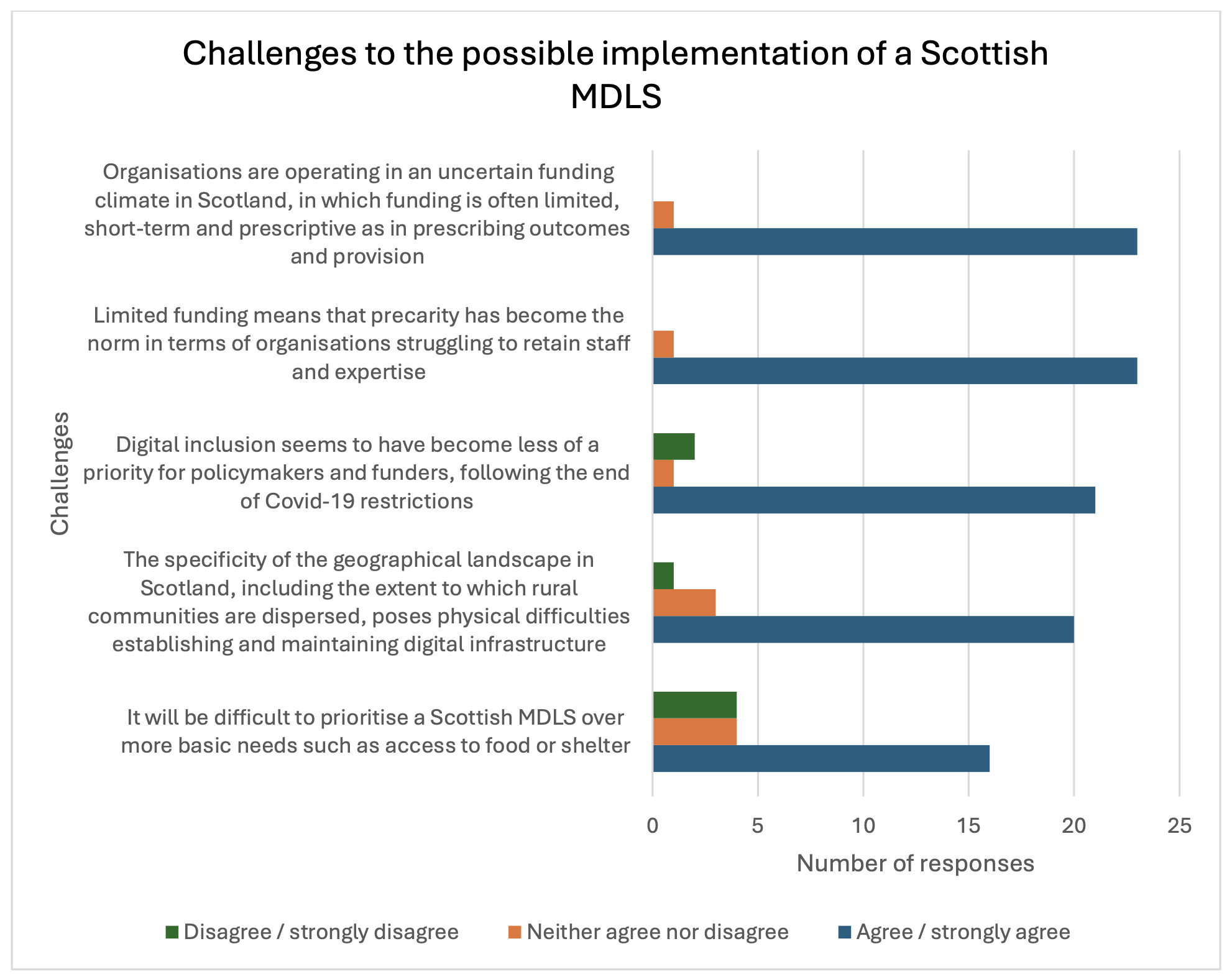
1. Statements regarding funding challenges generally resulted in greater consensus among respondents than on other issues. More specifically, almost all respondents either agreed or strongly agreed that they perceive Scotland to currently have an uncertain funding climate for digital inclusion.
2. They also agreed that this potential precarity, in terms of retaining staff and expertise, affects the work of digital inclusion organisations (23/24 respondents), with only one participant neither agreeing nor disagreeing.
3. A majority of respondents to the survey (21/24) also stated that they agreed or strongly agreed with the statement that digital inclusion is less of a priority for policymakers (in general – not solely the Scottish Government) since the end of Covid-19 restrictions. It should be noted that this reflects the perception of respondents, who were mainly from the third sector.
4. Likewise, while only one person strongly disagreed with the statement that the geographical landscape in Scotland presents physical challenges to digital infrastructure, the majority of respondents (20 out of 24) either agreed or strongly agreed, with three respondents remaining neutral.
5. Regarding the statement suggesting that a Scottish MDLS would be difficult to prioritise over basic needs, there was an even wider range of responses, with 16 respondents either strongly agreeing or agreeing, four neither agreeing nor disagreeing, and four either strongly disagreeing or disagreeing.
A challenge that respondents presented through their open-ended responses, which had not surfaced during the interviews, was the notion that introducing something new (a Scottish MDLS) that is neither carefully considered nor sufficiently resourced would not be effective.
4.1.4 Next steps for implementation
In Phase 1, we discussed the implementation of MDLS as part of the Scottish Government policy with stakeholders. Organisations were overwhelmingly positive about implementing a Scottish MDLS and were eager to showcase the aspects of their work that align with this objective. When discussing the implementation process in the interviews, key examples revolved around:
- The importance of working directly with communities includes strategies such as “co-production” of interventions and resources tailored to meet the needs of community members, incorporating a mix of formal and informal approaches.
- A Scottish MDLS requires a clear plan and vision, with a joined-up approach where digital inclusion is consistently embedded across different sectors, policy agendas, and government departments.
- A human rights approach to digital inclusion
- Sustainable and clearly defined digital inclusion roles (digital champions) at the community and local government level, with such staff taking a joined-up approach to digital inclusion.
- Providing free Wi-Fi in public places to implement a Scottish MDLS would be beneficial.
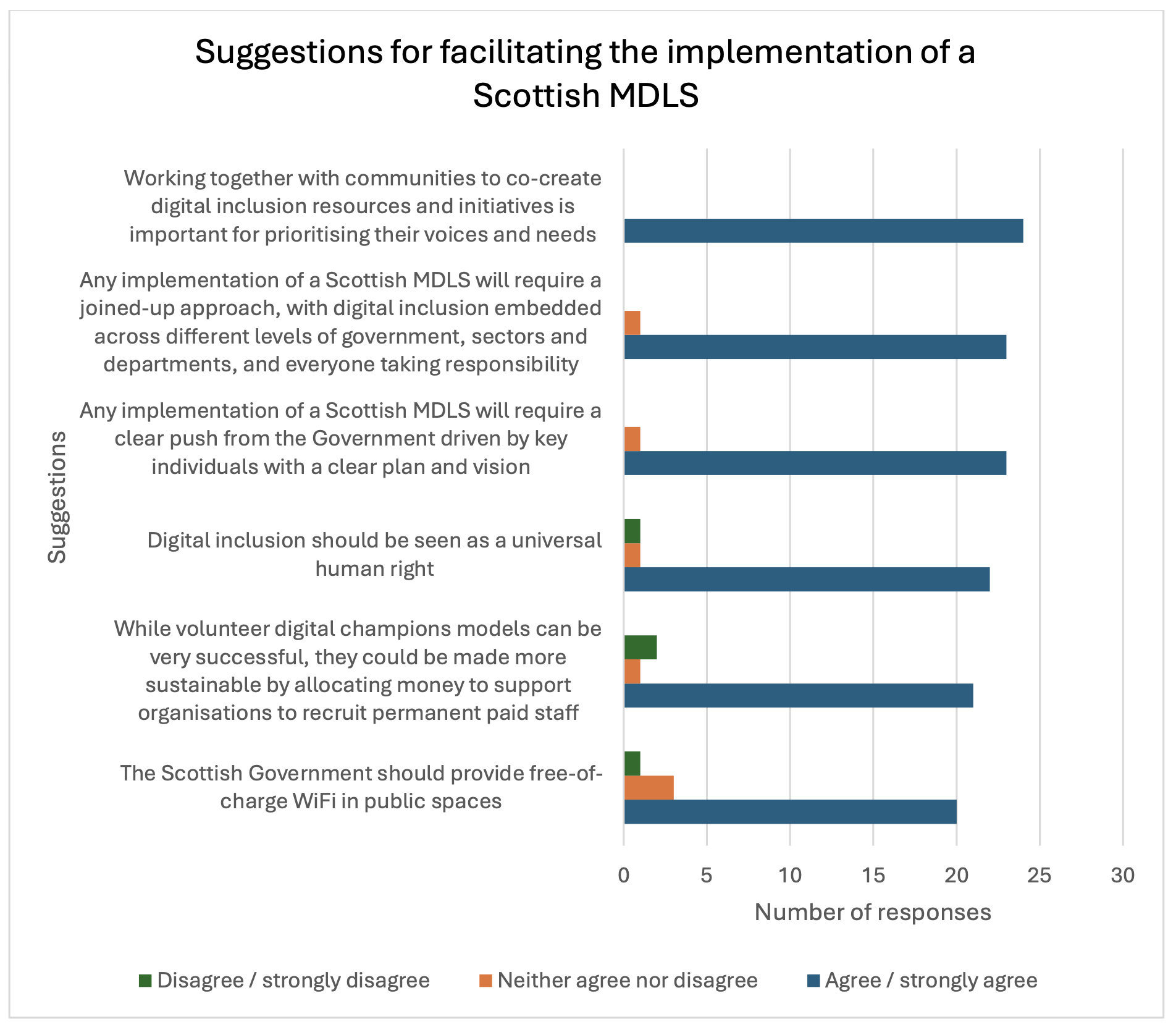
Not surprisingly, there was strong support from all participants (24 out of 24 either agreed or strongly agreed) that co-production of initiatives and resources is important for implementing interventions to support a Scottish MDLS. All but one person (23 out of 24) recognised the significance of adopting a joined-up approach, along with a clear push from the government (23 out of 24). Co-production is often raised as best practice in conversations with stakeholders. It covers everything from working closely with the government to grassroots citizen participation. We see the key takeaway as a desire to work closely with the Government. There was also consistent agreement, though with a few individual dissenters, regarding the following statements:
1. Digital inclusion should be recognised as a universal human right, with 22 respondents either agreeing or strongly agreeing, one neither agreeing nor disagreeing, and one strongly disagreeing.
2. Digital champion models must become more sustainable (with 21 respondents either agreeing or strongly agreeing, one neither agreeing nor disagreeing, and two either disagreeing or strongly disagreeing).
3. The Scottish Government should provide free Wi-Fi in public spaces, with 20 respondents either agreeing or strongly agreeing, 3 neither agreeing nor disagreeing, and 1 disagreeing.
A suggestion for implementation—one that had not emerged from the interviews—was to incorporate MDLS-relevant metrics into the standard data collection conducted by the Scottish Government (e.g., census/other surveys) to provide a long-term evidence base and track progress over time.
4.1.5 Survey conclusions
Most participants overwhelmingly agreed that the MDLS definition is important for addressing digital inclusion in the Scottish context. Responses also indicated a strong consensus on the benefits of a Scottish MDLS, with no respondents disagreeing that it would be advantageous across all questions. When participants were invited to share additional thoughts on potential benefits, some open-ended responses suggested that a Scottish MDLS could facilitate coordination among the public, private, and third sectors.
On the challenges of implementing a Scottish MDLS, there was also a clear consensus that the funding landscape is uncertain, potentially leading to issues of precarity. The one challenge that garnered some dissent was whether a Scottish MDLS would be difficult to prioritise over basic needs, with two-thirds of respondents agreeing that this is an issue. This signals that, for some respondents, digital inclusion needs are not necessarily subordinate to more basic needs but engage in a complex interaction with them. Since any form of support almost always has a digital component requiring digital access and skills, some participants’ open-ended responses suggested that introducing something new, like the MDLS, would be challenging unless it is carefully considered and equipped with sufficient resources.
Ultimately, most respondents acknowledged the importance of establishing collaboration and universal accountability (e.g., co-production, a coordinated approach among government departments and stakeholders, and a focused, overarching vision from the government). There was slightly less agreement on the philosophical issue of whether digital inclusion should be considered a human right and the extent to which the government should support initiatives such as providing free Wi-Fi. A new proposal in this phase was to utilise the MDLS in data collection exercises conducted by the Scottish government.
4.2 Family interviews
Families noted that using digital devices and connectivity is crucial for supporting a broad range of everyday activities. These activities include education and accessing services such as schools, community and support networks, public services, utilities, banks, and retail. Families also emphasised the importance of digital engagement for social connection and cultural participation, as well as for the learning and development of both parents and children. Resettled families further underscored the significance of digital access, enabling them to stay informed about global news and maintain contact with family and friends living abroad, including those in conflict areas. Additionally, the ability to carry and manage personal information and documentation digitally is invaluable for families whose lives have been uprooted, with one parent noting that bringing her laptop to Scotland felt “more important than some passport” (Dumfries and Galloway family 1).
4.2.1 Affordability, budgeting and access to resources
Families described the various challenges households face in meeting their everyday and basic needs. The rising costs of food and energy were noted as requiring careful budgeting, which was especially difficult with limited family resources. The cost of connectivity, data, and devices was seen as part of families’ basic needs, impacting their ability to participate, develop, and remain included.
Mother: Your phone is an essential in terms of getting a hold of people, communicating with the world and being able to see things, but could people live without a phone? It would be extremely hard in this day and age, so yes it probably is an essential, a phone. Would you be able to use that without the internet? No.
(Glasgow family 5)
Digitalisation was discussed in several different ways relating to family resources. In some instances, digital engagement was seen as a means for families to cope with limited resources. For example, families mentioned that digital engagement, combined with offline forms of play for children, could help alleviate some financial pressures during the school holidays, particularly in winter months and periods of bad weather. However, it's important to note that parents were not always content with this arrangement; sometimes, they felt they had little choice due to budget constraints.
Father: [The children] need to play, especially in the winter time, now summer coming up we have park very close by…but the winter time they are inside so they have to have internet to play, give them some activity or watch something on the tele, you know.
(Glasgow family 4)
Mother: … Everything is just so expensive that you just can’t afford to take two kids out and then they are off for 7 weeks and you’re like… what can you do?
(Glasgow family 5)
Digital engagement was also perceived as a source of financial strain itself, with families describing connectivity, for instance, as both essential and costly. Families indicated that broadband and/or data payments could compete with many other monthly bills, and as one participant summarised, in paying for one bill or service, “you’re taking it off something else” (Glasgow family 5). Some families had scoured for cheaper broadband and mobile data deals, noting that they could access better value as a ‘new customer’. One family had achieved substantial savings after receiving advice to consider switching providers. However, others might be paying even more for connectivity due to limited provider options, loyalty premium rates, or a need for optimum speeds to address connection issues.
For families without home broadband, this typically related to affordability, and they relied on mobile data for internet access at home. While this arrangement worked well for one family (a single parent with one child), others faced challenges. These included high monthly data costs in households with two parents having unlimited data, parents sharing their data with children, monitoring data usage, using free Wi-Fi or a friend’s Wi-Fi, and, for one larger family, rationing the time their children spent on high-intensity internet activities, as the mobile data could not support the entire family using it simultaneously.
There was variation in families’ knowledge of social tariffs, and among those who were aware of their existence, they stated that the internet speeds offered were insufficient to meet the needs of families with children. The families had different combinations and quantities of devices. Some children had received iPads through school, while others had not. These were seen as useful, particularly for older children who could bring them home and use them for schoolwork (whereas younger children’s devices remained at school). One mother who had been given a laptop by a local support organisation to aid her training found it beneficial for her daughter, who had previously had to do homework on her parent’s phone. Some families accumulated large screen devices, such as tablets or laptops, by keeping them running with limited functionality, while others completely forewent those types of devices. Many had to find ways to manage with a limited variety and quantity of devices; they demonstrated resourcefulness and described the workarounds they adopted to make the most of the resources they had. This usually involved assigning devices to particular family members (for instance, because they were in education, training, or a specific type of work) or sharing devices.
Mother: We all use the same laptop…The girls have got a Chrome Book, but it doesn’t do the Word documents.
Daughter: Yeah, you can’t get Word on it.
Mother: So, everybody uses the laptop. [If son] needed to do anything, homework or ordering his school lunch, he does it on the laptop, don’t you?...
(Dumfries and Galloway family 2)
Despite these workarounds, the lack of devices interacted with broader issues of affordability and financial pressures that impacted families. In families with few or no large-screen devices, parents were concerned about education and digital skills development, often for their children but also for themselves if they wanted to access training. Meanwhile, where children received iPads from school, some parents described the financial pressure of purchasing additional equipment (device chargers and styluses) or using home electricity to keep devices charged.
Mother: … I think they have platform for online [schoolwork and homework] but since [child] doesn’t have any iPad or laptop, …he is bringing paper, and I see this is not good for him because you know, future is for technology and [I] want him to be online…We don’t have tablets for everyone. And, even for myself, I need one and I like to do online training, and I don’t have laptop…
(Glasgow family 2)
4.2.2 Quality of infrastructure and family connectivity
Regardless of how families “juggled” (Glasgow family 5) resources, their digital experiences were also affected by the local infrastructure around them. Unstable broadband and data connectivity, along with a patchy mobile phone signal, could all contribute to inhibiting families’ digital engagement and overall day-to-day functioning. This could mean having to structure their digital use at home around where the signal was strongest. Families attributed unreliable connectivity to interruptions in their activities, such as streaming content, banking, and completing homework tasks. They also provided examples of how loss of contact with people made them feel unsafe. For instance, one family described signal issues and what this meant for the parents who often worked alone in potentially risky environments.
Interviewer: …Sometimes you’re alone, or working late, right?
Father: …One of the reasons I got [a mobile phone] in the first place, [was] because you’re…by yourself…But when you’re trying to phone me and it doesn’t ring, it works you up…But it’s pure and simple that there is no signal.
Mother: Put that into perspective then, you’ve had a [work] accident. That’s why my mind goes into overdrive.
(Dumfries and Galloway family 2)
The impact of poor mobile connectivity can be compounded when households depend on broadband and reside in areas susceptible to power outages. One family experienced a recent three-day power cut during storms, leaving them without Wi-Fi. They mentioned that their only means of contact was to stand outside to try to access sufficient signal to make calls.
Mother: We were literally all stood on the patio trying to phone everybody. So we didn’t get great signal, no…
Father: ‘Cause when you come in here, your phone automatically connects into the Wi-Fi because, you know, there’s no network if you don’t.
Interviewer: And do you have a house phone as well?
Mother: Not now. I cancelled it just a few weeks ago. It doesn’t work anyway…once the electric’s off, it’s not like copper, it’s a fibre optic one, so we’ve cancelled it.
(Dumfries and Galloway family 2)
This highlights the challenges faced by households dealing with various connectivity issues, along with the further complication of lost landline telephone infrastructure, which could serve as a backup, particularly in rural areas where internet and signal problems may be significant.
4.2.3 Digital skills, confidence and safety
The interview discussions highlighted the importance of digital skills and confidence, along with the connection between these factors and families’ exposure to digital goods, trust, and their sense of control over digital risks. Families frequently expressed feeling overwhelmed by the various apps, programmes, platforms, and interfaces they might need to use.
Father: [Devices and connectivity] are vital but there is an overwhelm of stuff and…things [such] as passwords and multiple platforms can end up being an obstacle.
(Glasgow family 3)
Lacking familiarity with some of these and the different functions they necessitated, such as following QR codes or uploading documents, could make digital activities difficult and off-putting. Families described a culture of digital assumption – an expectation that people share a certain level of ease and intuition with digital activities, which means they can adapt quickly to navigating different digital interfaces. Importantly, families felt that this digital assumption was misplaced and that it led to a lack of understanding among professionals interacting with families. For families, feeling digitally overwhelmed was therefore about not just the sheer volume of digitalised activities but also the difficulty of finding the best support. In describing these issues, families identified a gap between the training of service providers and the training available for families as service users.
Mother: [One of the school apps] is awful, [the other one] is fine, yes. I don’t even log in to [the first school app] now because I don’t know how to use it and nobody has showed me how to use it…
Daughter: You need to scan a QR code and that so I can get on to my account which is very confusing.
Mother: It is very difficult… It is just it is very difficult to navigate and then everything seems to have went digital now so kids like if they go to breakfast club or school dinners and stuff it is all online…
(Glasgow family 5)
Father: I quite often find that some of the stuff…you need a programme through… It’s quite simple [for service providers] because they’ve been trained in it. I haven’t. So why do they train the people at that end but don’t train the people at the other end? That’s one of my biggest bugbears with it. You’re supposed to work it out for yourself. But it’s simple. No, it’s not, show me how it works… And you ask them, and they look at you as if you’ve got two heads!... Oh, you just do this, this and this. I says, I wouldn’t even know where to start…there ought to be certain classes to show you how to use it… there was no computers [at school] when I was taught, so I’ve got no basis in computers… Quite frankly I’m busy, busy, busy, so I don’t have time to sit there and try and work it out. It needs to be done there and then…But there seems to be they’ve got this assumption that, because they know what they’re talking about, you should know what they’re talking about.
Mother: Makes their life easier, a lot of these things going digital, filling in forms and stuff online, it makes everything easier.
(Dumfries and Galloway family 2)
These challenges highlighted that while some parents and children felt they could learn by doing and take a trial-and-error approach to digital activities, this was not feasible for everyone. Exposure to devices and the internet (perhaps relating to time and device ownership) and the levels of trust in both online and offline organisations and spaces appeared to significantly affect family members’ digital skills and confidence. Families who identified themselves as particularly struggling with digital skills and confidence often described digital risks and harms as inevitable and beyond anyone’s control.
Similar to managing physical and financial resources, families discussed the workarounds they implemented to engage in digital activities using their existing skills. Whenever possible, family members collaborated to support each other’s activities and leverage their different areas of expertise and confidence. As the bill-payers, parents served as digital administrators by purchasing household devices and establishing contracts, which encompassed the skills and knowledge required to explore available service providers and device specifications; however, families reported varying levels of success in this regard. Broader digital skills were much more multi-directional, with either children or parents often taking on the role of the primary digital user in the household. Consequently, children sometimes assisted younger siblings or parents.
Interviewer: How confident do you feel about using the devices you have? And so, are you confident…to use the settings on your phones?
Mother: For my kids, yes. For me and my husband… sometimes, [we] ask for help from them.
(Glasgow family 6)
Interviewer: Do you ever need support with getting connected, setting up broadband, setting up mobile contracts?
Mother: The kids do that. If I need anything done for [the council], [son] does it. We needed a poster, he designed it. We’ve got a new broadband just a few weeks ago and I couldn’t get the printer set up, so he did that. When we went on holiday and I needed to put [phone] onto travelling mode, [daughter] did that! [laughs]
(Dumfries and Galloway family 2)
It was also identified, however, that it could not be taken for granted that families could work independently to navigate and develop the diverse skills required for using devices and staying safe online. This was important, given the role of digital engagement in learning and development, as well as in social connection and cultural participation. Skills and the ability to develop them were also related to affordability. Parents already undertaking training hoped that acquiring new skills would improve their prospects and household finances – but they also felt constrained by the costs of devices and connection.
4.2.4 Family centred ideas for digital support
Underlying any form of digital support for families was the need for trust. With digital skills, trust seemed to explain why many people preferred to seek support from within the family or among their friends first. When describing wider support, families mentioned that they looked to people and organisations who could serve as a trust anchor. Trust anchors were knowledgeable in the area families were seeking support and were reputable, usually due to their broader responsibilities, roles, and accountability in society, such as schools or Citizens’ Advice. Sometimes, a trust anchor was an individual in the local community. One parent who had recently resettled in Scotland stated that she had become a point of contact for families in the resettlement community.
Mother: For [some] [resettled] families…it’s very difficult to manage all forms and fill all forms online. And, usually, they asking for help!
[…]
Interviewer: And what do you think would help them to do that?
Mother: Some lessons maybe, or a person who will be just come.
Interviewer: Someone they can call on? [R2:Yeah! ] And do you think that the resettlement workers that helped with all the families, do you think that’s the kind of thing that they did with other families?
Mother: I don’t think that, no. Maybe sometimes, I don’t know. I think that maybe it’s complicated for people, because just from my own experience, for my friends it’s easier to ask me than ask [a professional].
(Dumfries and Galloway family 1)
Trust anchors provided families with a point of reference and were approachable. Schools served as prime examples of organisational trust anchors that families engaged with regularly. Families trusted the credibility of the information and resources provided by schools, believing they operated with the best intentions for children and families. Recognising the pressure that educational staff might already be under, digital champions could come from external organisations but work through schools, offering accessible in-person support and workshops for both parents and children. Digital champions in libraries could also directly support families or refer them to additional resources.
Families noted that face-to-face help and advice could be especially beneficial, contrasting this with self-guided learning resources provided through platforms like YouTube, which they indicated would not suffice for many parents.
Father: I think that they should have some sort of section or person who is trained in this field and appointed in the local library…School or library. And then they make the families…aware that… these are the places they can go. Either school or library and they will get the help or make appointments there. [Librarians] are…there already working and if they have got a… little bit extra skill to help…A lot of time [it is] five, ten minutes…and get the thing done and go […] [YouTube] will not be useful to everybody. Because they are not benefit out of it. It is very good when you’re sitting face to face and you ask questions and that is, then and there, explained…Sometimes, I want to learn something from You Tube and they are doing right, but I don’t understand. I go back again and again and again, how to do it…
(Glasgow family 4)
Families also sought assistance with digital goods and services. This could include advice on device specifications to help families find affordable equipment that meets their needs, as well as information about organisations providing new or reconditioned goods. It could also include guidance on internet providers and support for switching to avoid loyalty premiums. While some families recognised the availability of information online, they emphasised the potential exclusion associated with this and reiterated the importance of in-person and offline sources of support, which was linked not only to accessing information but also to evaluating the credibility of online content.
Mother: [Families] need help to find the provider of an internet, to find some different options, different prices, to explain how many days they can use.
(Dumfries and Galloway family 1)
Sometimes, direct provision of digital goods and services may also be necessary. Any package of this sort must be accompanied by broader digital guidance and skills development. It should also consider additional expenses, such as repairs, upgrades, or exit fees incurred when switching service providers. Families were positive about the provision of iPads in certain areas of Scotland, like Glasgow, and believed this was an example of support that should be more widely available. Families indicated that goods and services also needed to be fit for purpose. For instance, some families were aware of social tariffs, but due to insufficient speeds, they were often ineffective in addressing the challenges of poor connectivity and the exclusion that comes with it.
Contact
Email: connectingscotland@gov.scot