
Tackling child poverty - six priority families concept: overview and guidance
This guidance provides an overview of the six priority families concept which identifies the family groups at greatest risk of child poverty. It contains practical advice on how the concept should be used in practice to deliver more effective policy outcomes.
3. Using the concept to inform policy development
When using the priority family concept, we need to understand the key barriers and challenges those most at risk of poverty face. This is to ensure that when we are designing policies, we do so in a way which can help people at risk of poverty to overcome the barriers and challenges facing them.
The concept can be used in several ways, including:
- As a lens to identify the experiences of people living in poverty, for example their circumstances and the barriers they face.
- As a reminder to identify gaps and what works to tackle child poverty, through the lens of those experiencing it.
- As a reminder of the varying experiences that people can have, that poverty is unique to someone’s circumstances and that intersecting characteristics can make the journey out of poverty more complex.
- To understand whether policies are likely to support the child poverty mission.
Example of using the concept in practice – school age childcare
The School Age Childcare Delivery Framework used the priority families concept to shape its approach. Engagement with low income families helped inform the needs to be addressed, the design principle to shape policy decisions, and the location of projects where delivery would focus.
This focused on three key elements:
- Priority families were invited to take part in the approach design workshops, to understand user needs and overcome barriers.
- Engagement with priority families on test of change discussion, to design principles to guide policy decisions.
- Test of change projects in areas particularly known to have high levels of poverty or high concentration of any of the priority family types, to develop nuanced understanding of barriers specific marginalised groups face.
On an ongoing basis the priority family concept has also helped to understand the implementation and impact of the policy. This includes by looking at the experience of families using services and how they might be impacted financially.
Developing effective policies using the concept
When developing policies using the priority families concept, we must not only consider the links between priority groups and child poverty, we must also consider links between other characteristics and risk factors which intersect to create individual experiences.
Rather than viewing these as separate and distinct elements, it may instead be helpful to think of these as overlapping lenses which we must consider collectively when developing policies. By taking an intersectional approach to policy development, this will ensure the greatest potential of delivering positive outcomes for low income families.
An illustrative example is shown in Figure 2 below. In this instance, policy design takes a gendered approach, considering also specific circumstances of families in rural areas and through the lens of the priority family types. All of these lenses are viewed together to identify the overarching barriers which must be addressed to effectively support low income families.
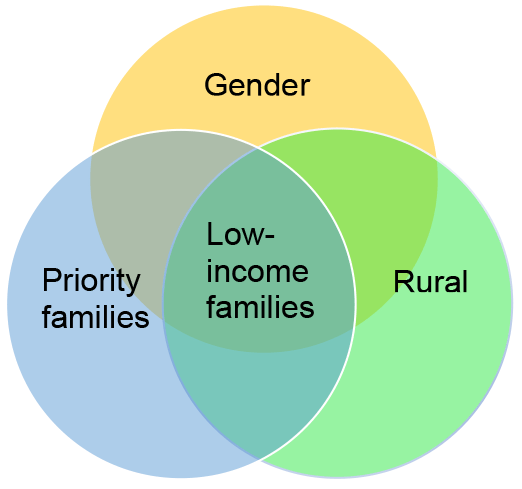
Illustration displaying the various lenses which can be considered when developing a policy. This illustration shows the intersectional nature of the priority families, gender and rural lenses.
Experience of multiple disadvantage
It is important that we recognise that in some instances, families may experience multiple disadvantages or adversities, including homelessness, offending, child protection interventions, child removals, stigma, trauma, marginalisation, substance dependency, domestic violence and mental health problems, which are not explicitly covered by the priority family grouping. Multiple disadvantages can make it harder to get out of poverty and overcome adversity. The implications are significant for families impacted, and many will also fall into one or more of our priority groups. The barriers faced and support needed by those experiencing multiple disadvantage will be significant and highly specific, and not covered appropriately by a response focused on the drivers of poverty, and so we must consider this when designing relevant interventions and approaches.
Gender
We must also consider the links between poverty and gender when using the priority families concept. For example, lone parents, who are predominantly women, and households where only one adult works, are often at risk of poverty. We know that women face a range of barriers to paid employment and progression and we cannot assume that women share the same access to resources, whether from paid work or social security, as men in the same household. Therefore, we must be aware of gender and poverty when developing interventions to ensure that approaches both work to tackle child poverty and also deliver on wider equality ambitions.
Geography
The places where families live can also create additional challenges, including due to income variation across Scotland. In particular, evidence shows additional barriers exist for those living in rural areas and areas of high deprivation. Higher costs of living in rural areas can lead to hidden poverty from factors such as fuel costs and access to affordable housing, and wider challenges exist relating to availability of provisions such as transport, forcing car ownership. Although not all people living in these areas are at greater risk of poverty, it’s important that relevant interventions recognise geographical barriers and can deliver for families in these areas.
Other marginalised groups
As part of the 2023-24 tackling child poverty progress report, we also produced a focus report on other marginalised groups at risk of poverty. This was intended to provide a deeper understanding of the challenges and barriers certain disadvantaged groups face when avoiding poverty or getting out of poverty. This review specifically focuses on families who are:
- Facing homelessness
- Gypsy/Travellers
- Victims/Survivors of domestic abuse
- Families of people in prison
- Care experienced
- Seeking asylum and refugees
It is important to highlight that these groups’ experiences are intrinsically linked to the barriers we already see amongst priority groups, such as those who live with a disability, are from a minority ethnic background, or who are women. There will be multiple layers of disadvantage that they will be facing. In the focus report, we have sought to highlight their experiences as known from published literature so far.
Contact
Email: TCPU@gov.scot