
Scottish Mental Health Nursing Review
The Mental Health Nursing Review report aims to enhance the conditions for mental health nursing to flourish in Scotland, now and in the future. The report was co-developed by mental health nurses, students, academics, with support from carers and people accessing mental health nursing care.
4. Introduction
4.1 Background
Scotland's Mental Health and Wellbeing Strategy (“the Strategy”) sets out our long-term commitment to improve the mental health and wellbeing of everyone in Scotland. The Strategy sets out our vision of a Scotland, free from stigma and inequality, where everyone fulfils their right to achieve the best mental health and wellbeing possible.
Delivering this ambitious vision and the actions within the Delivery Plan can only be achieved with the right workforce capacity and capability, including the mental health nursing workforce. The Scottish Mental Health Nursing Review (“the Review”) was announced by the Minister for Mental Wellbeing, Social Care and Sport in October 2023, with this commitment formally set out in the Strategy’s Workforce Action plan.
The work of mental health nurses is set in a context of increasing demand for mental health services, and reports of increasing complexity, demand and impact of mental illness is significant and ever-growing. According to a Lancet study, one out of every two people in the world will develop a mental illness at some point in their lives (McGrath et al, 2023).
This crisis does not affect all communities equally; vulnerable and minority groups bear a disproportionate share of the burden of poor mental health, often exacerbated by social determinants, such as poverty. We also know that people with severe mental illness often experience a higher prevalence of physical health conditions, such as cardiovascular disease, diabetes, and respiratory conditions.
Attaining parity for people with lived and living experience of mental ill health has had much greater focus, with mental health nurses at the forefront of advocating for:
- equitable access to effective mental and physical care and treatment
- equitable efforts to improve the quality of care
- equitable focus on realisation of human rights
- equitable status within health care education and practice
- equitably high aspirations for people with lived and living experience of mental illness
- equitable status in the measurement of health outcomes.
Mental health nurses use highly developed communication skills to initiate and maintain helpful and impactful relationships with individuals, their families, and carers (VOX Scotland and Carers Trust Scotland reports, 2023). They collaborate to plan and deliver care, using professional judgement and decision making, working, and often leading wider multi-disciplinary and multi-agency teams, including peer support workers. As such, mental health nurses form the essential core of the care team and are regularly rated by the public as the most trusted of healthcare professionals (IPSOS Veracity Index 2023).
Mental health nursing roles have transformed. Advanced Nurse Practitioners, Consultant Nurses and Clinical Nurse Specialists are now important roles in many services across a range of clinical settings from perinatal mental health, unscheduled care, primary care to prisoner healthcare. Their high-level, expert practice is characterised by autonomous decision making that includes assessment, diagnosis, and treatment, and can include prescribing, for people with complex, multiple needs.
Mental health nurses have also embraced new opportunities as service leaders, not only in the traditional, hierarchical sense, but also as leaders in service innovation and redesign, as well as leading service and quality improvement projects. Mental health nurses also make a significant contribution to developing and sustaining positive workplace cultures.
It is in this context that we see mental health nurses focused on making a real difference to people’s lives and affirming their position as being at the forefront of efforts to improve and reform services.
This Review will further enhance and support the conditions for mental health nursing to flourish in Scotland, now and in the future. This will ensure high quality care delivery, attend to identified workforce needs and promote best practice. This will ultimately lead to improved outcomes for people experiencing mental health challenges through optimising the skills, capabilities, and expertise of mental health nurses. The Review focuses on the following priority themes, identified by mental health nurses in Scotland:
1. Strengthening the contribution and impact of the mental health nursing profession
2. Mental health nursing leadership
3. Mental health nursing education and development
4. Nurturing the mental health nursing workforce
5. Rural and island considerations
Our aim is to ensure a Scotland where mental health nurses in all sectors are supported and confident to provide early intervention, prevention, and recovery focused care, with a strong emphasis on relational impacts, reducing stigma, promoting wellbeing, and ensuring equity for all. This will be achieved through championing and embedding our Principles for Care and Practice, utilising approaches, and innovations to meet our overarching Health and Social Care vision: a Scotland where people live longer, healthier and fulfilling lives.
4.2 The Mental Health Nursing Workforce in Scotland
Fundamental to the delivery of modern mental health nursing care is having the right size and shape of nursing workforce, a workforce that is highly skilled, well supported, and that is sustainable. The workforce also needs to be representative of the communities it serves.
We know that mental health nurses represent the largest paid workforce who deliver direct care to people with mental illness in Scotland and therefore, are the largest group that can have the most positive impact on people’s lives. As of April 2024, the Nursing and Midwifery Council (NMC) register has a record of 10,846 live mental health nursing registrations in Scotland.
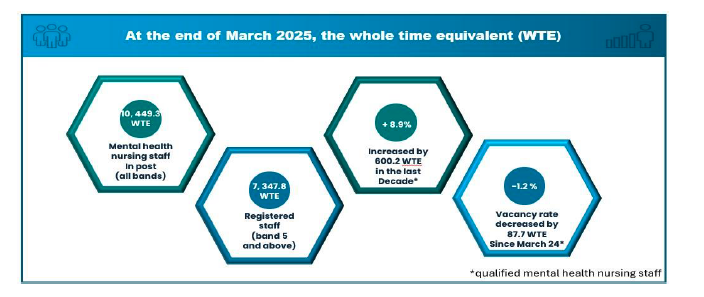
Alternative text: At the end of March 2025, the whole time equivalent (WTE) of mental health nursing staff in post was 10,449.3 WTE, from which 7,347.8 were registered mental health nursing staff (band 5 and above). The registered mental health nursing staff has increased by 8.9% (600.2 WTE) in the last decade. The vacancy rate was 3.8% (289.8 WTE), which has decreased, compared to 5% as at March 2024.
It is important to note that this data does not consider any demand for roles in areas such as nursing in care homes and there is currently no single source of data for the mental health and wellbeing workforce in Scotland, which reflects all sectors and settings.
That is why, as part of wider work already underway and as committed via the Mental Health and Wellbeing Workforce Action Plan (November 2023), Scottish Government is funding NES to improve the data collected and published on the mental health workforce, including on mental health nurses. The aim of this work is to also improve the equalities data collected and bring together all mental health workforce data into a single publication.
In September 2023, the Staff Vacancies in Care Services 2022 report jointly published by the Care Inspectorate and the Scottish Social Services Council highlighted nursing data. However, whilst data for mental health nurses specifically was not available, it is important to note the challenges faced in social care sectors.
Just over 6,000 nurses work in social care services, at the 31st December 2023. Many nurses in the sector (38%) work in private care homes for adults. There has also been a substantial increase in the reported number of nurses employed by nursing agencies in 2023. Most of these nursing agencies are private services. If we exclude nurses employed by nursing agencies, we see that of the remaining subsectors, around 93% of nurses are employed by care homes for adults.
In common with the overall health care workforce, the age profile within mental health nursing indicates a considerable number of the profession are aged 45 years and older. This has implications for both ensuring support for older nurses and emphasises the need for succession and future workforce planning, including pre-registration attraction and retention considerations. That was a key remit of the Nursing & Midwifery Taskforce.
We know these workforce challenges are not unique to Scotland. Health Education England’s report on mental health nursing – Commitment and Growth (2022), highlighted that vacancies were at an all-time high, and that ever-increasing numbers of nurses were leaving the profession. The report stated that if changes were not made, then mental health nursing risks becoming a lost profession.
4.2.1 Pre-registration Data
Every year, Scottish Government undertakes a nursing student intake planning process to determine the target number of pre-registration students which Scottish universities should recruit in the following academic year, to meet estimated future workforce demands.
For the academic year 2024/25, the Scottish Government set a target intake of 916, doubling the target since 2016. Despite this increase in target intake there has been recruitment challenges for some fields of nursing, including mental health.
Geographical variations in the acceptance rates for programmes is also recognised, adding to the complexity of student recruitment to pre-registration mental health programmes.
Not everyone chooses university straight from school and that is why, through the Nursing and Midwifery Taskforce, we will develop alternative routes into the profession, such as earn as you learn and apprenticeships. The Workforce Action Plan highlighted an example of widening access to mental health nurse education and training and highlighted the collaboration between The Open University in Scotland and NHS Lothian. Their earn as you learn model provides a pathway for healthcare support workers to train to become registered nurses while remaining in the workforce in their local Board area.
In conjunction with NES, a ‘Once for Scotland’ national education and development framework was published which outlines the knowledge, skills and behaviours required to enable healthcare support workers to deliver safe, effective, person-centred care. The framework also provides information on how to progress into a registered practitioner role. Further enhancements have included the addition of mental health specific knowledge and skills to support the development of the existing and new level 4 practitioners within the mental health workforce. We will continue to promote this framework to mental health support workers throughout Scotland.
4.3 Scottish Policy Context, Drivers, and Legislative Framework
4.3.1 Regulation
In addition to regulating mental health nursing practice, nursing and midwifery programmes delivered by higher education institutions are also approved by the NMC. Each programme must adhere to the requirements stipulated by the NMC, in keeping with the relevant standards for education, and NMC are responsible for monitoring of these programmes as part of regulatory quality assurance mechanisms.
The Nursing and Midwifery Council’s ‘Future Nurse’ standards first published in 2018, with programmes across the UK moving towards approval in line with these standards thereafter. As with previous changes in education standards, the shape of pre-registration programmes changed to reflect these new standards. This has led to debate by some about the preparation of mental health nurses as part of undergraduate programmes, including their fitness to practise at the point of registration (Warrender, 2024).
The NMC are currently undertaking a UK-wide review of pre-registration nursing and midwifery practice learning. The NMC are also collaborating with the four nations, health and social care regulators and other relevant stakeholders, to progress towards regulation of advanced nursing and midwifery practice in the UK. The Scottish Government will continue to engage with NMC and relevant stakeholders around this work to ensure that Scotland’s voice is heard and to promote opportunities for mental health nurses and students to feed into this work.
4.3.2 Policy Drivers
There are multiple areas of policy development and delivery at local and Scottish Government levels and across all sectors, which impact and influence the mental health nursing profession. This includes a range of legislative frameworks that covers the rights of people with mental illness and the provision of mental health services to support them. This Review Report does not seek to duplicate the work already underway, but rather to align with it and identify opportunities for mental health nurses to participate, influence and lead.
A range of policies, programmes and initiatives that were identified as having impact and influence on the profession are listed at Annex D and include (but not limited to):
The Nursing and Midwifery Taskforce (“the Taskforce”) report published in February 2025 and contained 44 recommended actions that aim to address key issues such as recruitment, retention, wellbeing, and professional development to create a more supportive and sustainable environment for nurses and midwives to work and study. The implementation phase of the Taskforce has now begun, and a Ministerial Oversight Group has been established to oversee delivery of the actions.
Many of the findings and recommended actions from the Mental Health Nursing Review align with the recommended actions of the Taskforce and, as such, will be taken forward through the Taskforce Oversight Group. This includes activity focussed on ensuring appropriate staffing levels, decreasing the administrative burden, developing alternative sustainable pre-registration models and activity around digital transformation.
Health and Social Care Reform. Mental health nurses have a critical role to support our ambitious steps to reform public services and achieving our Health and Social Care vision of a Scotland where people live longer, healthier and fulfilling lives.
As the First Minister outlined on 27 January 2025 and the Programme for Government 2025 to 2026, at the heart of the reform plans is action to reduce waiting times and making sure people get high quality care, more quickly. This vision is supported by four key areas of work: improving population health, a focus on prevention and early intervention, providing quality services, and maximising access, with all of these underpinned by giving due consideration to the people at the heart of those services.
As part of this work, mental health reform will continue to promote a mental health and wellbeing multi-disciplinary approach across Scotland and the need to define a well-balanced mental health system. This includes supporting a shift towards more community-based support, care, and treatment. The Scottish Government are considering what work is needed to ensure nationally consistent healthcare delivery and to define the future state of mental health services. As part of a wider programme of reform, we are considering the development of service specifications, or a target operating model for mental health services.
Contact
Email: mhnursingreview@gov.scot