
Scottish Income Tax and Businesses: Initial Evidence Review of Tax and Competitiveness
This report reviews evidence on how Scottish Income Tax policy may influence businesses and Scotland’s economic competitiveness. It examines potential effects on labour costs, recruitment and retention, migration, business behaviour and investment, drawing on research, surveys & business interviews.
3. How changes to personal taxation affect businesses
We know that individuals respond to changes to personal tax in several ways. This can include: adjusting the amount they work, lowering their taxable income through pension contributions and other means, and deciding where to live and work. Many individual responses to changing tax rates may have some degree of follow-through to businesses. At the same time, we know that government spending supported by tax revenue also affects businesses. Investment in areas such as skills and infrastructure are vital to a modern, competitive economy.
Some respondents noted that, in theory, Scottish Income Tax changes might make it harder to attract and retain skilled workers, especially in competitive labour markets where employees are mobile and aware of tax differences between Scotland and England.
The flow diagram below sets out some of the main ways in which changes to personal taxation may ultimately feed through to the business base.
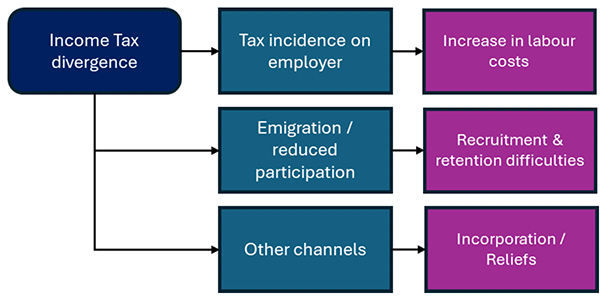
Literature on some of the ways in which personal income tax could affect businesses is scarce. Jacob and Vossebürger[8] attempt to show in their study of 27 European countries and three “within-country” examples (including a comparison on the border of Scotland and England[9]) that personal income taxes reduce business investment by raising the cost of labour and reducing demand for services.
Rates of personal tax in Scotland are not particularly high when measured against other European countries (see Box 2). We expect that questions regarding whether Scottish Income Tax has an impact on competitiveness in the main relate to the position relative to the rest of the UK[10].
We first take up the question of how Income Tax divergence can affect business labour costs. We then look at recruitment and retention before turning to incorporations, to consider the more direct effect of personal taxes on sole traders, and as another area where adjustments can be made to preserve net pay.
Box 2: International competitiveness
While there is Scottish Income Tax divergence with the rest of the UK, the effective tax rate is relatively low, particularly compared to countries with higher public spending.
Figure B.1 shows that compared to other Western European and Nordic countries Scotland has a relatively low effective tax rate, particularly on households with incomes around the middle of the income distribution.[11]
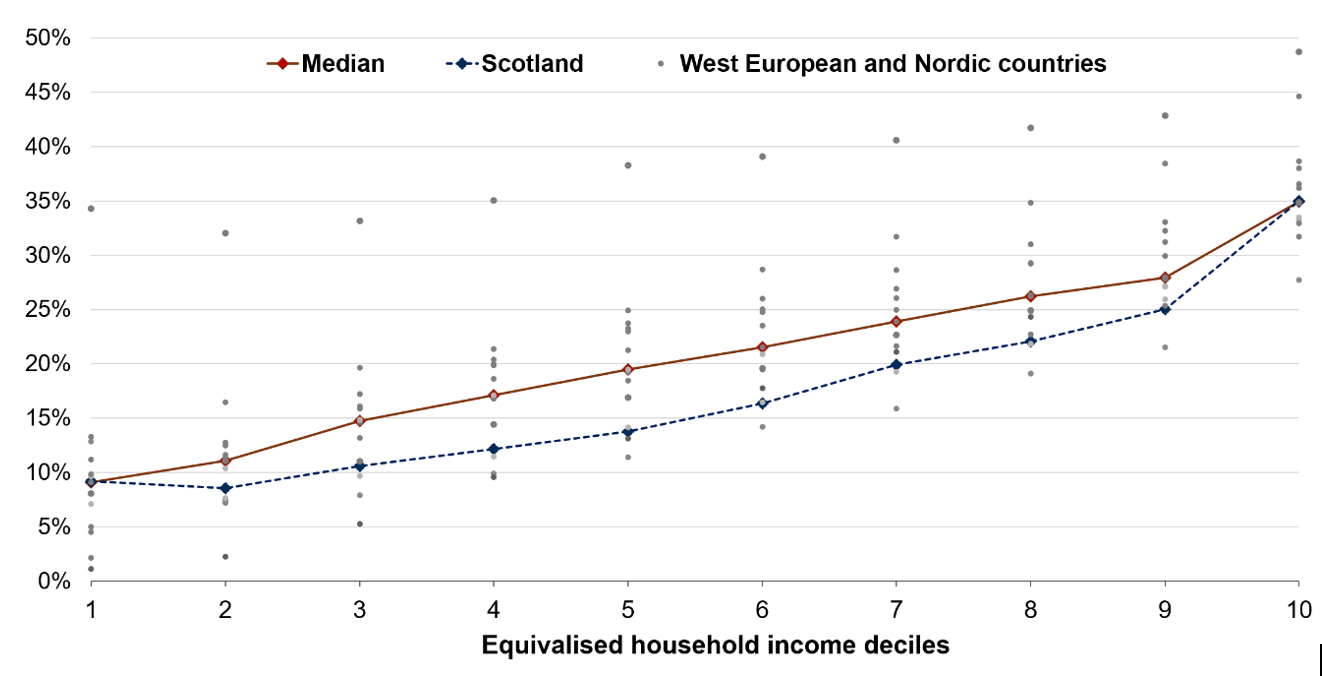
Source: Analysis using UKMOD, and EUROMOD statistics
The OECD Tax and Wages 2026 publication[12] estimates that the UK is below the average across the Tax Wedge and Average Tax Rate, particularly for single earners without children (this is despite the UK’s tax wedge growing the most out of all the OECD countries since last year). Tax Policy Associates – commenting on the 2025 OECD report – highlighted a broad theme in regards to the UK’s comparative tax take: “most people in the UK on low, moderate or reasonably high earnings pay less tax on their wages than their counterparts in other large developed countries, with the notable exception of the US.”[13]
The Institute for Fiscal Studies have previously highlighted that the UK has relatively low taxes due in large part to lower payroll taxes such as NICs – where other countries have retained more contributory links. They found that the UK is more of an outlier in how low tax is at the median compared to other countries than it is for top earners[14]. Despite the recent increase in employer NICs, UK employers still contribute less to social security contributions than in most OECD countries, and UK taxpayers retain a larger than average share of their earnings.
3.1 Labour costs
“Our employees, they're just paying more tax. So, we've got to then pay them more, which then reduces our profits.” – Financial and Insurance, 10-49 staff
According to the BICS around the time of the IFF research, the cost of labour was the most important challenge impacting business turnover. Labour costs can be affected by the wider macroeconomic environment, specific policies, differences in the cost of living[15] and labour market structure.
Overall, the proportion of businesses experiencing an impact due to labour costs appears similar between Scotland and the UK, although it has risen in the UK in more recent data, and the importance of some of the other impacts are slightly different. The Scotland BICS data excludes micro businesses (those with a headcount less than 10) which – while comparable with businesses with 10 or more employees in the UK BICS publication - necessitates the use of unpublished UK data when making sector-specific comparisons between Scotland and the UK. It is worth noting that at UK level fewer micro businesses appear to be experiencing issues with labour costs.
In Scotland, 63% of Accommodation & Food, 52% of Transport & Storage and 46% of Arts, Entertainment & Recreation were impacted by the cost of labour around the time of the IFF research, with higher average income sectors such as Professional, Scientific & Technical and Information & Communication among the least affected (20% and 24% respectively). The latest wave still shows Accommodation & Food as substantially the most commonly impacted (59%), while it has dropped in other sectors, Professional Scientific and Technical has risen to 27%, while ICT has dropped further to 11%. Economic uncertainty has risen substantially and is reported to be the biggest challenge by a slightly larger proportion of businesses (around 36%) in the May 2026 wave – this sharp rise is also reflected in the wider UK data.
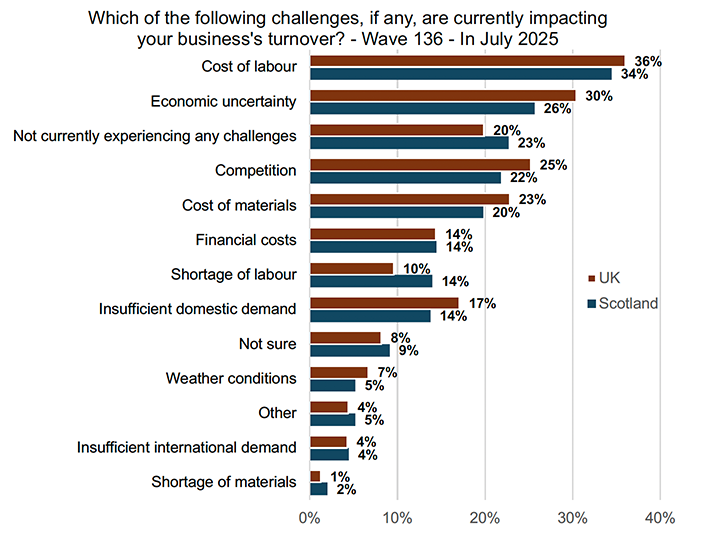
Source: Business Insights and Conditions Survey, Wave 136
How businesses deal with higher labour costs is another question – again micro businesses appear much less likely to consider passing on costs, complicating comparisons.
“Scottish income tax... it's increasing the costs. It's narrowing the opportunity of profit. You can't pass that on to the customer now because the cost of living is so high. So all the pressure is narrowing that profit margin.” – Retail and Hospitality, 250+ staff
The Accommodation & Food sector was again the most likely to consider passing on labour costs (61%) followed by Transport & Storage (46%) and Construction (44%) at the time of the IFF research. A relatively high proportion of Information & Communication, and Professional & Technical Services in Scotland were considering passing on some of the higher cost of labour in prices (around 36% each) while Health & Social Work were least likely to do this (24%). In the May 2026 wave, a greater proportion of businesses reported labour costs driving higher prices than at the time of the study in Scotland and the UK. Accommodation & Food remained most likely to report plans to pass on labour costs (65%), Admin & Support Services is substantially higher than it was (57% - and has been relatively elevated since the beginning of 2026), while Manufacturing was least likely (28%).
As can be seen in Figure 3, wider macroeconomic factors have been an important part of recent earnings growth, which has jumped up, remaining high since the UK economy rebounded from the COVID pandemic. High demand, particularly for services, pushed up inflation and subsequent pay increments have remained relatively high in both Scotland and the rest of the UK.
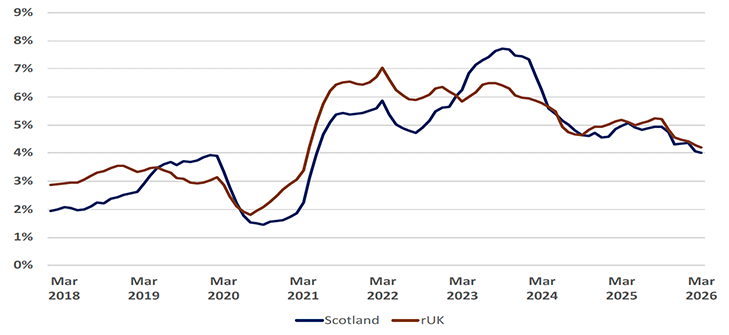
Source: RTI Earnings, ONS
3.2 The economic incidence of taxes
Who bears the tax, its economic incidence, can be more complicated than its statutory incidence – legally, who is required to pay. Although Income Tax is levied on employees, it could be borne by companies if they have to pay higher wages to staff to maintain post-tax incomes, and this may change over time. Businesses have talked about employees, particularly senior and specialist staff, asking for a ‘Scottish Premium’ with reference to the higher Scottish Income Tax. This mechanism was discussed by Feldstein and Vaillant[16], where they claimed that pre-tax wages would fully adjust after tax changes to offer the same net wage in the long run where workers are highly mobile. Later applied work, Bingley and Lanot[17], Giertz et al.[18] and Kubik[19], all find evidence of a partial shifting of the incidence of tax from workers to employers. Kleven et al.[20] find evidence of larger positive passthrough responses among very highly skilled individuals, where migration is a consideration.
“People are very conscious of this [Scottish Income Tax], saying, well, I should get more gross so I end up with the same... the dynamics are really starting to change quite markedly.” Professional, Technical and Scientific, 250+ staff
There is, however, considerable variation from study to study. Leigh[21] is not able to find any evidence of passthrough into gross wages, and Lehmann et al.[22] looking at the bottom half of the income distribution in France and Blomquist and Selin[23], looking at Sweden find that a tax increase leads to lower gross wages. In these cases, the resulting lower labour supply does not lead employers to raise wages. Adam et al.’s[24] UK study of employee[25] and employer NICs suggests that at least in the short run the incidence determines who bears the tax, with wages adjusting over time. They point to Melguizo et al’s meta-analysis[26] of the incidence of labour taxation which suggests that employees bear around two thirds of tax changes in the longer run[27]. Ultimately the split will be determined by the bargaining position of workers with their employer. The institutional context, such as the structure of wage bargaining, union coverage and mobility matters, and we shouldn’t expect to see the same effect in different settings. We are considering further analysis looking at gross wages by detailed sector over time.
In summary, the literature finds very mixed evidence about passthrough of taxes into gross income but suggests that employees primarily bear the cost of higher income taxes, particularly in the near term, although wages can adjust over time. We would expect the tighter labour market to have improved workers ability to bargain for more of the cost to be borne by the employer, with more mobile highly skilled and specialised workers, in particular, better able to negotiate some compensation for tax divergence by leveraging outside options which include moving to the rest of the UK.
3.3 Scottish Income Tax divergence in the context of other recent changes
In the individual interviews conducted by IFF Research, after prompting about challenges relating to tax, most businesses interviewed reported that tax policy has a significant impact on their operations, though UK-wide taxes were cited much more frequently than Scottish-specific taxes. The majority of businesses cited recent increases in employer NICs as having significantly raised labour costs which in turn has affected their ability to compete for talent, retain staff, and invest in growth. This was widely viewed as the most impactful tax change in recent years and corresponds well to the timing of the rise of taxation as a main concern across business surveys[28].
From April 2025, the rate that employers paid NICs on employee earnings rose from 13.8% to 15%, with the threshold that employers started paying contributions decreasing from £9,100 to £5,000. As discussed above, this is initially expected to be incident on the employer, raising their labour cost. It represents a large increase in the cost of a job across the income distribution for a single year (6.8% at £9,100 falling to around 1.5% for Top Rate taxpayers, and ultimately down to 1.2% on very high incomes).
“The cost base... was immediately hit by the increase in National Insurance... Unfortunately, there's no other place for it to flow back to have the range of wage increases we want.” Professional, Technical and Scientific, 250+ staff
At the same time, the National Living Wage (NLW) rose to £12.21 for 21-year-olds and above. This added around £1,400 a year to a full-time worker’s minimum gross income. Together with the increased employer NICS contribution would mean a NLW employee would cost a business 10.6% more than in the previous financial year, with knock-on effects expected further up the earnings distribution to preserve differentiation in pay. More recently, the NLW has increased to £12.71 for 2026-27, raising the minimum gross income by £910 for a full-time worker and increasing the cost to a business by a further 4.2%.
For existing workers in 2025-26 part of any impact from Income Tax divergence from earlier years is likely to already be reflected in gross wages. Assuming the employer was to bear around one-third of the cost of the 2024-25 changes (the introduction of the Advanced Rate and the increase in the Top Rate by 1p, which affects taxpayers earning over £75,000) this would increase employer costs by around 1.1% for a taxpayer earning £150,000. Timing is difficult to assess but the literature suggests that any adjustment could be slower and more piecemeal.
In interviews with businesses, they generally did not distinguish between recent Scottish Income Tax changes and earlier ones, largely due to low awareness and the overshadowing effect of other economic pressures, such as rising labour costs driven by minimum wage increases, National Insurance contributions, and inflation Although this may also reflect that if there is any passthrough it is gradual.
“National insurance, because it's straight on your revenue that it's a straight-line cost. Was it three million or whatever it cost at the start of our financial year was like we have got a one-off three million extra cost this year on the growth in national insurance. So that's three million that we need to save somewhere.” Retail, Hospitality and Leisure, 250+ staff
By sector in Scotland, concerns about taxation (excluding business rates) had been highest at the time of the IFF surveys for Accommodation & Food Services and Health & Social Work (16% and 14% respectively) - these are particularly labour-intensive sectors. It is worth noting that in this wave of the BICS, Accommodation & Food Services were also most likely to be concerned by business rates, possibly reflecting these sectors’ particular dependence on physical outlets and/or hubs to do business[29]. In the latest BICS wave, Admin & Support Services pushed Accommodation & Food Services into second place in terms of most concerned about taxation. Overall, concerns about taxation have become particularly high in the wake of the employer NICs changes announced by the UK Government. Scottish-specific “spikes” have occurred at the time of the Scottish Budgets, but settle down again soon afterwards.
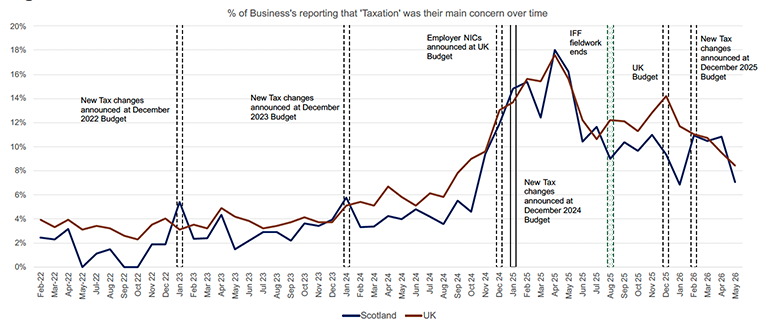
Source: Business Insights and Conditions Survey, to Wave 154
There were clear sectoral differences in the sample as researchers continued to explore the perceived impacts of Scottish Income Tax policy on businesses. Most businesses interviewed reported that recent changes to Scottish Income Tax have had little to no direct impact on their operations. This was especially true in retail and hospitality, where employee earnings typically fall below the thresholds affected by the policy changes. However, some businesses expressed concern about indirect effects of Income Tax policy, such as reduced consumer spending power which could dampen demand for goods and services. Others noted that the changes needed to be seen in the wider context of the public services provided by tax revenues, which could provide both direct and indirect benefits to companies.
3.4 Recruitment and Retention
“We've found it difficult to recruit… Lack of skills and people demanding far too much money for their skill sets.” but "We've been fine with staff retention." – Financial and Insurance, 10-49 staff
Income Tax divergence exacerbating difficulties attracting and recruiting talent is also an issue that has been raised. This is closely intertwined with the discussion of labour costs and picks up where it left off – employees with skills in demand across the UK can potentially leverage these outside options in bargaining.
The BICS suggests that attracting and retaining staff continues to be an issue with businesses both sides of the border experiencing difficulties, although these have been easing over time. Business surveys around the time IFF work was conducted suggested this easing could be due to businesses hiring intentions falling to record lows as a result of higher employment costs[30] and on most measures this continues to remain weak across the UK[31]. Discourse also points to the adoption of AI as a potential reducer for hiring intentions, with BICS adding questions about AI after the IFF research. Early results show modest effects, with 6% of AI-using businesses in Scotland reporting a reduction in headcount already and 15% expecting future reductions in Wave 153 (note that 57% reported no changes so far, and 45% not expecting reductions in future). Another suggestion is the growth in home working means hiring entry-level employees is less attractive, as unlike experienced hires, early-career workers require special supervision that is burdensome to provide when the workforce is at home[32].
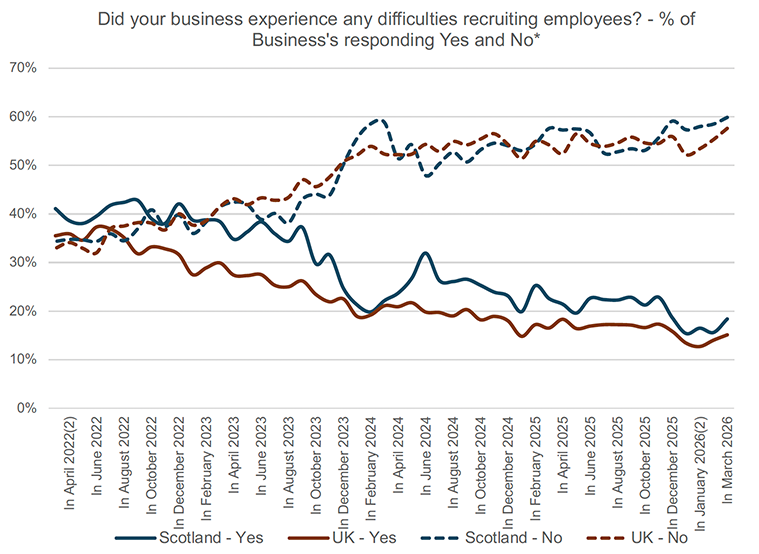
*Figures do not sum to 100% as they exclude the options “Not sure” and “Not applicable”
Source: Business Insights and Conditions Survey, to Wave 154
Analysis by HMRC looking at taxpayer migration[33] suggests people base their decisions on where to live and work on a wide range of factors, not just the tax they will pay. Indeed, as others, including the Fraser of Allander Institute (FAI) have pointed out, the similar recent trends between rUK - Scotland and rUK - Wales migration suggests that tax[34] is not the main consideration driving recent trends – in the paper HMRC suggest Covid (potentially the introduction of flexible working) could be driving the step-change seen in the latest available data. The benefit from lower tax would need to be traded off against a number of material and non-material costs of moving (these might include things like housing transaction and moving costs, family and network considerations, recognition of qualifications etc). The Q2 2024 FAI business monitor reported along these lines – that it was becoming difficult to attract candidates from outside Scotland[35]. One of the HMRC studies also found that the youngest, potentially least attached, were among the only groups with (marginal) net migration from Scotland to the rest of the UK in most years, which may reflect them being early in their career, but also having fewer ties than older taxpayers.
In the interviews, concerns about recruitment and retention were often linked to the idea of a “brain drain”, with young high-skilled workers perceived to be relocating out of Scotland for more favourable tax conditions. However, feedback on this point was largely anecdotal or second-hand in nature. Businesses also mentioned concerns about the progressivity of the tax system, in particular a “donut hole” effect, where promotions or pay rises push employees into higher tax brackets, reducing the incentive to reward top performers. In response, some firms have introduced alternative remuneration schemes or focused on improving workplace culture to retain staff.
While the interviews did hear some cases of migration to avoid tax, some version of these costs are more likely to be present in the retainment situation, compared to recruitment, and we might expect tax differentials to be most important for businesses trying to recruit from the rest of the UK for this reason. Indeed, a second study implies that in the absence of tax changes, there may have been around 1000 more migrants to Scotland in the policy year, although it was not possible to detect an effect in later years[36]. Only the 2018-19 policy changes have specifically been evaluated with respect to migration due to the lag in data, but intra-UK migration studies covering up to 2022/23[37] show that Scotland continues to have positive net migration despite its more progressive tax system. As of yet unpublished analysis with more up-to-date PAYE RTI suggests that migration is not a significant contributor to differences in taxable income between Scotland and rUK in the Top / Additional Rate band (at least in regard to PAYE taxpayers).
Notably, these matters were more frequently reported by businesses in high-salary industries operating in both Scotland and the UK. Concerns around ‘brain drain’ were especially common from businesses in higher-paying sectors such as technology and finance where workforces are particularly mobile. Researchers highlighted one organisation who reported the political landscape and more progressive Income Tax system had been a draw for talent being recruited into the business.
“Some of the people we’ve recruited in the last two years have made a decision to come to Scotland because they actually liked the political landscape… If that meant paying more income tax, then that was fine.” Professional, Technical and Scientific, 50 to 249 staff
Some businesses that operated in both Scotland and other parts of the UK said they found it harder to recruit in Scotland, citing location and lack of a talent pipeline respectively as contributing factors.
As indicated in Figure 3 above and discussed in much economic reporting (e.g Scottish Government[38] and Scottish Fiscal Commission[39]) Scottish and rUK labour markets have been tight since the recovery from the COVID pandemic. Although there remains uncertainty associated with the figures Scotland appears to have higher inactivity, and the larger public sector could keep demand elevated even as vacancies in the private sector fall. It also may be difficult to draw skilled workers away from where there are potentially sectoral agglomeration effects in places like London.
The types of recruitment difficulties looked broadly similar between Scotland and the UK in BICS at the time of the IFF survey, although UK businesses report struggling more to offer attractive pay packages while Scotland struggles more with reduced EU applications (this is particularly prevalent in Accommodation & Food, potentially due to lower wages in the sector not meeting visa minimum income requirements[40]). A lack of qualified applicants was high across sectors. In Scotland it was most likely to be reported by Construction (66%) and Accommodation & Food Services (61%) – over half (54%) of businesses in the Professional, Scientific & Technical sector also reported it as a reason. The latest wave presents a similar picture with the exception of Accommodation & Food Services, which appears to have fallen substantially, although sample sizes across sectors in Scotland are small.
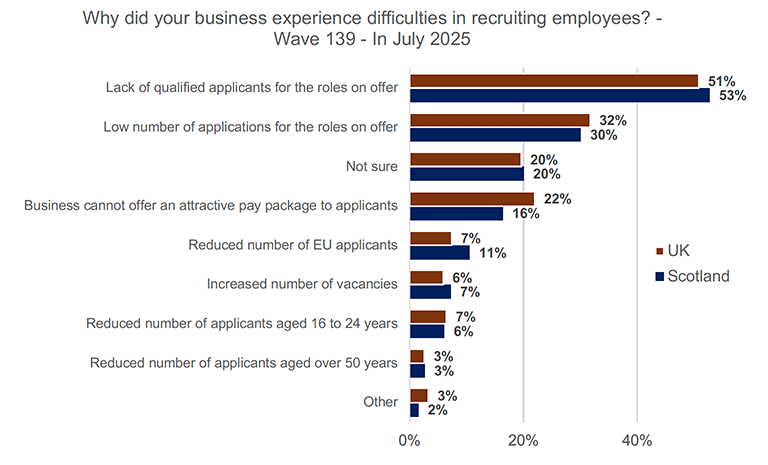
Source: Business Insights and Conditions Survey, Wave 139
Sectors reported very different recruitment needs. For example, Construction businesses – who are often at the top for responding “yes” to recruitment difficulties – were the most likely to report a shortage of skilled, manual or technical employees at the time of the IFF research (at 59%). Professional, Scientific & Technical Activities were most likely to report shortages of professional/managerial staff (at 23%) and Accommodation & Hospitality are most likely to need semi-skilled/unskilled staff (at 47%). Recruitment concerns for all types of workers have decreased in the latest BICS wave; by almost two-thirds for Construction with respect to skilled, manual or technical employees (down to 22%, bringing the sector level with Transport and Storage), the Construction and Professional Scientific and Technical sectors were among the sectors most likely to report difficulty recruiting professionals (above 10%, although with the latter having fallen sharply). Accommodation & Food had the largest proportion of businesses reporting challenges recruiting semi-skilled and unskilled workers (at 21%), this has fallen sharply but remains above the UK in the latest wave.
Corroborating this view, a small subset of businesses interviewed in high-salary sectors like tech and finance or those operating across both Scottish and English labour markets were more attuned to SIT changes. Some of these respondents expressed concern about potential behavioural impacts of SIT, such as the migration of high earners out of Scotland. Notably, even among those with strong views, most did not report any direct business impacts from SIT changes. There was little evidence, even among businesses that had been impacted by SIT, that it had prompted changes to business structures or significantly impacted decision making.
“I haven't seen an impact on our business. So, we recruit where the best people are... not because of tax policy.” "Honestly, it is invisible to me"
Professional, Technical and Scientific, 250+ staff
In conclusion, recruitment difficulties appear to be lessening but remain a persistent issue for many Scottish businesses. Analysis of net migration to date do not point to large numbers of people exiting the labour market in Scotland in the wake of the changes, but there are reasons to think that Income Tax divergence might be most relevant for recruitment from the rest of the UK.
3.5 Incorporations
Turning to other potential responses to Income Tax divergence, self-employed and working business owners can also be affected. For businesses like sole traders and partnerships, profits are taxed through the Income Tax of the owner(s) and treated essentially like the salary of an employee. Although tax is not generally the main reason for incorporation as shown in a study by BEIS[41] in some cases it can induce a behavioural effect, as tax on corporate profits and dividends tend to be significantly lower than personal income tax, thus incentivising incorporation[42].
Studies such as Egger et al.[43] and the Stanford Institute for Economic Policy Research[44] find incorporation has a positive relationship with personal income tax and a negative relationship with corporation tax. Individual employees – where circumstances allow - may also be incentivised to offer their labour through their own incorporation; perhaps as an alternative to other income tax mitigation efforts such as a salary sacrifice agreement or reduced hours. These studies would suggest that we should expect Income Tax divergence to result in higher levels of incorporation in Scotland. Indeed, that the divergence increases the incentive to incorporate is considered as part of the modelling that goes into the Scottish Income Tax forecasts produced by the SFC that accompany budgets.
It should be noted however, while potentially saving the business owner money, the decision to incorporate has to be weighed up against the associated costs, additional administration and mandated transparency of finances[45].
Data from Companies House shows that the number of new private company incorporations (a more natural route from sole trader/partnership than straight to public limited company) has not deviated much in the first few years Scotland has had the new tax powers. With some exceptions, the growth rates have more or less been similar ever since, suggesting the number of incorporations has not drastically increased as a result of Scottish-specific income tax changes. Note the spike for rUK in 2020-2021 – coinciding with the highest increase in UK incorporations since records began - is attributed to extreme fluctuations throughout the first year of the COVID pandemic[46].
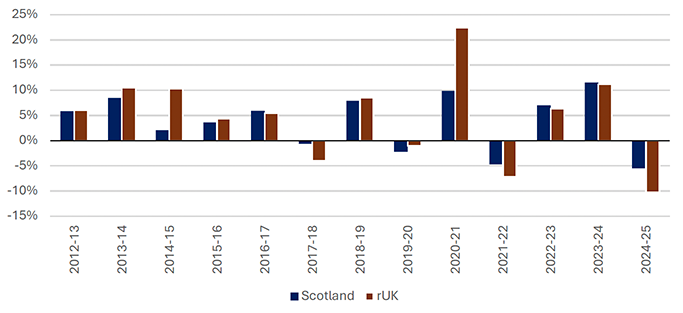
Source: Companies House
When said incorporations are considered as a proportion of the population, the Scottish rate has trended upwards with the rest of the UK, without a marked increase during times of diverging income tax policies. Self-employment rates would also be expected to decrease as a result. However, there was no sign of this in the immediate aftermath of the introduction of the new Scottish income tax bands. A decrease then only occurred during and in the wake of the COVID pandemic, with the latest data showing numbers climbing again in 2023/24.
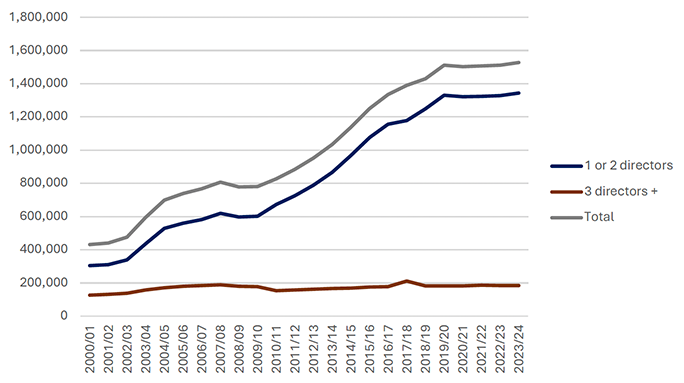
HMRC tracks the company population by the number of directors, although this is not regularly published. The outturn in Figure 8 shows that the rise in single director companies – the current minimum and most likely sign of a sole trader becoming incorporated – has flattened off since the pandemic.
Source: HMRC incorporations data
Furthermore, corporation tax may not be the most favourable rate in comparison to Capital Gains Tax (CGT), with the latter being applicable to sole traders/partnerships when selling business assets. CGT may discourage entrepreneurship and incentivise inefficient capital allocation if business owners become reluctant to sell assets that they would otherwise (although the UK does offer relief in some cases). Even so, Miller et al. find that most of the high responsiveness of owner-managers to marginal tax rate changes is mostly the result of shifting taxable income over time in order to minimise their liability, as opposed to a reduction in actual business activity. It also concludes that tax-induced retained profits are not reinvested in the business but kept as cash or a close equivalent. They also find no evidence that the preferential rate of capital gains tax encourages business investment.
Work is currently planned with HMRC to understand more about other forms of avoidance, primarily the use of pension reliefs, and salary sacrifice although we are reliant on surveys and assessments of bunching in taxable income to understand the extent of the latter given the decision to take less gross pay is not something that would be reported.
“We've got an employee benefits programme, and a lot of staff are looking at salary sacrifice. A lot of people will talk about it, take themselves below the tax threshold by using that. It’s become a very popular means, so, for example, we do the company car schemes where they can go into Tusker, they can salary sacrifice for a variety of different things, which makes it much more tax-efficient for individuals.”
Professional, Technical and Scientific, 250+ staff
Despite the issues raised, most businesses reported no significant changes to their business structures or investment decisions as a result of Scottish Income Tax. While a few implemented cost-saving measures or adjusted operations across the UK, it seems unlikely that Income Tax policy in Scotland was the primary driver. Similarly, Scottish Income Tax was not seen as a major factor in shaping investment strategies, though some businesses felt it could indirectly affect growth and reinvestment capacity.
In conclusion, income tax divergence does further incentivise incorporation, primarily by the offer of swapping income tax liability with more lenient capital tax rates. However, the decision to do so has to be weighed against a number of practical factors. Differences related to Income Tax divergence are part of the modelling that goes into Scottish Income Tax forecasts. Available statistics do not show a marked change in the trend of incorporations following recent Income Tax policy changes.
Contact
Email: Lorraine.king@gov.scot