
Publication - Research and analysis
Scottish economic bulletin: October 2025
Provides a summary of latest key economic statistics, forecasts and analysis on the Scottish economy.
Labour Market
Unemployment rose moderately to 3.9% in the three months to August, and hiring intentions continue to stabilise.
Employment, Unemployment, and Inactivity
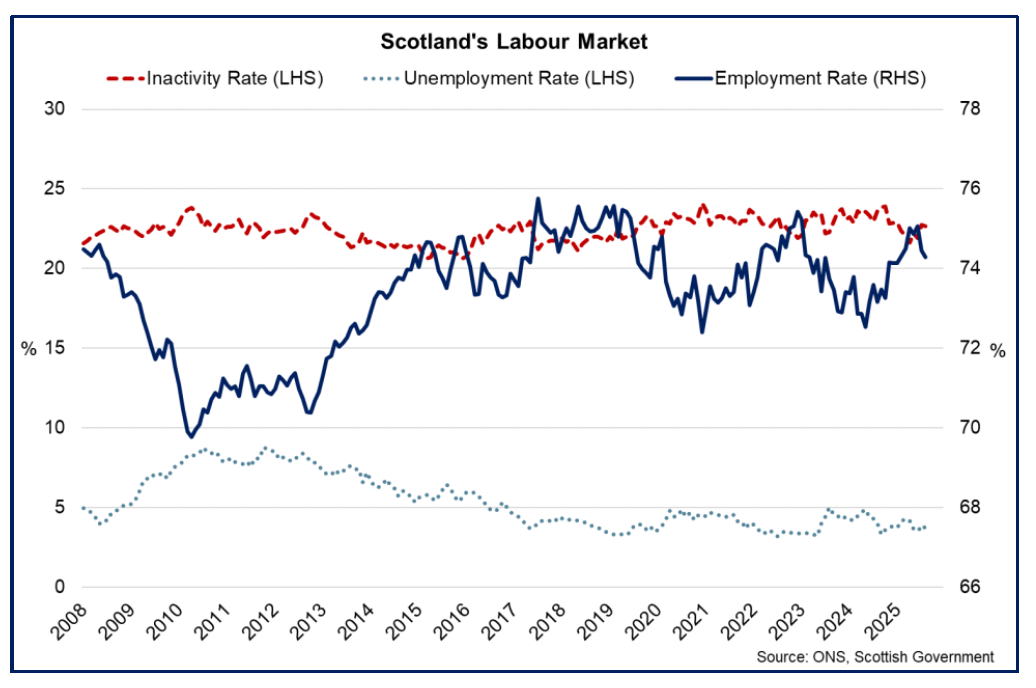
- Scotland’s labour market has remained resilient going into the second half of 2025 albeit there continues to be indications that the labour market has softened over the past year.
- The Labour Force Survey (LFS) for June to August shows Scotland’s unemployment rate (3.9%) rose 0.2 percentage points (p.p) over the quarter, but is 0.2 p.p lower than at the same time last year. Alongside this, Scotland’s employment rate (74.3%) fell 0.6 p.p. over the quarter, but was up by 1.1 p.p over the year. The inactivity rate (22.7%) rose by 0.4 p.p over the quarter but was down by 1.0 p.p over the year.[9],[10]
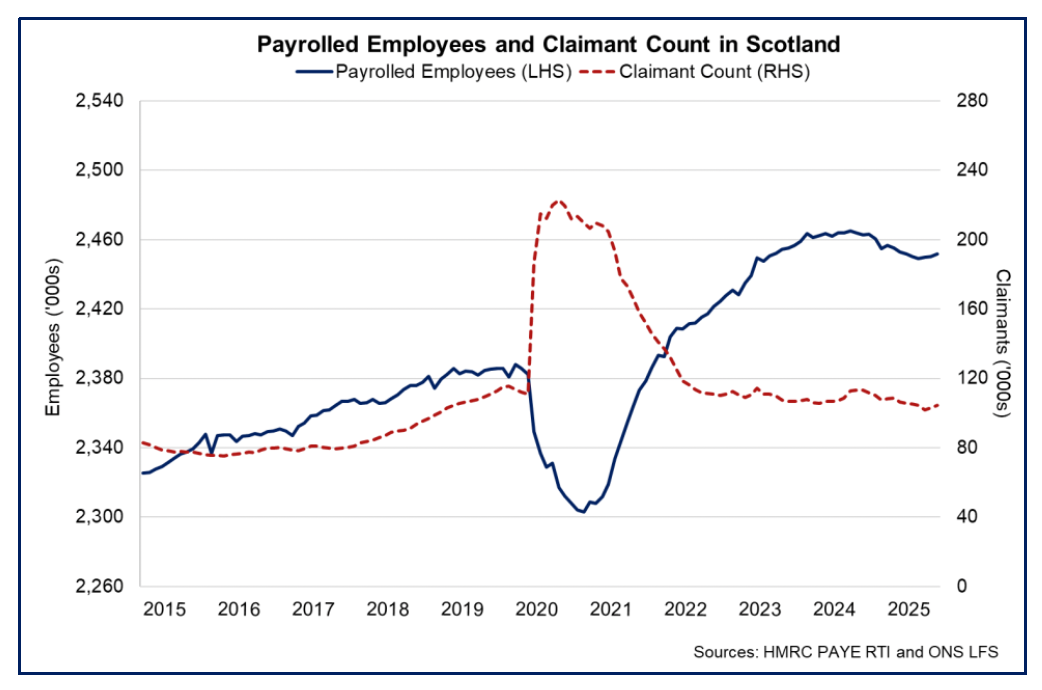
- More recently, Pay as you Earn (PAYE) Real Time Information data indicates that the number of payrolled employees (2.45 million) has remained relatively stable in recent months, rising by 0.1% (c. 1,600 employees) over the month of September. Over the past year, the number of payrolled employees has fallen by c. 10,900 (-0.4%) indicating a slight loosening in conditions.[11]
- Furthermore, Scotland’s Claimant Count unemployment rate rose moderately to 3.5% in September (from 3.4% in August), with the number of people claiming unemployment related benefits in Scotland (c. 104,500) up 1.6% over the month, albeit that it is has fallen 7.5% over the past year.[12],[13]
Recruitment Activity
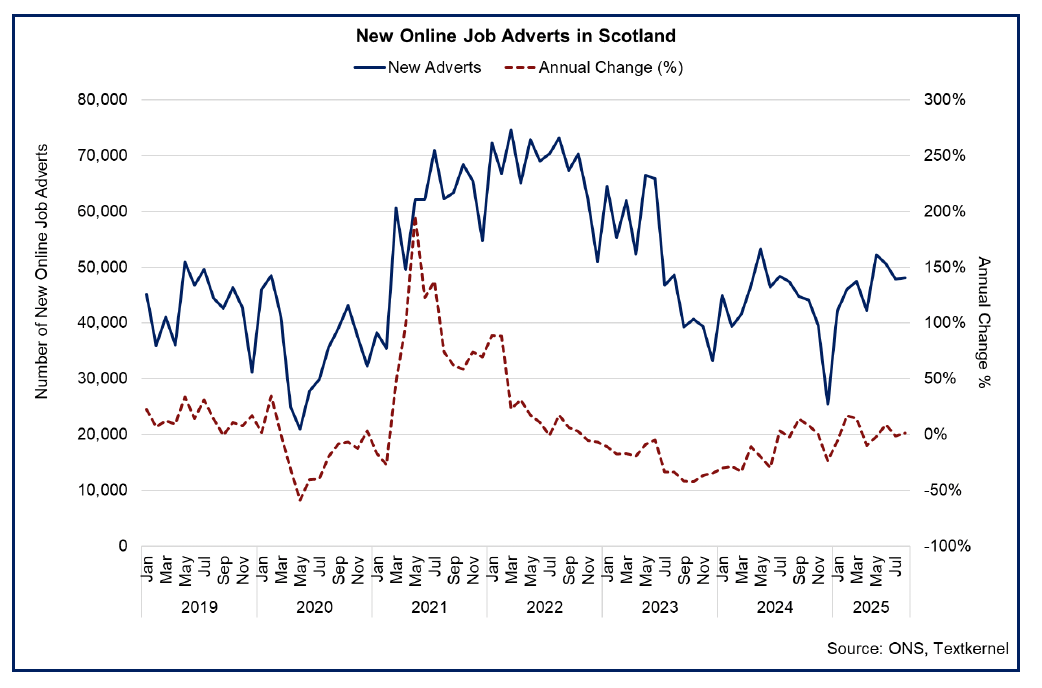
- Demand for labour has been stabilising over the past 18 months from more elevated levels in 2022 and 2023 and most recently has been impacted by a range of factors including increased economic uncertainty and labour costs.
- ONS Textkernel data shows that the number of new online job adverts posted has increased since the start of the year with c. 48,000 new online job adverts posted in Scotland in August, up 1.4% from August last year.[14]
New Online Job Adverts in Scotland
- Other business surveys also indicate that recruitment activity has seen improvements in recent months. The RBS Growth Tracker for September indicates that private sector staffing levels rose marginally for the first time since May, while the latest Scottish Business Monitor for Q3 2025 shows that businesses on balance have lowered employment for a fourth consecutive quarter (net-balance: -8.5), but to a lesser degree than during the first half of the year.
- Looking ahead, BICS data also indicates a largely stable outlook for labour demand, with most businesses (62.9%) reporting that they expect the number of employees to remain unchanged in October. This is consistent with the Scottish Chambers of Commerce Quarterly Economic Indicator which reported that 62% of firms do not expect their staff numbers to change in the next quarter.[15]
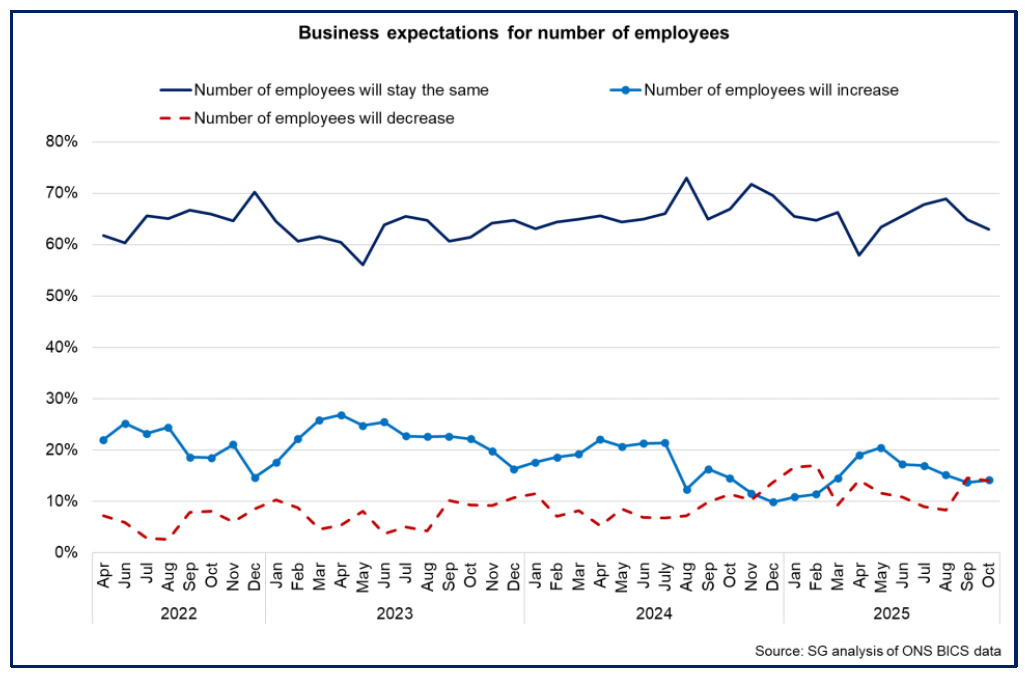
- However, there remains scope for some further softening in conditions. The BICS data indicates that over the past 3-months there has been a slight fall in the shares of businesses expecting the number of employees to remain unchanged or rise, offset by an increase in the share expecting employee numbers to fall.
Earnings
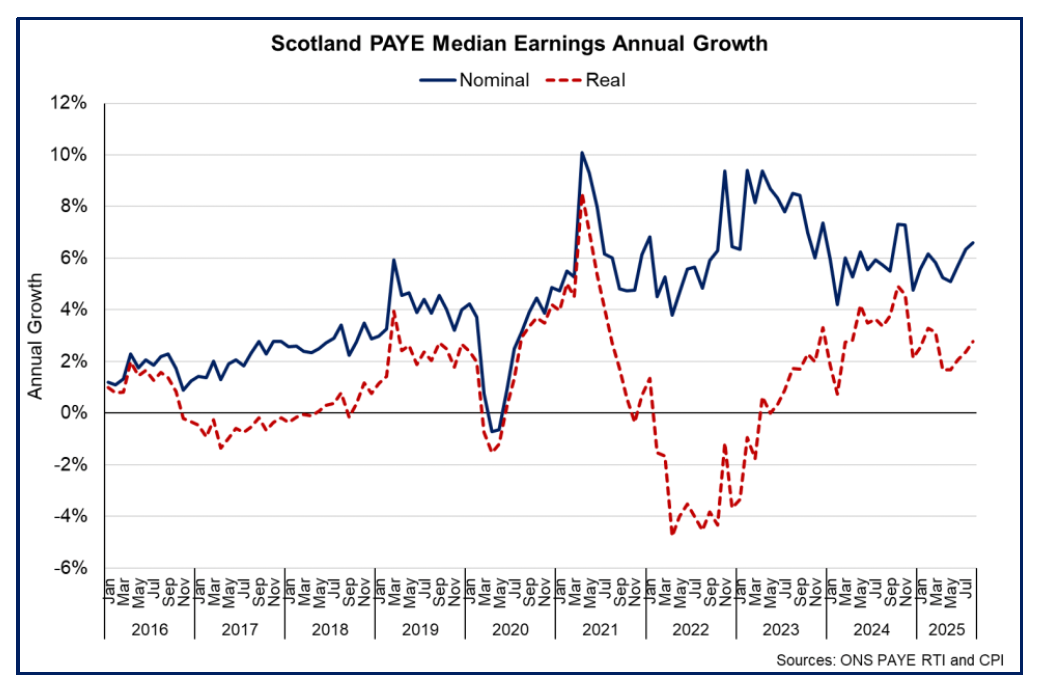
- Labour earnings have continued a trend of positive real terms growth, albeit at a slower pace than in 2024, partly reflecting the pick-up in inflation rate.
- Nominal median monthly PAYE pay in Scotland (£2,600) grew by 5.9% on an annual basis in September, with the pace of growth slowing from August and July. In real terms, adjusting for inflation, earnings grew 2.8% in August, slightly up from annual growth rates during the second quarter, however has slowed slightly from the average annual growth rate in 2024 (3.2%).[16]
Scotland PAYE Median Earnings Annual Growth
Contact
Email: economic.statistics@gov.scot